Struggling to choose a submersible pump?
The wrong choice leads to high energy bills and frequent, costly repairs.
This guide simplifies the process, ensuring you find the perfect fit.
The best submersible bore pump is not a single model but a system tailored to your specific needs. It matches your well's depth, water quality, and flow requirements. For ultimate efficiency and reliability, this involves pairing the right pump type (screw or impeller) with a high-efficiency BLDC motor and an intelligent controller.
Choosing the right pump can feel overwhelming.
You are faced with dozens of options and technical specifications.
This decision is critical, especially for deep wells or off-grid systems.
It directly impacts your water flow, repair frequency, and long-term operational costs.
Let's break down everything you need to know, from the basic principles to the detailed specifications, to select the ideal submersible pump for your application.
How Submersible Well Pumps Work
Feeling confused about how water gets from deep underground to your tap?
It seems complex, but the principle is simple.
Understanding it is the first step to making a smart choice.
A submersible pump works by being fully submerged in the well's water. Unlike surface pumps that pull water up, a submersible pump uses a sealed motor to push water to the surface. This method is more efficient for deep wells, quieter, and prevents issues like cavitation.
A submersible pump operates entirely beneath the waterline inside your well casing.
This fundamental design choice has significant advantages.
Surface pumps create a vacuum to pull water, which is a process that loses efficiency dramatically with depth.
Submersible pumps, however, do the job from below.
They use rotational energy to push water upwards through the pipe.
This pushing action is far more effective for overcoming the force of gravity in deep wells, which can be over 500 feet deep.
Because the pump is always underwater, it is naturally primed.
This eliminates the need for manual priming and protects the pump from a damaging condition called cavitation.
Cavitation occurs when air bubbles form and collapse violently inside the pump, eroding components and disrupting water flow.
Submersible pumps are also significantly quieter than surface pumps since the well and surrounding earth dampen the operational noise.
The Core Power Source: BLDC Motors
The heart of a modern, efficient submersible pump is its motor.
While traditional AC motors are common, Brushless DC (BLDC) permanent magnet motors represent a major technological leap forward.
These motors are the driving force behind the most competitive solar water pump systems.
A BLDC motor can achieve an operational efficiency exceeding 90%, a significant improvement over the 60-75% efficiency of many older motor types.
This means more of the input energy is converted directly into water movement, reducing wasted power.
The rotor is often made from high-strength materials like 40SH neodymium iron boron magnets.
This results in a motor that is not only powerful but also compact and lightweight—often up to 47% smaller and 39% lighter than traditional motors of equivalent power.
For end-users, this high efficiency directly translates to lower operating costs.
In solar-powered systems, it means you can achieve the same water output with up to 25% fewer solar panels, drastically reducing the initial system cost.
Submersible vs. Surface Pumps
The choice between a submersible and a surface pump is primarily determined by the depth of your water source.
| Feature | Submersible Pump | Surface Pump |
|---|---|---|
| Location | Inside the well, underwater | Above ground, near the wellhead |
| Mechanism | Pushes water to the surface | Pulls water using suction |
| Best Use Case | Deep wells (over 25 feet) | Shallow wells, ponds, tanks |
| Priming | Self-priming | Requires manual priming |
| Efficiency | Highly efficient for deep lifts | Efficiency drops with depth |
| Noise Level | Very quiet | Can be noisy |
| Cavitation Risk | Low | High, if not properly installed |
For any well deeper than 25 feet, a submersible pump is the superior and often only viable choice.
Their design inherently makes them more reliable and efficient for the demanding task of lifting water from significant depths.
The Specs That Matter
Overwhelmed by technical jargon like GPM, TDH, and HP?
Focusing on the wrong specs can lead to an inefficient system that fails prematurely.
Let's clarify what you really need to know.
To choose the right pump, focus on three key specs. Gallons Per Minute (GPM) is your flow rate. Total Dynamic Head (TDH) is the total height the water must be lifted. Horsepower (HP) is the motor's power to achieve the required GPM and TDH.
Selecting the right pump starts with understanding a few critical performance specifications.
These numbers aren't just for engineers; they are the language that defines a pump's capability and suitability for your specific needs.
Getting them right ensures your system runs efficiently for years.
Understanding Flow Rate (GPM/LPM)
Flow rate, measured in Gallons Per Minute (GPM) or Liters Per Minute (LPM), determines how much water the pump can deliver.
This is arguably the most important specification for meeting user demand.
A typical home might require 5 to 20 GPM to run appliances and fixtures without a drop in pressure.
Agricultural applications, like irrigation, can demand significantly higher flow rates.
It's crucial to calculate your peak demand to ensure the pump can keep up.
Calculating Total Dynamic Head (TDH)
Total Dynamic Head (TDH) is the total equivalent height that water must be moved.
It is a crucial factor in determining the pressure and power your pump needs.
TDH is the sum of two components:
- Vertical Lift: The vertical distance from the pumping water level in the well to the highest point of delivery (e.g., a storage tank).
- Friction Loss: The pressure lost due to friction as water moves through pipes, fittings, and valves. This loss increases with pipe length, flow rate, and the number of bends.
A residential system typically has a TDH between 80 and 400 feet.
Underestimating TDH will result in a pump that cannot deliver water to the destination, while overestimating it leads to wasted energy.
Motor Power and Material Construction
Motor horsepower (HP) dictates the pump's ability to move a certain volume of water against the TDH.
Most residential systems use motors between ½ and 1½ HP.
However, it's not just about raw power.
The motor's efficiency, like that of a BLDC motor, is just as important.
An efficient 1 HP motor can outperform an inefficient 1.5 HP motor, saving you money.
Material quality is equally vital for the pump's lifespan.
| Material | Best Use Case | Durability | Cost |
|---|---|---|---|
| Stainless Steel | Corrosive or abrasive water | Excellent (15+ years) | High |
| Thermoplastic | Clean, non-abrasive water | Good (8-12 years) | Medium |
| Cast Iron | General purpose, non-corrosive | Very Good (10-15 years) | Medium-High |
Pumps with stainless steel casings and impellers (like SS304 or SS316) offer superior resistance to corrosion and abrasion from sand or minerals.
Thermoplastic impellers are a cost-effective and surprisingly wear-resistant option for water with fine sand.
The right material choice can extend a pump's life by over 50% in harsh water conditions.
How to Size a Pump for Your Needs
Guessing your pump size is a recipe for disaster.
An oversized pump will short-cycle and burn out, while an undersized one won't deliver enough water.
Let's get it right.
Properly sizing a pump involves three steps. First, calculate your peak water demand. Second, determine your well's Total Dynamic Head (TDH). Finally, use a manufacturer's pump curve to match your demand and TDH to the most efficient pump model.
Sizing a pump is a balancing act.
The goal is to select a pump that operates at or near its Best Efficiency Point (BEP) under your typical operating conditions.
Running a pump far from its BEP wastes energy and puts excessive strain on its components, leading to a shorter lifespan.
A correctly sized pump can be over 20% more energy-efficient and last years longer.
Calculating Peak Water Demand
First, estimate the maximum amount of water you will use at any one time.
Make a list of all water-using fixtures and their typical flow rates.
- Household: A bathroom uses about 5 GPM, a kitchen 3 GPM, and laundry 4 GPM. Sum the fixtures that might run simultaneously.
- Livestock: Water demand depends on the animal type and quantity. For example, a single cow can drink up to 30 gallons per day.
- Irrigation: This is often the largest demand. It is calculated based on the area to be irrigated and the type of irrigation system used.
Once you have a total GPM, add a 20% buffer.
This safety margin ensures you have enough water during unexpected peak usage and accounts for potential future needs.
Measuring Your Well's Characteristics
You need accurate measurements from your well to calculate the TDH.
The two most important are:
- Static Water Level: The level of the water in the well when the pump is off.
- Pumping Water Level: The level the water drops to after the pump has been running for a period (e.g., one hour). This is also known as drawdown.
The vertical lift component of your TDH is the distance from the pumping water level to the discharge point.
You must also account for friction loss in the pipes, which can be calculated using standard engineering charts based on your pipe diameter and flow rate.
Reading a Pump Performance Curve
Once you know your required flow rate (GPM) and TDH (in feet), you can use a pump performance curve.
This chart, provided by the manufacturer, is essential for selecting the right model.
The curve plots the pump's flow rate on the x-axis against the head it can generate on the y-axis.
To use it:
- Find your required TDH on the vertical axis.
- Move horizontally until you intersect the pump's performance curve.
- Drop vertically down to the horizontal axis to find the flow rate (GPM) the pump will deliver at that head.
Your goal is to find a pump where your operating point (your GPM/TDH requirement) falls within the 70% to 120% range of the pump's Best Efficiency Point (BEP).
Operating in this sweet spot maximizes energy efficiency and dramatically extends the pump's service life.
Choosing the Right Pump Type for Your Application
There is no single "best" pump for every well.
The ideal choice depends entirely on your well's depth, water quality, and flow requirements.
Let's explore the top pump types.
The best pump type is a strategic choice. Solar screw pumps excel in deep wells with low flow needs. Plastic impeller pumps are economical for high-flow irrigation. Stainless steel impeller pumps offer ultimate durability in corrosive water.
With a clear understanding of your system's requirements (GPM and TDH), you can now select the pump technology that best fits your application.
The choice largely comes down to three main types of solar deep well pumps, each with a distinct advantage.
All are powered by high-efficiency BLDC motors, but the pump end—the part that actually moves the water—is what differentiates them.
The Solar Screw Pump: For Deep Wells and High Head
This pump type uses a simple, robust mechanism: a single helical stainless steel screw (the rotor) rotates inside a flexible rubber housing (the stator).
As the screw turns, it creates sealed cavities of water that are pushed progressively up the pump.
This design is known as a progressing cavity pump.
It is ideal for applications requiring low flow but very high head.
- Applications: Domestic water supply for homes with very deep wells, livestock drinking water in remote pastures, and small-scale drip irrigation. It is particularly popular in regions with deep water tables.
- Advantages: Excellent for deep wells (up to 600 feet or more), highly resistant to sand and sediment, and maintains efficiency even in harsh water conditions.
- Limitations: The flow rate is limited, making it unsuitable for large-scale irrigation or high-demand applications.
| Specification | Solar Screw Pump |
|---|---|
| Flow Rate | Low (e.g., 1-10 GPM) |
| Head | Very High (e.g., up to 600+ ft) |
| Sand Resistance | Excellent |
| Best For | Deep wells, domestic use |
The Solar Plastic Impeller Pump: For High Flow and General Use
This is a multi-stage centrifugal pump.
It uses a series of rotating impellers to accelerate water, and fixed diffusers to convert that velocity into pressure.
This model uses impellers made from durable, engineered plastics like Noryl.
This makes the pump lightweight, economical, and surprisingly wear-resistant.
- Applications: Farm irrigation, pasture water supply, filling storage tanks, and residential water systems with moderate well depths.
- Advantages: Delivers high water output (high flow), offers excellent resistance to fine sand (the "floating stack" design allows particles to pass through), and is a very cost-effective solution.
- Limitations: Less durable than stainless steel in highly corrosive water or at extreme depths where pressure and temperature are high.
| Specification | Solar Plastic Impeller Pump |
|---|---|
| Flow Rate | High (e.g., 10-50+ GPM) |
| Head | Medium (e.g., up to 400 ft) |
| Sand Resistance | Very Good (for fine sand) |
| Best For | Irrigation, high-volume needs |
The Solar Stainless Steel Impeller Pump: For Durability and Harsh Water
This pump is functionally similar to the plastic impeller model but built for maximum durability.
It utilizes impellers, diffusers, and a pump body made from high-grade SS304 or even SS316 stainless steel.
This construction is specifically designed for environments where water is acidic, alkaline, or has a high mineral content.
- Applications: Water supply in coastal areas with saltwater intrusion, regions with alkaline soil, high-end residential properties demanding maximum reliability, and any application with corrosive water chemistry.
- Advantages: Exceptional corrosion resistance, a very long service life (often 15+ years), and high reliability in the toughest conditions.
- Limitations: Higher upfront cost and greater weight compared to plastic models.
| Specification | Solar Stainless Steel Impeller Pump |
|---|---|
| Flow Rate | High (e.g., 10-50+ GPM) |
| Head | Medium to High (e.g., up to 500 ft) |
| Corrosion Resistance | Excellent |
| Best For | Corrosive water, maximum longevity |
The Hybrid AC/DC Advantage
For ultimate reliability, consider a system with a hybrid AC/DC controller.
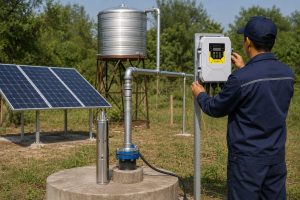
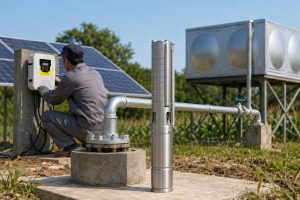
This intelligent device allows the pump to be powered by solar panels during the day and automatically switch to an AC power source (grid power or a generator) at night or on cloudy days.
The controller constantly monitors the solar input.
It can even blend power sources, using available solar energy and supplementing it with just enough AC power to meet demand.
This maximizes the use of free solar energy while ensuring a continuous, 24/7 water supply.
This feature is invaluable for critical applications like residential water systems or livestock watering, eliminating any worry about water availability.
Conclusion
The best submersible pump system intelligently combines the right pump type with a high-efficiency motor and smart controller to meet your specific needs for flow, head, and water quality.
FAQs
How long do submersible pumps last?
A quality submersible pump typically lasts 10 to 15 years.
Lifespan depends on water quality, usage, and proper sizing.
What is a good GPM for a well pump?
Most homes need 5 to 20 GPM for daily use.
The exact requirement depends on the number of fixtures and peak demand.
Is a 2-wire or 3-wire pump better?
A 3-wire pump is often better for serviceability.
Its control box is above ground, making troubleshooting and repairs much easier.
How much horsepower do I need for a well pump?
Residential pumps typically range from 1/2 to 1.5 HP.
The correct horsepower depends on the required flow rate (GPM) and total head (TDH).
Can a submersible pump be too powerful?
Yes, an oversized pump can short-cycle.
This rapid on/off switching wastes energy and causes premature wear on the motor and controls.
What is the most reliable brand of well pump?
Reliability comes from matching the pump to the well.
A stainless steel pump in corrosive water is more reliable than any brand of pump made from the wrong material.
How deep should a submersible pump be in a well?
The pump should be submerged at least 10-25 feet below the pumping water level.
This ensures proper cooling and prevents the pump from running dry.
What happens if a submersible pump runs dry?
Running dry is catastrophic for a pump.
It causes rapid overheating of the motor and destruction of the pump's internal components, leading to failure.