Your well pump is a long-term investment.
Choosing the wrong one means costly repairs and no water.
A wise choice ensures two decades of peace.
The best submersible pump brand depends on your specific needs, but Franklin Electric is often considered the top choice for overall value and reliability in North America. For superior energy efficiency and advanced engineering, Grundfos is a leading premium alternative, delivering long-term savings despite a higher initial cost.
Choosing a pump isn't just about picking a name from a list.
It's about understanding the technology that keeps water flowing to your home, farm, or business.
The debate over brands is important, but the real secret to a reliable water supply lies in matching the right pump type and motor technology to your well's unique conditions.
Let's explore the top brands, the critical specs, and the modern solutions that deliver water efficiently and reliably for years to come.
Best Submersible Pump Brands Ranked
A pump sits hundreds of feet underground for decades.
The brand you choose determines if it lasts 5 years or 25.
This isn't marketing; it's field-tested reality.
Franklin Electric and Grundfos are consistently rated as the most reliable submersible pump brands. Franklin excels in parts availability and value, while Grundfos leads in energy efficiency and premium engineering. Mid-range options like Goulds and Sta-Rite offer solid performance for their price points.
When you invest in a submersible pump, you're buying more than just a piece of equipment; you're buying peace of mind for the next 15-20 years.
The initial price tag can be misleading.
A cheap pump often becomes the most expensive option over its lifetime once you factor in repeated labor costs for replacement, which can run from $1,500 to $2,500 per job.
Understanding the strengths and weaknesses of each major brand helps you calculate the true total cost of ownership.
Top-Tier Brands: The Investment Grade
Franklin Electric is the industry standard in North America.
Their motors are the heart of most quality residential systems.
They offer exceptional reliability, with lifespans commonly reaching 15-25 years.
The biggest advantage is parts availability; nearly every well supply house stocks Franklin components, making service quick and easy.
Grundfos represents the pinnacle of pump engineering.
This Danish company focuses on integrated systems where the motor and pump end are designed together for maximum efficiency.
Their SQ series can reduce electricity costs by 10-30% compared to competitors.
They also include built-in protections like soft-start and dry-run prevention, which extend the motor's life.
Mid-Range and Budget Options
Goulds (Xylem) brings a commercial-grade heritage to the residential market.
These pumps are known for their robust construction and are particularly good at handling wells with higher levels of sand or sediment.
Sta-Rite (Pentair) is a reliable, budget-friendly choice.
It offers a solid 10-15 year lifespan at a price point often 15-25% lower than premium brands, making it a popular and accessible option.
Budget Brands like Flotec or Red Lion have the lowest upfront cost but typically the shortest lifespan, often failing in just 5-8 years.
For deep wells, the high cost of replacement labor makes these a poor long-term investment.
Brand Performance at a Glance
| Feature | Franklin Electric | Grundfos | Goulds (Xylem) | Sta-Rite (Pentair) | Budget Brands |
|---|---|---|---|---|---|
| Expected Lifespan | 15-25 years | 15-25+ years | 12-18 years | 10-15 years | 5-8 years |
| Pump Cost | $600 - $1,500 | $800 - $2,500 | $500 - $1,400 | $400 - $1,000 | $250 - $600 |
| Energy Efficiency | Good (65-70%) | Excellent (70-80%+) | Good | Fair | Poor |
| Parts Availability | Excellent | Good | Good | Excellent | Fair |
| Best For | Overall Value & Reliability | Maximum Efficiency | High-Sediment Wells | Budget-Conscious Quality | Temporary/Shallow Wells |
How Submersible Well Pumps Work
Your well pump seems complex, but its job is simple.
It pushes water up from deep underground, instead of pulling it.
This one difference changes everything for reliability.
A submersible pump operates completely underwater inside your well casing. By pushing water to the surface, it avoids priming issues and cavitation (air disruption) that affect surface pumps. This design makes them quieter, more efficient, and more reliable, especially for wells deeper than 25 feet.
Understanding the basic principle of a submersible pump is the first step to choosing the right one.
Unlike jet pumps that are installed at the surface and create a vacuum to suck water up, a submersible pump uses a series of impellers to grab water and push it up the pipe.
Because the pump is submerged, water pressure keeps it constantly primed and the surrounding water cools the motor, preventing overheating.
This fundamental design advantage is why they are the standard for nearly all modern deep-well applications.
The Pushing Advantage
A pump's ability to push water is far more efficient than its ability to pull it.
Atmospheric pressure limits a surface pump to a theoretical maximum lift of about 34 feet, but in practice, it's closer to 25 feet.
A submersible pump has no such limitation.
It can push water up from hundreds, or even thousands, of feet below ground.
This makes it the only viable option for the deep wells common in many rural and arid regions.
Key Components of the System
A submersible pump system consists of two main parts working together.
- The Pump End: This is the multi-stage centrifugal pump itself. It contains a stack of impellers, which are like small spinning fans. As water enters the pump, each impeller adds pressure and pushes the water up to the next stage, building enough force to send it all the way to the surface.
- The Motor: Located below the pump end, the motor is sealed in a waterproof housing. It drives the shaft that spins the impellers. The efficiency and durability of this motor are just as important as the pump end itself.
Water travels from the pump up a "drop pipe" to your home.
An electrical cable runs alongside the pipe to power the motor.
A check valve is also installed to prevent water from flowing back down into the well when the pump shuts off, which keeps your system pressurized.
The Specs That Matter
Choosing a pump based on brand alone is a mistake.
You need to match the pump's performance to your home's needs.
Getting the specs right ensures efficiency and longevity.
The most critical pump specifications are Gallons Per Minute (GPM), Total Dynamic Head (TDH), and motor Horsepower (HP). GPM measures flow rate, TDH measures the total work the pump must do, and HP provides the power. Matching these specs to your well is essential.
Diving into technical specifications can feel overwhelming, but a few key numbers tell you almost everything you need to know about a pump's suitability for your well.
Ignoring these specs is like buying a car without knowing how many seats it has or how fast it can go.
You might end up with a pump that is overworked and fails early, or one that is oversized and wastes electricity with every cycle.
GPM: Gallons Per Minute
This is the volume of water the pump can deliver.
Most homes require a flow rate between 5 and 20 GPM.
To calculate your need, estimate your peak water usage.
A typical bathroom uses about 5 GPM, and a kitchen or laundry room adds another 5 GPM.
Add up all fixtures that might run simultaneously to find your peak demand.
It's wise to add a 20% buffer to this number to ensure you never run short.
TDH: Total Dynamic Head
TDH is the total equivalent height that water must be lifted, considering both the vertical distance and friction loss in the pipes.
It's the most critical factor for sizing a pump correctly.
It is calculated as:
- Vertical Lift: The distance from the pumping water level in the well to the pressure tank.
- Friction Loss: Resistance from water moving through pipes and fittings. This increases with pipe length and flow rate.
- Pressure Tank Setting: The pressure the pump must create at the surface (e.g., 50 PSI is equivalent to lifting water another 115 feet).
Residential systems typically have a TDH between 80 and 400 feet.
HP: Motor Horsepower
Horsepower is the muscle behind the pump.
Most residential systems use motors between 1/2 HP and 1.5 HP.
The required HP is determined by the GPM and TDH you need.
A higher HP motor can move more water or push it higher.
However, an oversized motor on a pump that doesn't require it will lead to short-cycling and wasted energy, drastically reducing the pump's lifespan.
It's better to match the motor to the pump's "best efficiency point" on its performance curve.
| Specification | What It Measures | Typical Residential Range | Why It Matters |
|---|---|---|---|
| GPM | Water Flow Volume | 5 - 20 GPM | Determines if the pump can meet your household's peak water demand. |
| TDH | Total Pumping Work | 80 - 400 feet | Ensures the pump has enough power to lift water from your well and pressurize your system. |
| HP | Motor Power | 0.5 - 1.5 HP | Provides the force to achieve the required GPM and TDH. Must be sized correctly. |
The Rise of Solar-Powered Pumps
Grid power isn't always available or reliable.
For off-grid homes and remote farms, a new solution is emerging.
Solar pumps offer water independence and zero electricity bills.
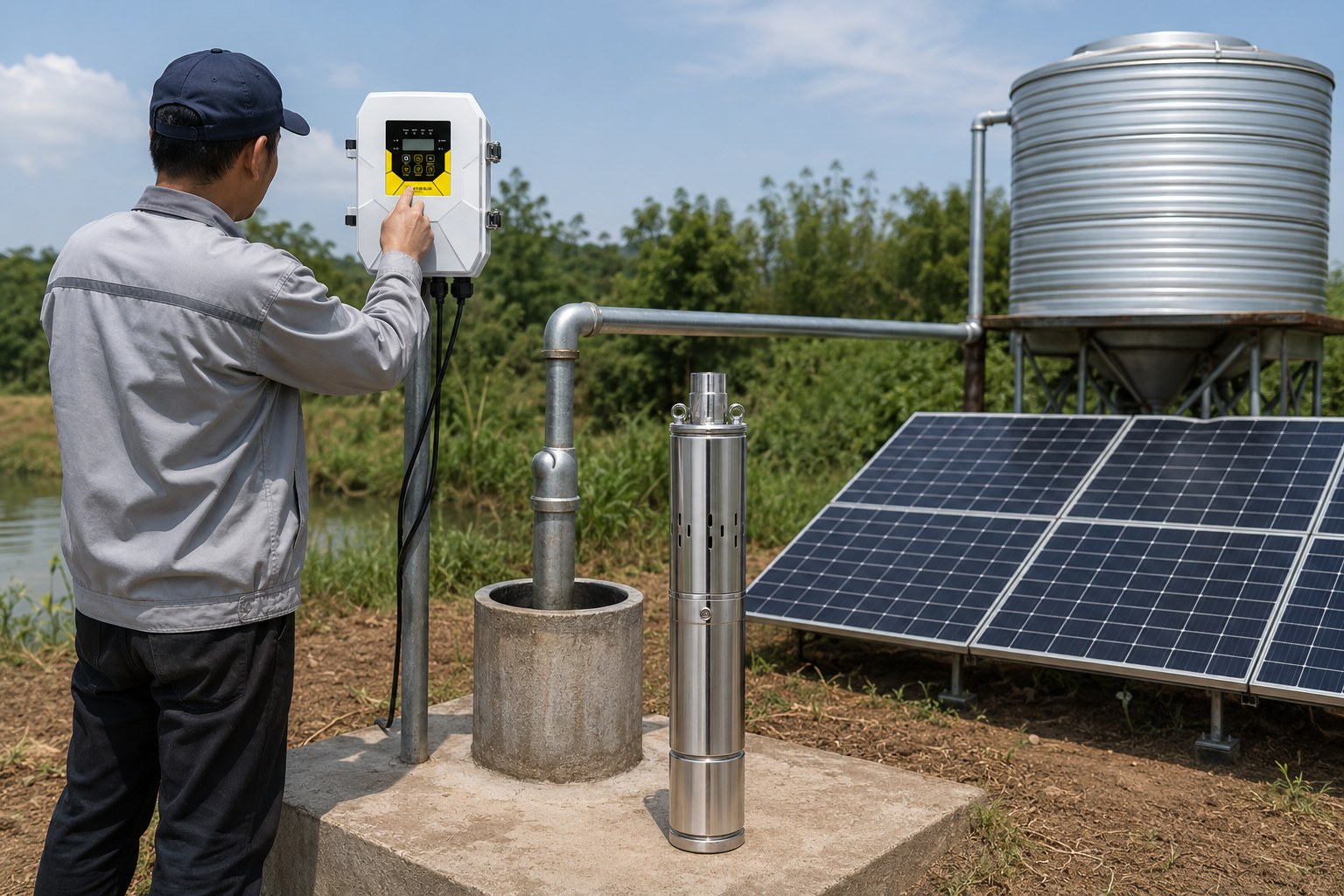
Solar deep well pumps are the definitive solution for off-grid water needs, using high-efficiency BLDC motors to provide reliable water for homes, livestock, and irrigation. Different pump types—screw, plastic impeller, and stainless steel impeller—are available to match specific well conditions and flow requirements.
As the world shifts toward sustainable energy, solar water pumps have become essential technology.
They operate independently of the electrical grid, making them perfect for rural and remote areas across Africa, the Americas, Australia, and Asia.
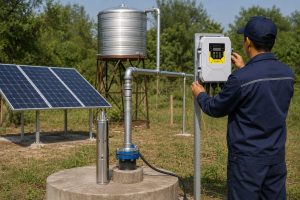
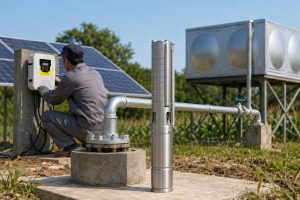
The system is simple: solar panels collect energy, a controller optimizes the power, and a highly efficient pump moves the water.
The core of this revolution is the motor technology, which has made solar pumping more powerful and affordable than ever before.
The Power of the BLDC Motor
The engine driving modern solar pumps is the Brushless DC (BLDC) permanent magnet motor.
This is not the same motor you'd find in a standard AC-powered pump.
BLDC motors achieve efficiencies exceeding 90%, compared to 60-70% for many conventional motors.
This high efficiency is critical for solar applications.
It means the pump can do more work with less power.
- Higher Efficiency: A 90%+ efficiency rating means you need up to 25% fewer solar panels to achieve the same water output, significantly reducing the system's initial cost.
- Greater Durability: With no brushes to wear out, BLDC motors are virtually maintenance-free and have a much longer service life.
- Compact & Lightweight: These motors are often up to 47% smaller and 39% lighter than traditional motors of the same power, simplifying installation.
Matching the Solar Pump to the Application
Not all wells are the same, so solar pumps come in different designs to meet diverse needs.
The three most competitive types form a complete product portfolio.
- Solar Screw Pump: This design uses a stainless steel screw rotating inside a rubber stator. It excels at producing very high pressure (head) but with lower flow rates. It's ideal for very deep wells or applications needing high lift for domestic water supply. Its ability to handle sandy water is a major advantage.
- Solar Plastic Impeller Pump: This is a multi-stage centrifugal pump that delivers high flow at a medium head. The wear-resistant plastic impellers are excellent at handling fine sand and make the pump lightweight and economical. It's the go-to choice for farm irrigation and general-purpose water supply.
- Solar Stainless Steel Impeller Pump: For corrosive water or applications demanding the highest durability, this is the premium choice. The SS304 stainless steel impellers and pump body resist acidic or alkaline water, ensuring a long, reliable service life in harsh environments.
Solar Pump Technology Comparison
| Pump Type | Flow Rate | Head (Pressure) | Sand Resistance | Best Application | Key Advantage |
|---|---|---|---|---|---|
| Solar Screw Pump | Low | Very High | Excellent | Deep wells, domestic supply | High lift capability |
| Plastic Impeller Pump | High | Medium | Very Good | Farm irrigation, high volume | High flow, cost-effective |
| Stainless Steel Impeller | High | Medium-High | Good | Corrosive water, premium homes | Maximum durability |
Modern solar pump systems also include intelligent MPPT (Maximum Power Point Tracking) controllers.
These devices constantly adjust the electrical load to maximize the energy harvested from the solar panels, ensuring you get the most water possible throughout the day, even in changing light conditions.
For even greater reliability, AC/DC hybrid controllers allow the system to automatically switch to grid or generator power when sunlight is insufficient, guaranteeing a 24/7 water supply.
Conclusion
Choosing the "number one" pump brand is less important than selecting the right pump technology for your specific well, water needs, and power source.
FAQs
What is the most reliable submersible well pump brand?
Franklin Electric and Grundfos are widely considered the most reliable brands. Both offer 5-year warranties and lifespans that often exceed 15-20 years with proper installation and maintenance.
How long do submersible well pumps last by brand?
Premium brands like Franklin Electric and Grundfos last 15-25 years. Mid-range brands like Goulds and Sta-Rite average 10-18 years, while budget brands may only last 5-8 years.
Is Franklin Electric better than Grundfos?
Neither is definitively "better," they serve different priorities. Franklin offers the best overall value and parts availability, while Grundfos provides superior energy efficiency and advanced built-in features for a premium price.
How much does a quality submersible pump cost?
A quality pump alone costs between $600 and $2,500. Franklin Electric pumps range from $600-$1,500, while Grundfos models are typically $800-$2,500, reflecting their premium engineering and efficiency.
Should I buy a cheap submersible pump to save money?
No, a cheap pump rarely saves money long-term. The repeated labor costs for replacement in a deep well will quickly exceed the initial savings, making a quality pump a better investment.
What size submersible pump do I need?
The size depends on your required flow rate (GPM) and Total Dynamic Head (TDH). A professional calculation is recommended to ensure the pump is not overworked or oversized for your system.
Is a 2-wire or 3-wire pump better?
A 3-wire pump is generally better for serviceability. Its starting components are in a control box above ground, making troubleshooting and repairs much easier and cheaper than with a 2-wire pump.
Can a submersible pump run on solar power?
Yes, specialized solar submersible pumps use highly efficient BLDC motors. They are an excellent, cost-effective solution for off-grid properties, farms, and remote water access, often paying for themselves in energy savings.