Struggling to find a clear answer on pump performance?
You need a reliable water supply, but horsepower ratings alone can be confusing.
A 1 HP pump's output isn't a single number.
It can range from 5 to over 25 gallons per minute (GPM).
This performance depends entirely on the pump's design, the well depth (head), and the specific application it's built for.
Understanding a pump's GPM requires looking beyond just its horsepower.
Horsepower is the engine, but the pump's design and the job it has to do determine the actual water flow.
This guide will break down the key factors—like total dynamic head, pump type, and motor efficiency—that dictate how many GPM you can truly expect from a 1 HP pump.
It will help you select a system that delivers the exact performance you need without wasting energy or money.
Understanding the Relationship Between HP, GPM, and Head
Confused by pump specifications?
You see HP, GPM, and head listed, but it's unclear how they work together to deliver water.
A 1 HP pump's GPM is not fixed.
It changes based on the total dynamic head (TDH), which is the total height and friction the pump must overcome.
As the head increases, the GPM decreases.
A pump performance curve shows this inverse relationship.
To truly grasp what a 1 HP pump can do, you must understand the forces it works against.
Horsepower (HP) provides the raw power.
Gallons Per Minute (GPM) measures the volume of water moved.
Total Dynamic Head (TDH) represents the total resistance the pump must overcome.
These three elements are locked in a performance triangle.
You cannot change one without affecting the others.
A 1 HP motor might be powerful, but its ability to move water diminishes significantly as the lifting distance and pipe friction increase.
What is Total Dynamic Head (TDH)?
TDH is the most critical factor in pump sizing.
It is the total equivalent height that water must be lifted, considering both the vertical distance and friction losses within the pipes.
It is calculated by adding the static head, pressure head, and friction loss.
- Static Head: The vertical distance from the water level in the well to the highest point in the delivery system.
- Pressure Head: The pressure required at the destination, converted into feet of head (1 PSI = 2.31 feet).
- Friction Loss: The resistance caused by water moving through pipes, fittings, and valves. Longer or narrower pipes create more friction.
For example, lifting water 100 feet and delivering it at 50 PSI requires the pump to overcome a head of over 215 feet, even before accounting for friction.
Reading a Pump Performance Curve
Every pump has a unique performance curve provided by the manufacturer.
This chart is the key to understanding its capabilities.
The vertical axis shows the head in feet, and the horizontal axis shows the flow rate in GPM.
To find a 1 HP pump's GPM, you first determine your system's TDH.
Then, you find that head value on the vertical axis and trace it horizontally until you intersect the pump's curve.
Dropping a vertical line from that intersection point to the horizontal axis reveals the GPM the pump will deliver at that specific head.
Example 1 HP Pump Performance
A single 1 HP pump can have vastly different outputs depending on its design (e.g., high-flow centrifugal vs. high-head screw).
The table below illustrates how GPM changes with head for a typical 1 HP submersible pump.
| Total Dynamic Head (Feet) | Flow Rate (GPM) | Typical Application |
|---|---|---|
| 50 | 25 | Shallow well, high-volume irrigation |
| 150 | 18 | Average residential well (100-125 ft deep) |
| 250 | 12 | Deeper residential well (200-225 ft deep) |
| 350 | 7 | Very deep well or high-elevation pumping |
This shows that asking "How many GPM for 1 HP?" is the wrong question.
The right question is, "At my required head, how many GPM will this specific 1 HP pump model deliver?"
How to Determine the Right Size Well Pump for Your Home
Worried about choosing a pump that's too weak or too strong?
Picking the wrong size leads to low pressure or a burned-out motor.
To size a pump correctly, you must first calculate your home's peak water demand in GPM.
This is done by adding up the flow rates of all fixtures and appliances that could run simultaneously.
A typical home needs 8-12 GPM for comfortable use.
Selecting the right pump is a balancing act.
It’s not about getting the most horsepower.
It’s about matching the pump’s output to your specific needs.
A correctly sized pump ensures consistent water pressure, operates efficiently, and enjoys a long service life.
An incorrectly sized pump, whether too large or too small, will cause problems.
It can lead to frustrating performance issues and expensive, premature replacement.
Follow a systematic approach to avoid these common pitfalls.
Calculating Your Peak Water Demand
The first step is to estimate how much water your household uses during peak times.
This involves counting all water-using fixtures and assigning them an average GPM value.
While a simple rule is to count 1 GPM per fixture, a more detailed breakdown provides greater accuracy.
Use the table below to create a more precise estimate for your property.
| Fixture Type | Average GPM |
|---|---|
| Faucet (Kitchen/Bath) | 1.0 - 2.0 |
| Shower | 2.0 - 2.5 |
| Toilet | 1.5 |
| Dishwasher | 1.5 |
| Washing Machine | 2.0 - 4.0 |
| Outdoor Spigot | 2.5 - 5.0 |
Add the GPM values for all fixtures that are likely to be used at the same time.
For a family of four, this might include a shower (2.5 GPM), a toilet flushing (1.5 GPM), and a dishwasher running (1.5 GPM), for a total peak demand of 5.5 GPM.
However, for larger homes or properties with irrigation, this number could easily exceed 15 GPM.
Your pump's flow rate must meet or slightly exceed this peak demand.
The Importance of Well Yield
Your pump can only deliver water that the well can provide.
The well yield is the maximum rate, in GPM, at which your well can be pumped without the water level dropping to the pump intake.
A pump’s GPM capacity should never exceed the well’s yield.
If a 1 HP pump is capable of pumping 20 GPM but the well only yields 10 GPM, the pump will "over-pump" the well.
This can cause the pump to run dry, leading to rapid overheating and catastrophic motor failure.
A professional well driller or pump installer can perform a well yield test to determine this crucial number.
Sizing for the Future
When selecting a pump, think about your future water needs.
Are you planning to add another bathroom, install a garden irrigation system, or build a workshop?
These additions will increase your peak water demand.
It is often more cost-effective to install a slightly larger pump now than to replace an undersized one in a few years.
For example, if your current need is 10 GPM but you plan to add a sprinkler system that requires 5 GPM, you should size your pump for a 15 GPM capacity.
This foresight ensures your water system remains robust and reliable as your needs grow.
Choosing the Right Pump Type for Your Application
Did you know the type of pump is as important as its horsepower?
Choosing the wrong design can lead to inefficiency and failure, even with a 1 HP motor.
The pump's internal mechanism determines its ideal application.
For example, a 1 HP screw pump excels at lifting water from very deep wells but provides low flow.
In contrast, a 1 HP centrifugal pump delivers high flow but is less effective at high heads.
A 1 HP motor is just the power source.
The actual work of moving water is done by the pump end, and its design dictates its performance characteristics.
Different applications demand different balances of flow (GPM) and pressure (head).
A pump designed for high-volume irrigation on a farm is fundamentally different from one designed to supply a deep-well home.
Understanding these distinctions is essential for building an efficient and long-lasting water system, especially in off-grid solar applications where every watt of energy counts.
Shallow vs. Deep Well Pumps
The first major distinction is based on well depth.
- Shallow Well Pumps (Jet Pumps): These are mounted above ground and use suction to pull water from depths of less than 25 feet. They are simpler to install and service but are limited by atmospheric pressure.
- Deep Well Pumps (Submersible Pumps): These are installed inside the well casing, below the water level. They push water to the surface, making them far more efficient for depths from 25 to over 400 feet. Submersible pumps are quieter, more powerful, and generally last longer.
For a 1 HP motor, a submersible design will deliver significantly more water from a deep well than a jet pump could.
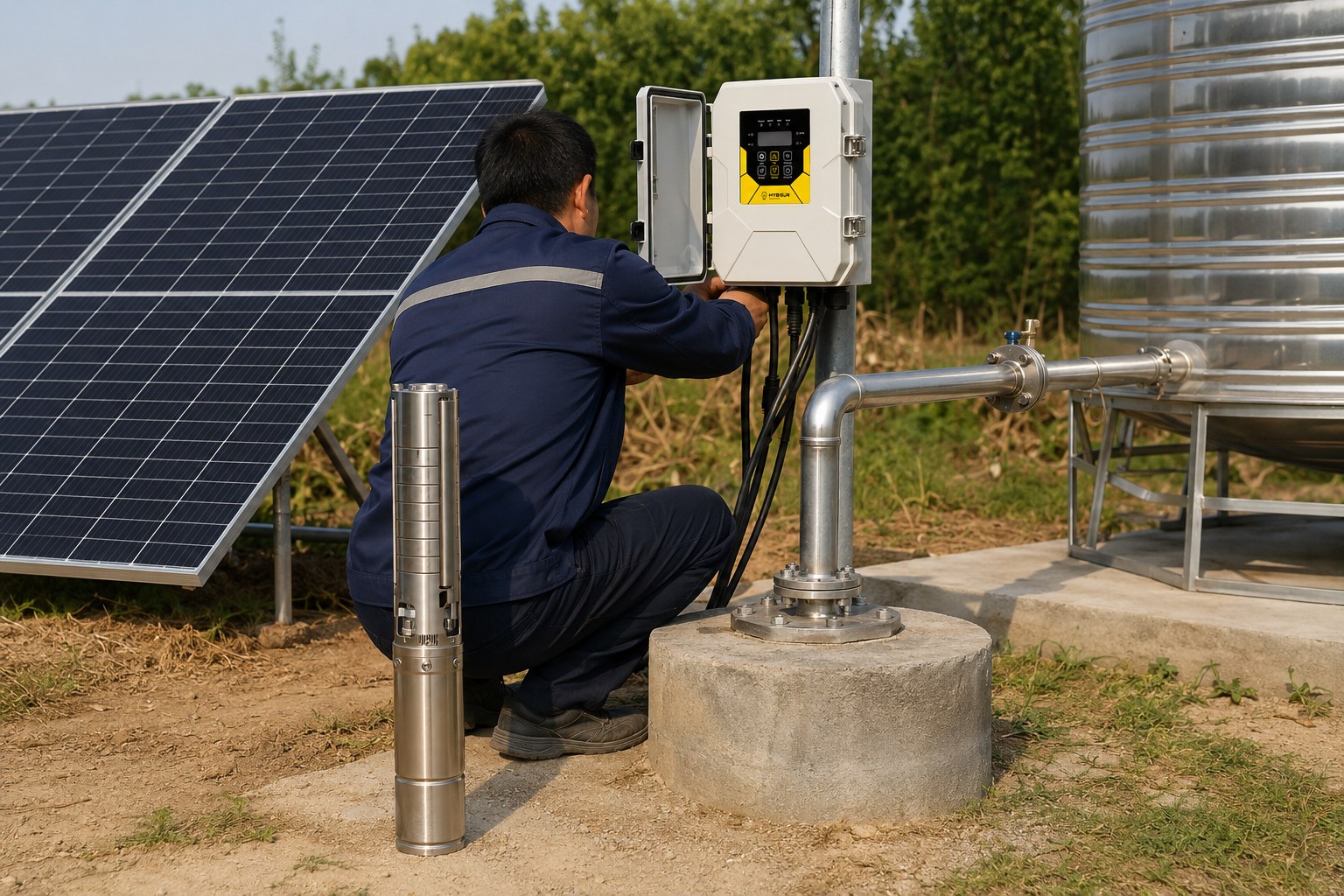
Specialized Solar Pumps for Off-Grid Needs
In off-grid environments, efficiency and durability are paramount.
Solar-powered pumps are designed to maximize water output using limited power from photovoltaic panels.
Three main types dominate the market, each with a 1 HP motor but for very different jobs.
| Pump Type | Primary Feature | Best For | Flow (GPM) | Head (Feet) |
|---|---|---|---|---|
| Solar Screw Pump | High Head | Deep wells, low-yield wells, domestic water | Low (3-10) | Very High (up to 500+) |
| Solar Plastic Impeller Pump | High Flow, Wear-Resistant | Farm irrigation, livestock watering, sandy water | High (15-30+) | Medium (up to 250) |
| Solar SS Impeller Pump | Corrosion Resistance | Corrosive water, high-end homes, long-term reliability | High (15-30+) | Medium-High (up to 350) |
A 1 HP solar screw pump is perfect for a 400-foot deep well supplying a home.
A 1 HP solar plastic impeller pump is ideal for irrigating a small farm from a 100-foot well.
The Power Behind the Pump: High-Efficiency Motors
The motor driving the pump is the heart of the system.
Modern solar pumps utilize advanced Brushless DC (BLDC) permanent magnet motors.
These motors achieve efficiencies exceeding 90%, compared to 60-70% for traditional AC motors.
This means more water is pumped per watt of solar power.
A high-efficiency 1 HP BLDC motor can perform like a 1.25 HP or 1.5 HP standard motor, delivering higher GPM at the same head.
This superior efficiency reduces the number of solar panels needed by up to 25%, lowering the initial system cost and simplifying installation.
The compact, maintenance-free design of BLDC motors also ensures a longer service life, making them the strategic core of any competitive solar pumping system.
Common Sizing Mistakes and How to Avoid Them
Think "bigger is better" for pumps?
This common mistake leads to high energy bills and a shorter pump lifespan.
An oversized pump is just as problematic as an undersized one.
It causes rapid on-off cycling, which overheats the motor and wears out system components.
To avoid this, you must perfectly balance pump capacity with your home's demand and your well's yield.
Selecting a well pump is about finding the sweet spot, not just maximizing power.
The goal is a balanced system where the pump runs for optimal cycle times, meets demand without strain, and operates efficiently.
Mistakes in sizing are common and costly.
They lead to everything from annoying pressure fluctuations to catastrophic system failure.
By understanding these common errors, you can ensure your investment is sound and your water supply is reliable for years to come.
The Dangers of Oversizing
An oversized pump delivers water faster than the system can use it, causing the pressure tank to fill up too quickly.
This triggers the pressure switch to shut the pump off.
As soon as a small amount of water is used, the pressure drops, and the pump kicks back on.
This rapid "short cycling" can happen every 30-60 seconds.
Effects of short cycling include:
- Motor Overheating: Constant starting draws a large inrush of current, generating excessive heat and leading to premature motor burnout.
- Increased Energy Bills: Starting a motor requires 3 to 5 times more energy than running it. Frequent starts can increase electricity consumption by over 50%.
- Component Wear: The pressure switch, check valves, and pressure tank bladder all wear out faster under the strain of constant cycling.
The Problems with Undersizing
An undersized pump cannot keep up with your home's peak water demand.
When multiple fixtures are running, you will experience a noticeable drop in water pressure.
The pump will run continuously, trying in vain to reach the pressure switch's cut-off point.
This constant operation puts immense strain on the motor.
Consequences of undersizing include:
- Low Water Pressure: Showers become weak, and faucets trickle, especially during peak usage times.
- Motor Strain and Failure: Continuous operation without rest can cause the motor to overheat and fail.
- Inconvenience: Simple tasks like washing dishes and doing laundry at the same time become impossible.
Ignoring the Pressure Tank and Well Yield
Even a perfectly sized pump will fail if other system components are ignored.
- Pressure Tank: The pressure tank must be sized correctly in relation to the pump's GPM. A common rule is to have at least one gallon of tank storage for every one GPM of pump capacity. An undersized tank will cause short cycling, even with a correctly sized pump.
- Well Yield: As mentioned before, your pump's GPM must not exceed your well's recovery rate. Always confirm the well yield before finalizing your pump selection.
Troubleshooting Common Pump Issues
| Problem | Possible Cause | Recommended Action |
|---|---|---|
| Low Pressure | Undersized pump; Clogged filter; Low well level | Verify pump size against demand; Clean/replace filters; Check static water level |
| Short Cycling | Oversized pump; Undersized/failed pressure tank | Add larger pressure tank; Check tank air pressure and replace if needed |
| Pump Runs Constantly | Undersized pump; Major leak in plumbing; Well yield too low | Upgrade pump; Inspect plumbing for leaks; Conduct well yield test |
| No Water | Pump failure; Tripped breaker; Well has run dry | Check power supply; Call a professional for diagnosis; Allow well to recover |
Advanced Pumping Solutions for 24/7 Water Access
Does your solar pump stop when a cloud passes over?
Relying solely on direct sunlight creates an unreliable water supply, especially at night or on overcast days.
To solve this, advanced hybrid systems provide uninterrupted water access.
These systems use intelligent controllers that can automatically switch between solar power and a secondary source, like the grid or a generator.
This ensures you have water whenever you need it, 24/7.
The biggest limitation of a standard solar pump is its dependence on the sun.
For critical applications like household water supply or livestock watering, this dependency is a significant risk.
What happens on a rainy day or after sunset?
The answer lies in hybrid technology.
Modern pumping solutions have evolved beyond simple DC-only systems.
By integrating AC/DC hybrid controllers, it is now possible to build a resilient, flexible, and highly efficient water system that guarantees a constant supply, maximizing the use of free solar energy while providing the reliability of a conventional grid-powered pump.
The Rise of Hybrid Pumping Systems
A hybrid pumping system is designed with two power inputs: one for DC power from solar panels and another for AC power from the electrical grid or a generator.
The system is managed by a smart controller that prioritizes solar energy.
This "best of both worlds" approach offers complete energy independence without sacrificing reliability.
It is the ideal solution for users who want the cost savings of solar but cannot afford any downtime in their water supply.
How AC/DC Hybrid Controllers Work
The core of the hybrid system is its intelligent controller.
This device constantly monitors the power generated by the solar panels.
- Priority on Solar: When sunlight is sufficient, the controller directs 100% of the DC power from the panels to the pump motor. The AC input remains on standby.
- Hybrid Power Blending: On partly cloudy days when solar power is reduced, the controller doesn't just switch off. It intelligently blends the available solar power with just enough AC power to meet the pump's operational needs. This maximizes the use of free solar energy and minimizes grid consumption.
- Automatic AC Switchover: When there is no solar input, such as at night or during heavy storms, the controller automatically switches over to the AC power source to run the pump at full capacity.
The entire process is seamless and automatic.
The user experiences a continuous, stable water flow without ever having to manually switch power sources.
Benefits of a Hybrid System
Investing in a hybrid system provides numerous advantages over a DC-only or AC-only setup.
- 24/7 Water Security: Eliminates downtime caused by weather or time of day, ensuring water is always available.
- Maximum Energy Savings: Prioritizes free solar energy and only uses grid power when absolutely necessary, significantly reducing electricity bills.
- Increased System ROI: By operating more consistently, the system delivers more water over its lifetime, improving the return on investment.
- Flexibility and Scalability: Works in any location, whether fully off-grid (with a generator) or grid-connected. The system can be adapted as energy availability or water needs change.
This technology transforms a solar water pump from a daytime-only tool into a complete, round-the-clock water supply solution.
Conclusion
A 1 HP pump's GPM is not a fixed value.
It depends on head, pump type, and motor efficiency.
Choosing the right system means balancing these factors to meet your specific water needs.
FAQs
What size pump do I need for a 200 ft well?
For a 200-foot well, you typically need a ¾ HP to 1.5 HP submersible pump. The final choice depends on your required GPM and pressure at the surface.
Will a bigger HP pump increase water pressure?
Not necessarily. Horsepower helps lift water from greater depths. For better pressure, consider adjusting your pressure switch or upgrading to a constant pressure system.
How many GPM is a good well?
A good well yield for a standard home is 5-10 GPM. This provides enough water for daily activities without over-pumping the aquifer or straining the pump.
What size well pump do I need for a 4 bedroom house?
A 4-bedroom house typically requires a pump that can deliver 10-15 GPM. This ensures adequate flow and pressure when multiple bathrooms and appliances are in use simultaneously.
How do you calculate GPM for a well pump?
To calculate GPM, you can perform a bucket test. Time how long it takes for the pump to fill a 5-gallon bucket and use that to calculate gallons per minute.
How many GPM can a 1.5 HP pump?
A 1.5 HP pump's output varies widely, from 10 GPM in very deep wells (over 400 feet) to over 35 GPM in shallow applications with low head.
What is the difference between a 1/2 HP and 3/4 HP well pump?
A 3/4 HP pump can deliver a higher flow rate (GPM) at the same depth or the same flow rate from a greater depth compared to a 1/2 HP pump.
Can a well pump be too powerful?
Yes. An oversized pump will short cycle, leading to motor overheating, increased energy use, and premature failure of the pump and pressure tank. It's a common and costly mistake.