Your pool pump is a massive energy drain.
It silently adds hundreds of dollars to your electricity bill each year.
A solar-powered pump offers a practical, eco-friendly solution to cut these costs.
You should run your solar pool pump during peak daylight hours, typically between 10 AM and 4 PM.
This timing maximizes energy from the sun.
It also aligns perfectly with when your pool needs filtration most, as sunlight promotes algae growth that the pump will combat.
Understanding the best time to run your pump is the first step.
But to truly benefit, you need to know how these systems work and when they are the right choice.
This technology isn't a universal solution for every pool.
Let's explore the ideal conditions for a solar pump and the technology that makes it a smart investment for your property.
We will cover how they work, the real-world benefits, and how to choose a system that delivers reliable performance for years to come.
How Do Solar Pool Pumps Work and When Do They Make Sense?
Traditional pool pumps are expensive to run.
They are completely dependent on the utility grid.
This makes them vulnerable to rising electricity prices and power outages.
Solar pumps provide an independent and cost-saving alternative.
A solar pool pump uses photovoltaic (PV) panels to generate DC electricity.
This power directly runs a high-efficiency DC motor that circulates your pool water.
The pump's speed naturally adjusts to the intensity of the sunlight, running hardest when the sun is strongest and filtration is most needed.
A solar pool pump system is elegantly simple.
It consists of three main components working in harmony.
Understanding each part helps clarify why this technology is so effective in the right environment.
The system's performance is directly tied to the sun, a relationship that is actually a major advantage for pool maintenance.
The Core Components of a Solar Pump System
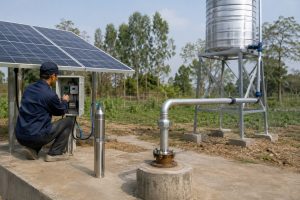
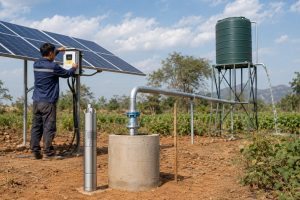
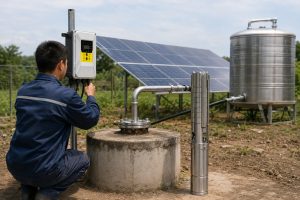
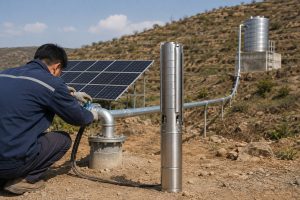
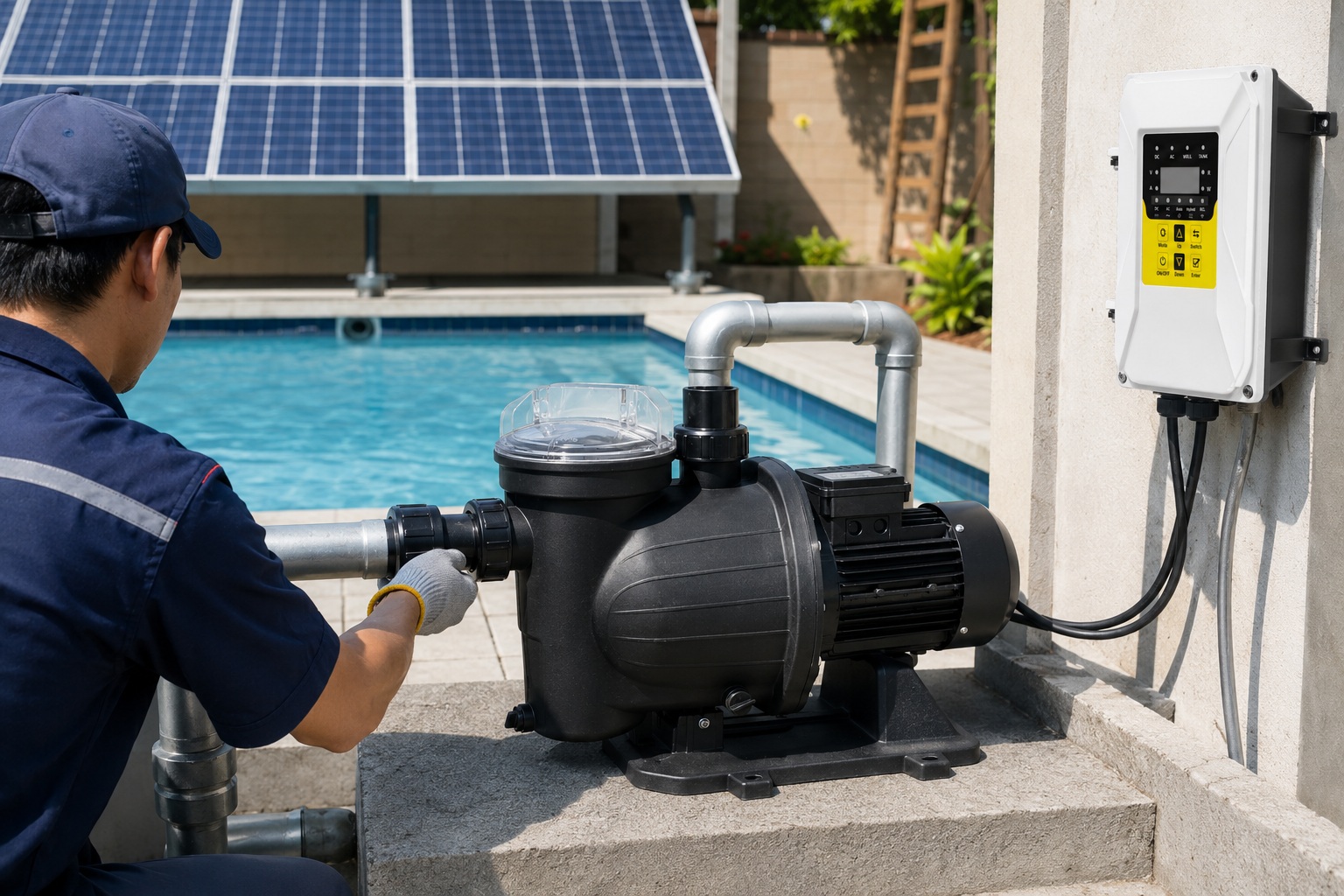
A solar pump system is comprised of solar panels, a controller, and the pump motor itself.
The solar panels (photovoltaic modules) capture sunlight and convert it into direct current (DC) electricity.
The number and wattage of panels determine the total power available.
The controller is the brain of the operation.
It manages the power from the panels, optimizing it for the pump motor.
High-quality controllers use Maximum Power Point Tracking (MPPT) technology.
MPPT ensures the pump gets the maximum possible power from the panels, even as sunlight conditions change throughout the day.
This can boost efficiency by up to 30%.
The pump motor is a high-efficiency brushless DC (BLDC) motor.
Unlike standard AC pumps, these motors are designed to run on the variable power produced by solar panels.
The Direct Sunlight Relationship
The pump's operation is naturally synchronized with the sun's cycle.
It starts slowly as the sun rises, runs at full power during peak midday sun, and slows down as the sun sets.
This might seem like a limitation, but it's perfect for pool filtration.
Sunlight is the primary catalyst for algae and bacteria growth.
By running most powerfully during the sunniest parts of the day, a solar pump actively counters this growth when it's most aggressive.
It ensures your pool stays clean and clear without wasting energy at night when circulation is less critical.
Ideal Scenarios for Adopting Solar
Solar pool pumps are not a universal fix, but they are a perfect solution in specific situations.
-
High Electricity Costs: If your property is in a region with high electricity rates, a pool pump can be one of your largest expenses. A typical 1 HP AC pump running 7 hours a day can cost over $500 annually in areas with electricity at $0.25/kWh. A solar pump eliminates this operating cost entirely.
-
Off-Grid or Remote Locations: For rural homes, farms, or vacation properties without easy grid access, installing a solar pump is often far cheaper than running new electrical lines. Trenching and wiring over a distance can cost thousands of dollars, making a standalone solar system a simple and reliable alternative.
-
Daylight Circulation Needs: The technology is a perfect match for any pool that primarily requires filtration during the day. This covers the vast majority of residential and light commercial pools.
-
Eco-Conscious Property Owners: For those looking to reduce their carbon footprint, a pool pump is a logical target. It's a high-consumption appliance that can be easily converted to run on 100% renewable energy.
| Scenario | Traditional AC Pump Challenge | Solar Pump Solution |
|---|---|---|
| High Energy Prices | Annual cost of $250 - $600+ | $0 annual electricity cost. |
| Remote Property | Thousands in grid connection costs. | Standalone power, no trenching needed. |
| Green Initiative | High carbon footprint from daily use. | Runs on 100% renewable energy. |
| Noisy Environment | Loud AC motor disrupts peace. | Operates at a near-silent level. |
What Are the Real-World Benefits and Potential Drawbacks?
The promise of free, clean energy to run your pool sounds perfect.
But what are the actual advantages and hidden problems you might face?
It is important to look beyond the marketing promises to understand the full picture.
The main benefits of a solar pool pump are zero operating costs, high energy efficiency from brushless DC motors, and exceptionally quiet operation.
However, potential drawbacks include inconsistent performance in shaded areas, a lack of nighttime circulation capability, and reliability issues with some cheaper imported models.
The benefits of switching to solar are tangible and can be measured in both cost savings and quality of life.
However, a smart investor also acknowledges the limitations.
Understanding both sides ensures you make an informed decision and avoid disappointment.
Let's break down the real-world performance, from the financial returns to the potential technical glitches.
Tangible Benefits Explained
The advantages of a solar pool pump system are significant.
Cost Savings and Payback: The most compelling benefit is the elimination of electricity costs.
Consider a standard 1 HP (750-watt) AC pump.
Running it 7 hours a day at an electricity rate of $0.20/kWh results in an annual cost of approximately $383.
A complete solar pump system, including panels, can be purchased for around $900.
This leads to a simple payback period of only 2.3 years.
After that, the energy is completely free.
Energy Efficiency & Longevity: This is where the core technology shines.
Solar pumps use brushless DC (BLDC) motors, which are vastly superior to the brushed AC motors in traditional pumps.
A BLDC motor can achieve over 90% efficiency, converting more electricity directly into pumping power.
In contrast, many AC motors operate at 60-70% efficiency.
Furthermore, a BLDC motor has a typical lifespan of 20,000 to 30,000 hours.
A standard brushed motor may only last 2,000 to 5,000 hours.
This means a solar pump motor can last up to 10 times longer, dramatically reducing replacement costs and maintenance headaches.
Quiet Operation: Traditional AC pool pumps can be notoriously loud, creating a constant, disruptive hum in your backyard.
BLDC motors, however, are virtually silent.
This drastically improves the peacefulness and enjoyment of your pool area.
Acknowledging the Limitations
It is equally important to be aware of the situations where a solar pump may not be the best fit.
Heavy Shade: Solar panels need direct, unobstructed sunlight to function effectively.
A pool area surrounded by tall trees or buildings may not receive enough consistent sun to power the pump adequately, leading to poor filtration.
Nighttime Operation: Solar pumps are designed to run during the day.
They cannot operate at night without a battery storage system, which significantly increases the cost and complexity of the installation.
This makes them unsuitable for pool owners who rely on cheaper, off-peak electricity rates to run their pumps overnight.
The "Cycling Glitch": Some lower-quality imported models suffer from a significant design flaw.
On partly cloudy days or in the late afternoon, as sunlight becomes inconsistent, their simple controllers can cause the motor to rapidly turn on and off.
This frequent cycling creates excessive stress on the motor and can lead to premature failure.
A well-designed controller with smart logic is essential to prevent this issue.
How to Choose the Right Solar Pump and Avoid Common Pitfalls?
You are ready to invest in a solar pump system.
But the market can be confusing.
You see a wide range of prices and often find poor technical documentation.
How do you choose wisely and ensure you get a reliable, long-lasting product?
Focus on the quality of the motor and controller, not just the pump itself.
A high-efficiency brushless DC (BLDC) motor is critical for performance and longevity.
Also, carefully consider your pool size, local climate, available warranty, and the controller's features to avoid premature failure.
Making the right choice goes beyond just matching horsepower.
It involves a careful evaluation of the system's core technology and how it fits your specific needs.
An informed buyer looks at the engine behind the pump, the intelligence of its controller, and even the materials it's made from.
This approach helps you avoid the common pitfalls of a chaotic market, such as paying too much for a subpar product or buying a system that fails within a year.
Key Selection Criteria
When evaluating a solar pump system, focus on these critical factors.
Pool Size and Required Flow Rate: The pump must be powerful enough to turn over your pool's entire volume of water at least once per day.
Oversizing is better than undersizing.
A simple guideline is to match the pump's power to your pool's volume.
| Pool Volume (Gallons) | Recommended Pump Power (Watts) |
|---|---|
| Up to 15,000 | 300W - 500W |
| 15,000 - 30,000 | 500W - 750W |
| Over 30,000 | 750W+ |
Sunlight Exposure (Solar Irradiance): The amount of direct sunlight your location receives, measured in "peak sun-hours," is crucial.
A location with only 4 peak sun-hours per day will require a more powerful panel array to achieve the same daily filtration as a location with 6 hours.
Ensure your chosen panel location is free from shade between 9 AM and 4 PM.
Motor and Controller Quality
This is the most important consideration for reliability and long-term value.
Brushless DC (BLDC) Permanent Magnet Motors: Insist on a pump with a BLDC motor.
These are the heart of a modern solar pump system.
Their efficiency, often exceeding 90%, means you need fewer solar panels, reducing the overall system cost.
The use of powerful neodymium magnets results in higher torque and a more compact, lightweight design compared to older motor technologies.
Intelligent MPPT Controllers: The controller is just as important as the motor.
Look for a system with a Maximum Power Point Tracking (MPPT) controller.
This technology constantly adjusts the electrical load to extract the maximum amount of power from the solar panels as the sun's intensity changes.
More advanced controllers also include "soft start" and "soft stop" logic.
This prevents the damaging on/off "cycling glitch" by smoothly ramping the motor speed up or down in response to changing light, significantly extending the motor's life.
Some premium controllers also offer an AC/DC hybrid input.
This allows the system to automatically switch to grid power on cloudy days or at night, offering 24/7 operation.
Pump Construction (Impeller Type)
The materials used in the pump itself determine its durability, especially in different water conditions.
While often discussed for well pumps, the same principles apply to pool pumps.
Plastic Impellers: High-quality, wear-resistant plastic impellers are an excellent, cost-effective choice for most residential pools.
They are lightweight and perform well in water with fine, non-abrasive debris.
Stainless Steel Impellers: For saltwater pools or regions with corrosive water, a pump with SS304 stainless steel impellers and a stainless steel pump body is a superior long-term investment.
This material offers exceptional resistance to corrosion and abrasion, ensuring a much longer service life and higher reliability, albeit at a higher initial cost.
What Are Common Installation and Troubleshooting Issues?
Your new solar pump system is installed.
But it is not working as you expected.
Low water flow, strange noises, or the pump not starting at all can be frustrating.
The good news is that most of these issues are common and easily fixable.
The most frequent problems are inadequate sunlight reaching the panels, incorrect electrical wiring, or pump priming issues.
Start by ensuring the panels are clean and unshaded, double-checking all wire connections for correct polarity, and bleeding any trapped air from the system.
Troubleshooting a solar pump system is a logical process.
Problems can almost always be traced back to one of three areas: the power source (panels), the water flow (plumbing), or the pump itself (mechanical issues).
By systematically checking each area, you can quickly diagnose and resolve over 90% of common problems without needing to call a professional.
Let's walk through the steps to get your system running smoothly.
Diagnosing Power Issues
If the pump isn't running or is running very slowly, start here.
Inadequate Sunlight: This is the most common culprit.
Visually inspect the solar panels.
Are they covered in dirt, dust, leaves, or bird droppings?
A dirty panel can lose over 25% of its power output.
Also, check for new sources of shade, like tree growth, that may be blocking the sun during peak hours.
Incorrect Wiring: DC electricity is sensitive to polarity.
Double-check that the positive (+) and negative (-) wires from the solar panels are connected to the correct terminals on the controller.
Reversing the polarity can damage the controller or prevent the system from working.
Also, ensure all connections are tight and secure.
Loose connections create resistance and reduce power.
Inefficient Panel Performance: Check the panels for any physical damage, like cracks in the glass.
A damaged panel will have a significantly reduced output.
Also, verify the panels are angled correctly to face the sun for most of the day.
Diagnosing Water Flow Issues
If the pump is running but water flow is weak, investigate the plumbing.
Pump Priming Failure: A pump cannot move water if it is full of air.
This is known as a priming issue.
The most common cause is an air leak in the suction line (the pipe between the skimmer and the pump).
Check all fittings and the pump lid O-ring for a tight seal.
To prime the pump, turn it off, open the lid, and fill the pump basket with water from a hose before restarting.
Insufficient Water Flow: A clogged filter or a full pump basket will severely restrict water flow.
Clean both thoroughly.
Check for any kinks in flexible hoses or closed valves that might be blocking the line.
Addressing Mechanical Problems
If you hear unusual noises or the motor feels excessively hot, inspect the pump itself.
Noise or Vibration: A rattling or grinding noise often indicates debris is trapped in the pump's impeller.
Turn off all power and inspect the impeller for stones or leaves.
Vibration can be caused by the pump not being securely mounted to its base.
Overheating: Pump motors are designed to get warm, but they should not be too hot to touch.
Overheating is often caused by a lack of proper ventilation.
Ensure the area around the motor is clear of debris and has adequate airflow.
Running a pump with severely restricted water flow can also cause it to work harder and overheat.
Conclusion
Solar pool pumps are a smart investment.
They work best in sunny locations when run during the day.
Choose a quality system with a reliable motor and controller for years of cost-free, silent operation.
FAQs
Can a solar pool pump run 24 hours?
No, a standard solar pump runs only when there is sunlight.
To run 24 hours, you would need a large battery bank or a hybrid AC/DC model that can switch to grid power.
How many solar panels do I need for a pool pump?
This depends on the pump's wattage and your location.
Typically, a 500W pump requires about 600-800 watts of solar panels to ensure good performance even on less sunny days.
Do solar pool pumps work on cloudy days?
Yes, but at a reduced speed.
The pump's flow rate will be lower than on a bright, sunny day, but it will still provide some circulation and filtration.
What size solar pool pump do I need?
Your pump should be able to filter your entire pool's volume in about 8 hours.
Calculate your pool volume in gallons and choose a pump with a matching flow rate (GPH).
Are solar pool pumps worth it?
Yes, in most cases.
With a payback period of just 2-4 years and a motor that can last 10 times longer than a traditional one, they offer excellent long-term value.
How long do solar pool pumps last?
The high-quality brushless DC motor can last 20,000-30,000 hours, or over 10 years of typical use.
The solar panels themselves have a performance warranty of 25 years.
Can you run a pool pump directly from solar panels?
Yes, that is exactly how they are designed to work.
The system uses a controller to manage the DC power from the panels and sends it directly to the DC pump motor.