Struggling with unreliable grid power or high electricity bills for your water supply?
Power outages and remote locations can cut off your access to water, disrupting farms, homes, and businesses.
**You can run a water pump without electricity by using a solar-powered system, an electric generator, or a battery bank.
The most efficient and sustainable method is a direct solar pump system, which uses photovoltaic (PV) panels to power a DC pump, eliminating fuel costs and grid dependency.
**
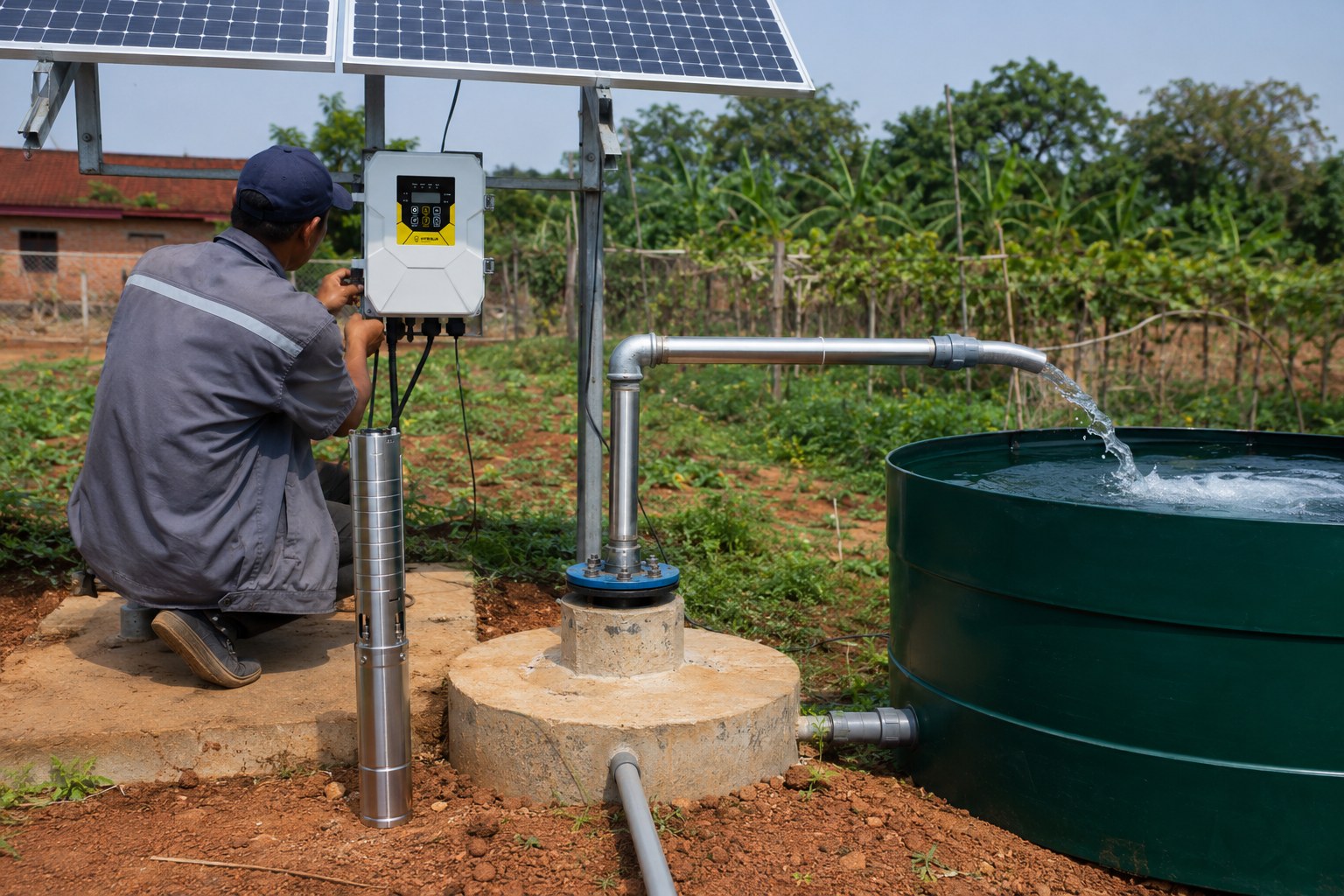
These grid-independent solutions offer true water security.
However, choosing the best method depends entirely on your specific needs, budget, and environmental conditions.
From retrofitting existing pumps to installing a fully off-grid system, understanding the options is key.
Let's explore the most effective ways to pump water without a traditional power supply.
AC Pump with an Inverter and Solar Panels
You have a reliable AC pump but want to slash your energy bills and go green.
Retrofitting with solar can seem complex and expensive, involving multiple components.
**For a sustainable approach, you can power a standard AC pump using solar panels and an inverter.
The solar panels generate DC electricity, which the inverter converts to AC power to run your existing pump, making it a popular eco-friendly upgrade.
**
This method bridges the gap between traditional infrastructure and renewable energy.
It allows users to leverage their investment in an existing AC pump while transitioning to a cleaner power source.
This setup is particularly useful for homes and farms aiming to reduce their carbon footprint without a complete system overhaul.
However, it is crucial to understand both the mechanics and the trade-offs involved.
How This System Works
The system operates through a clear three-step process.
First, photovoltaic (PV) solar panels capture sunlight and convert it into direct current (DC) electricity.
Second, this DC power is fed into an inverter.
The inverter's primary job is to transform the DC electricity into alternating current (AC) electricity, the standard form of power used by most household and industrial pumps.
Finally, this AC power runs your water pump.
This allows a standard pump to operate using solar energy instead of grid power.
Efficiency and Cost Considerations
While this method is innovative, it comes with an inherent efficiency loss.
The process of converting DC to AC power in the inverter is not 100% efficient.
Typically, you can expect an energy loss of 10% to 15% during this conversion.
This means that for every 100 watts of power your solar panels generate, only 85-90 watts will reach the pump.
This inefficiency requires a larger, more expensive solar panel array to achieve the same pumping performance as a native DC system.
The initial investment can be high, including the cost of solar panels, a suitable inverter, and professional installation.
| Feature | AC Pump + Solar/Inverter | AC Pump + Generator |
|---|---|---|
| Power Source | Renewable (Sunlight) | Non-renewable (Gas/Diesel) |
| Operating Cost | Very Low (after setup) | High (Fuel) |
| Emissions | Zero | Noise and Fumes |
| Efficiency Loss | 10-15% (in conversion) | ~5% (in power transfer) |
| Upfront Cost | High | Moderate |
| Maintenance | Low (panel cleaning) | High (engine service) |
Ideal Applications
This setup is best suited for specific scenarios.
It is an excellent choice for users who already own a functional AC pump and wish to integrate renewable energy.
It is also ideal for applications with consistent, high sunlight exposure where the larger panel array needed is feasible.
Homes and small farms looking to lower their electricity bills and environmental impact find this solution very attractive.
It serves as a powerful stepping stone toward full energy independence.
DC Pump with Solar Panels
Are you tired of complex setups, energy losses, and recurring costs?
Inverters and batteries add extra components that can fail and increase maintenance requirements.
**A direct DC pump and solar panel system is the most efficient solution for off-grid water.
This setup eliminates the need for an inverter, cutting costs and boosting performance by up to 25%.
It's perfect for remote irrigation, livestock watering, and rural homes.
**
This approach represents the pinnacle of simplicity and efficiency in solar water pumping.
By connecting a DC pump directly to solar panels through a smart controller, you create a robust, low-maintenance system that works whenever the sun shines.
The global demand for these systems is soaring in regions like Africa, the Americas, and Australia, where grid access is limited but sunlight is abundant.
The core of this system's success lies in its advanced components, particularly the motor and the pump-end design, which can be tailored to diverse needs.
The Powerhouse: BLDC Permanent Magnet Motors
The heart of any modern solar pump is its motor.
High-efficiency Brushless DC (BLDC) permanent magnet motors are the driving force behind the industry's most competitive pumps.
These motors achieve an operational efficiency exceeding 90%, a significant leap from traditional motors.
The rotor is constructed from 40SH neodymium iron boron, a powerful rare-earth magnet that ensures high torque and performance.
This advanced engineering results in a motor that is 47% smaller and 39% lighter than its predecessors.
For the end-user, this means lower solar panel requirements, reduced installation costs, and a maintenance-free design with a long service life.
The motor's efficiency is the foundation of the entire system's cost-effectiveness and reliability.
Option 1: Solar Screw Pumps for Deep Wells
When you need to pull water from extreme depths, the solar screw pump is the ideal choice.
This pump utilizes a progressing cavity design, featuring a stainless steel screw rotating within a rubber stator.
This mechanism pushes water upwards through compression, delivering low flow rates but exceptionally high head.
It is engineered to overcome the immense vertical distances found in deep borewells.
| Feature | Solar Screw Pump |
|---|---|
| Flow Rate | Low |
| Head (Lift) | Very High (up to 200+ meters) |
| Primary Use | Deep well domestic water, livestock watering |
| Sand Resistance | Excellent |
| Best For | Electricity-scarce regions with deep water tables |
This design is highly resistant to sand and can operate reliably in harsh water conditions, making it a lifeline in parts of Africa and Latin America.
Its main limitation is a lower flow rate, which makes it less suitable for large-scale agricultural irrigation.
However, for domestic water supply and livestock, it provides unparalleled performance.
Option 2: Solar Plastic Impeller Pumps for High Flow
For applications requiring high volumes of water, the solar plastic impeller pump is the workhorse.
This is a multi-stage centrifugal pump equipped with durable, wear-resistant plastic impellers.
It is designed to deliver high flow rates at a medium head, making it perfect for farm irrigation, pasture water supply, and filling residential tanks.
It offers an excellent balance of performance and economy.
| Feature | Solar Plastic Impeller Pump |
|---|---|
| Flow Rate | High |
| Head (Lift) | Medium (up to 100 meters) |
| Primary Use | Farm irrigation, pasture water, home gardens |
| Sand Resistance | Good (for fine sand) |
| Best For | General agriculture and residential use in Africa & the Americas |
Its lightweight construction makes installation easier and more affordable.
The pump provides excellent resistance to the fine sand often found in agricultural wells.
However, its durability may be compromised in highly corrosive water or when pushed to operate at extreme depths.
It is the most economical choice for high-flow requirements in typical water conditions.
Option 3: Solar Stainless Steel Impeller Pumps for Durability
When water quality is a challenge, the solar stainless steel impeller pump provides a premium, long-lasting solution.
This model features an SS304 stainless steel impeller and pump body.
It is specifically engineered to operate in corrosive water environments, such as those with acidic or alkaline properties.
It offers both high flow rates and a medium-to-high head capacity.
| Feature | Solar Stainless Steel Impeller Pump |
|---|---|
| Flow Rate | High |
| Head (Lift) | Medium-High (up to 150 meters) |
| Primary Use | Corrosive water, high-end homes, premium ranches |
| Corrosion Resistance | Excellent |
| Best For | Alkaline soils in Australia, special water conditions |
This pump is the top choice for regions with challenging water chemistry, like the alkaline soil areas of Australia or certain parts of the Americas.
Its robust construction guarantees high reliability and a long service life, protecting the investment over many years.
The trade-offs are a higher initial cost and increased weight compared to plastic impeller models.
This positions it as a high-end solution for niche markets where durability is non-negotiable.
Hybrid and Battery-Powered Systems for 24/7 Water
What happens when the sun sets or clouds roll in?
A standard solar pump stops working, which can be a critical problem for continuous water needs.
**For uninterrupted 24/7 water access, pair a DC pump with a battery bank or an AC/DC hybrid controller.
Batteries store solar energy for nighttime use, while hybrid controllers automatically switch to grid or generator power when sunlight is unavailable.
**
These advanced systems are designed to eliminate the primary drawback of solar power: its intermittency.
Whether for household use, critical livestock watering, or industrial processes, having a reliable water supply around the clock is often essential.
By integrating a backup power source, you gain total peace of mind and complete water security, regardless of the weather or time of day.
Let's examine the two leading approaches for achieving this.
The Battery Backup Method
The most straightforward way to store solar energy is with a battery bank.
In this setup, solar panels power the DC pump during the day while simultaneously charging a deep-cycle battery array.
When sunlight fades, the system's controller automatically draws power from the batteries to keep the pump running.
This method is highly effective for off-grid applications requiring nighttime or low-light operation.
It is also ideal for portable water pumping setups, as the entire system can be self-contained.
However, there are important considerations.
Batteries require regular maintenance to ensure longevity and performance.
They also have a limited lifespan, typically 3-7 years, and will eventually need costly replacement.
The system's runtime is directly limited by the battery capacity, so undersizing the bank can lead to unexpected shutdowns.
| Battery Capacity (Ah) | Approx. Runtime for 300W Pump | Key Consideration |
|---|---|---|
| 100Ah (12V) | ~3-3.5 Hours | Good for short-term backup |
| 200Ah (12V) | ~6-7 Hours | Suitable for overnight use |
| 400Ah (12V) | ~12-14 Hours | Ideal for multi-day low-sun conditions |
Note: Runtimes are estimates and depend on battery health, depth of discharge, and pump load.
The AC/DC Hybrid Controller Advantage
A more advanced and increasingly popular solution is the AC/DC hybrid controller.
This intelligent device provides ultimate flexibility by allowing the pump system to draw power from two sources simultaneously.
You can connect both solar panels (DC) and a grid or generator supply (AC) to the controller at the same time.
The controller's smart logic prioritizes solar power first, always using the free energy from the sun when available.
If solar power is insufficient due to clouds, the controller seamlessly blends in AC power to maintain pump performance.
When there is no solar input at all, such as at night, it automatically switches over to the AC source entirely.
This ensures worry-free water access 24 hours a day without the maintenance and replacement costs associated with batteries.
This "best of both worlds" approach maximizes the use of free solar energy to keep operating costs low while guaranteeing the reliability of a conventional power source.
For users with access to a grid or generator, the hybrid controller is often the most practical and cost-effective solution for round-the-clock water.
Conclusion
Solar pumps provide versatile, eco-friendly water solutions for any off-grid need.
The key is matching the pump type, motor efficiency, and control system to your requirements for a reliable, cost-effective system.
FAQs
Can a solar water pump run at night?
Yes, a solar pump can run at night if the system includes a battery bank to store energy or an AC/DC hybrid controller connected to the grid or a generator.
How many solar panels do I need for a 1 HP pump?
A 1 HP (approximately 746 watts) pump typically requires between 1000 to 1200 watts of solar panels to ensure sufficient power, especially during less-than-ideal sun conditions.
How deep can a solar pump pull water?
Solar screw pumps are designed for deep wells and can pull water from depths exceeding 200 meters (over 650 feet), making them ideal for arid regions.
Are solar water pumps expensive?
While the initial investment is higher than for traditional pumps, solar pumps have zero fuel costs and minimal maintenance, making them more cost-effective over the long term.
How long do solar water pumps last?
A quality solar pump system is very durable. The pump and motor can last over 10 years, while solar panels are typically warrantied for 25 years or more.
Can solar pumps work on cloudy days?
Yes, they can work on cloudy days, but their performance will be reduced. Modern MPPT controllers help maximize power output even in low-light conditions.
What is an AC/DC hybrid solar pump?
It's a system that can run on both solar (DC) power and grid/generator (AC) power. An intelligent controller automatically switches between sources to ensure a constant water supply.
What maintenance do solar pumps require?
Maintenance is minimal. It mainly involves cleaning the solar panels periodically to remove dust or debris and occasionally checking wiring and plumbing connections for any issues.