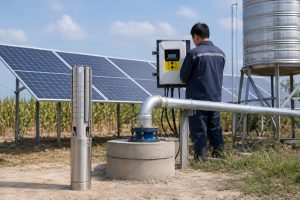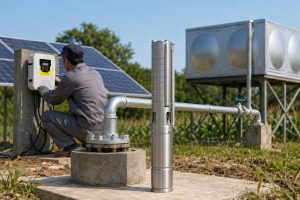
Struggling to get water from a very deep well?
Many standard pumps fail at great depths, leaving you with low pressure or no water at all.
This forces you to consider expensive, power-hungry solutions.
**For delivering the highest pressure, especially from deep wells, the solar screw pump is unmatched.
This type of pump uses a progressive cavity design, allowing it to generate immense head (pressure) to push water from extreme depths where other pumps would fail, even with lower flow rates.**
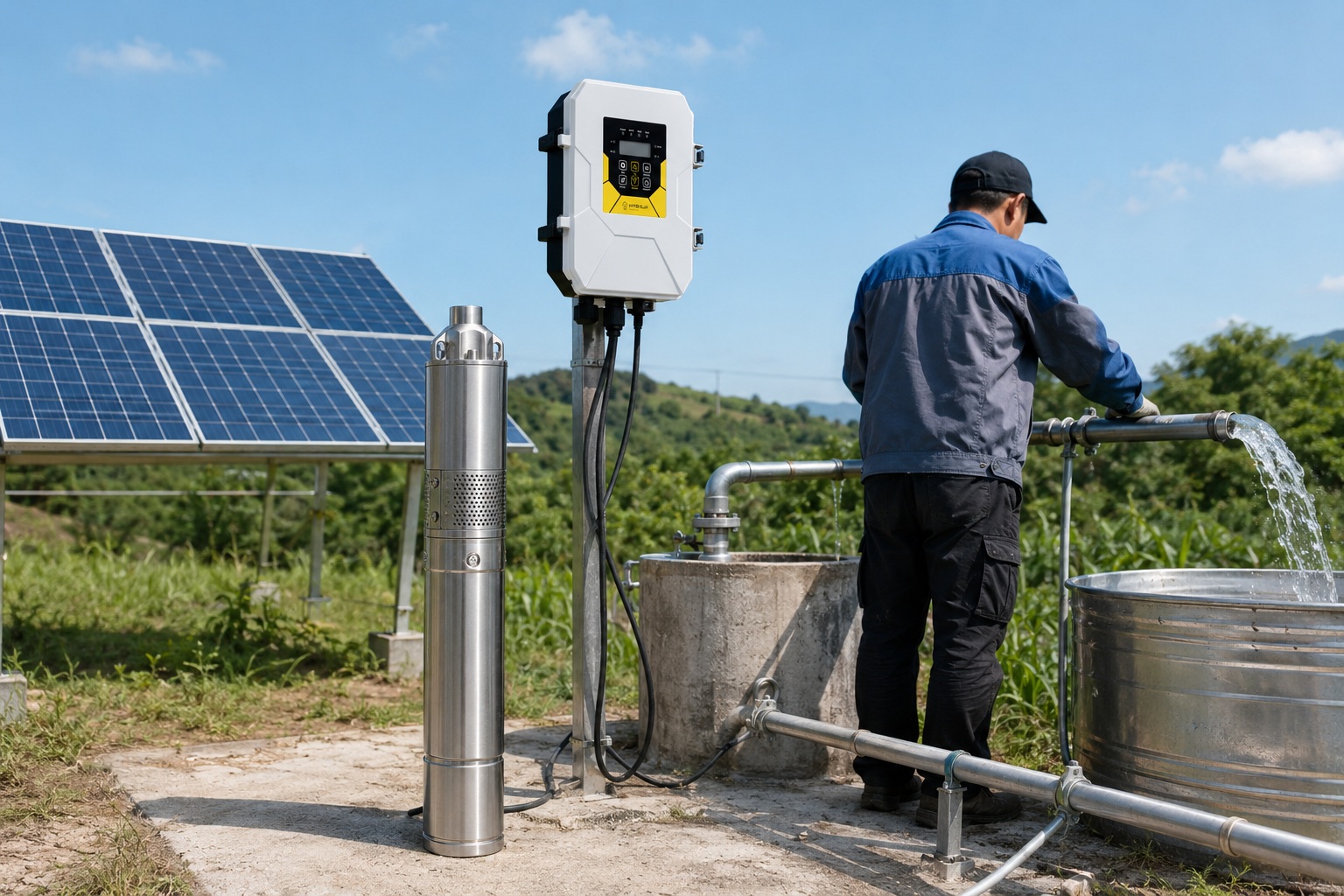
Choosing a pump isn't just about finding the highest pressure.
The ideal pump must also match your specific needs for water volume, or flow rate.
A pump that gives you incredible pressure might not deliver enough water for your farm.
Conversely, a high-flow pump might not be able to lift water from your deep well.
The secret is to find the perfect balance between pressure (head) and flow for your unique situation.
Let's explore the different types of solar pumps to see which one is the right fit for your pressure and volume requirements.
Solar Screw Pump: The High-Pressure Specialist
Your well is incredibly deep, perhaps over 100 meters.
You know that surface pumps are not an option.
Even many submersible pumps struggle to generate enough force to lift water that high.
**A solar screw pump is the definitive solution for high-pressure, high-head applications.
Its specialized design, featuring a screw-shaped rotor, excels at creating the force needed to push water up from extreme depths, making it the top choice when high lift is far more critical than high water volume.**
A solar screw pump provides the highest pressure by using a unique mechanism called a progressive cavity.
This design is fundamentally different from common centrifugal pumps.
It consists of a single helix-shaped stainless steel rotor turning inside a double helix rubber stator.
As the rotor turns, it forms a series of sealed cavities that move progressively from the pump's intake to its outlet.
Water is trapped in these cavities and pushed steadily upwards.
This process is more like pushing water with a piston than flinging it with an impeller.
This is why it can generate such significant pressure, or head, even at low speeds and with low flow rates.
How a Screw Pump Dominates in High-Head Scenarios
The progressive cavity method provides a constant, non-pulsating flow.
More importantly, the pressure it can generate is directly related to the length of the rotor and stator.
Longer designs create more seals and therefore build more pressure.
This allows screw pumps to be engineered for well depths exceeding 200 meters (over 650 feet), a task that is challenging for many other pump types.
This makes them the go-to solution for domestic water supply in mountainous regions or for watering livestock in areas with very deep water tables, such as parts of Africa and Latin America.
Performance Data & Sand Resistance
One of the standout features of a screw pump is its exceptional resistance to sand and abrasive particles.
The rubber stator can flex slightly, allowing small solids to pass through without causing significant damage or wear.
In contrast, the high-speed, tight-tolerance impellers of a centrifugal pump can be quickly eroded by sandy water.
A screw pump can often handle water with a sand content of up to 3%, whereas many centrifugal pumps recommend less than 0.5%.
| Pump Feature | Solar Screw Pump | Solar Centrifugal Pump |
|---|---|---|
| Max Pressure (Head) | Very High (up to 250m+) | Medium to High (up to 150m) |
| Flow Rate | Low (e.g., 0.5 - 5 m³/h) | High (e.g., 5 - 25 m³/h) |
| Sand Resistance | Excellent | Fair to Good |
| Best Application | Deep well domestic water, livestock | Farm irrigation, community supply |
Limitations to Keep in Mind
The main trade-off for this incredible pressure is a lower flow rate.
The design is optimized for lifting water, not for moving massive volumes of it quickly.
Therefore, a screw pump is generally not suitable for applications that require high-volume water delivery, such as flood irrigation for large agricultural fields.
For those scenarios, another type of pump is a much better fit.
Solar Centrifugal Pumps: Balancing Pressure and Flow
You need a large volume of water for your farm, ranch, or community.
A pump that only offers high pressure won't be enough.
It will only deliver a trickle of water when you need a flood.
**Solar centrifugal pumps are the workhorses for applications demanding both high flow and moderate pressure.
By using a series of stacked impellers, these pumps can move large volumes of water efficiently, making them the ideal choice for farm irrigation, pasture water supply, and filling large reservoirs.**
Unlike a screw pump that pushes water, a centrifugal pump uses rotational force to move it.
Water enters the pump at the center of a spinning impeller.
The impeller's vanes catch the water and accelerate it outward at high speed.
This high-velocity water is then directed into a diffuser, which slows the water down and converts its kinetic energy into pressure.
This process happens very quickly, allowing for high flow rates.
To achieve higher pressure, these pumps employ a multi-stage design.
The Power of Multi-Stage Design
A single-stage centrifugal pump can only generate a limited amount of pressure.
To overcome this, a multi-stage pump stacks several impellers in a series within the same pump housing.
The water is discharged from the first impeller and immediately directed into the inlet of the second.
The second impeller adds more energy and pressure, and this process continues through all the stages.
Each stage acts as a separate pump, adding its pressure to the previous one.
A 5-stage pump can generate roughly five times the pressure of a single-stage pump with a similar impeller design.
This design is what allows centrifugal pumps to achieve the medium-to-high head needed for many irrigation and residential applications while still maintaining a high flow rate.
Plastic vs. Stainless Steel Impellers: A Head-to-Head Comparison
The material of the impellers is a critical factor in a centrifugal pump's performance, durability, and cost.
The two most common options in solar pumps are wear-resistant engineered plastic and stainless steel.
Choosing the right one depends entirely on your water quality and budget.
| Feature | Plastic Impeller Pump | Stainless Steel Impeller Pump |
|---|---|---|
| Primary Use | High flow, general irrigation, fine sand | Corrosive water, premium applications |
| Pressure (Head) | Medium (e.g., 50-100m) | Medium to High (e.g., 60-150m) |
| Flow Rate | High (5-20 m³/h) | High (5-25 m³/h) |
| Corrosion Resistance | Good | Excellent (SS304 standard) |
| Sand Resistance | Excellent (against fine sand) | Good (but can wear from abrasion) |
| Cost | Economical | Premium |
| Best For | Farms in Africa & Americas, home gardens | Alkaline soils in Australia, coastal areas |
When to Choose Plastic Impellers
Modern engineered plastic impellers are not the cheap plastic you might imagine.
They are made from durable, high-strength polymers designed for excellent wear resistance, particularly against fine sand particles.
This makes them a very economical and effective choice for many agricultural applications in regions like Africa and the Americas.
Their lightweight nature also reduces the startup torque required from the motor, which can be an advantage in low-light solar conditions.
They provide a fantastic balance of high flow, decent pressure, and affordability.
When to Invest in Stainless Steel
For applications with aggressive water conditions, stainless steel is the superior choice.
If your water is acidic or alkaline, such as in the alkaline soil regions of Australia, a stainless steel impeller (typically SS304) will resist corrosion far better than plastic, ensuring a much longer service life.
This makes them the preferred option for high-end homes, commercial properties, and applications where water purity and long-term reliability are the top priorities.
While the initial cost is higher, the investment pays off through extended durability and reduced maintenance in harsh environments.
The Engine Behind the Power: The BLDC Motor
You've selected the perfect pump for your pressure and flow needs.
But the pump head is only half of the system.
Pairing it with a weak or inefficient motor will cripple its performance, increase your costs, and lead to premature failure.
**The heart of any modern high-performance solar pump is its motor.
A Brushless DC (BLDC) permanent magnet motor is the core technology that provides the high efficiency, powerful torque, and long-term reliability needed to drive the pump, ultimately reducing the number of solar panels required.**
The motor is what converts electrical energy from your solar panels into the mechanical rotation that drives the pump.
The efficiency of this conversion is one of the most important factors in the entire system.
Traditional DC motors use carbon brushes to transmit power to the rotor, which wear out over time, create dust, and cause energy loss.
BLDC motors eliminate these brushes completely.
Why BLDC is a Game-Changer for Solar Pumps
A BLDC motor uses an electronic controller instead of physical brushes to switch the direction of the current in the motor windings.
This creates the rotating magnetic field that turns the rotor.
This design has several profound advantages.
First, with no brushes to wear out, the motor is virtually maintenance-free and has a significantly longer lifespan.
Second, the elimination of friction from brushes increases the motor's efficiency dramatically.
Most high-quality BLDC motors used in solar pumps operate with an efficiency exceeding 90%, compared to 60-75% for older brushed motors.
Technical Advantages by the Numbers
The superior design of BLDC motors, which often use powerful rare-earth magnets, leads to impressive performance metrics.
These motors are not only more efficient but also more compact.
A modern BLDC motor can be up to 47% smaller and 39% lighter than a traditional AC motor with the same power output.
This has a direct, practical benefit for the user.
A lighter, smaller pump is much easier and cheaper to install, especially in a deep well.
More importantly, the high efficiency means the motor requires less power to do the same amount of work.
This directly reduces the number of expensive solar panels needed to run the system, lowering the initial investment cost.
The Motor's Impact on Overall System Cost
The solar panel array can account for 30-40% of the total cost of a solar pumping system.
Let's say a pump requires 1000 watts of power to operate.
If it is driven by a 75% efficient motor, the motor itself will draw about 1333 watts from the solar panels.
If that same pump is driven by a 92% efficient BLDC motor, it will only draw about 1087 watts.
That's a reduction of nearly 20% in power demand.
This means you can either get 20% more water with the same number of panels or reduce the size of your solar array by 20%, saving you a significant amount of money upfront.
Intelligent Control: Maximizing Every Ray of Sunlight
The sun doesn't shine with the same intensity all day.
It's weaker in the morning and evening, and clouds can reduce its power at any time.
This fluctuating energy source can cause your pump's performance to drop dramatically or stop altogether.
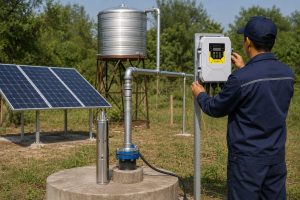
**An intelligent controller is the brain of the solar pump system, ensuring you get the most water possible from every bit of available sunlight.
A controller with Maximum Power Point Tracking (MPPT) can boost your daily water output by up to 30% by constantly optimizing the power transfer from the panels to the motor.**
A solar panel doesn't have a single, fixed power output.
Its output voltage and current change continuously depending on the amount of sunlight and the temperature.
For any given condition, there is a specific "maximum power point" where the panel produces the most possible energy.
Connecting a pump motor directly to a panel is inefficient because the motor's electrical requirements rarely match the panel's maximum power point.
This is where an MPPT controller comes in.
How MPPT Maximizes Your Water Output
An MPPT controller is a sophisticated DC-to-DC converter that sits between the solar panels and the pump motor.
It constantly measures the voltage and current from the panels and calculates the point of maximum power.
It then adjusts its internal converter to "trick" the panels into operating at that ideal point, while simultaneously delivering the exact voltage and current that the motor needs to run most efficiently.
This continuous optimization ensures that no solar energy is wasted.
On a bright, sunny day, this might mean a 10-15% increase in water flow.
On a cloudy or overcast day, when power is limited, the benefit is even greater.
The MPPT can make the difference between the pump running slowly or not running at all, often increasing water output by 30% or more over the course of a day.
Beyond MPPT: Hybrid AC/DC Controllers
What happens when you need water at night or during long periods of heavy rain?
This is where the most advanced controllers offer a hybrid solution.
A hybrid AC/DC controller is designed with inputs for both solar (DC) power and grid or generator (AC) power.
The controller's smart logic always prioritizes using the free energy from the sun.
When solar power is sufficient, it runs the pump entirely on DC.
If clouds reduce the solar input, the hybrid function can blend in just enough AC power to maintain the pump's speed, maximizing the use of solar energy before drawing from the grid.
When there is no solar input at all, like at night, it automatically switches over to the AC power source.
This ensures you have a reliable, 24/7 water supply without having to manually switch power sources.
It provides total water security for critical applications.
Essential System Protections
A high-quality controller does more than just optimize power.
It also serves as a crucial protective device for your pump and motor.
It includes built-in safeguards such as:
- Dry-Run Protection: It can detect when the well water level drops too low and will shut off the pump to prevent it from overheating and being destroyed.
- Over-Voltage Protection: Protects the motor from voltage spikes from the solar array.
- Over-Current Protection: Prevents the motor from drawing too much current and burning out.
- Reverse Polarity Protection: Prevents damage if the solar panels are accidentally wired backward during installation.
These protections are vital for ensuring a long and trouble-free life for your entire water pumping system.
Conclusion
The highest pressure comes from a solar screw pump.
However, the best pump for you balances pressure, flow, and your specific water conditions.
The motor and controller are equally vital for efficiency and reliability.
FAQs
What pump has the highest psi?
A progressive cavity pump, also known as a screw pump, generally produces the highest PSI (pressure) as it's designed specifically for high-head, deep-well applications.
What type of pump creates the most pressure?
The pump type that creates the most pressure is the positive displacement pump. A solar screw pump is a perfect example of this type.
How can I increase the pressure of my water pump?
To increase pressure, you can use a multi-stage pump with more impellers or add a separate booster pump to your system after the primary pump.
Is higher HP in a water pump better?
Not always. A pump's horsepower (HP) should be correctly matched to your head and flow requirements. An oversized pump wastes energy and can short-cycle, reducing its lifespan.
What is the difference between a high pressure and high flow pump?
High-pressure (high-head) pumps are built to lift water from great depths. High-flow pumps are designed to move large volumes of water over shorter vertical distances.
Can a solar pump work on cloudy days?
Yes, a solar pump can work on cloudy days, but its output will be reduced. An MPPT controller is essential for maximizing performance in low-light conditions.
Do I need a battery for a solar water pump?
No, most solar pump systems are designed to run directly from solar panels during the day and store water in a tank, eliminating the need for batteries.
How deep can a solar submersible pump go?
This varies by model. Solar screw pumps can be designed for depths over 200 meters (650+ feet), while multi-stage centrifugal pumps are typically used for depths up to 150 meters.