Struggling to choose a water pump?
The endless options and technical jargon can be overwhelming, risking a costly and inefficient purchase.
The best pump brand depends on your specific needs.
For deep wells, brands excelling in reliability and efficiency are top choices.
For industrial use, heavy-duty engineering is key.
For home use, look for a balance of performance, quiet operation, and energy savings.
Choosing the right pump is more than just picking a name.
It's about matching technology to your specific application.
From deep wells to large-scale irrigation, different brands excel in different areas.
Let's explore what makes a brand truly stand out, from customer satisfaction to real-world performance.
We'll also look at the future of pumping: advanced, sustainable solar solutions.
Customer Satisfaction Rankings Among Leading Well Pump Manufacturers
Worried about your pump failing?
Customer reviews often highlight reliability, revealing which brands consistently deliver on their promises and prevent unexpected breakdowns.
Leading manufacturers consistently top satisfaction rankings due to proven durability, efficiency, and strong performance.
Brands known for deep well submersibles, robust construction, and sand-resistant designs often receive the highest praise from users for their long-term reliability and value.
When you look at customer reviews, a clear pattern emerges.
The brands that people love are the ones that they can install and forget about.
Reliability isn't a luxury; it's the most important feature of a water pump.
A cheap pump that fails after two years is far more expensive than a premium pump that runs for over a decade.
What Drives High Customer Satisfaction?
Customer satisfaction is a direct result of a pump meeting or exceeding expectations in three key areas: durability, efficiency, and application-specific performance.
Users don't just want a pump; they want a solution to a problem.
Durability: This comes from the quality of materials.
Pumps with stainless steel or heavy-duty cast-iron bodies resist corrosion and physical damage.
Internal components like precision-machined impellers and ceramic bearings also contribute to a longer service life, with many premium models lasting 10-15 years compared to 3-5 years for budget options.
Efficiency: An efficient pump delivers more water for less electricity.
Modern pumps with permanent magnet motors can be up to 90% more efficient than older designs.
This translates directly into lower monthly electricity bills, a benefit every user appreciates.
Application-Specific Features: The right feature can solve a common headache.
For example, a built-in check valve prevents backflow and protects the pump.
A patented floating stack design can prevent sand from locking up the pump, a feature that earns rave reviews from users in sandy regions.
| Feature That Boosts Satisfaction | Why Customers Praise It | Impact on Performance |
|---|---|---|
| Stainless Steel Construction | It prevents rust and corrosion, leading to a much longer service life and cleaner water. | Extends pump life by over 200% in harsh water conditions. |
| Anti-Sand / Floating Stack Design | It stops the pump from jamming in sandy wells, a very common and costly point of failure. | Maintains consistent flow rates (e.g., 20 GPM) even in challenging environments. |
| Built-in Check Valve | It simplifies installation and reliably prevents backflow, protecting the motor from damage. | Increases system reliability and reduces the need for extra components. |
| High-Efficiency Motor | It dramatically lowers electricity bills, with savings of up to 80-90% in some cases. | Delivers higher flow rates (e.g., 10 GPM) with smaller horsepower motors (e.g., 1/2 HP). |
Ultimately, the most satisfied customers are those whose pumps solve their specific problems reliably and cost-effectively over many years.
Performance Analysis: Flow Rates and Durability Across Top Brands
Is your pump powerful enough?
Choosing a pump based on brand alone can lead to poor performance, wasting both energy and money on a mismatched system.
A deep dive into performance metrics reveals why certain brands outperform others.
Key factors include flow rate (GPM), pump head (depth), horsepower (HP), and motor efficiency.
Premium brands often deliver higher GPM with lower HP, demonstrating superior engineering.
Brand reputation is a good starting point, but the real story is in the numbers.
You must look at the technical specifications to understand if a pump can do the job you need it to do.
A pump curve chart, which shows flow rate at different head pressures, is one of the most important tools for making the right choice.
It tells you exactly how the pump will perform in your specific system.
Key Performance Metrics Explained
To compare pumps effectively, you need to understand the language of performance.
- Flow Rate (GPM/GPH): Gallons Per Minute or Gallons Per Hour. This measures how much water the pump can move. A typical home might need 10-15 GPM for daily use, while irrigation could require 20 GPM or more.
- Head: This is the maximum height the pump can lift water. It's a measure of pressure. You must choose a pump with a head rating that exceeds the total height from the water source to the outlet, including friction loss from pipes.
- Horsepower (HP): This measures the motor's power. However, more HP is not always better. A well-designed 1 HP pump can outperform a poorly designed 1.5 HP pump. Efficiency is the key.
- Motor Efficiency: This is the most critical factor for long-term cost. It's the ratio of power output to power input. An efficient motor does more work with less electricity.
Technology That Boosts Performance
The best pumps use advanced technology to achieve impressive stats.
Permanent magnet motors, for example, are a game-changer.
They allow for variable speeds and are significantly more efficient than traditional induction motors.
One top-tier 1/2 HP model can deliver 10 GPM at a head of over 500 feet, a feat that would have required a much larger motor a decade ago.
Ceramic bearing sleeves and precision-machined impellers also enhance durability and performance by reducing friction and wear.
These innovations are what separate premium brands from the competition.
| Pump Application | Typical HP | Target Flow Rate (GPM) | Target Head/Depth | Essential Technology |
|---|---|---|---|---|
| Deep Well Domestic Use | 0.5 - 1.5 HP | 5 - 12 GPM | 100 - 500 ft | High-efficiency permanent magnet motor, multi-stage impellers. |
| High-Flow Farm Irrigation | 1.0 - 2.0 HP | 20+ GPM | 50 - 150 ft | Sand-resistant floating stack design, robust motor cooling. |
| Shallow Well Home Use | 0.5 - 1.0 HP | 10 - 15 GPM | < 25 ft | Jet pump design with ceramic bearings for enhanced durability. |
| High-Pressure Booster | 0.75 - 1.5 HP | Varies | Adds 40-60 PSI | Multi-stage impellers, variable frequency drive (VFD) for constant pressure. |
When you analyze these metrics, you see that the best brands aren't just selling a name; they're selling engineered performance.
The Future of Pumping: High-Efficiency Solar Solutions
Facing high electricity bills or living off-grid?
Traditional pumps are costly and dependent on an unstable grid, making reliable water access a constant challenge.
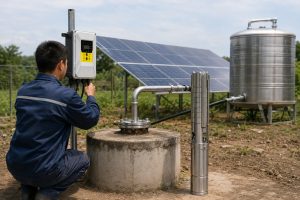
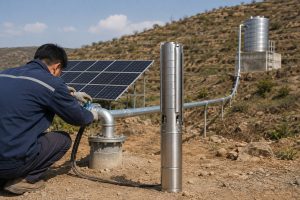
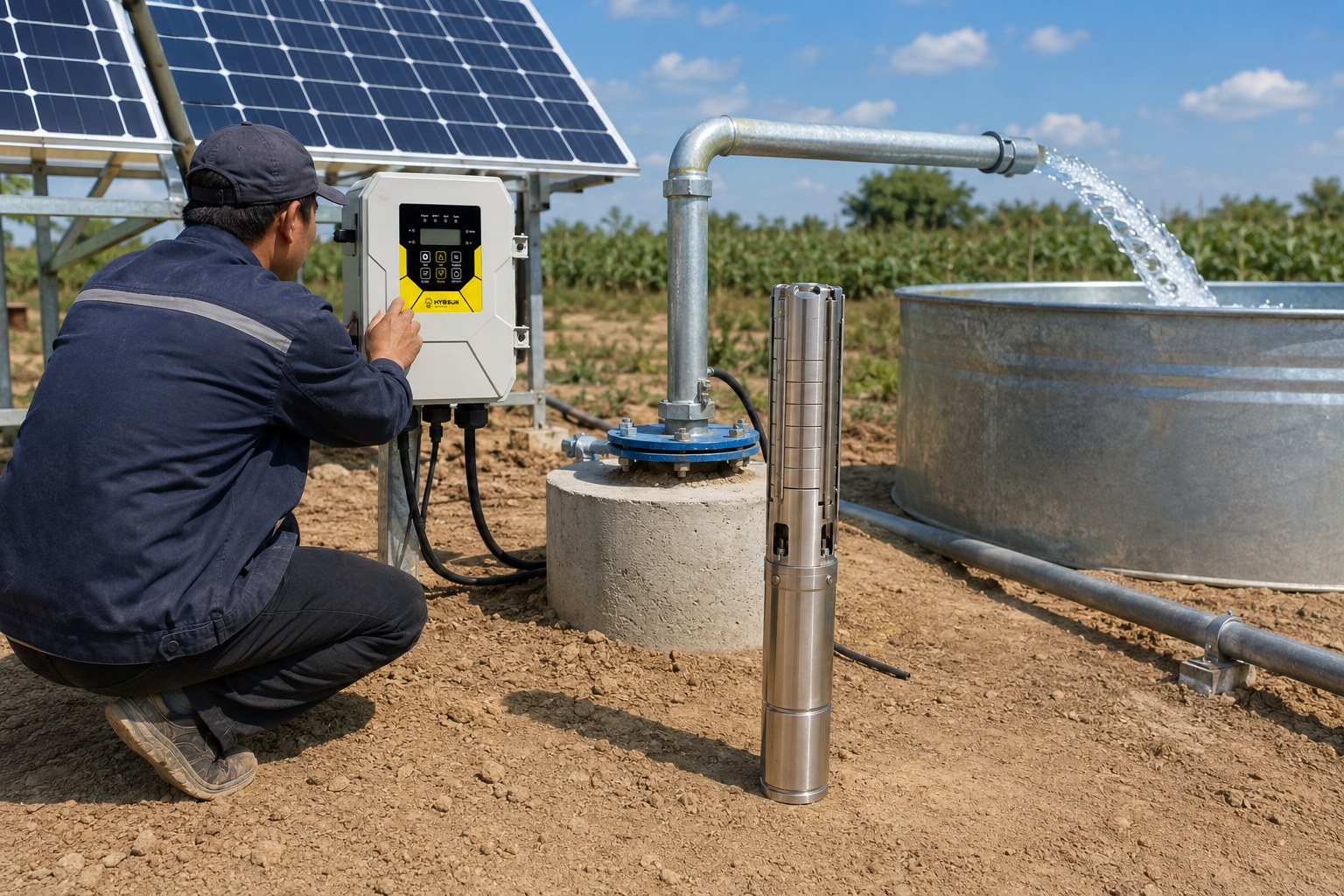
Solar water pumps offer a game-changing solution.
They are grid-independent, environmentally friendly, and highly cost-effective in the long run.
Driven by high-efficiency BLDC motors, these pumps provide reliable water for homes, farms, and livestock worldwide.
The global demand for sustainable water solutions is growing rapidly.
In regions like Africa, Australia, and the Americas, where sunlight is abundant but grid power is not, solar pumps have become essential.
They represent a fundamental shift in how we access and manage water.
This technology is not just for remote areas anymore; it's a smart investment for anyone looking to reduce energy costs and increase their water security.
The Core of Solar Pumping: The BLDC Motor
The magic behind modern solar pumps is the Brushless DC (BLDC) permanent magnet motor.
This is the core technology that makes them so powerful and efficient.
These motors regularly achieve efficiencies exceeding 90%, compared to 50-70% for standard AC motors.
The rotor is constructed from high-grade materials like 40SH neodymium iron boron, which creates a powerful magnetic field.
This advanced design has huge benefits.
- High Efficiency & Power: It converts more solar energy directly into pumping power, requiring fewer solar panels. This can reduce the initial system cost by up to 25%.
- Compact & Lightweight: The motor design is significantly smaller and lighter. Some models are 47% smaller and 39% lighter than their traditional counterparts, making installation far easier.
- Reliability: With no brushes to wear out, these motors are virtually maintenance-free and have an extremely long service life, often exceeding 10 years.
This high-efficiency motor is the engine that drives the entire system's value proposition.
Choosing the Right Solar Pump for Your Needs
A complete solar pump portfolio meets diverse market needs by offering different pump-end technologies, all powered by the same efficient motor.
| Solar Pump Type | Mechanism | Performance Profile | Ideal Applications | Key Advantages |
|---|---|---|---|---|
| Solar Screw Pump | A stainless steel screw rotates inside a rubber stator, pushing water. | Low Flow, High Head. | Deep wells (>300 ft), domestic water, livestock watering in off-grid areas. | Extremely resistant to sand and silt. Can achieve very high pressure from a small motor. |
| Solar Plastic Impeller Pump | A multi-stage centrifugal design using durable, wear-resistant plastic impellers. | High Flow, Medium Head. | Farm irrigation, pasture water supply, and garden systems where high volume is needed. | Delivers large volumes of water. Lightweight and highly economical. Excellent resistance to fine sand. |
| Solar Stainless Steel Impeller Pump | A multi-stage centrifugal design using SS304 stainless steel impellers and pump body. | High Flow, Medium-to-High Head. | Corrosive or alkaline water conditions, high-end residential, and ranches. | Superior corrosion resistance for maximum durability. Highest long-term reliability. |
Advanced Control for 24/7 Water Access
The smartest systems pair the pump with an intelligent MPPT (Maximum Power Point Tracking) controller.
This controller optimizes the output of the solar panels and protects the motor.
For ultimate reliability, advanced AC/DC hybrid controllers are available.
These controllers can be connected to both solar panels and an AC power source (grid or generator) simultaneously.
The system automatically prioritizes free solar power.
If sunlight fades due to clouds, the hybrid function supplements with AC power to maintain output.
When no solar power is available at night, it automatically switches to the AC source, ensuring you have a worry-free water supply 24 hours a day.
Value Proposition: Price-to-Quality Ratio of Premium Well Pumps
Shocked by the price of a premium pump?
The high initial cost can make you consider cheaper alternatives, but this might lead to higher long-term expenses.
Premium pumps justify their higher price through extended service life, lower operational costs, and superior reliability.
An analysis of the price-to-quality ratio shows that the initial investment is often outweighed by long-term benefits and reduced maintenance needs.
It's a common mistake to focus only on the upfront purchase price.
A pump is a long-term investment, and its true cost is revealed over its entire lifespan.
When you factor in electricity, maintenance, and the potential cost of replacement, the "cheaper" option often ends up being the most expensive.
Customer reviews consistently confirm this, with users of premium brands reporting fewer problems and greater satisfaction over many years.
Thinking Beyond Acquisition Cost
The best way to evaluate a pump's value is to calculate its Total Cost of Ownership (TCO).
This simple formula gives you a much clearer picture:
TCO = Initial Price + Energy Costs + Maintenance Costs
Let's look at a 10-year comparison.
- Budget Pump: Costs $300. It's inefficient, costing $400/year in electricity. It fails every 4 years, requiring two replacements ($600). Total 10-year cost: $300 + ($400 x 10) + $600 = $4,900.
- Premium VS Pump: Costs $900. It's highly efficient, saving 80% on energy, costing only $80/year. It lasts the full 10 years. Total 10-year cost: $900 + ($80 x 10) + $0 = $1,700.
In this scenario, the premium pump saves you $3,200 over a decade.
The initial investment pays for itself through energy savings alone in less than two years.
Features That Add Long-Term Value
This value doesn't come from nowhere.
It's engineered into the product through better materials and smarter design.
- Stainless Steel Construction: This feature alone can double or triple a pump's life in areas with even moderately corrosive water. It prevents the slow decay that kills cheaper pumps.
- Innovative Designs: Features like floating stack impellers prevent sand-locking. This eliminates a primary cause of motor burnout and costly service calls.
- High-Efficiency Motors: As shown above, a permanent magnet motor is the single biggest contributor to long-term savings. It's the gift that keeps on giving every time your electricity bill arrives.
When evaluating a pump, prioritize this extended performance horizon.
The peace of mind that comes with a reliable, efficient pump is a value that's hard to put a price on.
Matching the Right Pump to Your Application
Have you chosen a pump that's wrong for your well?
A mismatched pump can lead to sand-locking, poor flow, or premature failure, causing endless frustration.
The best pump is one correctly matched to its environment.
For deep wells, high-head models are essential.
In sandy conditions, anti-sand designs excel.
For corrosive water, stainless steel construction is non-negotiable.
Matching the pump to the well type ensures optimal performance.
Field testing across thousands of installations has proven one thing.
There is no single "best" pump for every situation.
The top-performing brands have earned their reputations by offering specific models that excel in specific conditions.
The key to success is a proper diagnosis of your water source and system requirements before you buy.
When a pump is correctly matched to its job, it will outperform generic alternatives every time.
A Guide to Different Well and Water Conditions
Your water source is unique.
Is your well deep or shallow?
Is the water sandy or clear?
Is its pH acidic or alkaline?
The answers to these questions will point you toward the right technology.
| Well/Water Condition | Recommended Pump Feature | Why It Matters | Performance Example |
|---|---|---|---|
| Deep Wells (100-500 ft) | High-head multi-stage submersible with an efficient motor. | It needs significant power to lift water from great depths without consuming excessive energy. | Reliably delivers 10 GPM flow rates from a 400-foot depth. |
| Sandy Environments | Floating stack impeller design or a screw pump mechanism. | This prevents abrasive sand particles from jamming or wearing out the pump internals, a common cause of failure. | Maintains a consistent 20 GPM flow without locking up in wells with high sand content. |
| Corrosive Water (Acidic/Alkaline) | Full SS304 or SS316 stainless steel pump body and impellers. | It resists the chemical corrosion that would quickly destroy a standard cast-iron or plastic pump. | Provides a 10-15 year service life in water conditions that would kill a standard pump in 2 years. |
| Rural/Off-Grid Applications | Solar-powered pump with an AC/DC hybrid controller. | It provides energy independence, ultra-low operating costs, and 24/7 reliability. | Supplies a steady 12 GPM flow for livestock using only solar power. |
| Low-Yielding Wells | A variable speed pump or a solar pump with a smart controller. | The controller can be set to match the well's recovery rate, preventing the pump from running dry. | Can be programmed to pump at a slow 3 GPM to avoid draining the well. |
The Importance of System Synergy
The pump is the heart of your water system, but it doesn't work alone.
It must be properly matched to your filter and your plumbing.
Every filter has a maximum flow rate.
If you push too much water through it, filtration becomes ineffective, and you can even damage the filter media.
Likewise, your pipe diameter limits flow.
Standard 1.5-inch pipes can handle about 60 GPM, while 2-inch pipes can manage around 100 GPM.
This is another area where modern pumps shine.
A variable speed or solar pump with an intelligent controller allows you to set a maximum flow rate.
You can program the system to protect your filter and plumbing, ensuring every component works in harmony for maximum efficiency and longevity.
Conclusion
Choosing the best pump means matching the right technology to your specific application.
Prioritize performance metrics, long-term value, and system compatibility over brand hype.
High-efficiency solar pumps represent the future of sustainable, cost-effective water access.
Frequently Asked Questions
How long should a good water pump last?
A quality, well-maintained pump can last 8-15 years.
Factors like water quality, usage, and proper installation significantly impact its lifespan.
Is more horsepower always better for a water pump?
No, bigger is not better.
An oversized pump wastes energy and can overwhelm your filter and plumbing, leading to poor performance and damage.
What is the most reliable type of well pump?
Submersible well pumps are highly reliable, often lasting 10-15 years.
They operate quietly underwater and many models include built-in protection features.
Are variable-speed pumps worth the extra cost?
Yes, for most users.
They can reduce energy costs by up to 90%, paying for themselves in 1-2 seasons, while also running much quieter.
Can I install a water pump myself?
DIY installation is possible for simpler, plug-in pumps.
However, for hardwired systems (especially 230V), a licensed electrician is recommended for safety and warranty compliance.
How do I choose the right size pump for my house?
Sizing depends on your home's water demand (flow rate in GPM) and pressure needs.
A professional can help calculate this, but a 1-1.5 HP pump is often sufficient.
What maintenance does a water pump require?
Regularly clean the strainer basket, check for leaks, and lubricate O-rings.
Proper winterization is also crucial in cold climates to prevent freeze damage.
How does a solar pump work on cloudy days?
Modern solar pumps use MPPT controllers to maximize all available light.
Hybrid AC/DC systems can also automatically switch to grid or generator power when sunlight is insufficient.