Struggling to find reliable, grid-independent water solutions for your market?
You are losing customers to competitors who offer more efficient and cost-effective solar water pumps.
The best source for solar water pumps is not a general retailer, but a specialized manufacturer or a dedicated B2B wholesale distributor.
They offer a complete portfolio of pumps, motors, and controllers, along with the technical expertise and support needed to meet diverse market demands, from agriculture to residential use.
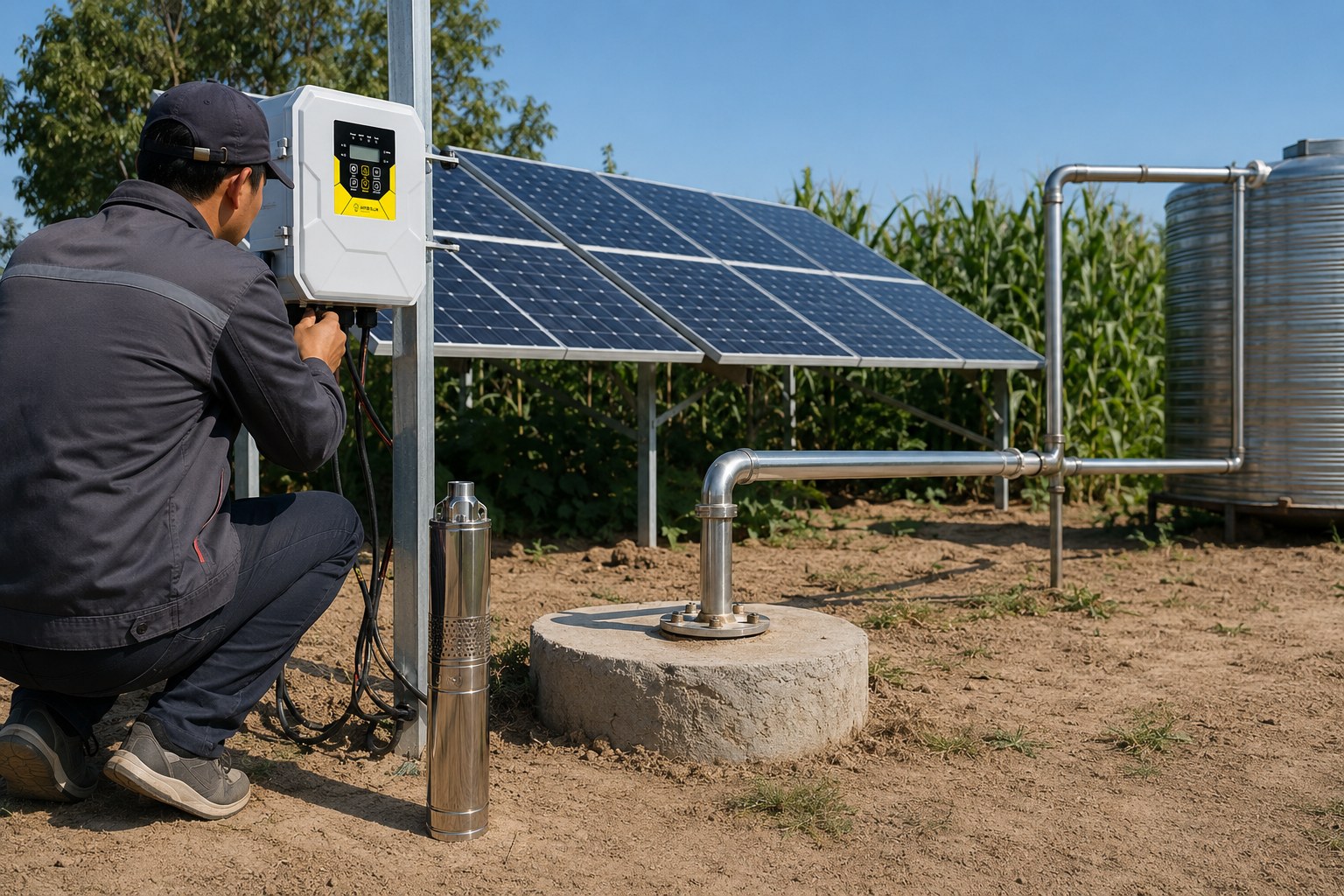
Finding the right solar water pump goes beyond a simple online purchase.
For importers and distributors, the goal is to build a competitive product portfolio that meets the specific needs of your customers.
This means partnering with a source that understands the nuances of pump technology, from the pump type itself to the motor that drives it.
Let's explore the key components that define a high-quality solar water pump system, so you can make an informed purchasing decision for your business.
Understanding the Core: Which Pump Type Fits Your Market?
Choosing the wrong pump type leads to unhappy customers and damaged reputations.
Your inventory is sitting idle because the pumps don't match local water conditions or application needs.
Selecting the right solar pump—screw, plastic impeller, or stainless steel impeller—is crucial for meeting specific demands for flow, head, and water quality, ensuring customer satisfaction and market leadership.
The global demand for solar water pumps is not uniform.
A pump that excels in a shallow well for farm irrigation in the Americas might fail in a deep, sandy borehole in Africa.
As a distributor, your success hinges on offering a targeted selection that solves real-world problems for your clients.
The three most popular types of solar deep well pumps each address a different segment of the market.
All are powered by high-efficiency brushless DC (BLDC) motors, but their internal mechanics are designed for very different tasks.
Understanding these differences is the first step in building a powerful and profitable product lineup.
This strategic approach allows you to cater to everyone, from small homeowners with deep wells to large agricultural operations needing high volumes of water.
Building a Diverse Portfolio
To effectively cover the market, your inventory should reflect the diverse needs of end-users.
A one-size-fits-all approach is a recipe for failure.
Instead, think of your product line as a toolkit.
Each pump type is a specialized tool for a specific job.
By offering a range, you position yourself as an expert and a one-stop-shop for solar water solutions.
| Pump Category | Primary Application | Key Advantage | Target Market Segment |
|---|---|---|---|
| Solar Screw Pump | Deep well domestic water | High Head | Residential, Small Livestock |
| Plastic Impeller Pump | Farm & Garden Irrigation | High Flow, Low Cost | Agriculture, General Use |
| Stainless Steel Pump | Corrosive Water Conditions | Durability, Purity | High-End, Special Environments |
The Power of Specialization
Focusing on these distinct pump categories allows you to create targeted marketing campaigns and provide more knowledgeable support to your customers.
Instead of just selling a "solar pump," you are selling a "deep well water solution" or a "high-volume irrigation system."
This level of specialization builds trust and brand loyalty.
It demonstrates that you understand your customers' challenges and have curated a selection of products specifically to overcome them.
This expertise is what separates a successful distributor from a simple reseller.
It is your true competitive advantage in a growing global market.
The Specialist for Deep Wells: Solar Screw Pumps
Your customers have deep wells but can't get water to the surface efficiently.
Standard pumps lack the vertical lift, or "head," required, resulting in weak flow or complete failure.
Solar screw pumps are the solution.
They are engineered for high-head, low-flow applications, perfect for deep boreholes and providing reliable water for homes and livestock in off-grid areas.
When the water source is far below the ground, a standard centrifugal pump often isn't enough.
This is where the solar screw pump, also known as a progressive cavity pump, truly shines.
Its unique design allows it to generate immense pressure, pushing water to heights that other pumps of a similar size cannot reach.
This makes it an indispensable tool for domestic water supply and livestock watering in regions with deep water tables, such as parts of Africa and Latin America.
Its ability to handle sand and silt without significant wear also makes it exceptionally durable in harsh water conditions.
How Screw Pumps Achieve High Head
The magic of a screw pump lies in its core components: a single-helix stainless steel rotor that turns inside a double-helix rubber stator.
As the rotor spins, it forms a series of sealed cavities that "progress" from the pump's inlet to its outlet.
This mechanism pushes the water through compression, acting like a piston and generating very high pressure.
This process is less dependent on rotational speed for creating pressure compared to centrifugal pumps, allowing it to lift water from significant depths even with moderate solar power.
Performance Data: Head vs. Flow
The defining characteristic of a screw pump is its inverse relationship between flow rate and head.
It moves a smaller volume of water but can push it much higher.
| Model Example | Max Flow Rate | Max Head | Ideal Well Depth |
|---|---|---|---|
| Screw Pump A | 10 GPM (38 LPM) | 450 ft (137 m) | 250-400 ft |
| Centrifugal Pump B | 30 GPM (114 LPM) | 150 ft (46 m) | 50-100 ft |
This table illustrates that for a deep well application (e.g., 300 feet), the screw pump is the only viable option, even though its flow rate is lower.
Key Advantages and Limitations
Understanding the pros and cons is crucial for positioning this pump correctly in your market.
Advantages:
- Exceptional Head: Can pump from depths exceeding 400 feet.
- High Sand Resistance: The screw design can handle water with a higher concentration of sand and sediment compared to impeller pumps.
- Self-Priming: The mechanism is inherently self-priming once the initial cavities are filled.
- Efficient at Low Speeds: Maintains good pressure even in lower sunlight conditions.
Limitations:
- Lower Flow Rates: Not suitable for applications requiring high volumes of water, such as large-scale farm irrigation.
- Stator Wear: The rubber stator is a wear part and may need replacement over its service life, especially in highly abrasive conditions.
For distributors, the solar screw pump is a powerful solution for a specific, high-need market segment.
It solves the critical problem of deep-well water access where other technologies fall short.
The High-Volume Workhorse: Solar Plastic Impeller Pumps
Your agricultural customers need to move a lot of water, but their pumps are inefficient or wear out quickly from sand.
This leads to crop loss and high replacement costs, eating into their profits and your credibility.
Solar plastic impeller pumps deliver the perfect balance.
They offer high flow rates at an economical price point and are designed with wear-resistant materials to handle the fine sand common in farm wells.
For applications like farm irrigation, pasture watering, or filling large tanks, the priority shifts from head to flow.
You need to move a large volume of water quickly and efficiently.
This is the domain of the multi-stage centrifugal pump, and models equipped with durable plastic impellers have become a market favorite, especially in the Americas and Africa.
These pumps use a series of spinning impellers to accelerate water, converting velocity into pressure.
By stacking multiple impellers (stages), they can achieve a good balance of both flow and medium head, all while remaining lightweight and cost-effective.
The Centrifugal Advantage for High Flow
Unlike the positive displacement action of a screw pump, a centrifugal pump uses rotational energy.
Water enters the center (eye) of a spinning impeller and is thrown outward by centrifugal force.
The shape of the pump casing (volute) then collects this high-velocity water and slows it down, converting the kinetic energy into pressure.
A multi-stage pump simply directs the water from one impeller stage into the next, increasing the pressure with each step.
This design is inherently suited for producing high flow rates.
Performance: Plastic Impellers vs. The Field
The choice of impeller material is critical.
High-quality, engineered plastic impellers offer an excellent compromise between performance, durability, and cost.
| Feature | Plastic Impeller Pump | Screw Pump | Stainless Steel Pump |
|---|---|---|---|
| Max Flow Rate | High (e.g., 40 GPM) | Low (e.g., 10 GPM) | High (e.g., 40 GPM) |
| Sand Resistance | Good (for fine sand) | Excellent | Moderate |
| Cost | Low | Medium | High |
| Weight | Low | Medium | High |
The data shows that for high-flow needs, the plastic impeller pump competes directly with the stainless steel model but at a significantly lower cost and weight, making it an attractive option for many agricultural and residential users.
Market Opportunities and Ideal Use Cases
The economic and lightweight nature of these pumps opens up a wide range of applications.
- Farm Irrigation: Powering sprinklers or drip systems for small to medium-sized farms.
- Livestock Water Supply: Quickly filling large water troughs for cattle or other animals.
- Pond Management: Circulating water or powering waterfalls in large garden ponds.
- Residential Water Supply: Ideal for homes with shallower wells that require higher water pressure for multiple fixtures.
Their excellent resistance to fine sand makes them a reliable choice in areas where water quality is not pristine, a common scenario in many agricultural regions.
By offering a robust solar plastic impeller pump, you provide a cost-effective, high-performance solution that meets the bulk of the market's needs.
The Premium Solution: Solar Stainless Steel Impeller Pumps
Your high-end customers demand the best, but standard pumps fail in their corrosive water, leading to frequent replacements.
This tarnishes your reputation as a supplier of quality products and results in lost sales in a lucrative market segment.
Offer the ultimate in durability with solar stainless steel impeller pumps.
Engineered with SS304 components, they provide unmatched corrosion resistance and longevity, securing your position in the premium market.
In certain regions, water is not just water.
It can be acidic, alkaline, or have a high mineral content that corrodes standard pump materials in a matter of months.
For these challenging environments, and for customers who demand the longest possible service life, the solar stainless steel impeller pump is the only logical choice.
From the pump body to the impellers themselves, these models are constructed from SS304 or higher-grade stainless steel.
This provides superior resistance to corrosion and abrasion, ensuring reliable performance and water purity.
This makes them the go-to solution for alkaline soil regions in Australia, parts of the Americas with acidic water, and high-end residential or commercial properties where reliability is non-negotiable.
Why SS304 Stainless Steel is a Game-Changer
SS304 is an austenitic stainless steel known for its excellent corrosion resistance.
The high chromium (at least 18%) and nickel (at least 8%) content creates a passive, self-repairing oxide layer on the surface.
This layer protects the underlying metal from chemical attack by acids, alkalis, and chlorides.
Key benefits of SS304 construction:
- Corrosion Resistance: Withstands a wide pH range and dissolved solids, preventing rust and degradation.
- Durability: Harder and more resistant to abrasion from sediment than plastic.
- Purity: Does not leach materials into the water, making it ideal for potable water systems.
- Temperature Stability: Maintains its structural integrity at higher operating temperatures.
Comparative Analysis: Stainless Steel vs. Plastic
While both can be used in high-flow centrifugal pumps, the choice between stainless steel and plastic impellers comes down to a trade-off between initial cost and long-term value in specific environments.
| Feature | Stainless Steel Impeller | Plastic Impeller |
|---|---|---|
| Corrosion Resistance | Excellent (pH 4-10) | Moderate (pH 6-8) |
| Lifespan in Harsh Water | 5-10+ years | 1-3 years |
| Initial Cost | High (1.5x - 2x) | Low |
| Weight | High | Low |
| Target Market | Premium Residential, Corrosive Wells | General Agriculture, Budget-Conscious |
For a customer in an alkaline region of Australia, the higher initial investment in a stainless steel pump is easily justified, as it could outlast three or four plastic impeller pumps, resulting in a lower total cost of ownership.
Capturing the High-End Market
Distributors who carry stainless steel models are able to cater to a lucrative niche.
These customers are typically less price-sensitive and prioritize quality, longevity, and peace of mind.
Ideal Applications:
- Coastal areas with saltwater intrusion risk.
- Geothermal wells with high mineral content.
- Luxury homes, golf courses, and exclusive ranches.
- Potable water systems where purity is the top priority.
By including solar stainless steel impeller pumps in your portfolio, you send a clear message: you offer solutions for every challenge, from the most basic to the most demanding.
The Engine Behind Efficiency: BLDC Permanent Magnet Motors
Your customers complain about high costs.
They need too many solar panels, and the systems are bulky and expensive to install.
The problem isn't the pump; it's an inefficient motor that wastes precious solar energy, driving up system size and cost.
The solution is a high-efficiency Brushless DC (BLDC) permanent magnet motor.
With efficiency exceeding 90%, it dramatically reduces solar panel requirements, lowering overall system cost and complexity.
The pump itself only moves water.
The motor is the heart of the system, converting electrical energy into the mechanical power that drives the pump.
The single most important factor in a solar water pump's overall performance and cost-effectiveness is the efficiency of its motor.
All three leading pump types—screw, plastic impeller, and stainless steel impeller—achieve their peak potential only when paired with an advanced BLDC permanent magnet motor.
These motors are a technological leap forward from older brushed DC or AC motors, offering unparalleled efficiency and reliability.
What Makes BLDC Motors Superior?
A Brushless DC (BLDC) motor operates without the physical "brushes" found in traditional DC motors.
Instead, an electronic controller switches the current in the stator windings to create a rotating magnetic field that interacts with permanent magnets on the rotor, causing it to spin.
Technical Advantages:
- No Brushes: Eliminates the most common point of failure and maintenance in DC motors.
- Higher Efficiency: With no friction from brushes, efficiencies can exceed 90%, compared to 60-75% for brushed motors.
- Longer Lifespan: Fewer wearing parts means a service life of 20,000+ hours is common.
- Compact & Lightweight: Can be up to 47% smaller and 39% lighter than conventional motors of the same power output.
- High Torque: Delivers excellent starting torque, which is crucial for pumps.
The Direct Impact on System Cost
Motor efficiency has a direct and significant impact on the total cost of a solar water pumping system.
A more efficient motor requires less power to do the same amount of work.
This means you can use a smaller, less expensive solar panel array.
| Motor Efficiency | Power Required (for a specific task) | Required Solar Array Size | Estimated Panel Cost |
|---|---|---|---|
| BLDC Motor (90%) | 500 Watts | ~600 Watts | $300 |
| Brushed Motor (70%) | 643 Watts | ~770 Watts | $385 |
In this example, the 20% efficiency gain from the BLDC motor translates to a 22% reduction in required solar panel wattage and cost.
For larger systems, these savings can amount to thousands of dollars, making your product offering far more competitive.
The Strategic Value for Your Business
As a distributor, highlighting the BLDC motor is a powerful selling point.
It's not just a feature; it's the core reason your solar pump systems are more affordable, reliable, and easier to install.
You can confidently market your products as:
- More Cost-Effective: Requiring fewer panels and a smaller investment.
- More Reliable: With maintenance-free motors designed for a long service life.
- More Powerful: With a compact design that delivers superior torque and performance.
The BLDC motor is the engine of your competitive advantage.
It's the technology that enables you to deliver maximum value to your customers.
Maximizing Power: The Role of Intelligent Controllers
Your customers' pumps stop working on cloudy days or can't run at night.
This unreliability makes solar a hard sell for critical applications, forcing users to invest in expensive, separate backup systems.
An advanced AC/DC hybrid controller solves this problem completely.
It automatically maximizes solar power when available and seamlessly switches to an AC grid or generator backup, ensuring a 24/7 water supply.
A high-quality pump and an efficient motor are two-thirds of the puzzle.
The final piece, the brain of the operation, is the pump controller.
A basic controller simply turns the pump on and off.
An intelligent controller, however, optimizes the entire system's performance and adds a layer of reliability that transforms a solar pump from a daytime convenience into a round-the-clock utility.
The two most important technologies in modern controllers are Maximum Power Point Tracking (MPPT) and AC/DC hybrid functionality.
Unlocking Every Watt with MPPT
Solar panel output varies constantly with sunlight intensity.
MPPT (Maximum Power Point Tracking) is a sophisticated algorithm that continuously adjusts the electrical load of the motor to match the exact point where the solar panel is producing the most power.
Benefits of MPPT:
- Increased Efficiency: Can boost the water output of a system by up to 30% over the course of a day compared to non-MPPT controllers.
- Better Low-Light Performance: Allows the pump to start earlier in the morning, run later in the evening, and continue operating during overcast conditions when other systems would shut down.
- System Protection: Monitors voltage and current to protect the motor from under-voltage or over-voltage conditions.
Without MPPT, you are leaving a significant amount of free energy on the table every single day.
The Hybrid Advantage: A 24/7 Water Guarantee
For many users, water is not an optional resource.
Farms, homes, and businesses need it around the clock.
This is where an AC/DC hybrid controller provides an unbeatable competitive edge.
These controllers are designed with dual power inputs, allowing you to connect both the solar array and an AC source (grid power or a generator) simultaneously.
How it Works:
- Solar Priority: The controller will always use 100% of the available solar power first, as it is free.
- Hybrid Blending: If solar power is insufficient to meet the pump's demand (e.g., on a cloudy day), the controller intelligently blends in just enough AC power to make up the difference, maximizing the use of solar energy.
- Automatic Switchover: When there is no solar input at all (e.g., at night), the controller automatically switches over to the AC source to ensure the pump continues to run.
This functionality provides the ultimate peace of mind and makes solar a viable primary water source for even the most critical applications.
A Decisive Selling Point for Distributors
Offering systems with AC/DC hybrid controllers allows you to target a broader market.
You are no longer just selling a solar pump; you are selling uninterrupted water security.
This feature is particularly valuable for:
- Residential customers who want off-grid living without sacrificing convenience.
- Agricultural operations that require overnight irrigation.
- Any application where water availability is mission-critical.
By providing a single, integrated solution, you save your customers the cost and complexity of rigging up separate backup systems.
This makes your product offering simpler, more elegant, and far more valuable.
Conclusion
The best place to buy a solar pump is from a source that offers a complete, optimized system.
True value lies in the synergy of the right pump, an efficient motor, and an intelligent controller.
FAQs
How long do solar water pumps last?
A quality solar water pump system can last for 10-20 years. The brushless motor often has a lifespan of over 20,000 hours, while solar panels are typically warrantied for 25 years.
Do solar water pumps work on cloudy days?
Yes, but at a reduced flow rate. Systems with MPPT controllers are much more effective, and AC/DC hybrid models can use grid power to supplement solar energy on overcast days.
Can a solar pump fill a tank?
Absolutely. Solar pumps are excellent for filling storage tanks. This allows you to store water pumped during peak sunlight hours for use at any time, day or night.
How much does a solar pump system cost?
Costs vary widely from a few hundred to several thousand dollars. The price depends on the pump type, well depth, required flow rate, and the size of the solar array needed.
What size solar panel do I need for a water pump?
This depends on the pump motor's power rating (in watts) and your location's daily sun hours. A general rule is to have a solar array with 1.2 to 1.5 times the pump's wattage.
Can solar pumps run at night?
Pumps running only on solar panels cannot run at night. However, systems with an AC/DC hybrid controller can automatically switch to grid or generator power to operate 24/7.
What is the difference between a solar surface pump and a submersible pump?
A surface pump sits on land and pulls water from a source, ideal for shallow ponds or tanks. A submersible pump is placed directly in the water, designed to push water up from deep wells.
How deep can a solar water pump work?
This depends on the pump type. Solar submersible screw pumps are designed for high-head applications and can effectively pump water from depths of 400 feet (over 120 meters) or more.