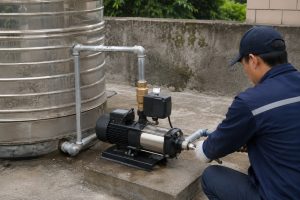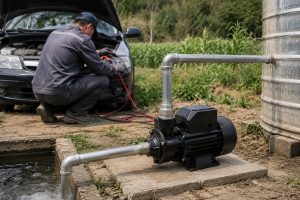
Stuck needing to pump water but far from a power outlet?
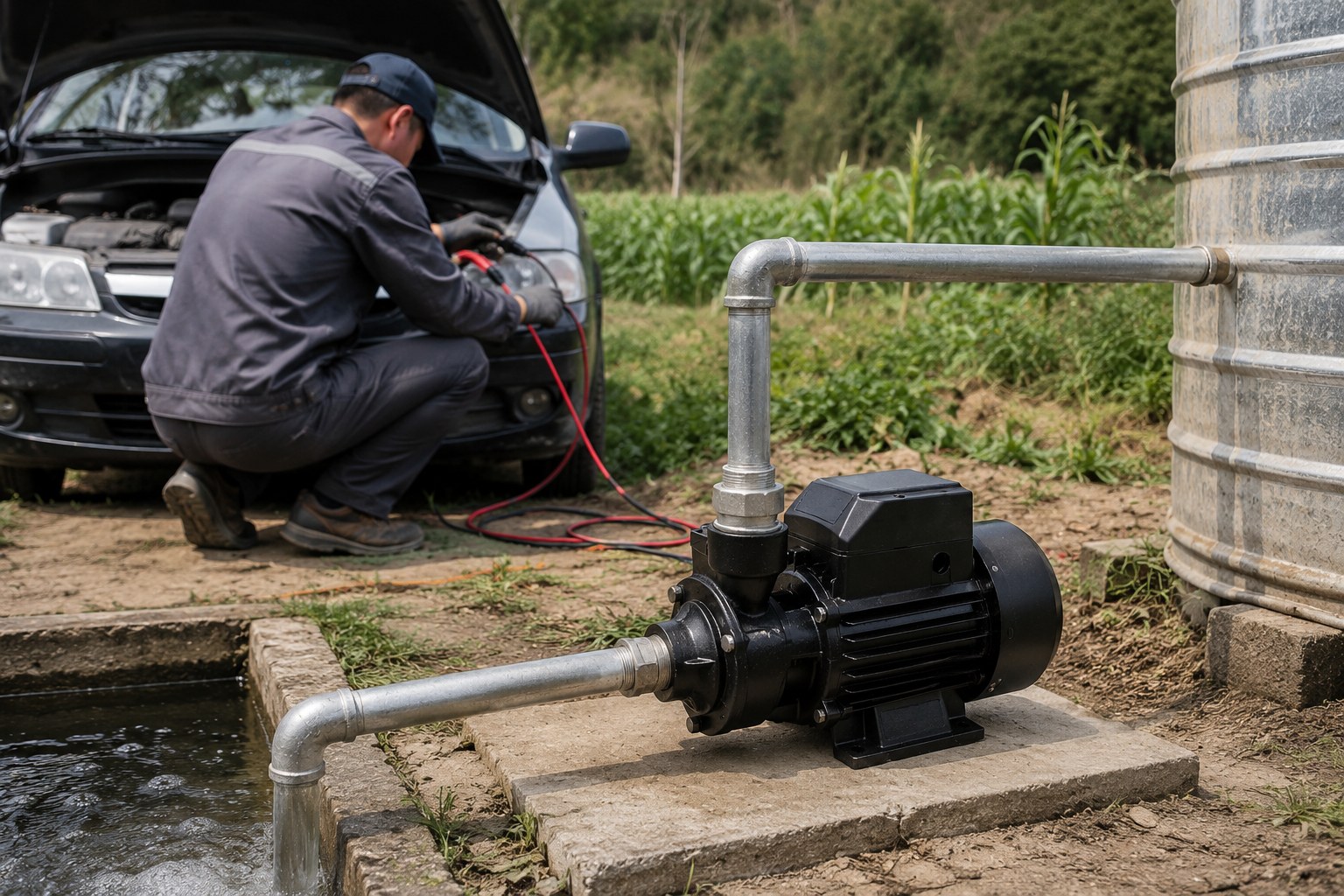
You have a 12V water pump and a car, but how long will that battery last?
A standard car battery may run a typical pump for only 2-5 hours, as it's not designed for deep, continuous power draws.
A deep-cycle battery is a much better choice, offering 7-14 hours of runtime.
The real answer to how long your pump will run is not a single number.
It depends on the battery type, its health, the pump's power draw, and even the wiring you use.
Understanding these factors is crucial to avoid a dead battery when you need water most.
Let's explore what you need to know to get reliable power for your 12V pump, whether you're using a car battery in a pinch or designing a robust off-grid system.
Why a Car Battery Isn't Your Best Choice
Have you ever relied on your car battery for a task, only to find you can't start your car later?
This is a common risk when using it to power a water pump.
Your car's battery is designed for starting your engine, not for running a pump for hours.
It provides a massive burst of power for a few seconds.
Using it for a long, slow drain can permanently damage it and shorten its lifespan, leaving you stranded.
To power a 12V pump effectively, you need to understand the fundamental difference between battery types.
The battery in your car is a starting, lighting, and ignition (SLI) battery.
Its job is to deliver a huge number of amps for a very short time to crank the engine.
The internal construction reflects this, with many thin lead plates designed to maximize surface area for quick power release.
Deeply discharging a car battery causes damage to these thin plates through a process called sulfation, drastically reducing its ability to hold a charge.
In an emergency, it might work, but it's a costly gamble.
The Right Tool: Deep-Cycle Batteries
The proper battery for a water pump is a deep-cycle battery, sometimes called a marine or AGM battery.
These are built differently, with fewer but much thicker lead plates.
This design allows them to be discharged and recharged many times without significant damage.
They are engineered to provide a steady, reliable current over many hours, which is exactly what a water pump needs.
Understanding Battery Ratings
You can tell the difference between these batteries by their ratings.
Car batteries are rated in Cold Cranking Amps (CCA), which measures their ability to start an engine in cold weather.
Deep-cycle batteries are rated in Ampere-Hours (AH).
An 80 AH battery, for example, can theoretically supply 4 amps for 20 hours.
The higher the AH rating, the longer your pump will run.
| Feature | Car Battery (SLI) | Deep-Cycle Battery (e.g., AGM, Gel) |
|---|---|---|
| Primary Use | Starting an engine | Continuous power for electronics/motors |
| Design | High-power burst | Low, steady discharge |
| Rating | Cold Cranking Amps (CCA) | Ampere-Hours (AH) |
| Plate Structure | Many thin plates | Fewer, thick plates |
| Discharge Tolerance | Low (Damaged by deep discharge) | High (Designed for deep cycles) |
| Best For | Your car's ignition | 12V water pumps, RVs, solar systems |
For backup sump pumps or any regular 12V pump use, always choose a deep-cycle battery.
While Gel Cell and Absorbed Glass Mat (AGM) types are more expensive, they are sealed, maintenance-free, and resist corrosion and vibration better, making them a safer and more reliable choice for use in basements or vehicles.
How to Calculate Your 12V Pump's Runtime
Worried about your battery dying in the middle of a critical pumping job?
You can easily estimate runtime and avoid the guesswork, ensuring you have enough power to finish.
To calculate runtime, you need two numbers: your battery's Ampere-Hour (AH) rating and your pump's amp draw.
The basic formula is: Runtime (Hours) = Battery AH / Pump Amps.
*Remember to only use 50% of the AH rating for lead-acid batteries to preserve their lifespan.
Calculating your pump's runtime is empowering.
It transforms an unknown variable into a predictable plan.
You can confidently set up your system, knowing exactly what to expect from your battery.
Let's break down the process into simple steps so you can do it yourself.
Step 1: Find Your Battery's Amp-Hour (AH) Rating
First, you need to know your battery's capacity.
This is almost always printed on a label on top of the battery case.
Look for a number followed by "AH".
A typical deep-cycle battery might be rated at 75 AH, 100 AH, or even higher.
If you can only find a Reserve Capacity (RC) rating, you can estimate the AH by dividing the RC by 2.4.
A 100 AH battery is a very common size for these applications.
Step 2: Determine Your Pump's Amp Draw
Next, you need to know how much power your pump consumes.
This is measured in amps (A).
This information is usually found in the pump's manual or on its specification label.
The amp draw varies significantly based on the pump's size and workload.
A small RV pump might draw 5-8 amps, while a larger agricultural pump could draw 10-20 amps.
For example, a typical boat washdown pump running at 70 PSI might draw around 9 amps.
Step 3: Do the Math
Now you can calculate the theoretical runtime.
However, you should never fully drain a lead-acid battery.
Discharging it below 50% of its capacity will significantly shorten its life.
Therefore, you should always multiply the battery's AH rating by 0.50 in your calculation.
The practical formula is: *Runtime (Hours) = (Battery AH 0.50) / Pump Amps**
Let's use an example.
You have a 100 AH deep-cycle battery and a 12V pump that draws 7 amps.
- Battery Capacity for Use: 100 AH * 0.50 = 50 AH
- Calculation: 50 AH / 7 Amps = 7.14 hours
So, you can expect about 7 hours of continuous runtime.
| Battery Capacity (AH) | Pump Draw (Amps) | Safe Usable Capacity (50%) | Estimated Continuous Runtime |
|---|---|---|---|
| 75 AH | 5 Amps | 37.5 AH | 7.5 hours |
| 75 AH | 10 Amps | 37.5 AH | 3.75 hours |
| 100 AH | 7 Amps | 50 AH | ~7.1 hours |
| 100 AH | 15 Amps | 50 AH | ~3.3 hours |
| 120 AH | 8 Amps | 60 AH | 7.5 hours |
This table shows how runtime changes dramatically with different batteries and pumps.
Always plan for a bit less runtime than you calculate, as other factors can reduce battery performance.
What Factors Can Reduce Your Pump's Runtime?
You've done the math, but your battery died faster than expected.
What went wrong?
Several hidden factors can drain your battery's power much quicker than you anticipate.
Your pump's actual runtime is affected by more than just the numbers.
Battery age, wire size, and how hard the pump is working can reduce performance by 20-30% or more.
Ignoring these factors leads to unreliable results and unexpected failures.
The runtime you calculate is a best-case scenario with a new battery and a perfect setup.
In the real world, performance often falls short.
Understanding what causes this power loss is key to building a robust and dependable system.
Let's dive into the common culprits that drain your battery faster than expected.
Battery Age and Health
A battery is not immortal.
As it ages, its ability to hold a full charge diminishes.
The lead plates inside can corrode or sulfate, creating internal resistance and lowering the effective capacity.
A battery that was 100 AH when new might only perform like a 70 AH battery after a few years.
You can check its health with a voltmeter.
A fully charged 12V battery should read around 12.7 volts or higher.
If it rests below 12.1 volts, it's a sign that it is aging and may fail prematurely.
Pumping Demands: Head and Flow
Your pump's amp draw isn't constant.
It works harder, and draws more current, when it has to push water higher (vertical head) or fight against restrictions in the plumbing.
A pump just transferring water between two tanks on level ground will use far less power than one lifting water 30 feet out of a well.
A 20-30% increase in amp draw under heavy load is common, which directly cuts into your runtime.
Voltage Drop from Wiring
This is one of the most overlooked problems in DIY installations.
Electricity loses energy as it travels through a wire.
Using a wire that is too thin for the distance and current will cause a significant "voltage drop."
Your 12V pump might only receive 11V or less.
At this lower voltage, the pump's motor performs poorly, and its flow rate can drop by 20-30%.
To compensate, the motor may try to draw more amps, further draining the battery.
Always use the wire gauge recommended by the pump manufacturer, typically a thick 10 or 12-gauge wire, and keep the distance from the battery as short as possible.
Environmental Conditions
Batteries are sensitive to temperature.
Extreme cold can reduce a battery's available capacity by up to 50%, while extreme heat can accelerate its aging process and increase self-discharge.
Likewise, running a pump motor in a hot, unventilated space can cause it to overheat, reducing its efficiency and lifespan.
Proper placement and ventilation are essential for both the battery and the pump.
How to Choose the Right 12V Water Pump
Are you overwhelmed by the sheer number of 12V pumps available?
Choosing the wrong one means poor performance, wasted energy, or even premature failure for your specific task.
Selecting the perfect 12V pump is simple if you focus on three key factors: flow rate (GPM), pressure (PSI), and power consumption (Amps).
Matching these specs to your specific application, whether it's for an RV, a boat, or a farm, is the secret to success.
Buying a water pump isn't a one-size-fits-all situation.
The pump that's perfect for filling a livestock trough could be completely inadequate for providing shower pressure in an RV.
Instead of getting lost in technical jargon, let's focus on the practical questions that will guide you to the right choice.
By clearly defining your needs first, you can easily narrow down the options and select a pump that will serve you reliably for years.
Define Your Required Flow Rate (GPM)
First, how much water do you need to move, and how fast?
This is measured in Gallons Per Minute (GPM).
Don't guess.
Think about your specific task.
- For an RV water system providing water to a sink and shower, a pump with 3-5 GPM is usually sufficient.
- For a boat washdown pump used for cleaning decks, you'll want a bit more force, so 4-6 GPM is a good range.
- For agricultural uses like livestock watering or small-scale irrigation, your needs might be much higher, often in the 10-20 GPM range or more.
It's always wise to choose a pump with slightly more capacity than you think you need.
It's better to have extra performance available than to be left wanting more.
Consider Your Pressure Needs (PSI)
Next, think about pressure, measured in Pounds per Square Inch (PSI).
If you are simply transferring water from one tank to another at the same level, pressure is not a major concern.
However, if you want a satisfying shower or need to spray-clean equipment, pressure is critical.
- RV and Marine freshwater systems typically require 40-60 PSI to feel similar to a home faucet.
- Washdown pumps need higher pressure to create a strong spray, so look for models in the 60-80 PSI range.
- Agricultural transfer or irrigation often operates at lower pressures, typically 20-40 PSI, as the goal is volume, not force.
Some high-pressure 12V models can deliver over 100 PSI, which is powerful enough for serious cleaning jobs.
Check the Power Consumption (Amps)
Finally, for any battery-powered system, efficiency is key.
Every amp your pump draws is one less amp available for other devices or for longer runtime.
Check the pump's specifications for its amp draw under a normal load.
Efficient modern pumps typically pull between 5 and 10 amps.
If you are running your system off a limited battery bank or a solar panel, choosing a pump with a lower amp draw can make a huge difference.
Today's pump designs are significantly more efficient, moving more water while using less power than models from just a few years ago.
| Application | Typical Flow Rate (GPM) | Pressure Needed (PSI) | Average Power Draw (Amps) |
|---|---|---|---|
| RV Water System | 3-5 GPM | 40-60 PSI | 5-8 Amps |
| Boat Washdown | 4-6 GPM | 60-80 PSI | 7-10 Amps |
| Livestock Watering | 5-15 GPM | 20-40 PSI | 6-12 Amps |
| Agricultural Transfer | 10-30 GPM | 10-30 PSI | 10-20 Amps |
Beyond Batteries: The Rise of Solar-Powered Pumps
Are you tired of constantly worrying about battery life and replacement costs?
There is a more sustainable, long-term solution that provides water without depending on batteries or the grid.
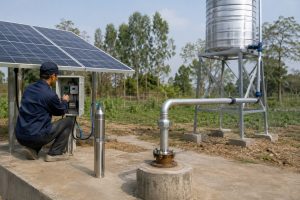
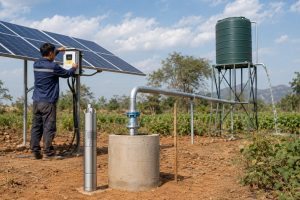
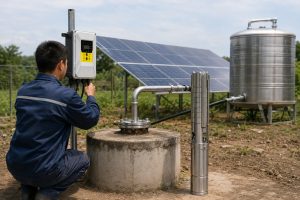
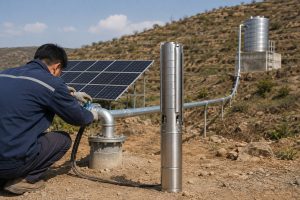
Solar water pumps offer true off-grid independence.
They harness free energy from the sun to provide a reliable water supply for decades, with minimal operating costs and maintenance.
This technology has become the go-to solution for agriculture and homes in remote areas.
While batteries provide portability, they are ultimately a temporary solution with ongoing costs and limitations.
For anyone needing a dependable, long-term water source in an off-grid location, solar-powered pumping systems represent a revolutionary leap forward.
These systems are not just environmentally friendly; they are often more cost-effective over their lifespan than running power lines or relying on fuel-powered generators.
Let's explore the components that make these systems so effective and how they can be tailored to meet diverse water needs.
The Heart of the System: BLDC Motors
The core of a modern solar pump is its motor.
High-efficiency Brushless DC (BLDC) permanent magnet motors are the driving force behind their performance.
These motors achieve efficiencies exceeding 90%, which is a massive improvement over traditional motors.
This high efficiency means they can pump more water with less power, significantly reducing the number of solar panels required.
This lowers the initial system cost and simplifies installation.
The motors are also maintenance-free and have a much longer service life, making them a fit-and-forget solution.
Matching the Pump to the Well
Just as with 12V pumps, there is no single solar pump for every job.
The pump end is chosen based on the well's depth and the required water volume.
Three main types cover most applications:
-
Solar Screw Pump: This design is a master of depth. It uses a stainless steel screw to push water, achieving a very high head (lifting capability) at a lower flow rate. It's ideal for deep wells, domestic water supply, and livestock watering in arid regions.
-
Solar Plastic Impeller Pump: This is the workhorse for volume. It's a multi-stage centrifugal pump that delivers a high flow rate at a medium head. Its wear-resistant plastic impellers make it excellent for farm irrigation and pasture water supply where sand content may be a concern.
-
Solar Stainless Steel Impeller Pump: This is the premium option for durability and harsh conditions. With a full stainless steel construction, it offers high corrosion resistance, making it perfect for acidic or alkaline water. It's the top choice for high-end homes and applications where reliability is paramount.
| Pump Type | Best For | Flow Rate | Head (Lift) | Key Advantage |
|---|---|---|---|---|
| Solar Screw Pump | Deep wells, Homes | Low | High | Excellent sand resistance |
| Solar Plastic Impeller | Farms, Irrigation | High | Medium | High volume and cost-effective |
| Solar Stainless Steel Impeller | Corrosive water, Ranches | High | Medium-High | Maximum durability & lifespan |
Uninterrupted Water: AC/DC Hybrid Systems
What about cloudy days or pumping at night?
Modern solar pump systems have solved this problem with intelligent AC/DC hybrid controllers.
These controllers can accept power from both solar panels and an AC source like the grid or a generator.
The system automatically prioritizes solar power.
When sunlight is insufficient, it can blend in AC power or switch over completely, ensuring you have a 24/7 water supply without any manual intervention.
This provides the best of both worlds: the cost savings of solar and the reliability of a grid connection.
Conclusion
A car battery is a poor, short-term fix.
A deep-cycle battery is better.
But for true, long-term reliability and cost savings, a solar-powered pump system is the superior choice.
FAQs
How long will a 100Ah battery run a water pump?
A 100Ah battery can run a typical 7-amp pump for about 7 hours, as you should only use 50% of its capacity to ensure a long lifespan.
Can a car battery run a sump pump?
Only in a very brief emergency. A car battery is not designed for the continuous power a sump pump needs and will be damaged by the deep discharge.
What size battery do I need for a 12V water pump?
Choose a deep-cycle battery with at least a 75-100Ah rating. This provides a good balance of runtime and portability for most RV and marine pump applications.
How many amps does a 12V water pump draw?
Most 12V pumps draw between 5 to 10 amps under normal load. Larger agricultural or high-pressure models can draw 15 amps or more.
Does a 12V water pump need a special charger?
Yes, you need a smart trickle charger designed for deep-cycle batteries. A standard car battery charger can overcharge and damage a deep-cycle battery.
Can I use a solar panel to charge my 12V pump battery?
Absolutely. Using a solar panel with a charge controller is an excellent way to keep your battery topped off, creating a self-sufficient, off-grid water system.
What's the difference between a marine battery and a car battery?
A marine battery is a deep-cycle battery designed for long, steady power draw. A car battery is a starting battery designed for a short, powerful burst.
Is it better to use a 12V or 24V water pump?
A 24V system is more efficient for larger pumps as it runs at a lower amperage for the same power output, allowing for smaller wires over longer distances.