Are you wondering about water pump replacement costs for your car?
That’s a common search, but many are also seeking solutions for homes, farms, or off-grid properties.
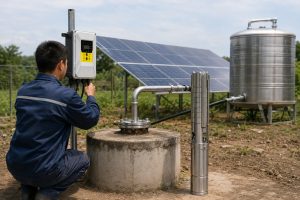
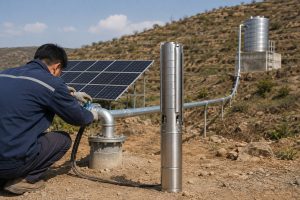
A car water pump from a retailer like Autozone typically costs between $30 and $150, excluding labor. However, if you need a pump for water supply, like for a well or irrigation, you are looking at a completely different category of technology: solar water pumps.
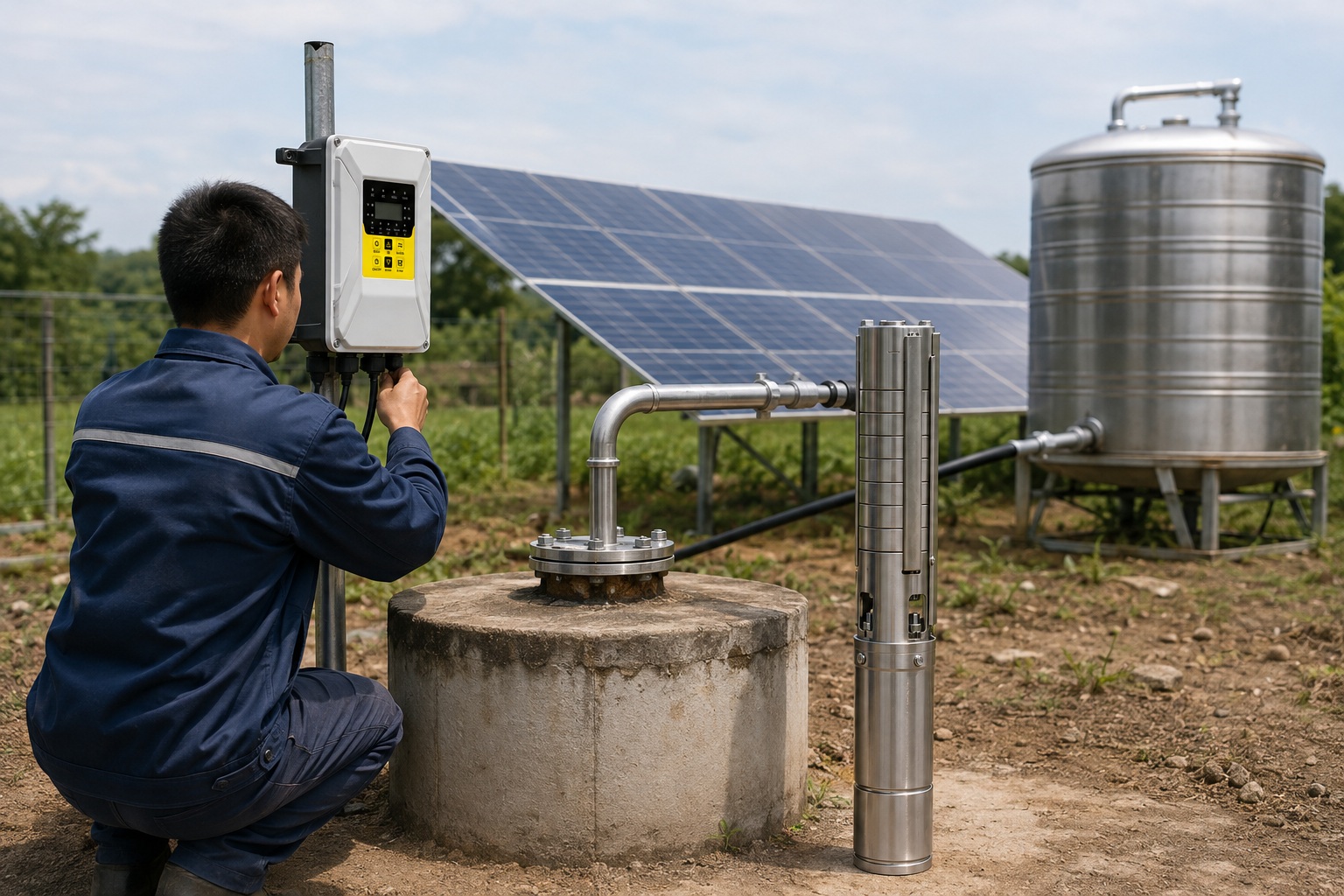
While a failing car water pump is an urgent fix, the challenge of securing a reliable and affordable water supply in remote or off-grid locations is a much larger problem.
For farmers, ranchers, and homeowners in areas without stable electricity, traditional pumps mean constant fuel costs, loud generators, and frequent maintenance.
This guide pivots from the simple automotive query to address this bigger issue.
We will explore the world of solar water pumps, a modern solution that offers energy independence, lower operational costs, and long-term reliability.
Forget the grid, fuel, and generators.
Let’s dive into how you can manage water efficiently and sustainably.
Manage Water Efficiently Off-Grid with a Solar Pump
Struggling with unreliable water access and high energy bills in a remote location?
A solar water pump provides a sustainable and consistent water supply, powered entirely by the sun.
Solar pumps are built for the toughest climates, harnessing sunlight to deliver water without needing mains power, generators, or fuel. They offer a cost-effective, long-term investment with lower maintenance and a return on investment often seen in two years or less, making them ideal for agriculture.
Traditional water pumping systems, whether powered by diesel, petrol, or the electrical grid, come with a long list of operational headaches and expenses.
Fuel costs fluctuate, generators require constant refueling and noisy operation, and grid dependence means you are powerless during an outage.
These systems also have more moving parts, leading to more frequent breakdowns and costly maintenance schedules.
A solar water pump system fundamentally changes this equation.
The Financial Advantage of Solar
At first glance, the initial setup cost for a solar pump can seem higher than a traditional system.
However, this initial investment is where the high costs end.
With solar, your energy source—the sun—is free.
This immediately eliminates ongoing fuel or electricity bills, which can represent up to 85% of the total lifetime cost of a conventional pump.
| Cost Factor | Traditional Fuel Pump | Solar Water Pump |
|---|---|---|
| Initial Cost | Lower | Higher |
| Fuel/Energy Cost | High & Ongoing | $0 |
| Maintenance | Frequent & Costly | Minimal |
| Operational Noise | High | Very Low |
| Asset Lifespan | Shorter (5-10 years) | Longer (20+ years) |
| ROI Period | N/A | ~2 Years |
Built for Reliability and Longevity
Solar pump systems are designed with simplicity and durability in mind.
They have significantly fewer moving parts compared to their fuel-powered counterparts.
This streamlined design directly translates to fewer points of failure and a drastic reduction in maintenance requirements.
You no longer need to worry about oil changes, filter replacements, or engine servicing.
The major components, the solar panels and the pump itself, are built to withstand harsh environmental conditions, from scorching heat to drought-prone areas.
This robust construction ensures a longer asset lifecycle, often exceeding 20 years for the panels and 10-15 years for a high-quality pump, delivering reliable performance day in and day out.
This is why they have become a go-to solution for Aussie farmers and agricultural operations in remote regions worldwide.
Choosing the Right Solar Pump: Three Key Types
Choosing the wrong pump can lead to poor performance and wasted investment.
You need a solution tailored to your specific water depth, volume needs, and water quality.
The three most popular solar deep well pumps are the solar screw pump for high head, the plastic impeller pump for high flow, and the stainless steel impeller pump for corrosive water. Each is designed for different applications, from domestic wells to large-scale irrigation.
The effectiveness of a solar water pump system is not just about the solar panels; it's critically dependent on choosing the right type of pump for the job.
The three dominant designs in the market each serve a distinct purpose, forming a comprehensive portfolio that can meet nearly any off-grid water demand.
Understanding the strengths and limitations of each is the first step toward building an efficient and reliable system.
Let's break down these core pump technologies.
Solar Screw Pump: The Deep Well Specialist
This pump type is the undisputed champion for deep well applications where high pressure (head) is needed more than high volume (flow).
It operates using a simple, effective mechanism: a rotating stainless steel screw (rotor) inside a rubber housing (stator).
As the screw turns, it creates sealed cavities of water that are pushed upwards, generating powerful lift.
- Best For: Deep bores, domestic water supply, and livestock drinking troughs where the water source is far below the surface.
- Key Advantage: Its ability to handle sandy or silty water is exceptional. The design is inherently more resistant to abrasion than centrifugal pumps, making it a durable choice for less-than-perfect water conditions often found in Africa and Latin America.
- Limitation: The trade-off for its high-head capability is a lower flow rate. It is not designed for applications requiring large volumes of water quickly, such as flood irrigation for large farms.
| Feature | Solar Screw Pump |
|---|---|
| Primary Use | High Head, Low Flow |
| Max Head | Up to 300 meters |
| Sand Resistance | Excellent |
| Ideal Application | Deep domestic wells, livestock water |
Solar Plastic Impeller Pump: The High-Volume Workhorse
When you need to move a lot of water for applications like irrigation or filling large tanks, a multi-stage centrifugal pump with plastic impellers is often the most economical and effective choice.
These pumps use a series of spinning impellers to accelerate water outwards, building pressure and flow with each stage.
- Best For: Farm irrigation, pasture water management, and home garden systems where high flow is the priority.
- Key Advantage: They deliver a significantly higher flow rate than screw pumps. The use of durable, wear-resistant plastic for the impellers makes them lightweight, cost-effective, and surprisingly resilient against fine sand. This has made them popular in the agricultural sectors of Africa and the Americas.
- Limitation: While robust, plastic impellers are not ideal for highly corrosive water or extreme deep-well applications where pressure and stress are very high.
Solar Stainless Steel Impeller Pump: The Premium Durability Option
This is the top-tier choice for performance and longevity, especially in challenging water conditions.
It functions like the plastic impeller pump but uses SS304 stainless steel for both the impellers and the pump body.
This material upgrade provides superior resistance to corrosion and abrasion.
- Best For: Water sources with acidic or alkaline properties, such as those found in the alkaline soil regions of Australia or parts of the Americas. Also ideal for high-end homes and commercial ranches where reliability is paramount.
- Key Advantage: Unmatched durability and corrosion resistance. It can operate for years in water that would quickly degrade lesser pumps, ensuring a long service life and high reliability.
- Limitation: The superior materials and construction come at a higher initial cost and increased weight. This pump targets a more niche, high-end market where performance in harsh conditions justifies the premium investment.
The Core of Efficiency: Understanding the Motor
A great pump is useless without an efficient motor.
Using an outdated or inefficient motor wastes precious solar energy, requiring you to buy more panels and driving up system costs.
All modern, high-performance solar pumps are driven by a Brushless DC (BLDC) permanent magnet motor. This core technology boasts efficiency over 90%, significantly reducing solar panel requirements and overall system cost while increasing reliability and lifespan.
The pump itself—whether screw or centrifugal—is only half of the system.
The motor that drives it is the true heart of the operation, determining the overall efficiency, reliability, and ultimately, the cost-effectiveness of your entire solar water pumping system.
The shift from older, brushed motors to advanced BLDC permanent magnet technology is the single biggest reason for the modern solar pump's success.
A BLDC motor uses permanent magnets (specifically, high-strength Neodymium Iron Boron magnets) on its rotor and an electronic controller to switch the electromagnets in the stator.
This design eliminates the physical "brushes" found in traditional DC motors.
Why Brushless is Better
Brushes are a point of friction, wear, and energy loss.
By removing them, BLDC motors achieve several critical advantages.
- Unmatched Efficiency: BLDC motors regularly achieve efficiencies of over 90%. Traditional brushed motors often operate at 60-75% efficiency. This 15-30% efficiency gain is massive. It means more of the sun's energy is converted into water pumping power and less is wasted as heat.
- Longer Lifespan: With no brushes to wear out, the motor's lifespan is dramatically extended. They are virtually maintenance-free, a crucial benefit for pumps installed in remote, hard-to-reach locations.
- Compact and Powerful: The high power density of permanent magnets allows BLDC motors to be significantly smaller and lighter. A typical BLDC motor can be up to 47% smaller and 39% lighter than a brushed motor with the same power output. This simplifies installation and reduces shipping costs.
The Real-World Value of High Efficiency
The market value of a high-efficiency motor is simple: it saves you money.
Because the motor converts more sunlight into work, you need fewer solar panels to achieve the same water output.
Solar panels can account for a significant portion of the system's total cost, so a 20% reduction in panel requirements can translate into thousands of dollars in savings.
| Motor Type | Efficiency | Maintenance | Lifespan | Impact on System Cost |
|---|---|---|---|---|
| Brushed DC Motor | 60-75% | Regular brush replacement | Shorter | Requires ~25% more solar panels |
| BLDC Motor | >90% | None | Very Long | Reduces panel needs, lowers total cost |
This core technology, combined with an intelligent MPPT (Maximum Power Point Tracking) controller, ensures that every drop of solar energy is maximized.
The controller constantly adjusts the electrical load to keep the solar panels operating at their peak power output, regardless of changing sunlight conditions.
This synergy between an efficient motor and a smart controller is what makes modern solar pump systems so powerful and competitive.
How Many Solar Panels Do You Need for a Water Pump?
You've chosen a pump, but how do you power it?
Guessing the number of solar panels can lead to an underpowered system that fails when you need it or an overpriced system that wastes your money.
To determine the number of solar panels, you must calculate the pump's daily energy use (watts x hours), divide it by your location's peak sun hours, and then divide that result by the wattage of a single solar panel. Always add about 14% for efficiency losses.
Sizing your solar array correctly is the most critical step to ensure your pump runs efficiently and reliably.
This calculation isn't complex, but it requires you to gather a few key pieces of information.
Let's walk through the process step-by-step using a common example.
Step 1: Calculate Your Pump's Daily Energy Consumption
First, find your pump's power rating in watts.
Pump motors are often rated in horsepower (HP).
The conversion is simple: 1 HP = 745.7 watts.
Let's say you have a 1.5 HP pump.
Power (watts) = 1.5 HP × 745.7 = 1,118.55 watts
Next, determine how many hours per day the pump needs to run.
This depends on your water needs (e.g., filling a tank of a certain size).
For this example, we'll assume it needs to run for 5 hours.
Daily Energy Use (watt-hours) = 1,118.55 watts × 5 hours = 5,592.75 Wh (or ~5.6 kWh)
Step 2: Find Your Location's Peak Sun Hours
"Peak sun hours" is not the same as "hours of daylight." It's a standardized value representing the number of hours per day that solar intensity averages 1,000 watts per square meter.
This number varies greatly by location and season.
You can find this data from renewable energy labs or local solar installers.
| Location Example | Average Peak Sun Hours |
|---|---|
| Arizona, USA | 5.75+ |
| Florida, USA | 5.0 |
| Ohio, USA | 4.0 |
| South Africa | 5.5 |
| Central Australia | 6.0 |
For our example, let's assume your location gets 5 peak sun hours.
Step 3: Size the Solar System and Add a Buffer
Now, calculate the required size of your solar array in kilowatts (kW).
Solar System Size (kW) = Daily Energy Use (kWh) ÷ Peak Sun Hours = 5.6 kWh ÷ 5 hours = 1.12 kW
Solar systems are never 100% efficient due to factors like dust on panels, cloudy weather, wire resistance, and panel orientation.
It's standard practice to add a safety buffer of about 14-25%. Let's use 15%.
Adjusted System Size = 1.12 kW × 1.15 = 1.29 kW (or 1,290 watts)
Step 4: Calculate the Number of Panels
Finally, divide the adjusted system size by the wattage of the solar panels you plan to use.
Panel wattage typically ranges from 250W to 450W.
Let's use 350-watt panels.
Number of Panels = 1,290 watts ÷ 350 watts/panel = 3.68 panels
Since you can't buy a fraction of a panel, you must round up.
In this case, you would need 4 solar panels of 350 watts each to reliably run your 1.5 HP pump for 5 hours a day.
Ensuring 24/7 Water Access: The Role of Hybrid Systems
What happens on cloudy days or when you need water at night?
A standard solar-only pump will stop working, leaving you without water when you might need it most.
A hybrid AC/DC solar pump system solves this problem by automatically switching to an alternate power source. When sunlight is insufficient, the intelligent controller can draw power from the grid or a generator, ensuring an uninterrupted 24-hour water supply.
While solar pumps offer incredible autonomy, their one limitation is their dependence on sunlight.
For critical applications like domestic water supply or livestock watering, you cannot afford to have your system shut down for hours or days due to poor weather.
This is where hybrid AC/DC pump systems provide the ultimate solution for reliability and peace of mind.
These systems are designed with dual power inputs, allowing them to be connected to both your DC solar array and an AC power source simultaneously.
Intelligent Power Management
The core of the hybrid system is its advanced controller.
This controller acts as the brain, constantly monitoring the power being produced by the solar panels.
- Priority on Solar: The system is programmed to prioritize solar power above all else. As long as the sun is providing enough energy to run the pump, the controller will use 100% free solar energy.
- Hybrid Functionality: When solar input drops due to clouds, the controller doesn't just switch off. It intelligently blends the available solar power with just enough AC power to keep the pump running at the required speed. This maximizes the use of free solar energy and only supplements with grid power as needed.
- Automatic Switchover: When there is no solar input at all (e.g., at night or during heavy storms), the controller automatically and seamlessly switches over to the AC power source. The pump continues to operate without any manual intervention.
- Seamless Return to Solar: As soon as the sun returns and the solar panels begin producing sufficient power again, the controller automatically switches back to solar priority.
The Best of Both Worlds
This dual-power capability offers unparalleled flexibility and reliability.
You get the massive cost savings and energy independence of a solar pump during sunny conditions, combined with the 24/7 on-demand reliability of a traditional grid-powered pump.
It completely eliminates the "range anxiety" associated with solar-only systems.
| System Type | Power Source(s) | Operational Hours | Energy Cost | Reliability |
|---|---|---|---|---|
| Standard Solar | Solar Panels (DC) | Sunlight Hours Only | Very Low | Weather Dependent |
| Grid-Powered | Electric Grid (AC) | 24/7 | High | High |
| Hybrid AC/DC | Solar (DC) + Grid/Generator (AC) | 24/7 | Low to Medium | Very High |
This makes hybrid systems the ideal choice for residential homes in rural areas, critical livestock operations, and any application where a constant water supply is non-negotiable.
It ensures you are never left without water, all while keeping your energy costs to an absolute minimum.
Conclusion
From simple car parts to advanced agricultural solutions, the world of water pumps is vast.
Solar pumps offer a powerful, cost-effective, and reliable way to manage water off-grid.
Choosing the right pump type, motor, and system configuration is key to unlocking energy independence and long-term savings.
FAQs
How much does a water pump cost to replace?
For a car, the part is $30-$150, but with labor, the total cost can be $300-$800. For a home well pump, replacement can range from $1,000 to $2,500.
Is it worth replacing a water pump yourself?
For a car, it's possible for experienced DIY mechanics but can be complex. For a submersible well pump, professional installation is highly recommended due to electrical and plumbing risks.
How long does a water pump last?
A typical car water pump lasts 60,000 to 100,000 miles. A quality solar deep well pump can last 10-15 years, with the solar panels lasting over 25 years.
What are the signs of a bad water pump?
In a car, signs include coolant leaks, overheating, and a whining noise from the engine. For a well pump, signs are low water pressure, no water, or the pump running constantly.
Can a solar pump work without a battery?
Yes, most modern solar water pump systems are direct-drive and do not require batteries. They pump water whenever there is sufficient sunlight and store the water in a tank.
How deep can a solar pump go?
This depends on the pump type. Solar screw pumps are designed for high head and can effectively pump water from depths of 300 meters (nearly 1,000 feet) or more.
Do solar pumps work on cloudy days?
They work at a reduced speed on overcast days. For full power, a hybrid AC/DC system that can switch to grid or generator power is the best solution for consistent operation.