Struggling with unreliable water in remote locations?
Solar pumps seem ideal, but fears about cost and cloudy days can stop you.
Let's explore these weaknesses and find practical solutions.
The primary weaknesses of a solar water pump are the high initial investment and its dependence on sunlight.
However, these are easily managed with proper system design, long-term cost analysis, and modern technologies like water storage or hybrid AC/DC power options, making them a superior long-term choice.
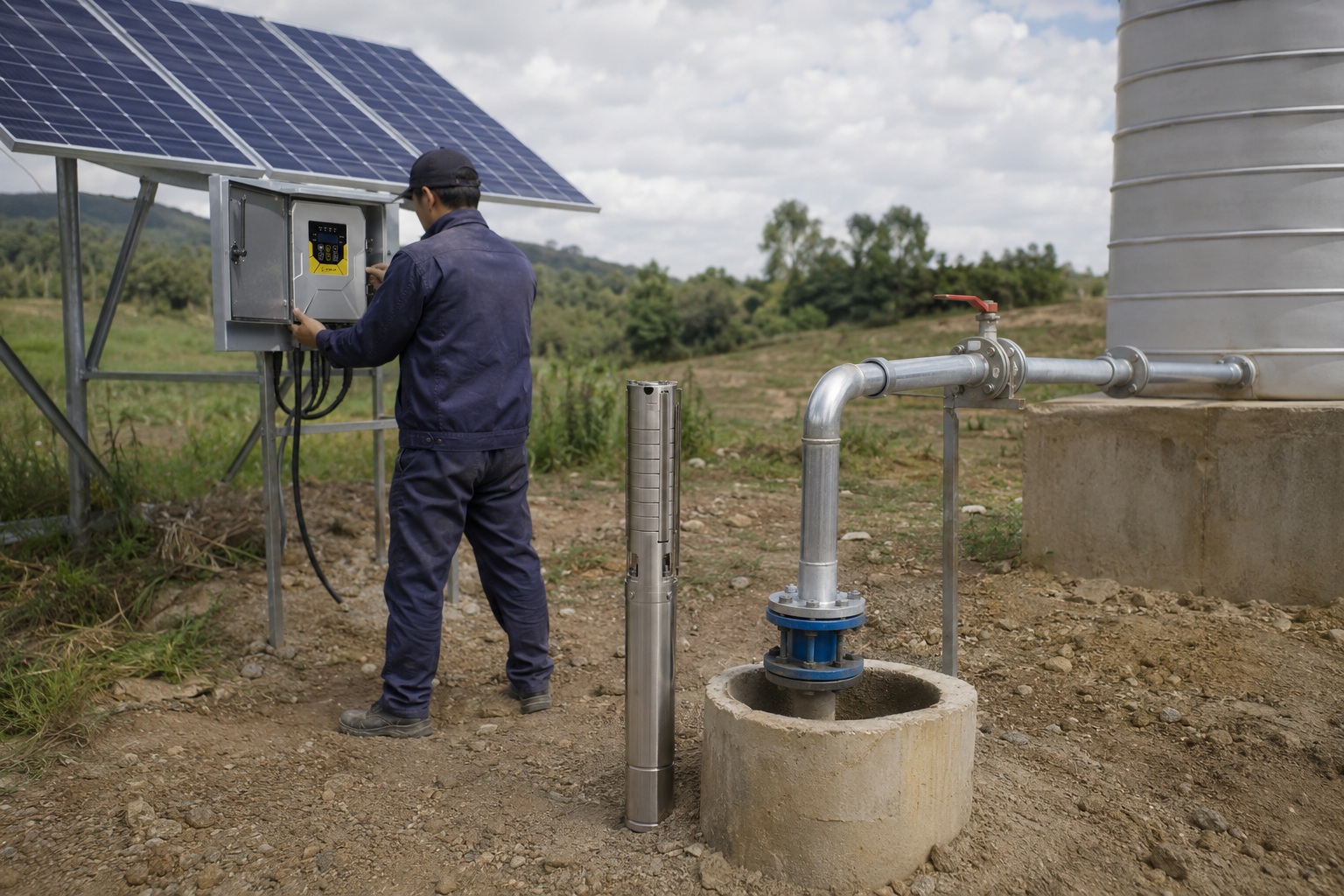
While solar water pumps offer incredible benefits like zero fuel costs and grid independence, it's crucial to understand their potential drawbacks.
Ignoring these can lead to an undersized system, unexpected water shortages, and a poor return on investment.
But with a little planning, every perceived weakness can become a strength.
This article will break down the main disadvantages and provide clear, data-driven solutions to help you design a reliable and cost-effective solar water pumping system for your customers.
We will cover the initial cost, reliance on weather, and the critical importance of choosing the right components to ensure optimal performance.
The High Upfront Cost
Worried about the high initial price tag of a solar water pump system?
You see the benefits, but the upfront cost compared to a diesel pump seems daunting.
Let's break down the numbers.
A complete solar water pump system has a higher initial capital cost than a diesel or gas pump.
This is because you are purchasing the pump, motor, controller, and the solar panel array all at once.
For many, this initial barrier is the biggest disadvantage.
To truly understand the cost, we must look beyond the initial purchase price and analyze the Total Cost of Ownership (TCO) over the system's lifespan.
While the upfront cost is higher, the operational costs are virtually zero.
There is no fuel to buy, and maintenance is minimal.
Diesel pumps, on the other hand, have low initial costs but create a continuous stream of expenses for fuel, maintenance, and parts replacement.
A Data-Driven Cost Comparison
Let's compare the long-term costs of a typical solar PV pump system versus a comparable diesel pump system.
Studies show a dramatic shift in economic advantage over time.
While a diesel system might be cheaper for the first year or two, the solar system quickly becomes the more economical choice.
The data below, adapted from industry analyses, illustrates the financial case over a 20-year period for a mid-sized system.
| Cost Component | Solar Pump System (Example) | Diesel Pump System (Example) |
|---|---|---|
| Initial Capital Cost | $18,188 | $3,840 |
| Annual Operating Costs (Fuel, Maint.) | $600 | $5,642 |
| Total Cost After 10 Years | $24,188 | $60,260 |
| Total Cost After 20 Years | $30,188 | $116,680 |
As the table shows, the diesel pump system's total cost over 20 years is nearly 400% higher than the solar pump system's cost.
The solar pump pays for itself through savings on fuel and maintenance, often within 3-5 years.
Falling Costs and Smarter Choices
The economic advantage of solar is growing every year.
Global market trends show a consistent decline in the price of solar PV panels, with average annual market growth rates for PV technology around 40-60% in recent years.
This directly reduces the main cost component of a solar water pump system.
Conversely, fossil fuel prices are volatile and generally trend upward, making diesel systems a riskier long-term investment.
Furthermore, you can manage upfront costs by selecting the right components for the job.
-
For deep wells with low water needs: A solar screw pump is ideal. It can achieve high head (lifting water from deep down) efficiently, without needing a large, expensive motor.
-
For large-scale irrigation: A solar plastic impeller pump provides high flow at a more economical price point.
-
For corrosive water: A stainless steel impeller pump has a higher cost but prevents premature failure, saving money on replacements in the long run.
Choosing the correct pump avoids over-spending on a system that is not suited for the application.
Dependence on Sunlight and Weather
Is your biggest fear that a few cloudy days will leave you without water?
It's a valid concern.
Solar pumps run on the sun, so what happens when it's not shining?
The output of a solar water pump is directly tied to solar irradiance, or the amount of sunlight hitting the panels.
This means performance drops on overcast days, and pumping stops completely at night.
This is a significant disadvantage if you need a constant 24/7 water supply without any planning.
This weakness is not a deal-breaker; it simply requires a shift in thinking from "pumping on demand" to "pumping when energy is available."
With smart system design, you can ensure a reliable water supply regardless of the weather or time of day.
The solutions are simple, proven, and effective.
Solution 1: Water Storage (The Best Practice)
The most common and cost-effective solution is to store water, not energy.
Instead of pumping water only when you need it, the system is designed to pump water into a storage tank whenever the sun is shining.
-
How it Works: During peak sun hours (e.g., 9 AM to 4 PM), the pump works at its maximum capacity, filling a large storage tank. Water can then be distributed from the tank 24/7 via gravity feed or a small booster pump.
-
Sizing the Tank: We recommend a water storage capacity of 3 to 5 days of average usage. This buffer ensures you have plenty of water to get through extended cloudy periods or storms without running the pump.
-
Benefits: This approach is far cheaper and more durable than using batteries. A water tank has a very long lifespan and requires virtually no maintenance. It turns an intermittent energy source into a constant water supply.
Solution 2: Hybrid Power Systems
For critical applications where a tank may not be practical or where absolute 100% uptime is required, a hybrid system is the ultimate solution.
This approach gives you the best of both worlds: the free energy of solar and the reliability of a backup power source.
Modern solar pump controllers are designed to manage multiple power inputs automatically.
-
AC/DC Hybrid Controllers: These advanced controllers can accept both DC power from the solar panels and AC power from the grid or a generator.
-
Automatic Switching: The controller prioritizes solar power. It will run the pump using only solar energy whenever it is sufficient. If solar power drops due to clouds, the controller automatically supplements or switches over to the AC source to maintain pump operation.
-
Power Blending: The most sophisticated controllers can even blend power. If the panels are providing 70% of the needed power, the controller will only draw the remaining 30% from the AC source, maximizing your use of free solar energy and minimizing utility or fuel costs.
This technology eliminates any concerns about cloudy days or nighttime pumping, providing a truly worry-free, 24-hour water supply.
| Solution | How it Works | Best For | Pros | Cons |
|---|---|---|---|---|
| Water Storage Tank | Pump fills a tank during sunny hours; water is used from the tank anytime. | Most agricultural and domestic applications. | Low cost, high reliability, long lifespan. | Requires space for a tank. |
| Battery Backup | Solar panels charge batteries; pump runs on battery power at night or on cloudy days. | Small systems or when a tank isn't feasible. | Provides water on demand. | High cost, short lifespan (3-5 years), maintenance. |
| AC/DC Hybrid System | Controller automatically switches between solar and a grid/generator backup. | Critical applications requiring 100% uptime. | Ultimate reliability, 24/7 water, maximizes solar use. | Requires access to an AC power source. |
Maintenance and Performance Optimization
Think solar pumps are "install and forget"?
While they are incredibly low-maintenance, neglecting them entirely can hurt performance.
Simple care and smart component choices are key to long-term success.
A common misconception is that solar pumps are zero-maintenance.
While they require far less attention than diesel engines, they are not completely self-sufficient.
Panel cleanliness and component selection are crucial factors that can degrade performance if ignored, representing a hidden weakness.
Optimizing a solar pump system goes beyond just installation.
It involves a small amount of regular maintenance and, more importantly, making the right choices during the design phase.
Choosing the right pump and motor for your specific water conditions is just as important as the number of solar panels you install.
This proactive approach ensures you get the most water for every watt of power generated.
Simple Panel Maintenance for Peak Power
Your solar panels are the fuel tank of the system.
If they are dirty, they can't generate full power.
Dust, dirt, bird droppings, and pollen can accumulate on the surface of the panels, reducing their efficiency.
In some tests, dirty panels have shown a power output reduction of over 20-30%.
This means 30% less water being pumped.
The solution is simple: periodic cleaning.
- Frequency: The cleaning schedule depends on your environment. In dusty or agricultural areas, cleaning every few months may be necessary. In other areas, annual cleaning may suffice.
- Method: Cleaning is as simple as washing a window. Use water and a soft brush or cloth to wipe the panels down. It's a quick task that pays big dividends in water volume.
The Critical Role of the Motor and Pump
The biggest hidden weakness of any solar pumping system is a mismatch between the equipment and the job.
The efficiency of the pump and motor directly impacts the overall system cost and performance.
An inefficient motor requires more solar panels to do the same amount of work, increasing the upfront cost significantly.
The Motor: Heart of the System
Modern solar pumps utilize advanced Brushless DC (BLDC) permanent magnet motors.
These are a game-changer for system efficiency.
- High Efficiency: BLDC motors can achieve efficiencies of over 90%. This is a huge leap compared to older DC or AC motor technologies.
- Practical Impact: An increase in motor efficiency from 80% to 90% means the system needs about 11% fewer solar panels to deliver the same amount of water. This directly lowers the primary cost of the system.
- Other Benefits: They are also more compact, lighter, and virtually maintenance-free due to the lack of brushes that can wear out.
Choosing the Right Pump End
The pump itself must be matched to the water source and demand.
Using the wrong type of pump is a common failure point.
| Pump Type | Application | Key Advantage | Performance Note |
|---|---|---|---|
| Solar Screw Pump | Deep wells, livestock water | Handles sandy water very well. High head. | Best for low-flow, high-lift situations. |
| Plastic Impeller Pump | Farm irrigation, high-volume | High water flow, economical. Good wear resistance. | Ideal for high-flow, medium-lift needs. |
| Stainless Steel Impeller Pump | Corrosive or alkaline water | Maximum durability and lifespan in harsh water. | A premium choice that prevents costly failures from corrosion. |
By carefully selecting the motor and pump type, you not only improve reliability and performance but also optimize the upfront cost of the entire solar water pump system.
This turns a potential weakness into a significant competitive advantage.
Conclusion
The weaknesses of solar pumps—cost and sun dependency—are easily overcome with smart planning, modern technology, and a focus on long-term value, making them a superior water solution.
FAQs
How long do solar water pumps last?
A quality solar pump system can last for 20-25 years. The solar panels have a long lifespan, while the pump and motor may need maintenance or replacement after about 10 years.
Can a solar pump run without a battery?
Yes, most solar water pump systems are designed to operate without batteries. They pump water into a storage tank during the day for 24/7 access.
What happens to a solar pump on a cloudy day?
On a cloudy day, the pump's output will be reduced. It will pump less water, but it will still operate as long as there is some daylight.
How deep can a solar water pump go?
Solar pumps can service a wide range of depths. Screw-type pumps are designed for very deep wells, capable of lifting water from hundreds of meters.
Do solar pumps work in the winter?
Yes, solar pumps work in winter, but their output is lower due to shorter days and weaker sunlight. System design should account for the lowest-sunlight month.
Can you run a well pump off a generator?
Yes, you can run a well pump off a generator. Hybrid AC/DC solar pump controllers allow you to use a generator as a backup power source automatically.
How many solar panels do I need to run a water pump?
The number of panels depends on the pump's power rating, the well's depth, and your daily water needs. A professional supplier can calculate the exact requirement.