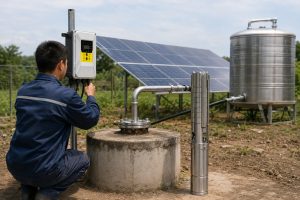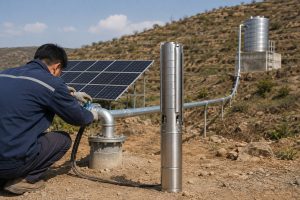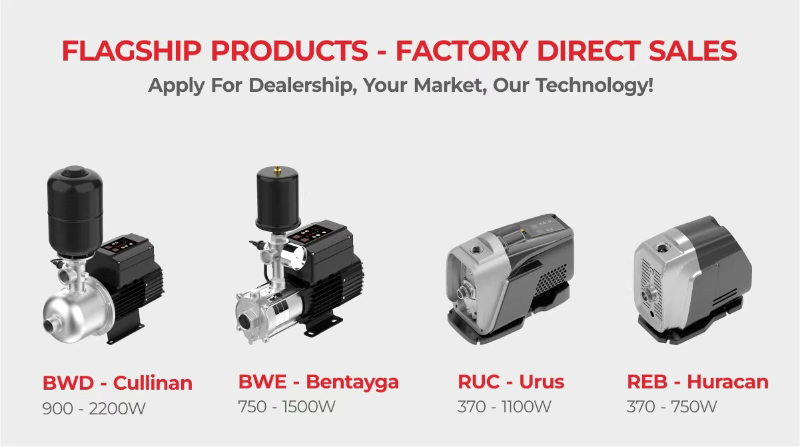
Struggling with high electricity bills or no grid access for your water pump?
You need a reliable and cost-effective solution to move water where you need it.
Solar pumps can be either DC (Direct Current) or AC (Alternating Current).
DC pumps connect directly to solar panels and are highly efficient.
AC pumps require an inverter to convert the panel's DC power to AC but can offer higher flow rates.
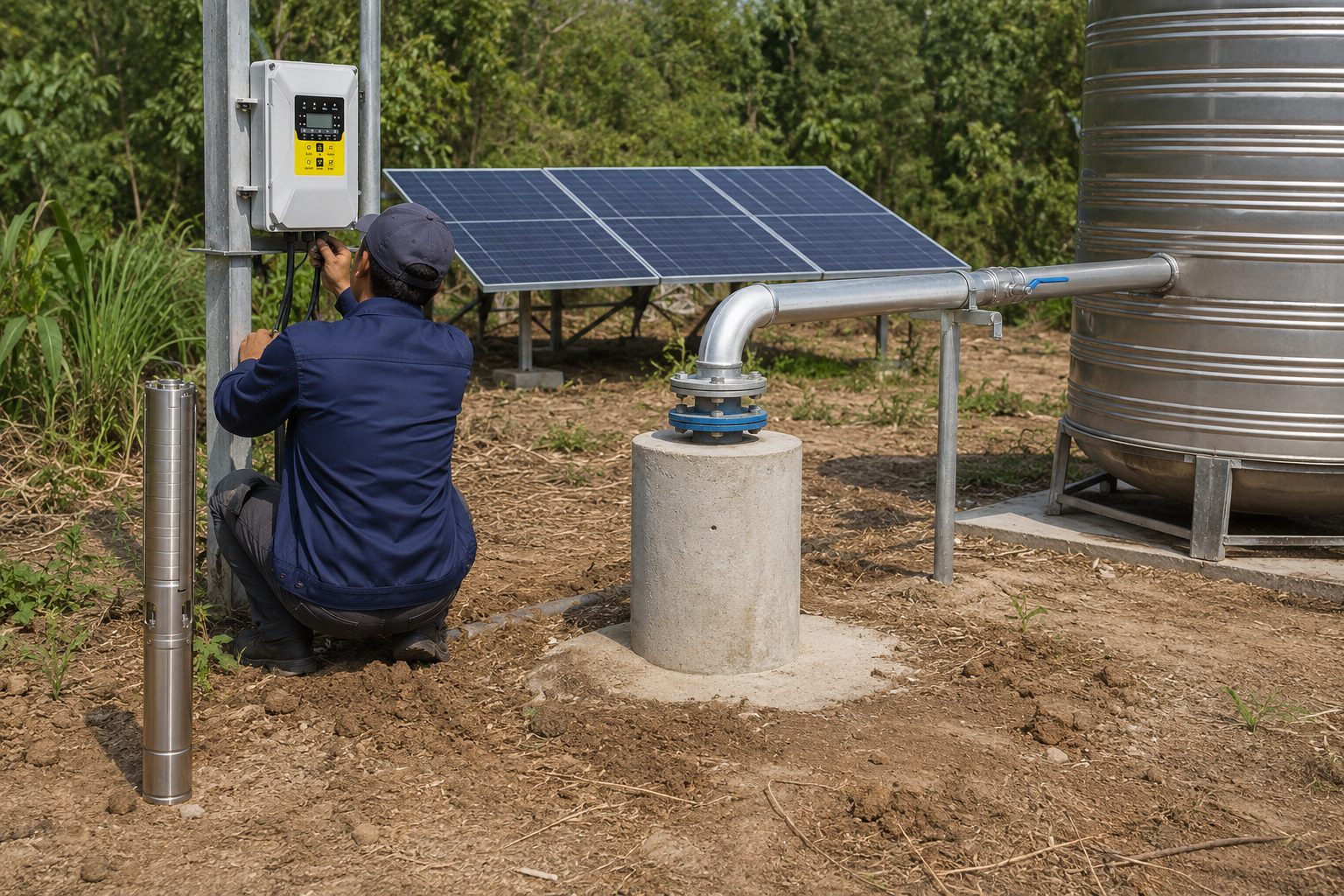
Understanding this core difference is the first step toward choosing the right water pump.
However, the decision involves much more than just the type of power.
Factors like efficiency, cost, application, and the very design of the pump's motor play a crucial role.
Let's explore the details to help you make an informed choice for your specific needs, whether for a small home or large-scale agriculture.
What is the Difference Between AC and DC Water Pumps?
Confused about AC and DC power?
This simple difference dramatically impacts your pump's performance, cost, and application.
The main difference is the power source and the nature of the electrical current.
AC pumps use alternating current, like grid power, which rapidly changes direction.
DC pumps use direct current, a steady flow of power from sources like batteries or solar panels.
To truly grasp the implications for your water pumping system, it's essential to look closer at how these currents work and how they are used.
The power source directly influences the pump's design, efficiency, and ideal use case.
This fundamental distinction is the starting point for every other comparison between the two technologies.
Understanding the Current
Alternating Current (AC) is the standard form of electricity delivered by utility grids to homes and businesses.
The current's direction "alternates" many times per second, typically at 50 or 60 Hertz (Hz).
This characteristic allows it to be transmitted efficiently over very long distances.
Direct Current (DC), on the other hand, flows in a single, constant direction.
This is the type of power produced by solar panels and stored in batteries.
Because the flow is steady, DC power can be used more efficiently by certain types of motors without the energy loss associated with converting or alternating the current.
Powering Your Pump
An AC pump is designed to run on grid power.
You can plug it into a standard wall outlet.
It can also be powered by an AC generator or a solar setup that includes a DC-to-AC inverter.
A DC pump runs directly on DC power.
This makes it a natural fit for solar applications.
You can connect its motor terminals directly to solar panels or a battery bank.
This direct connection eliminates the need for an inverter, which simplifies the system and improves overall efficiency.
| Power Source | Usable with AC Pump? | Usable with DC Pump? | Notes |
|---|---|---|---|
| Solar Panels (Direct) | No | Yes | The most efficient setup for a DC pump. |
| Battery Bank | With Inverter | Yes | Ideal for off-grid power storage and use at night. |
| Utility Grid | Yes | With Converter | The primary source for standard AC pumps. |
| AC Generator | Yes | With Converter | A common backup for AC pumps in remote areas. |
The Role of the Inverter
When you want to run an AC pump with solar power, you need a device called an inverter.
The inverter's job is to take the DC electricity from your solar panels or batteries and convert it into AC electricity.
While this makes the system versatile, the conversion process is not 100% efficient.
A typical inverter can lose between 5% and 15% of the energy as heat during the conversion.
This energy loss means you may need more solar panels to achieve the same pumping performance compared to a DC pump system that avoids this conversion step altogether.
A Comparison of AC vs. DC Solar Pumps
Choosing a pump feels overwhelming.
One costs more upfront, while the other costs more to run over time.
Which one is the smarter investment for your business?
DC pumps are more energy-efficient and quieter, making them perfect for off-grid and residential use where noise is a concern.
AC pumps are less expensive initially and provide significantly higher flow and pressure, making them suitable for large-scale, heavy-duty tasks.
The best choice depends entirely on balancing initial cost against long-term operational expenses and matching the pump's capabilities to the demands of the job.
Let's break down the key differences in performance, cost, and usability to clarify which pump technology offers the best return on investment for different scenarios.
Performance: Flow Rate and Pressure
When it comes to raw power, AC pumps generally have the upper hand.
They are engineered to handle large-scale applications and can achieve significantly higher flow rates and pressure.
This makes them the go-to choice for tasks like large-scale irrigation, municipal water distribution, or moving water over long distances and to high elevations.
An AC pump can often deliver 50% to 200% more water per minute than a similarly sized DC pump.
DC pumps, in contrast, are optimized for efficiency rather than maximum output.
They offer reduced pressure and flow rates, which are perfectly adequate for many applications.
These include residential water supply, livestock watering, filling smaller tanks, and small-scale irrigation.
Energy Efficiency and Operating Costs
This is where DC pumps truly shine.
Modern DC pumps almost exclusively use brushless DC (BLDC) motors, which are highly efficient.
These motors can convert over 90% of the electrical energy into mechanical work.
AC motors are inherently less efficient, typically operating in the 65% to 75% efficiency range.
They lose a larger portion of energy as waste heat.
This 15-25% efficiency gap has significant long-term consequences.
Running a less efficient AC pump will consume more electricity, leading to higher utility bills or the need for a larger, more expensive solar panel array and battery system.
Over the lifetime of the pump, the energy savings from a DC pump can easily offset its higher initial purchase price.
Cost, Installation, and Maintenance
The financial and practical aspects of owning a pump extend beyond its performance.
Initial cost, ease of installation, and long-term maintenance are critical factors for any buyer.
AC and DC pumps present a classic trade-off between upfront investment and lifetime cost of ownership.
| Feature | AC Water Pump | DC Water Pump |
|---|---|---|
| Initial Cost | Lower | Higher (often by 15-30%) |
| Operating Cost | Higher (due to lower efficiency) | Lower (due to higher efficiency) |
| Installation | Bulkier, requires standard AC wiring | More compact, low-voltage wiring, simpler |
| Control | Difficult to control flow speed | Precise speed and flow control |
| Maintenance | Simpler motor, widely available parts | Complex motor/electronics, may need a specialist |
| Noise Level | Generally noisier | Operates almost silently |
An AC pump's simpler motor construction makes it cheaper to manufacture and easier to repair.
A DC pump's advanced BLDC motor and electronics make it more expensive to purchase and potentially more challenging to service in remote areas.
What are the Main Types of Solar Pumps?
Not all solar pumps are created equal.
Using the wrong type for your well can lead to poor performance, unreliable water flow, and premature failure.
The main types are submersible pumps, which go underwater in a well, and surface pumps, for sources like rivers or ponds.
For deep wells, submersible pumps are essential.
These are further classified by their internal mechanism, such as progressive cavity (screw) pumps or centrifugal pumps with different impeller materials.
The heart of any modern, high-performance solar pump is its motor.
Understanding the motor technology and the specific pump-end design is critical to selecting a product that is not only efficient but also durable enough for your specific water conditions.
The Engine of the Pump: The BLDC Motor
The vast majority of high-quality DC solar pumps are powered by a Brushless DC (BLDC) permanent magnet motor.
This is the core technology that gives them their competitive edge.
These motors boast efficiencies exceeding 90%, a massive improvement over traditional AC or brushed DC motors.
They achieve this by using a rotor made of powerful rare-earth magnets, like 40SH neodymium iron boron.
This advanced design eliminates the friction and energy loss from brushes, resulting in a motor that is remarkably powerful for its size.
A BLDC motor can be up to 47% smaller and 39% lighter than a traditional motor with the same power output.
This has practical market value: a more efficient motor requires up to 20% fewer solar panels to do the same amount of work.
This reduces the total system cost, simplifies installation, and extends the operational life of the pump.
Deep Well Pump Technologies
For deep well applications, the "pump end" attached to the motor is just as important.
The design of the pump end determines its flow rate, head pressure, and suitability for different water qualities.
Three popular types dominate the market, each serving a distinct need.
| Pump Type | Solar Screw Pump | Solar Plastic Impeller Pump | Solar Stainless Steel Impeller Pump |
|---|---|---|---|
| Mechanism | Progressive Cavity | Multi-Stage Centrifugal | Multi-Stage Centrifugal |
| Performance | Low Flow, Very High Head | High Flow, Medium Head | High Flow, Medium-to-High Head |
| Best For | Deep wells, high lift | General farm & home use | Corrosive or high-purity water |
| Sand Resistance | Excellent | Good (for fine sand) | Moderate |
| Application | Domestic water, livestock | Farm irrigation, pasture supply | Acidic water, alkaline soils, premium homes |
| Cost | Moderate | Economical | Premium |
Matching the Pump to the Water Source
Choosing the right pump technology is critical for ensuring longevity and reliable performance.
If your water source has a high concentration of sand or grit, a solar screw pump is the ideal choice.
Its progressive cavity design can handle abrasives far better than centrifugal pumps, preventing premature wear and failure.
For general-purpose applications with relatively clean water, such as farm irrigation or home water supply, a solar plastic impeller pump offers an excellent balance of performance and value.
Its wear-resistant plastic impellers provide high flow rates at an economical price point.
In environments with corrosive water, such as in areas with acidic water or high-alkalinity soil, a solar stainless steel impeller pump is essential.
The SS304 stainless steel construction of the impeller and pump body resists corrosion, ensuring a long and reliable service life where other pumps would quickly fail.
How to Choose Between AC and DC Solar Pumps?
You now know the options, but how do you make the final decision?
Choosing the wrong pump can mean wasted money, an oversized solar array, and an unreliable water supply when you need it most.
Your choice depends on your grid access, water volume needs, and budget.
For off-grid, low-to-medium volume needs, a DC pump is almost always the best choice.
For very high-capacity, grid-connected applications, an AC pump is often more practical.
However, a modern hybrid AC/DC pump offers the most flexibility.
By systematically evaluating your specific requirements, you can confidently select the most cost-effective and reliable solution.
Let's walk through the key decision factors, including a look at an innovative hybrid technology that combines the benefits of both systems.
Decision Factor 1: On-Grid vs. Off-Grid
Your access to the electrical grid is the first and most important consideration.
If your pump location is truly remote and has no grid connection (off-grid), a DC solar pump is the natural choice.
It is designed to run efficiently directly from solar panels, maximizing every watt of energy produced and minimizing the size and cost of your solar array.
If the pump is located where there is a stable grid connection (on-grid), an AC pump can be a straightforward and cost-effective option, especially if you need very high flow rates.
It can run on grid power anytime and can be supplemented by a solar array with an inverter.
Decision Factor 2: Pumping Capacity
You must accurately determine how much water you need and how fast you need to move it.
A DC pump is a perfect choice for low to medium requirements.
This includes applications like providing drinking water for a household, watering livestock, or irrigating a small garden, typically requiring up to 50-70 liters per minute.
An AC pump is built for high-volume tasks.
If you need to irrigate multiple acres of farmland, manage large water features, or supply a commercial building, you will likely require the high flow rates (100+ liters per minute) and pressures that AC pumps provide.
| Application | Typical Flow Requirement | Recommended Pump Type |
|---|---|---|
| Livestock Watering | 10 - 30 LPM | DC |
| Small Home Water Supply | 20 - 40 LPM | DC |
| Small-Scale Drip Irrigation | 30 - 60 LPM | DC |
| Large Home / Ranch | 60 - 100 LPM | DC or AC/DC Hybrid |
| Large-Scale Farm Irrigation | 100 - 500+ LPM | AC or AC/DC Hybrid |
The Best of Both Worlds: The Hybrid AC/DC Solution
What if you want the efficiency of DC but need the reliability of a 24/7 water supply, even on cloudy days or at night?
This is where hybrid AC/DC solar pump systems come in.
These systems use an intelligent controller with inputs for both solar panels (DC) and a grid or generator connection (AC).
The controller automatically prioritizes using free energy from the sun.
When solar power is abundant, the pump runs entirely on DC power.
If clouds roll in and solar power drops, the hybrid function can blend in AC power to maintain the pump's speed and water flow, maximizing the use of every bit of solar energy.
When there is no solar input at all, like at night, the controller seamlessly switches over to the AC power source.
This ensures you have a worry-free, uninterrupted water supply around the clock, while still taking full advantage of cost-free solar energy whenever it is available.
Conclusion
The choice between AC and DC solar pumps depends on your application, grid access, and budget.
DC excels in efficiency for off-grid use, while AC provides high power for large-scale tasks.
Ultimately, the most competitive solutions pair the right pump with a high-efficiency motor and an intelligent controller, with modern hybrid systems offering the ultimate flexibility.
Frequently Asked Questions
Can a DC pump run on AC power?
Not directly.
A DC pump requires a device called a converter or rectifier to change the AC power from the grid into the DC power the pump needs to operate.
Which motor is best for a solar water pump?
A brushless DC (BLDC) permanent magnet motor is the best.
It is highly efficient (often >90%), reliable, and requires no maintenance, reducing overall system costs and improving performance.
Do solar water pumps work at night?
They can if the system includes a battery bank to store solar energy during the day.
Alternatively, a hybrid AC/DC system can automatically switch to grid or generator power at night.
How deep can a solar pump pull water from?
This depends on the pump type.
Solar screw pumps are designed for very deep wells, capable of lifting water from over 200 meters, while centrifugal pumps handle low to medium depths.
What size solar panel do I need for a water pump?
This depends on the pump's power rating (watts), your location's daily sunlight hours, and your daily water needs.
A professional supplier can help calculate the precise array size for you.
Is a solar water pump worth the investment?
For off-grid locations, absolutely.
The initial cost is offset by eliminating fuel costs, utility bills, and power line extension fees, offering a great return on investment over its long lifespan.
How long do solar water pumps last?
A quality solar water pump system can last for 15-20 years.
The solar panels have a lifespan of 25+ years, while the pump and motor may require maintenance or replacement after about 10 years.