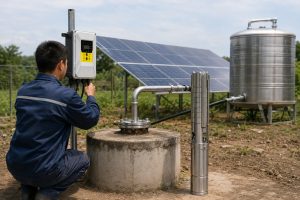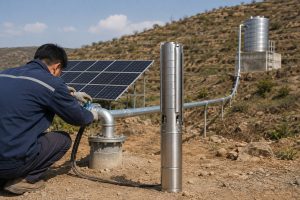
Struggling to get water in remote locations without reliable grid power is a major challenge.
You need a dependable water source, but running conventional pumps is expensive and impractical.
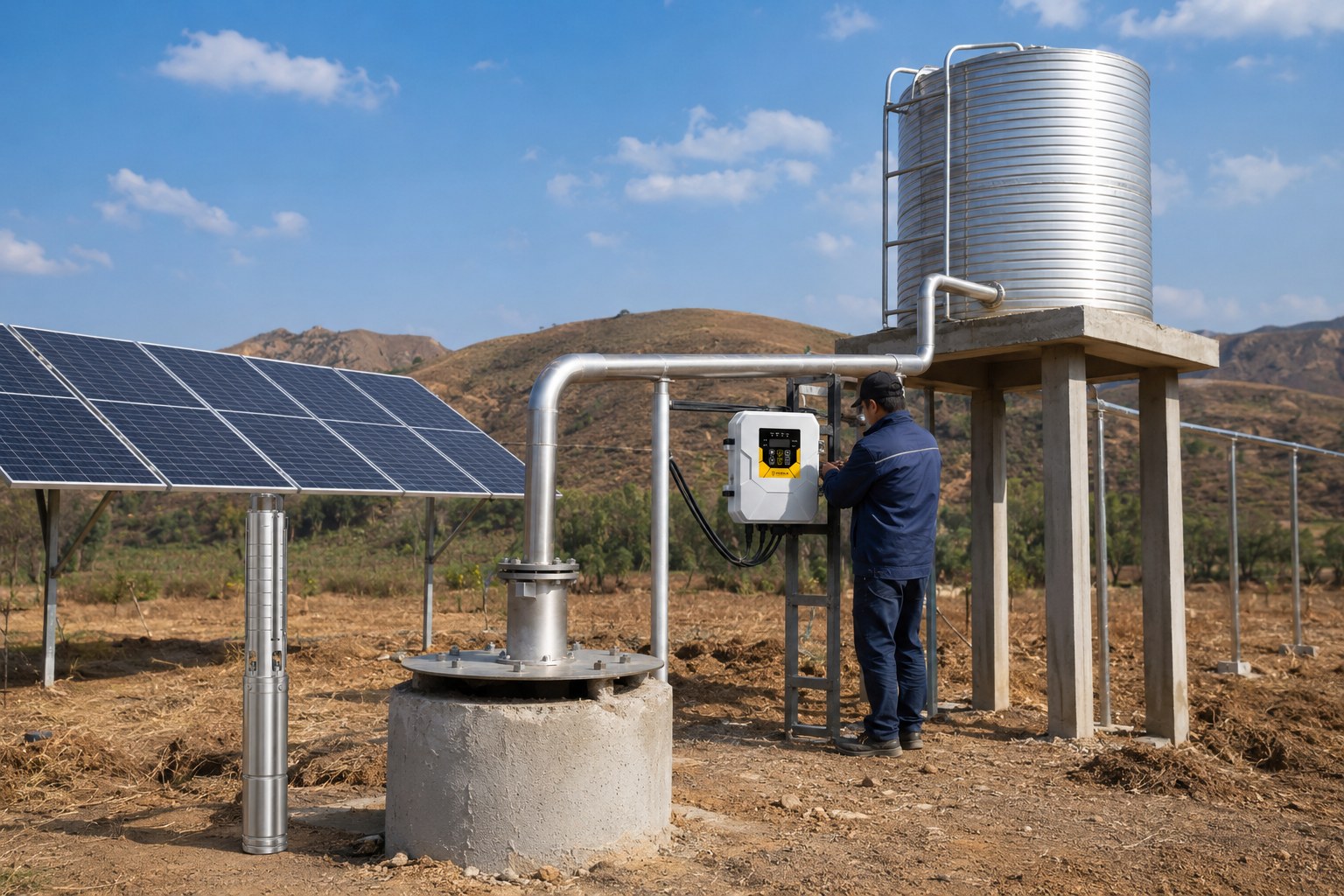
A solar pump's lifting height, or head, can range from a few meters to over 600 meters (about 2000 feet).
The maximum height depends entirely on the pump type, its motor power, and the overall system design, including the number and wattage of the solar panels used.
Understanding a pump's maximum lift is not about a single number.
It involves a careful balance of several critical factors that define the pump's performance.
To select the right pump and ensure a reliable water supply, you must first understand these technical details.
Let's explore the key specifications that determine how high a solar pump can truly move water, helping you make an informed investment for your specific needs.
Understanding Key Pump Specifications
Choosing the wrong pump for your well depth leads to system failure and wasted money.
You need to understand the technical terms to make an informed decision and avoid costly mistakes.
Key specifications for a pump are Flow (GPM/LPM), Head (meters/feet), and Power Consumption (Watts).
Total Dynamic Head, which includes the vertical lift and all pipe friction, is the single most critical factor for determining a pump's true lifting capability in a real-world scenario.
To properly size a solar pumping system, you must move beyond simple specifications and dive deeper into how these factors interact.
The terms on a spec sheet can be confusing, but they are essential for designing a system that works efficiently for years to come.
Understanding them is the first step toward a successful installation.
What is "Head" and Why Does It Matter?
"Head" is the most common way to measure a pump's lifting ability.
It represents the maximum vertical height to which the pump can deliver water.
This is also a direct measure of the pump's pressure output.
For example, a pump that can achieve 100 meters of head can create approximately 10 bar (or 145 PSI) of pressure.
You must differentiate between two types of head.
Static Head is the simple vertical distance from the water source to the final discharge point.
Total Dynamic Head (TDH) is a more realistic and crucial measurement.
TDH includes the static head plus all the friction losses within the system.
Friction loss is the pressure lost as water moves through pipes, bends, and valves.
Longer pipes, smaller pipe diameters, and higher flow rates all significantly increase friction loss, effectively adding to the "head" the pump must overcome.
A pump might be rated for 150 meters of static head, but if your system has 20 meters of friction loss, its actual maximum lift is only 130 meters.
Ignoring TDH is a common cause of underperforming systems.
| Factor | Description | Impact on Performance |
|---|---|---|
| Static Head | The vertical distance the water is lifted. | The primary workload for the pump. |
| Friction Loss | Pressure lost due to pipes, fittings, and valves. | Adds to the total head, reducing flow rate. |
| Total Dynamic Head (TDH) | Static Head + Friction Loss. | The true measure of the work the pump must do. |
The Relationship Between Flow and Head
Flow and head have an inverse relationship.
This is a fundamental characteristic of all pumps.
As the total head (the height and friction the pump works against) increases, the flow rate (the volume of water delivered) decreases.
Conversely, a pump will deliver its maximum flow rate at the lowest head.
This relationship is illustrated by a "pump curve" graph.
The pump curve shows exactly how much water a pump will deliver at any given head.
For example, a pump might deliver 100 liters per minute (L/m) at 20 meters of head.
However, the same pump might only deliver 20 L/m at 80 meters of head.
That's an 80% reduction in water volume for a 4x increase in lift.
When selecting a pump for a high-head application, you must check the pump curve.
You need to find the model that provides your required flow rate at your calculated Total Dynamic Head, not just at zero head.
Suction Lift vs. Pushing Power
Pumps move water in two ways: by sucking it (suction lift) or by pushing it.
Surface pumps, which are installed on the ground, use suction to draw water from a source below them.
However, atmospheric pressure limits the theoretical maximum suction lift to about 7.5 meters (25 feet) at sea level.
In practice, most surface pumps perform poorly with a suction lift of more than 5-6 meters.
For this reason, they are not suitable for deep wells.
Submersible pumps are the ideal solution for high-lift applications.
These pumps are installed completely underwater in the well, lake, or stream.
Since they are submerged, they don't need to suck water.
Instead, they use their energy to push water up to the surface.
This design makes them far more efficient and capable of lifting water from depths of hundreds of meters.
They are the standard choice for deep wells and boreholes.
Choosing the Right Pump Type for High-Head Applications
Not all solar pumps are created equal.
Picking a pump designed for low lift when you have a deep well is a recipe for disaster and disappointment.
For extreme high-head applications, a solar screw pump is the specialist, designed to deliver water from very deep wells.
For moderate head with higher flow requirements, centrifugal pumps with either plastic or stainless steel impellers are better choices, depending on the water quality and budget.
The type of pump you choose is the single most important decision for a high-lift water system.
Each design has unique strengths tailored to different conditions.
A screw pump excels at overcoming immense pressure in deep boreholes, while a centrifugal pump is built to move large volumes of water efficiently.
Understanding these differences ensures you invest in a solution that matches your well's depth, your water needs, and your water quality.
Solar Screw Pumps: The High-Head Specialist
Solar screw pumps are positive displacement pumps.
They operate using a simple, robust mechanism: a single helical rotor (a stainless steel screw) rotates inside a resilient stator (a rubber sleeve).
This action creates sealed cavities of water that are pushed progressively up toward the outlet.
This design allows the pump to build immense pressure.
It can lift water from extreme depths, often exceeding 300 meters (nearly 1000 feet).
Because of their design, they are exceptionally resistant to abrasion from sand and sediment, which would quickly destroy other pump types.
This makes them ideal for newly drilled wells or areas with sandy water.
Their primary application is for deep well domestic water supply, livestock watering, and small-scale drip irrigation where flow rate is less critical than lift.
While they are unbeatable for head, their limitation is a relatively low flow rate compared to centrifugal pumps of similar power.
For example, a 750W screw pump might deliver 10 L/m at 150 meters of head, whereas a 750W centrifugal pump may not even reach that height.
Solar Centrifugal Pumps: Balancing Flow and Head
Solar centrifugal pumps use a series of rotating impellers to move water.
Water enters the pump's center and is thrown outward by the spinning impellers, converting rotational energy into water pressure and flow.
By stacking multiple impellers and diffusers (a multi-stage design), these pumps can achieve medium to high head while delivering significantly higher flow rates than screw pumps.
They represent a balance between lifting power and water volume.
Within this category, the impeller material is a key differentiator.
| Feature | Plastic Impeller Pump | Stainless Steel Impeller Pump |
|---|---|---|
| Best For | Farm irrigation, high-flow needs, budget-conscious projects | Corrosive water, high-end homes, long-term reliability |
| Head | Medium (e.g., up to 150m) | Medium-to-High (e.g., up to 200m) |
| Flow Rate | High | High |
| Durability | Good wear resistance, lightweight | Excellent corrosion resistance, heavy-duty |
| Cost | More economical | Premium Price |
Plastic Impeller Pumps use engineered polymers that are durable and highly resistant to wear from fine sand.
They are a lightweight and cost-effective choice for general farm irrigation, pasture water supply, and home gardens where water quality is not aggressive.
Stainless Steel Impeller Pumps are the premium option.
They are built with SS304 or SS316 stainless steel impellers and pump bodies.
This construction provides superior resistance to corrosion from acidic or alkaline water, which is common in many parts of Australia and the Americas.
While more expensive, their long service life and reliability in harsh water conditions make them a wise investment for high-end homes, critical water supplies, and regions with known water quality issues.
Choosing stainless steel can prevent premature failure and a performance drop of over 50% that can occur in corrosive environments.
Powering Your Pump: How Many Panels Are Needed?
Underpowering your solar pump means it will not start reliably or deliver the water you need.
Overpowering it means you have wasted significant money on unnecessary solar panels.
The number of panels depends on the pump's horsepower (HP) and power consumption (Watts).
A small 0.5 HP pump might need 500-600W (two large panels), while a powerful 2 HP pump could require over 2000W (around six panels) to operate effectively.
The power system is the engine of your water pump.
Its performance is determined by two core components: the efficiency of the motor driving the pump and the size of the solar array feeding it.
Getting this combination right is crucial for maximizing water output while minimizing your initial investment.
An efficient motor reduces the number of panels required, and a correctly sized solar array ensures the pump runs from sunrise to sunset.
The Core of Efficiency: The BLDC Motor
The heart of a modern solar pump is its motor.
High-quality systems use a Brushless DC (BLDC) permanent magnet motor.
These motors are a major technological leap over older brushed DC or standard AC motors.
Their key advantage is exceptional efficiency, often exceeding 90%.
This is significantly higher than the 75-85% efficiency of typical AC motors.
This high efficiency has a direct financial benefit: a more efficient motor requires less power to do the same amount of work.
A pump with a 90% efficient motor might require 10-15% fewer solar panels than one with an 80% efficient motor to pump the same amount of water.
This directly reduces the upfront cost of the system.
BLDC motors are also more reliable and have a longer lifespan.
They have no brushes that can wear out and require replacement, making them virtually maintenance-free.
Their advanced design also allows them to be more compact and lightweight (up to 40% smaller and lighter than traditional motors), which simplifies transportation and installation, especially in remote areas.
Sizing Your Solar Array
Once you have chosen a pump, you must pair it with a correctly sized solar array.
The goal is to provide enough power for the pump to run effectively, even on days that are not perfectly sunny.
A common rule of thumb is to size the solar array's wattage to be 1.3 to 1.5 times the pump motor's wattage.
This overhead accounts for real-world factors like cloudy weather, high temperatures, and system inefficiencies, ensuring the pump receives enough power.
| Pump Size | Pump Power (approx.) | Recommended Solar Array (Watts) | Est. Number of 375W Panels |
|---|---|---|---|
| 0.5 HP | 375 W | 500 - 600 W | 2 |
| 1.0 HP | 750 W | 1000 - 1200 W | 3 |
| 2.0 HP | 1500 W | 2000 - 2250 W | 6 |
| 5.0 HP | 3700 W | 4800 - 5600 W | 13 - 15 |
The system's controller also plays a vital role.
A Maximum Power Point Tracking (MPPT) controller constantly adjusts the electrical load to ensure the solar panels operate at their peak efficiency.
An MPPT controller can boost the water output by up to 30% over a day compared to a simple controller.
It allows the pump to start earlier in the morning, run later in the evening, and continue pumping at a reduced speed during cloudy periods.
Case Study: Sizing a Pump for 500 Feet of Lift
Theory is good, but real-world scenarios are complex.
A 500-foot well does not mean you simply need a pump rated for 500 feet of lift.
For a 500-foot lift, you must also account for pressure requirements and pipe friction loss.
For a home needing 60 PSI of pressure, you must add another 140 feet to your calculation, requiring a pump that can handle at least 640 feet of Total Dynamic Head.
Let's walk through a few practical examples to see how these principles are applied.
Pump sizing is a process of gathering requirements and calculating the true workload.
These case studies illustrate how different factors like pressure tanks, long pipe runs, and desired flow rates influence the final pump selection.
They show why a one-size-fits-all approach never works.
Example 1: Residential Deep Well
A homeowner has a well with a static water level at 470 feet and wants to set the pump at 500 feet.
The pump needs to feed a pressure tank set to turn on at 40 PSI and off at 60 PSI.
The family needs enough water for normal household use, including long showers.
First, we calculate the Total Dynamic Head (TDH).
The static head is 500 feet.
The pressure tank requirement adds to this.
To create 60 PSI of pressure, the pump must be able to lift water an additional 140 feet (60 PSI x 2.31 ft/PSI).
So, the TDH is 500 ft + 140 ft = 640 feet.
Now we must select a pump that can provide adequate flow at this very high head.
A standard shower head uses 2-4 GPM, so we should aim for a pump that delivers at least 6-10 GPM at 640 feet of head.
A 2 HP pump might only deliver 6 GPM under these conditions.
A more powerful 3 HP pump might provide 11.5 GPM, nearly double the flow.
The final choice depends on the user's priority: higher upfront cost for better performance or a lower cost with a more modest water supply.
Example 2: Long Distance Pumping with Elevation Gain
A farmer needs to pump water from a well to a pond for livestock.
The pump will be set at 250 feet in the well.
The pond is 1000 feet away horizontally and has an elevation gain of 250 feet from the wellhead.
The total static head is the sum of the lift from the well and the elevation gain to the pond.
Static Head = 250 ft (in well) + 250 ft (elevation gain) = 500 feet.
Next, we consider friction loss over the 1000-foot pipe run.
The farmer wants to replenish about 3,400 gallons per day to offset evaporation, which equals a constant flow of roughly 2.5 GPM.
At such a low flow rate, the friction loss in a 1-inch or larger pipe is negligible, so it does not significantly add to the TDH.
Therefore, we need a pump that can deliver at least 2.5 GPM at 500 feet of TDH.
A small, efficient 1 HP screw pump or centrifugal pump designed for high head would be a perfect fit.
It meets the requirement without being oversized, making it a very cost-effective solution.
The Hidden Cost of Friction Loss
A user wants to move the maximum possible volume of water between two ponds.
The distance is 1500 feet with a 500-foot elevation change.
They have an existing 1.5-inch pipeline they do not want to upgrade.
The static head is 500 feet.
The goal is to maximize flow.
A high-volume 5 HP pump can normally deliver 30 GPM at 500 feet of head.
However, we must calculate the friction loss for pushing 30 GPM through 1500 feet of 1.5-inch pipe.
Using a friction loss chart, we find this creates about 48 PSI of back-pressure.
This is equivalent to an additional 110 feet of head (48 PSI x 2.31 ft/PSI).
The pump's actual TDH is 500 ft + 110 ft = 610 feet.
Looking at the pump curve for that 5 HP pump, the flow rate at 610 feet of head drops to 27 GPM.
The friction in the undersized pipe causes a 10% reduction in water flow.
While the pump can handle this extra load, it demonstrates the trade-off.
Using a larger diameter pipe (e.g., 2.5 or 3 inches) would eliminate this friction loss and restore the full 30 GPM flow, but at the cost of new piping.
Ensuring 24/7 Water: The Role of Hybrid Systems
Solar pumps are great, but what happens on cloudy days or at night?
Running out of water is not an option for critical applications like homes or livestock.
AC/DC hybrid solar pump controllers solve this problem entirely.
They automatically switch between solar power and a grid or generator backup, ensuring a continuous, uninterrupted water supply 24 hours a day without any manual intervention.
The sun provides free energy, but it is not always available.
For applications that demand water around the clock, relying solely on solar energy can be risky.
Batteries are one solution, but they are expensive and require maintenance.
A more modern and cost-effective approach is a hybrid system, which combines the best of both worlds: free solar power and the reliability of a conventional power source.
How AC/DC Hybrid Controllers Work
A hybrid controller is an intelligent device with two power inputs: one for DC power from solar panels and one for AC power from the grid or a generator.
The controller's primary goal is to use as much free solar energy as possible.
When the sun is shining brightly, the controller uses 100% solar power to run the pump.
If clouds appear and solar power drops, the controller can activate its hybrid function.
It seamlessly blends AC power with the available solar power to maintain the pump's performance, ensuring solar energy is never wasted.
When the sun goes down, or if there is no solar input, the controller automatically switches to 100% AC power.
This entire process is fully automatic.
The user does not need to do anything.
It guarantees that water is available whenever it is needed, day or night, rain or shine.
Solar-Direct vs. Battery vs. Hybrid
When planning a solar pumping system, you have three main architectural choices.
Each has its own set of advantages and is suited for different scenarios.
| System Type | Best For | Pros | Cons |
|---|---|---|---|
| Solar-Direct | Filling a storage tank (livestock, irrigation) | Simple, lowest initial cost, very reliable | Pumping only during sunny hours, requires a large water tank |
| Battery System | Fully off-grid homes and cabins where no AC is available | Pump on demand 24/7, provides stable pressure | Highest cost, batteries require regular maintenance and replacement (3-7 year lifespan) |
| AC/DC Hybrid | Homes, farms, and businesses with grid or generator access | 24/7 water, prioritizes free solar energy, no batteries to maintain or replace | Requires access to a secondary AC power source |
The economic advantage of a hybrid system is clear.
It provides the 24/7 reliability of a battery system but without the high upfront cost and eventual replacement expense of a large battery bank.
For any user who has access to grid power or owns a generator, a hybrid system is often the most practical and financially sound choice for ensuring a worry-free water supply.
Conclusion
A solar pump's lift height depends on the pump type, motor efficiency, and total system design.
Choosing the right combination ensures a reliable, cost-effective water solution for any deep well application.
FAQs
How deep can a solar pump go?
This depends on the model.
Solar screw pumps are designed for deep wells and can be set at depths of over 300 meters (or 1,000 feet).
Can a solar pump fill a tank?
Yes, this is one of the most common and effective uses.
A pump fills an elevated tank during the day, and water is then gravity-fed for use anytime.
Do solar pumps work on cloudy days?
Yes, they do, but with reduced flow.
Systems with MPPT controllers perform much better in low light, and hybrid systems can use AC power to assist.
How long do solar water pumps last?
A quality system with a brushless DC motor can last over 10 years.
The solar panels themselves are typically warrantied for 25 years of power output.
Can a solar pump run a sprinkler?
Yes, provided the pump is correctly sized.
It must be able to produce the specific pressure (PSI) and flow rate (GPM) that the sprinkler system requires to operate.
What is the difference between a solar pump and a normal pump?
Solar pumps typically use highly efficient brushless DC motors designed to run on variable DC power from solar panels.
Normal pumps use standard AC motors that require a stable grid or generator power.
Can a solar pump run at night?
A standard solar-direct pump cannot run at night.
However, a system with batteries or an AC/DC hybrid controller can provide water 24/7, using stored energy or a backup power source.
How much does a solar water pump system cost?
The cost varies widely, from a few hundred dollars for a small fountain pump to tens of thousands for a large-scale agricultural system.
It depends on the pump size, well depth, and number of panels.