Choosing a submersible pump feels like a gamble.
A poor choice means pulling it from 200 feet underground in just a few years, costing you thousands.
This guide helps you choose wisely.
The best submersible pump brand depends entirely on your application. For general residential wells, Franklin Electric offers unmatched reliability and value. For those prioritizing peak energy efficiency, Grundfos is the premium choice. However, for specialized or off-grid use, the true performance comes from the motor and control system.
Choosing the right pump is a major decision.
It's a long-term investment that sits deep underground, silently doing its job for decades—or failing prematurely.
The market is filled with options, from trusted industry giants to budget-friendly alternatives.
But the "best" brand isn't a one-size-fits-all answer.
It depends on your well depth, water quality, energy source, and budget.
This guide breaks down the top brands, explains the technology that truly matters, and helps you calculate the total cost of ownership to make an informed decision.
We'll compare the established leaders for traditional grid-tied systems and then explore the revolutionary world of solar pumps, where motor efficiency becomes the most critical factor.
Best Submersible Pump Brands (2026) | Ranked
Your well pump is a 20-year investment running 24/7.
A cheap pump fails early, costing you thousands in labor fees alone for replacement.
Understand the total cost of ownership before you buy.
For most traditional wells, Franklin Electric is the industry standard, perfectly balancing cost, proven reliability, and widespread parts availability. Grundfos is the premium option for those who prioritize superior energy efficiency and cutting-edge engineering, though it comes at a higher price.
When professionals discuss reliable submersible pumps, two names consistently dominate the conversation: Franklin Electric and Grundfos.
These brands have built their reputations over decades by manufacturing pumps that deliver long-term performance in the demanding environment of a water well.
Choosing between them often comes down to prioritizing either upfront value or long-term energy savings.
However, other brands like Goulds and Sta-Rite also offer compelling options for specific needs and budgets.
Understanding the strengths and weaknesses of each is the first step to selecting a pump that won't leave you high and dry.
Franklin Electric: The Industry Standard
Franklin Electric is the backbone of the North American residential well market.
Their motors are so prevalent that they power pump ends from many other manufacturers.
Founded in 1944, their reputation is built on one thing: rock-solid motor reliability.
Most well contractors know these motors inside and out, which means service and parts are never far away.
While they may not be the absolute most efficient, their proven 15-25 year lifespan makes them the go-to choice for a dependable, set-it-and-forget-it system.
| Pros | Cons |
|---|---|
| Exceptional reliability (15-25 year lifespan) | Higher upfront cost than budget brands |
| Best parts availability in North America | Not the most energy-efficient option |
| Preferred by most professional installers | Utilitarian, non-premium design |
| Proven track record of over 80 years |
Grundfos: Premium Engineering Excellence
Grundfos, a Danish company, is the world's largest pump manufacturer and a leader in innovation.
They approach pump design holistically, engineering the motor and pump end as a single, integrated unit.
This results in superior energy efficiency, often reducing electricity costs by 10-30% compared to competitors.
Their SQ and SQE series pumps are famous for their slim design, quiet operation, and built-in protections like soft-start and dry-run prevention.
If you are willing to invest more upfront for lower operating costs and cutting-edge technology, Grundfos is an exceptional choice.
| Pros | Cons |
|---|---|
| Superior energy efficiency (saves 10-30%) | Highest price point in the market |
| Exceptional build quality and materials | Proprietary systems; harder to mix parts |
| Quiet operation with less vibration | Parts may not be stocked by all suppliers |
| Built-in motor protection features | Fewer contractors are intimately familiar with them |
Head-to-Head Data Comparison
The choice between Franklin and Grundfos often comes down to a simple trade-off between upfront cost and long-term operating expense.
For most homeowners, the reliability and serviceability of Franklin Electric provide the best overall value.
However, for those with high electricity costs or a focus on sustainability, the energy savings from a Grundfos pump can pay for its premium price over the system's life.
| Factor | Franklin Electric | Grundfos |
|---|---|---|
| Pump Cost | $600 - $1,500 | $800 - $2,500 |
| **Installed Cost*** | $2,000 - $3,500 | $2,300 - $4,500 |
| Energy Efficiency | Good (65-70%) | Excellent (70-80%) |
| Expected Lifespan | 15-25 years | 15-25 years |
| Parts Availability | Excellent | Good |
| Contractor Familiarity | Excellent | Good |
| Best For | Overall Value & Reliability | Maximum Efficiency |
*Installed costs are estimates for typical 200-400 foot wells.
Are Mid-Range and Budget Pumps a Smart Investment?
The high upfront cost of a premium pump can be daunting.
Is it safe to save money with a mid-range or budget brand?
Let's analyze the real-world trade-offs you make for that lower price tag.
Mid-range brands like Goulds (Xylem) and Sta-Rite (Pentair) offer a respectable balance of quality and affordability for less demanding applications. However, budget brands often result in much higher long-term costs due to significantly shorter lifespans and the high cost of repeated replacement labor.
Not every well requires a premium-priced pump.
Mid-range manufacturers with long histories in the industry provide a viable path for homeowners looking for quality without the top-tier price.
These brands are often workhorses in commercial and agricultural settings.
The real danger lies at the bottom of the market with "budget" or store-brand pumps.
While the initial savings of a few hundred dollars is tempting, field data overwhelmingly shows that this is a poor economic choice for any primary home well, especially deep ones where labor costs for replacement are substantial.
Goulds (Xylem): The Commercial Workhorse
Goulds Water Technology has a history stretching back to 1848, with deep roots in industrial and municipal water systems.
This commercial heritage is evident in their pump construction, which is often heavier-duty and more tolerant of challenging conditions like sand and sediment.
Many Goulds pumps even use Franklin Electric motors, pairing their robust pump ends with a proven motor.
They represent a solid mid-range option, delivering commercial-grade durability at a price point below the premium brands.
They are an excellent choice for wells known to have higher sediment levels.
Sta-Rite (Pentair): The Reliable, Affordable Choice
Sta-Rite, part of the Pentair family, is a major player in the residential water systems market.
Their pumps are known for providing solid, reliable performance at a very competitive price, often 15-25% less than a comparable Franklin Electric model.
With wide availability at both professional supply houses and major home improvement retailers, they are an accessible option for both professional and DIY installations.
While their expected lifespan of 10-15 years is shorter than premium brands, they offer dependable quality for homeowners on a tighter budget.
The Hidden Cost of Budget Pumps
The math on budget pumps simply does not work out in the long run.
The primary cost of replacing a submersible pump is not the unit itself, but the skilled labor required to pull the old pump and install the new one, which can easily cost $1,500-$2,500.
A cheap pump's short lifespan forces you to pay this labor cost multiple times.
A premium pump that lasts 20 years costs you that labor fee only once.
As the table below illustrates, the "expensive" pump is almost always the cheapest option over the life of the system.
| Brand Tier | Pump Cost (Avg.) | Lifespan | Replacements (in 20 yrs) | Labor Cost/Replacement* | Total 20-Year Cost |
|---|---|---|---|---|---|
| Premium (Franklin/Grundfos) | $1,200 | 20 yrs | 0 | $1,500 | $2,700 |
| Mid-Range (Goulds/Sta-Rite) | $800 | 12 yrs | 1 | $1,500 | $3,800 |
| Budget (Store Brands) | $400 | 5 yrs | 3 | $1,500 | $6,700 |
*Based on a one-time initial install labor cost of $1,500.
Beyond the Grid: Why Solar Pumps Are a Game Changer
Grid power is expensive, unreliable, or completely unavailable in many regions.
This puts essential water access for homes, farms, and livestock at constant risk.
Solar water pumps offer a cost-effective, durable, and completely independent solution.
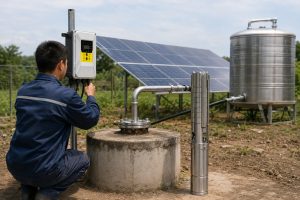
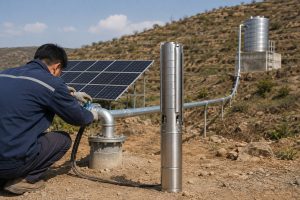
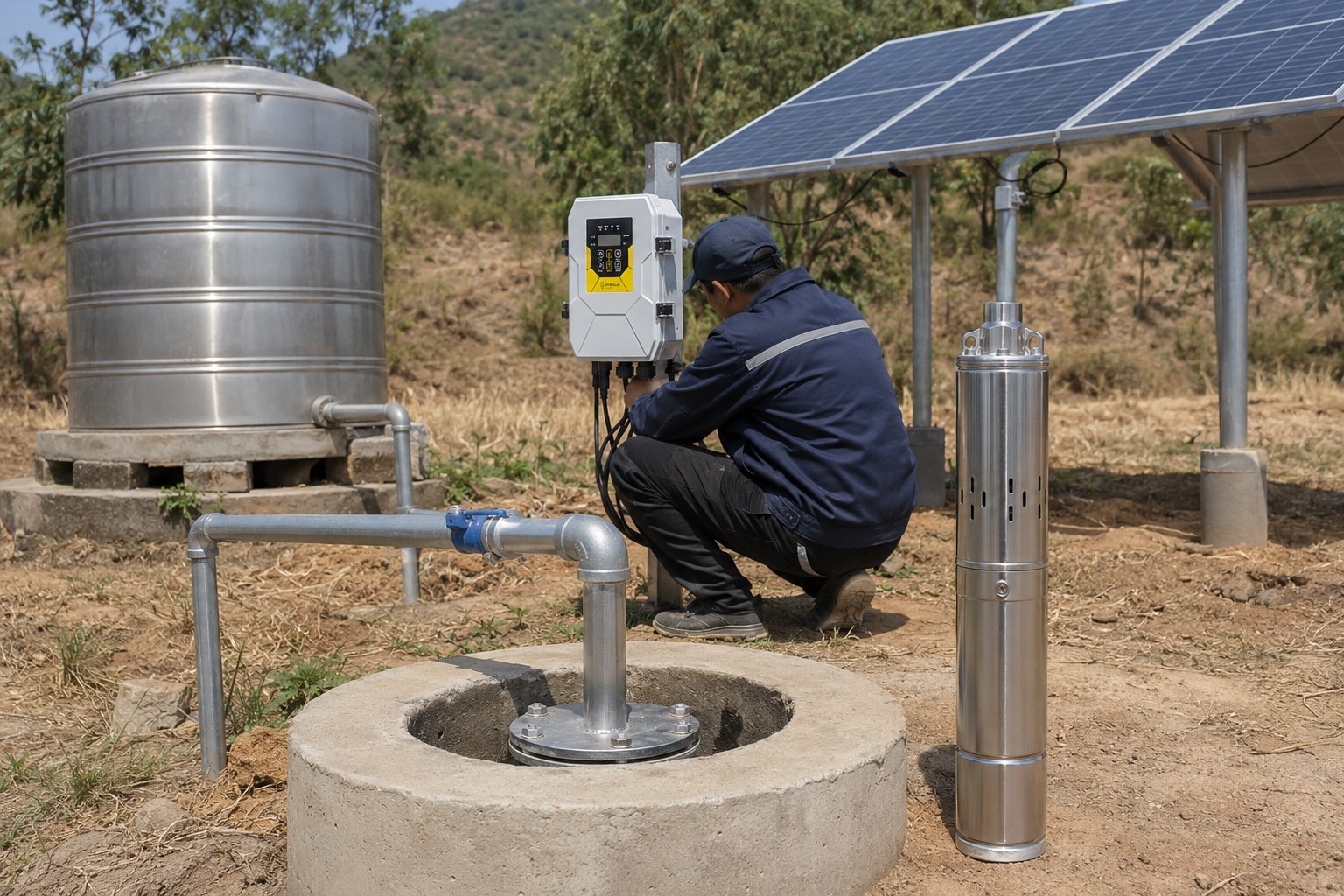
Solar water pumps provide reliable off-grid water access by matching pump technology to the specific need. Solar screw pumps are for deep wells, plastic impeller pumps are for high-flow irrigation, and stainless steel impeller pumps are for corrosive water, all powered by the sun.
With the global demand for clean energy and sustainable water solutions surging, solar water pumps have become vital.
They are essential in Africa, the Americas, Australia, and Asia for agriculture, livestock, and domestic water supply.
These systems operate independently of the electrical grid, offering an environmentally friendly and highly cost-effective alternative.
The key to a successful solar pump system is not just the pump itself, but a complete product portfolio designed to meet diverse needs, all driven by ultra-efficient motor technology.
Instead of a single "best" pump, the market offers a trio of specialized solutions.
The Three Pillars of Solar Pumping
The diverse demands of off-grid water require a flexible product portfolio.
No single pump type can efficiently handle every scenario, from a deep domestic well to large-scale farm irrigation.
Three distinct solar pump designs have emerged as leaders.
-
Solar Screw Pump (Low Flow, High Head): This design uses a stainless steel screw rotating inside a rubber stator. It acts like an Archimedes' screw, pushing water upward with immense force. It's the perfect solution for very deep wells where high pressure (head) is needed to lift water to the surface, making it ideal for domestic water in electricity-scarce regions.
-
Solar Plastic Impeller Pump (High Flow, Wear-Resistant): This is a multi-stage centrifugal pump equipped with durable, engineered plastic impellers. It's designed to move a large volume of water at medium pressure. Its excellent resistance to fine sand and lower cost make it the workhorse for farm irrigation and pasture water supplies.
-
Solar Stainless Steel Impeller Pump (Premium Corrosion Resistance): This model uses high-grade SS304 stainless steel for both the impellers and the pump body. It is engineered specifically for longevity in harsh water conditions, such as acidic or alkaline water. It's the premium choice for high-end homes and ranches in areas with corrosive water.
Solar Pump Application Matrix
Choosing the right solar pump involves matching the technology to your well's characteristics and your water demand.
This matrix breaks down the ideal use case for each of the three main types.
| Pump Type | Best For | Flow Rate | Head/Pressure | Sand Resistance | Key Advantage |
|---|---|---|---|---|---|
| Solar Screw | Deep domestic wells, low-yield wells | Low | Very High | Excellent | Lifts water from extreme depths efficiently |
| Solar Plastic Impeller | Farm irrigation, livestock, high demand | High | Medium | Good | High water volume at an economical price |
| Solar Stainless Steel | Corrosive water, coastal areas, alkaline soils | High | Medium-High | Good | Maximum durability and corrosion resistance |
What Truly Powers a High-Performance Pump?
You have chosen the right pump type, but performance and efficiency can still vary dramatically.
How do you guarantee you are getting the most water for every watt of power?
The answer lies beyond the pump itself—in the motor and the controller.
The motor is the heart of any pump system. High-efficiency Brushless DC (BLDC) permanent magnet motors are the true competitive advantage, boosting total system efficiency to over 90%. This technology dramatically reduces solar panel requirements and long-term operating costs.
While the pump end (screw vs. impeller) determines the application, the motor determines the efficiency.
In a solar-powered system, efficiency is everything.
An inefficient motor requires you to buy more solar panels, increasing the system's upfront cost and complexity.
This is where modern technology has created a massive leap forward.
The most advanced solar pump systems are built around a core of a high-efficiency motor paired with an intelligent controller.
This combination is what unlocks the full potential of solar energy, ensuring you get more water while spending less.
The BLDC Motor Advantage
The core power behind all three leading solar pump types is the BLDC (Brushless DC) permanent magnet motor.
These are not the simple motors of the past.
They use powerful neodymium iron boron permanent magnets and sophisticated electronic controls instead of traditional, failure-prone brushes.
The result is a powerhouse of efficiency.
- Unmatched Efficiency: BLDC motors achieve efficiencies exceeding 90%, compared to 60-70% for standard motors. This means more of the sun's energy is converted into water flow.
- Significant Cost Savings: Higher efficiency means you need fewer solar panels to achieve the same water output, reducing the initial system cost by as much as 25%.
- Compact and Lightweight: This advanced technology results in a motor that is up to 47% smaller and 39% lighter than traditional motors, simplifying installation.
- Superior Longevity: With no brushes to wear out, these motors are virtually maintenance-free and have a significantly longer service life.
Intelligent Control: Maximizing Every Sunbeam
A smart motor needs a smart brain.
This is the role of the MPPT (Maximum Power Point Tracking) controller.
The controller constantly analyzes the power output from the solar panels, which varies with sun intensity.
It then adjusts the electrical load to the motor to ensure it is always operating at its peak efficiency point.
An advanced MPPT controller can increase the daily water output of a pump system by up to 30% compared to a system without one.
The Hybrid Solution: 24/7 Water Security
What happens on cloudy days or at night?
For critical applications, relying solely on the sun is not enough.
This is where AC/DC hybrid controllers provide total water security.
These intelligent controllers can accept power from two sources simultaneously: DC power from solar panels and AC power from the grid or a generator.
The system prioritizes free solar power whenever it's available.
If solar energy is insufficient, it automatically blends in or switches completely to the AC source.
This ensures you have reliable, worry-free water access 24 hours a day, maximizing the use of solar energy while providing a seamless backup.
Conclusion
The "best" pump is a complete, optimized system.
It involves matching the right pump type to your well, powered by a high-efficiency BLDC motor and managed by an intelligent controller for ultimate performance and reliability.
Frequently Asked Questions
What is the most reliable submersible well pump brand?
Franklin Electric and Grundfos are considered the most reliable brands, both offering lifespans of 15-25 years. Franklin is known for value and parts availability, while Grundfos excels in efficiency.
Is Franklin Electric better than Grundfos?
Neither is definitively "better"; they serve different priorities. Franklin Electric offers the best balance of cost and reliability for most users. Grundfos is superior for those prioritizing energy efficiency and are willing to pay a premium.
How much does a quality submersible pump cost?
A quality pump alone costs $600 to $2,500. Franklin Electric pumps are typically $600-$1,500, while Grundfos ranges from $800-$2,500. Total installed cost is usually $2,000-$4,500.
How long do submersible well pumps last by brand?
Premium brands like Franklin and Grundfos last 15-25 years. Mid-range brands like Goulds and Sta-Rite last 10-15 years. Budget brands often fail in 5-8 years, making them more expensive long-term.
Should I buy a cheap submersible pump to save money?
No, it rarely saves money. The high cost of repeated labor for replacement makes a durable, premium pump much cheaper over the system's 20-year life.
What is a BLDC motor in a pump?
A Brushless DC (BLDC) motor is a highly efficient, durable motor that uses permanent magnets. It's ideal for solar pumps as it requires less power, reducing the number of solar panels needed.
Do solar pumps work on cloudy days?
Yes, but at a reduced flow rate. For consistent water supply, a hybrid AC/DC controller that automatically switches to grid or generator power is the best solution.
Can I use a solar pump for my whole house?
Absolutely. With proper sizing, a pressure tank, and a hybrid AC/DC system for 24/7 operation, a solar pump can easily supply all the water needs for a modern home.