Struggling to find a reliable water source in off-grid areas?
You need a dependable pump, but grid electricity is unavailable or too expensive, making your project seem impossible.
The "best" solar pump is not a single model but a portfolio. It depends on your specific needs for water flow, well depth (head), and water quality. The three main types are screw pumps for high head, plastic impeller pumps for high flow, and stainless steel impeller pumps for corrosive water.
Choosing the right solar pump system can feel complicated.
You need a solution that is not only effective but also cost-efficient and durable for the long term.
Understanding the core components and how they fit together is the key to unlocking a successful water project.
This guide will break down the three most popular types of solar deep well pumps, their core motor technology, and intelligent control systems.
We will help you understand which pump is right for which job, empowering you to build a competitive and reliable product offering.
Solar Screw Pump: The High-Head Specialist
Your customers need to draw water from very deep wells.
Traditional pumps struggle to provide the necessary pressure, leading to insufficient water supply and frustration.
A solar screw pump is the ideal solution for low-flow, high-head applications. It uses a stainless steel screw to push water upwards, making it perfect for deep wells, domestic water supply, and providing drinking water for livestock in remote areas.
A solar screw pump, also known as a progressing cavity pump, offers a unique solution for challenging water extraction scenarios.
Its design allows it to generate immense pressure, making it capable of lifting water from depths that are inaccessible to many other pump types.
This capability is crucial in arid regions or areas with deep water tables, such as those found across Africa and Latin America.
Understanding its specific strengths and limitations is key for any distributor aiming to serve these markets effectively.
How a Screw Pump Works
The core of the pump consists of a single-helix metal rotor (the screw) that rotates inside a double-helix rubber stator.
As the rotor turns, it creates sealed cavities that "progress" from the pump's inlet to its outlet.
This mechanism effectively pushes the water column upwards with consistent pressure, independent of the pump's speed.
This is fundamentally different from centrifugal pumps, which rely on velocity to create pressure.
Key Performance Characteristics
The screw pump's design directly translates to its performance profile.
It is defined by its ability to deliver a relatively constant flow rate across a wide range of pressure heads.
| Feature | Solar Screw Pump | Standard Centrifugal Pump |
|---|---|---|
| Primary Strength | High Head (Pressure) | High Flow (Volume) |
| Flow Rate vs. Head | Relatively constant flow as head increases | Flow decreases sharply as head increases |
| Sand Handling | Excellent (up to 1.5% sand content) | Poor to Moderate (prone to wear) |
| Typical Max Head | > 150 meters (490+ ft) | 50-80 meters (160-260 ft) |
| Typical Flow Rate | 0.5 - 4 m³/h | 5 - 20 m³/h |
Ideal Applications and Limitations
This pump excels in specific, demanding situations.
- Deep Well Domestic Water: Providing household water from wells over 80 meters deep.
- Livestock Watering: Reliably supplying water to troughs in remote pastures with deep boreholes.
- Small-Scale Drip Irrigation: Delivering precise, low volumes of water at high pressure.
However, its primary limitation is its flow rate.
It is not designed for flood irrigation or applications requiring large volumes of water quickly.
For distributors, positioning this pump as a deep-well specialist is the correct strategy.
Solar Plastic Impeller Pump: The High-Flow Workhorse
Your customers on farms and ranches need to move a lot of water.
They require a pump for irrigation that is both powerful and economical, but finding a durable option can be difficult.
The solar plastic impeller pump is a multi-stage centrifugal pump designed for high flow and medium head. Equipped with durable, wear-resistant plastic impellers, it is perfect for farm irrigation, pasture water supply, and filling residential tanks.
When the primary goal is water volume, a centrifugal pump is the answer.
The solar plastic impeller model is engineered to be a cost-effective and reliable solution for a wide range of agricultural and residential applications.
Its ability to move large quantities of water efficiently makes it a popular choice in markets across the Americas and Africa.
The key to its success lies in its multi-stage design and the advanced materials used in its construction.
How a Centrifugal Pump Works
This pump uses a series of rotating impellers to move water.
Water enters the center of the first impeller and is thrown outward by centrifugal force, increasing its velocity.
It then passes through a diffuser, which converts this velocity into pressure.
In a multi-stage pump, the water then enters the next impeller, and the process repeats, with each stage adding more pressure to the water.
This allows the pump to achieve a good balance of both flow and head.
Performance and Wear Resistance
The use of engineered plastic for the impellers is a significant advantage.
Modern polymers offer excellent resistance to abrasion from fine sand, a common issue that quickly destroys metal impellers in other pumps.
This makes the pump more durable in typical well conditions.
| Feature | Solar Plastic Impeller Pump | Solar Screw Pump |
|---|---|---|
| Primary Strength | High Flow (Volume) | High Head (Pressure) |
| Typical Max Flow | > 15 m³/h | < 4 m³/h |
| Typical Max Head | ~ 80 meters (260 ft) | > 150 meters (490+ ft) |
| Sand Resistance | Excellent for fine sand/silt | Excellent for coarse and fine sand |
| Cost | Economical | Moderate |
| Weight | Lightweight | Moderate |
Target Markets and Applications
The plastic impeller pump is the go-to solution for volume-driven tasks.
- Farm Irrigation: Supplying water to sprinklers or flood irrigation systems for crops.
- Livestock Water Supply: Quickly filling large water tanks and troughs for cattle.
- Residential and Community Water: Pumping water to storage tanks for homes, gardens, and small communities.
Its main limitation is its head capacity compared to a screw pump.
It is not the best choice for extremely deep wells but is a perfect, economical workhorse for the majority of agricultural needs.
Solar Stainless Steel Impeller Pump: The Durability Champion
Your customers operate in areas with aggressive or corrosive water.
Standard pumps fail quickly, leading to costly replacements and downtime, damaging your brand's reputation for quality.
The solar stainless steel impeller pump is a premium, high-flow centrifugal pump. It features SS304 stainless steel impellers and a pump body, making it exceptionally resistant to corrosion and ensuring a long service life in harsh water conditions.
For the most demanding environments, material science matters.
This pump is functionally similar to the plastic impeller model but is built to withstand chemical challenges that would destroy lesser materials.
It's designed for high-end applications and regions with known water quality issues, like the alkaline soils in Australia or certain acidic water sources in the Americas.
This pump represents the pinnacle of durability and reliability in a solar pumping system.
Why Stainless Steel is Superior
SS304 is a specific grade of stainless steel that contains high amounts of chromium and nickel.
This composition creates a passive, non-reactive layer on the surface of the metal.
This layer protects the pump from rust and corrosion caused by water with high or low pH (acidic or alkaline conditions).
It ensures the pump's internal components maintain their precise shape and efficiency over a much longer lifespan.
Performance in Corrosive Environments
While both plastic and stainless steel offer good performance, their longevity in different water types is the key differentiator.
| Feature | SS Impeller Pump | Plastic Impeller Pump |
|---|---|---|
| Corrosion Resistance | Excellent (Ideal for pH <6.5 or >8.0) | Good (Best for neutral pH 6.5-8.0) |
| Long-Term Durability | Superior, especially in harsh water | Very good in non-corrosive water |
| Target Application | High-value assets, special water | General agriculture, residential |
| Initial Cost | Higher | Economical |
| Weight | Heavier | Lightweight |
When to Specify the Stainless Steel Model
Choosing this pump is an investment in long-term reliability.
It is the clear choice for:
- Geothermal and Mineral-Rich Water: Where dissolved minerals can be highly corrosive.
- Coastal Regions: Where saltwater intrusion can be a risk.
- High-End Homes and Ranches: Where clients demand the longest possible service life and are willing to pay for premium quality.
- Alkaline Soil Regions: Common in Australia and parts of the American West, where groundwater pH is high.
While it has a higher initial cost, the total cost of ownership is often lower due to its extended lifespan and reduced need for replacement.
For a distributor, offering this premium option establishes a reputation for quality and the ability to solve complex customer problems.
The Unseen Hero: The BLDC Permanent Magnet Motor
You're selling pumps, but your real competition is selling inefficient systems.
Customers focus on the pump but ignore the motor, leading to oversized solar arrays, higher costs, and poor performance on cloudy days.
The core of every modern, competitive solar pump is the high-efficiency Brushless DC (BLDC) permanent magnet motor. This technology is the engine that drives performance, reduces system costs, and ensures long-term reliability for the end-user.
The pump head (screw or impeller) gets the attention because it moves the water.
However, the motor is what determines how efficiently the system converts sunlight into water pressure.
A superior motor is the single greatest factor in the overall value and performance of a solar pumping system.
Understanding and communicating this advantage is a powerful tool for distributors.
What is a BLDC Motor?
A Brushless DC (BLDC) motor is an advanced electric motor that uses permanent magnets on the rotor instead of wound coils.
It has no "brushes" that wear out, unlike older DC motors.
This design eliminates friction, reduces maintenance to zero, and dramatically increases efficiency.
The motors in these solar pumps use high-grade 40SH Neodymium Iron Boron magnets, one of the strongest types of permanent magnets available, to maximize power in a compact size.
Measurable Efficiency and Design Advantages
The numbers tell a clear story.
A high-quality BLDC motor is not just a small improvement; it's a revolutionary leap in performance.
| Motor Type | Typical Efficiency | Size & Weight | Maintenance | Lifespan |
|---|---|---|---|---|
| BLDC Permanent Magnet | > 90% | Compact (47% smaller) | None | Long (10+ years) |
| Brushed DC Motor | 60-75% | Bulky | Requires brush replacement | Short (2-5 years) |
| AC Induction Motor | 75-85% | Heavy | Low | Long |
The BLDC motor's efficiency of over 90% means that more of the sun's energy is used to pump water and less is wasted as heat.
Its design also results in a motor that is up to 39% lighter than traditional counterparts, making installation easier and cheaper.
The Impact on the Total System
Higher motor efficiency has a direct, positive impact on the entire solar pumping system.
- Reduced Solar Panel Requirement: A 90% efficient motor needs fewer solar panels to do the same work as a 75% efficient motor. This can reduce the total system cost by 15-20%.
- Better Low-Light Performance: The high efficiency and high torque of a BLDC motor allow it to start earlier in the morning, run later in the evening, and perform better on cloudy days.
- Increased Reliability: With no wearing parts like brushes, the motor itself is virtually maintenance-free, with a design life exceeding 10 years.
The BLDC motor is the strategic core of the product. It is the key technology that makes the entire portfolio of pumps efficient, durable, and competitive.
Smart Control: Maximizing Every Drop of Energy
Your customer installed a solar pump, but it doesn't work on cloudy days or at night.
This limitation restricts their water access and makes the solar solution seem unreliable, especially for critical applications.
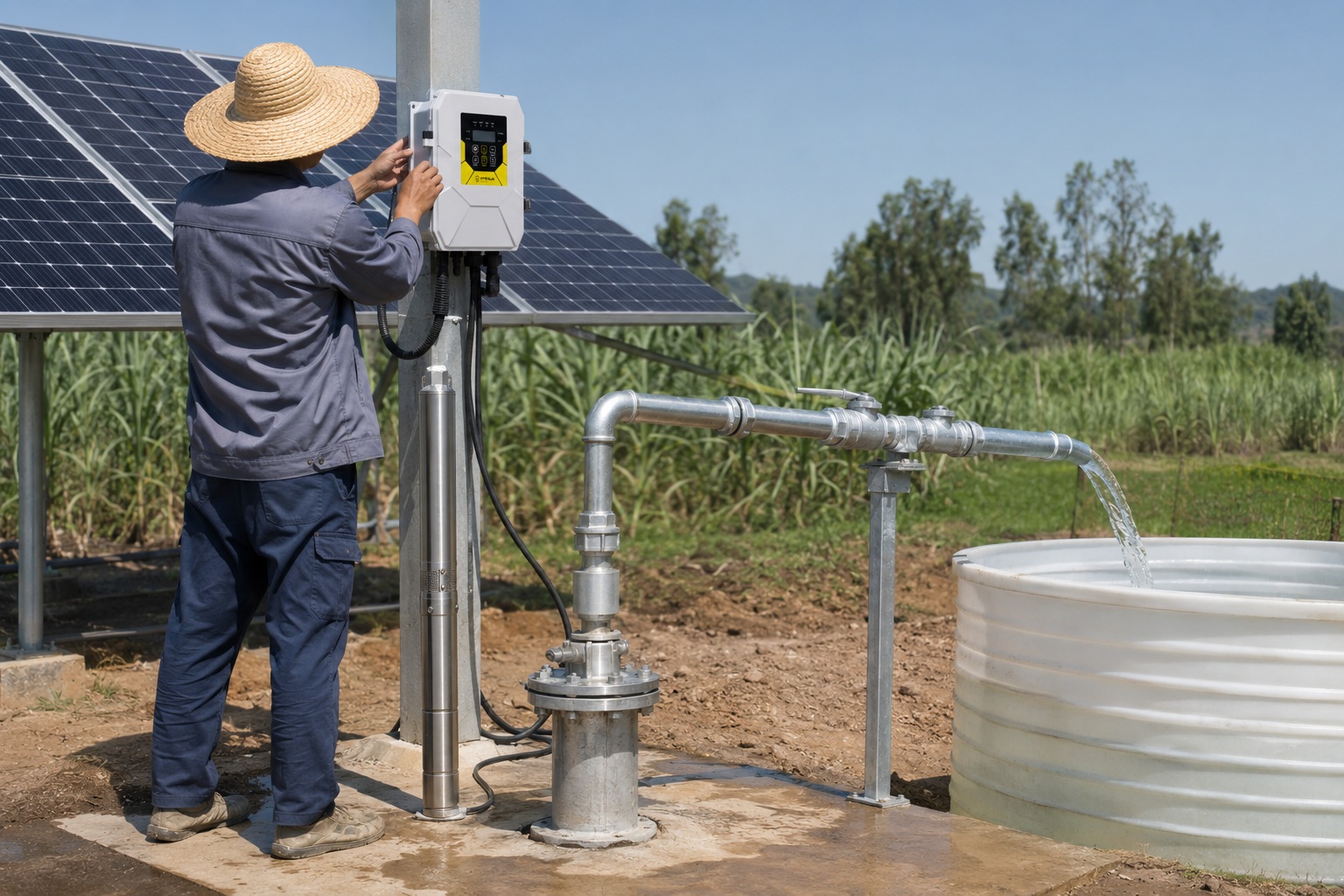
A smart controller is the brain of the solar pump system. It uses MPPT technology to maximize solar energy and can feature an AC/DC hybrid design, ensuring you have a reliable water supply 24 hours a day, regardless of the weather.
A solar pump is more than just a pump and a panel.
The controller is the vital link that manages power, protects the equipment, and ultimately determines the system's usability and reliability.
Modern controllers have evolved from simple on/off switches to sophisticated power management devices.
Offering systems with advanced control features provides a significant competitive advantage and solves real-world problems for end-users.
Understanding MPPT Technology
MPPT stands for Maximum Power Point Tracking.
It is an electronic algorithm that constantly adjusts the electrical operating point of the solar panels to extract the maximum available power.
Solar panels have a complex relationship between voltage and current that changes with sunlight intensity and temperature.
- Without MPPT: A simple controller connects the pump directly to the panels. If the sunlight is not perfect, the system operates at a low efficiency, often stalling or failing to start.
- With MPPT: The controller actively "finds" the sweet spot (the maximum power point) on the panel's curve. This can boost the amount of water pumped per day by up to 30% compared to non-MPPT systems.
The Game-Changer: AC/DC Hybrid Controllers
The most advanced controllers offer a hybrid power input.
This design features separate inputs for both DC power from solar panels and AC power from the grid or a generator.
The controller's internal logic is programmed to prioritize solar power, making it both economical and resilient.
How Hybrid Systems Ensure 24/7 Water
The operation is seamless and automatic.
- Full Sun: The controller powers the pump exclusively from the solar panels (DC input). Grid power (AC input) is not used.
- Cloudy Conditions: The controller's hybrid function intelligently blends solar power with a small amount of AC power. It uses every available watt from the sun first before supplementing from the grid, maximizing solar energy use.
- Night or No Sun: When no photovoltaic input is detected, the controller automatically switches to the AC power source. The pump continues to run at full capacity.
This ensures a worry-free, 24/7 water supply for critical needs like homes, livestock, and businesses, while still maximizing the cost savings from solar energy whenever it is available.
Conclusion
The best solar pump is a flexible portfolio.
It combines efficient motors and smart controllers with specialized pump ends to meet any customer need, from deep wells to high-volume irrigation.
FAQs
Can solar pumps run without batteries?
Yes, most modern solar pump systems are direct-drive and do not require batteries. They pump water when the sun is shining and stop when it is dark, using a storage tank to hold water.
How long do solar water pumps last?
A quality solar water pump system can last for 15-20 years. The solar panels have a lifespan of 25+ years, and the BLDC motor often exceeds 10 years, with the pump end being the main serviceable component.
How deep can a solar pump go?
Solar screw pumps are designed for deep wells and can lift water from over 200 meters (650 feet). Centrifugal pumps are better for shallower wells, typically up to 80 meters (260 feet).
Do solar pumps work on cloudy days?
Yes, but at a reduced flow rate. Systems with high-efficiency BLDC motors and MPPT controllers perform significantly better in low-light conditions than older, less efficient systems.
What size solar pump do I need?
Sizing depends on your daily water requirement and the total dynamic head (well depth plus pressure). A professional can calculate the exact pump and panel array needed for your specific location and needs.
Are solar water pumps worth it?
For off-grid locations, absolutely. The initial investment is often lower than the cost of running grid power to a remote site. With no ongoing fuel or electricity costs, the return on investment is very high.
How do I protect my solar pump from running dry?
Modern controllers include dry-run protection. They use sensors in the well or monitor motor power to automatically shut off the pump if the water level drops too low, preventing damage.
Can I use a solar pump for my swimming pool?
Yes, dedicated solar pool pumps are available. They are highly efficient and can run during the day when the sun is out, significantly reducing the electricity costs associated with pool filtration.