Choosing the wrong pump for a deep well is a costly mistake.
You risk low pressure, high energy bills, and premature equipment failure.
A 7.5 HP pump offers significant power, but is it the right choice for your depth?
A 7.5 HP well pump can typically reach depths between 500 and 1,200 feet.
However, the exact depth depends heavily on the required water flow rate (GPM) and the system's Total Dynamic Head (TDH).
For lower flow rates, the pump can push water from greater depths.
Horsepower is a familiar number, but it doesn't tell the whole story.
The true performance of a 7.5 HP pump is unlocked only when you understand the environment it operates in.
Factors like your well's specific characteristics, your household's water demand, and even the size of your pipes play a critical role.
Simply installing a powerful pump without considering these details is like buying a race car to drive in city traffic.
It's inefficient and likely to cause problems.
Let's break down the essential factors to ensure you select the perfect pump for your needs.
What are the Sizing Factors for Well Pumps?
Picking a pump based on horsepower alone often leads to problems.
An improperly sized pump runs inefficiently, wears out quickly, and inflates your electricity costs.
Understanding the key sizing factors is essential for a reliable and cost-effective water system.
The most critical sizing factors are well depth, static water level, drawdown, required flow rate (GPM), and system pressure.
These elements combine to calculate the Total Dynamic Head (TDH), which represents the total work the pump must perform to deliver water to your home.
To correctly size a well pump, especially a powerful 7.5 HP unit, you must look beyond the motor's rating and analyze the entire system.
This process involves calculating the total resistance the pump will face.
This resistance, known as Total Dynamic Head (TDH), is the sum of three key components.
Failing to account for any of them can lead to selecting a pump that is either too weak or wastefully powerful for your specific application.
Calculating Total Dynamic Head (TDH)
The formula for TDH is simple yet comprehensive:
TDH = Static Head + Friction Loss + Pressure Requirement
-
Static Head: This is the total vertical distance the water must be lifted.
It's measured from the pumping water level (not the bottom of the well) to the height of the pressure tank.
For example, if the pumping water level is 400 feet and the tank is 10 feet above ground, the static head is 410 feet. -
Friction Loss: As water moves through pipes, elbows, and valves, it encounters friction.
This resistance adds to the pump's workload.
Friction loss increases with longer pipe runs, smaller pipe diameters, and higher flow rates.
A 200-foot run of 1.25-inch pipe at 20 GPM might have 12 feet of friction loss, while the same flow through 1-inch pipe could have over 30 feet of loss. -
Pressure Requirement: Your home's pressure tank requires the pump to build additional pressure.
This is converted into feet of head by multiplying the tank's cut-off pressure (in PSI) by 2.31.
A standard 60 PSI setting adds 138.6 feet (60 x 2.31) to the TDH.
Flow Rate (GPM) and Well Yield
Your required Gallons Per Minute (GPM) is determined by peak household demand.
A common rule is to budget 1 GPM for every fixture that might run simultaneously.
A large home with 4 bathrooms, a kitchen, and laundry might need 15-25 GPM during peak morning hours.
However, this demand must be balanced against your well's production rate, or "yield."
If your well only produces 10 GPM, installing a pump rated for 25 GPM will drain the well, pull in sand, and damage the pump.
In these low-yield situations, a smaller pump fills a large storage tank, and a separate booster pump supplies household pressure.
The Impact of GPM on a 7.5 HP Pump's Depth
A 7.5 HP pump's performance is a trade-off between flow and depth.
The more water it has to move (higher GPM), the less vertical distance it can push it.
This relationship is detailed on a pump's performance curve.
| Required Flow Rate (GPM) | Example Maximum Depth for a 7.5 HP Pump |
|---|---|
| 15 GPM | ~1,100 feet |
| 30 GPM | ~950 feet |
| 50 GPM | ~700 feet |
| 75 GPM | ~500 feet |
Note: These are estimates.
Always consult the specific pump's performance curve for accurate data.
What are the Different Types of Well Pumps?
Navigating the world of pumps can be confusing.
Terms like submersible, centrifugal, and screw pump describe different technologies for different jobs.
Choosing the wrong type, even with the right horsepower, will result in poor performance and a short lifespan.
For deep wells, submersible pumps are the standard.
These are further divided into types based on their internal mechanics, such as centrifugal or screw designs.
Each is optimized for specific conditions like flow rate, depth, and water quality, making the right choice critical.
The 7.5 HP rating tells you the power of the motor, but not how that power is applied.
Different pump designs use that horsepower in unique ways to move water.
For deep well applications, the technology inside the pump is just as important as the motor driving it.
Modern systems, particularly those powered by solar energy, have introduced specialized designs that offer distinct advantages for off-grid users, agricultural operations, and environmentally conscious homeowners.
Understanding these types is key to leveraging the full potential of a 7.5 HP motor.
The Powerhouse: Submersible Centrifugal Pumps
For most deep wells, a multi-stage submersible centrifugal pump is the go-to solution.
These pumps consist of a series of impellers stacked on top of each other.
Each impeller and its diffuser is a "stage."
As water passes through each stage, its pressure is boosted.
More stages mean the pump can push water from greater depths.
A 7.5 HP motor can be paired with different "pump ends" containing varying numbers of stages to match the required TDH.
They are known for being quiet, efficient, and reliable.
The Rise of Solar-Powered Pumps
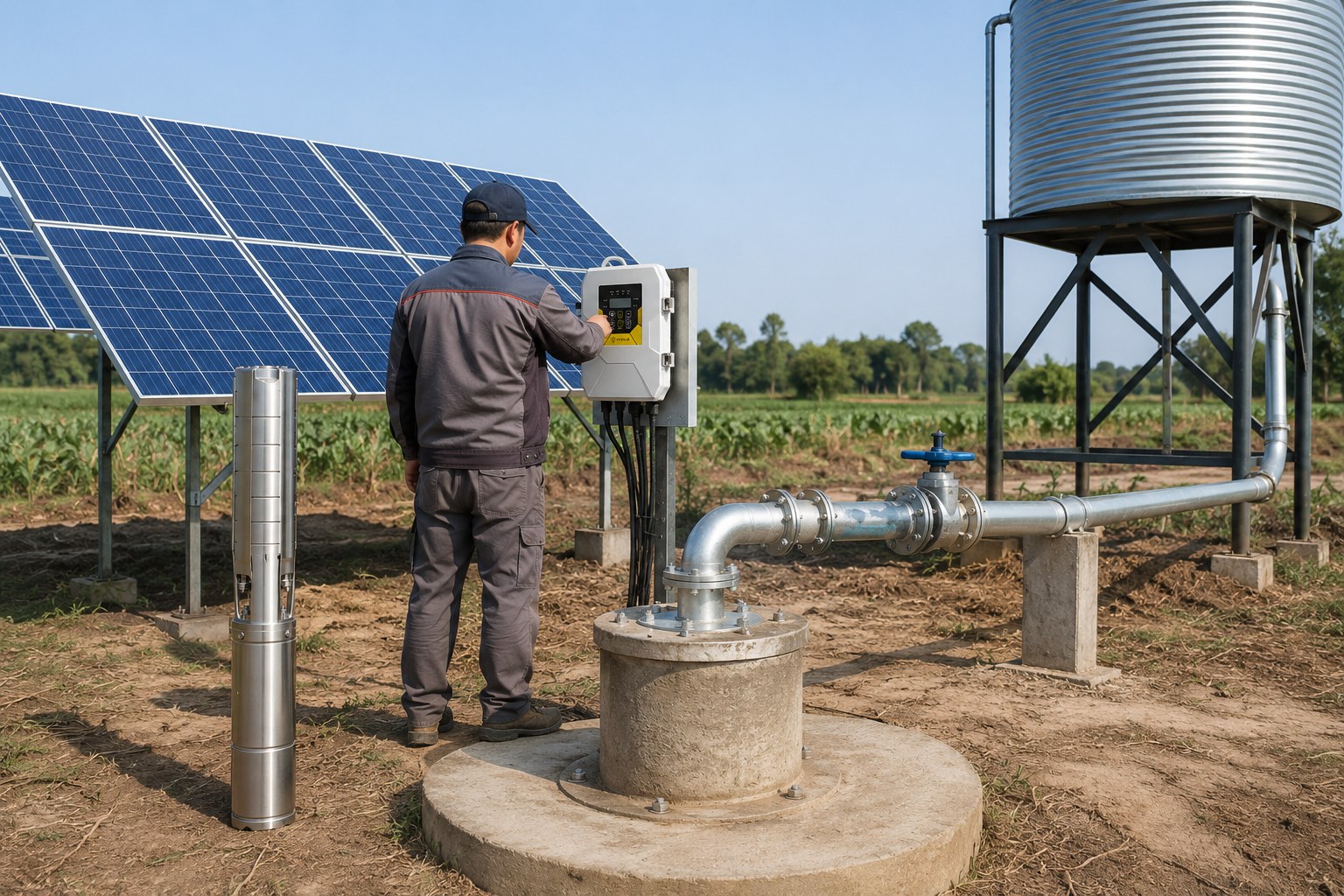
With the global shift towards sustainable solutions, solar well pumps have become a dominant technology.
They operate independently of the grid, offering water security in remote areas.
These pumps are driven by highly efficient motors and come in several designs.
-
Solar Screw Pumps: This design uses a helical rotor (a stainless steel screw) that turns inside a rubber stator.
This action creates sealed cavities of water that are pushed progressively up to the surface.
This mechanism provides very high head (pressure) but at a lower flow rate.
It is exceptionally resistant to sand and abrasive particles, making it ideal for newly drilled wells or those with challenging water conditions.
A 7.5 HP screw pump can achieve incredible depths, perfect for livestock watering or domestic use from very deep aquifers. -
Solar Centrifugal Pumps: These operate on the same principle as standard submersible pumps but are optimized for use with solar power.
They are available with two main impeller types:- Plastic Impellers: These are a cost-effective and lightweight choice.
Modern engineered plastics offer excellent resistance to wear from fine sand and are suitable for general farm irrigation and residential water supply.
They provide high flow rates at medium head. - Stainless Steel Impellers: For the ultimate in durability and corrosion resistance, stainless steel is the premium choice.
These are designed for harsh water environments, such as areas with acidic or alkaline water.
They are ideal for high-value agricultural operations and high-end homes where reliability is paramount.
- Plastic Impellers: These are a cost-effective and lightweight choice.
The Core of Efficiency: BLDC Motors
Modern solar pumps, regardless of type, are almost universally powered by Brushless DC (BLDC) permanent magnet motors.
These motors are a technological leap forward, with efficiencies often exceeding 90%.
This is a significant improvement over traditional AC motors, which might operate at 60-75% efficiency.
This high efficiency means that a 7.5 HP BLDC motor requires significantly fewer solar panels to operate compared to an older AC motor of the same rating.
This reduces the total system cost by 15-25% and simplifies installation.
They are also smaller, lighter, and virtually maintenance-free due to the absence of brushes that can wear out.
Hybrid Systems for Uninterrupted Water
A primary concern with solar-only systems is the lack of water on cloudy days or at night.
Advanced controllers solve this with hybrid AC/DC functionality.
These smart controllers can accept power from both solar panels and an AC source (grid or generator) simultaneously.
The system prioritizes solar power, blending in AC power only when sunlight is insufficient.
When there is no sun, it automatically switches to the AC source, guaranteeing a 24/7 water supply.
| Pump Technology | Best Application | Flow Rate | Head (Depth) | Key Advantage | Primary Limitation |
|---|---|---|---|---|---|
| Solar Screw Pump | Deep wells, sandy water | Low | Very High | Superior sand resistance | Limited water volume |
| Solar Plastic Impeller | General agriculture, homes | High | Medium | Economical and wear-resistant | Lower chemical resistance |
| Solar Stainless Impeller | Corrosive water, premium use | High | Medium-High | Excellent durability & corrosion resistance | Higher initial cost |
What Happens if My Well Pump is Oversized or Undersized?
You might assume that buying a bigger pump is a safe bet.
This "bigger is better" myth is one of the most destructive and expensive mistakes in the water well industry.
It leads to rapid equipment failure, well damage, and wasted electricity.
An oversized pump short-cycles, destroying the motor with excessive starts and stops.
An undersized pump runs constantly, leading to overheating and premature failure.
Proper sizing ensures the pump operates within its most efficient range, maximizing lifespan and minimizing energy consumption.
The goal of pump selection is not to get the most powerful pump, but the right pump.
A 7.5 HP motor is a serious investment, and protecting that investment means ensuring it's matched perfectly to your system's demands.
Both oversizing and undersizing create distinct, predictable patterns of failure that can be easily avoided with a proper TDH calculation.
Understanding these failure modes is crucial for any well owner or installer.
The Dangers of an Oversized 7.5 HP Pump
When a pump is too powerful for the system, it fills the pressure tank extremely quickly.
This causes the pressure switch to shut the pump off.
Because the tank's usable volume is small, a toilet flush or hand washing will quickly drop the pressure, turning the pump back on.
This rapid on-and-off behavior is called short-cycling.
-
Motor Burnout: A motor draws 3 to 5 times its normal running current every time it starts.
This surge creates a massive amount of heat in the motor windings.
A properly sized pump might cycle 4-6 times per hour.
An oversized pump can cycle over 20 times per hour, never giving the motor a chance to cool down.
A pump that should last 10-15 years can burn out in just 2-3 years under these conditions. -
Well Damage and Sand Infiltration: When a 7.5 HP pump pulls water much faster than the aquifer can replenish it, the water level around the well screen drops violently.
This turbulence can pull fine sand and sediment into the well.
This abrasive material erodes the pump's impellers, clogs check valves, and can eventually fill the bottom of your well, reducing its effective depth and potentially collapsing the surrounding formation. -
Excessive Energy Costs: A 7.5 HP motor uses significantly more electricity than a 5 HP or 3 HP motor.
If a smaller pump could have done the job, you are paying 40-60% more in electricity every hour the pump runs.
Compounded by the fact that short-cycling makes it run more frequently, the financial waste can add hundreds of dollars to your annual electric bill.
The Frustration of an Undersized Pump
An undersized pump is just as problematic, though its symptoms are different.
The most obvious sign is a noticeable drop in water pressure when multiple faucets are running.
The pump may run continuously for long periods, struggling to reach the pressure tank's cut-off setting.
-
Motor Overheating: Submersible motors are cooled by the flow of water past the motor housing.
When an undersized pump runs for hours on end at maximum capacity, it generates more heat than the water flow can dissipate.
This sustained high temperature degrades the motor's internal insulation, leading to an electrical short and complete motor failure.
We often see undersized pumps fail in 4-6 years, less than half their expected service life. -
Inadequate Water Supply: In the worst-case scenario, the pump simply cannot keep up with demand.
During peak usage times, like mornings or evenings, the system pressure may never recover, leaving the household with an unusable trickle of water.
Sizing Problem Diagnosis
| Symptom | Likely Cause | Primary Consequence | Solution |
|---|---|---|---|
| Pump turns on and off every few minutes | Oversized Pump | Rapid motor burnout, high energy bills | Replace with correctly sized pump. |
| Shower pressure drops when toilet flushes | Undersized Pump | Motor overheating, low pressure | Replace with correctly sized pump. |
| Sand or sediment in water | Oversized Pump | Pump wear, well damage | Replace pump; investigate well for damage. |
| Pump runs constantly but pressure is low | Undersized Pump | Premature motor failure | Replace pump; consider a storage tank for low-yield wells. |
Conclusion
A 7.5 HP pump is a powerful tool capable of servicing very deep wells.
However, its actual depth is dictated by flow rate and TDH, not just horsepower.
Proper sizing and selecting the right pump technology are crucial for efficiency, reliability, and longevity.
FAQs
What size well pump do I need for a 500 foot well?
For a 500-foot well, you'll likely need a 2 HP to 5 HP pump, depending on your required GPM.
A professional TDH calculation is essential for an accurate size.
Can I put a bigger HP pump in my well?
It is strongly discouraged.
An oversized pump will short-cycle, leading to premature motor failure, well damage, and higher energy costs.
Matching the pump to the system is best.
How many GPM does a 7.5 HP well pump produce?
A 7.5 HP pump's GPM varies widely, from 15 GPM at very high head (over 1000 ft) to over 100 GPM at lower head (around 300 ft).
What is the difference between a 2-wire and 3-wire submersible pump?
A 2-wire pump has its starting components inside the motor down in the well.
A 3-wire pump has these components in a control box at the surface for easier service.
How long should a 7.5 HP well pump last?
A properly sized and installed 7.5 HP pump should last 10 to 15 years.
Oversizing or undersizing can drastically reduce this lifespan to as little as 2-5 years.
Does a deeper well always need a bigger pump?
Generally, yes, as depth increases TDH.
However, a shallow well with a very low water level can require a more powerful pump than a deep well with a high water level.
What is the most efficient type of well pump?
Modern solar-powered pumps with Brushless DC (BLDC) motors are the most efficient, often exceeding 90% efficiency, which significantly reduces energy or solar panel requirements.
How do you calculate TDH for a well pump?
TDH is calculated by adding the static head (vertical lift), all friction losses from pipes and fittings, and the pressure requirement of your home (PSI x 2.31).