Struggling with low water pressure from your 300 ft well?
An incorrectly sized pump wastes energy and wears out fast, costing you money and peace of mind.
For a 300-foot well, a 1 HP submersible pump is a common and versatile choice, typically providing 10-20 gallons per minute (GPM). However, the best size depends on your home's water demand and Total Dynamic Head (TDH), not just depth alone.
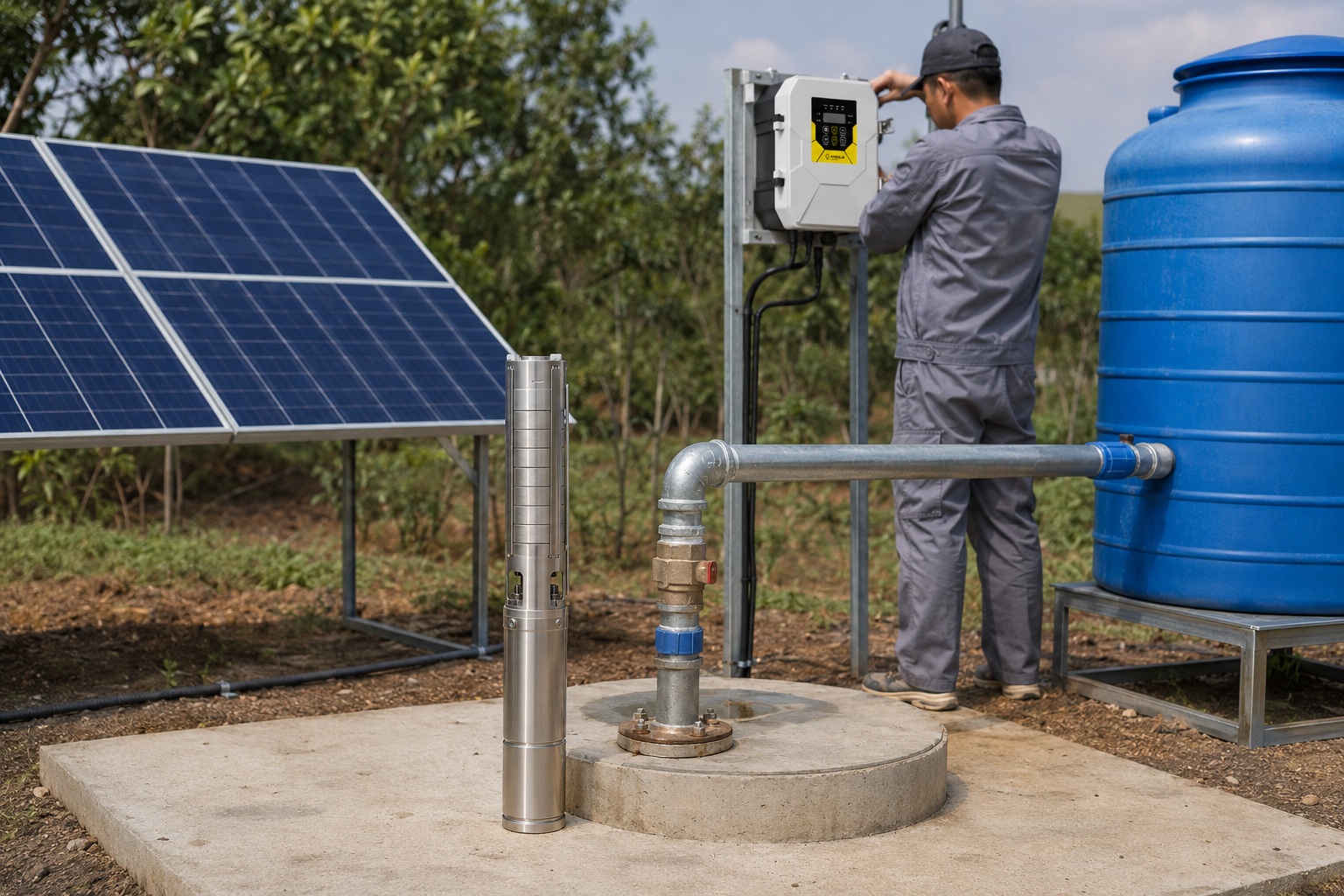
Selecting the right pump is about more than just horsepower.
It's a delicate balance of depth, flow rate, and the specific needs of your water system.
Choosing correctly means you get reliable water pressure without wasting electricity or causing premature wear on your equipment.
Let's break down how to choose the perfect pump to ensure reliable water for years to come.
What is the most common well pump size?
You need a reliable pump but feel lost in a sea of technical jargon.
Choosing the wrong one means poor performance and wasted money.
The most common size is a 1 HP, 4-inch diameter submersible pump. This size is versatile, handling wells up to 300-400 feet deep and suiting residential, livestock, and irrigation needs, making it a popular and effective choice for many applications.
A 1 horsepower (HP) pump is considered a workhorse in the water pump industry.
Its popularity stems from its ability to meet the demands of a wide range of applications.
It can serve a single-family home, provide water for livestock, or even handle small-scale irrigation.
However, the "1HP" label only refers to the motor's power.
The actual performance in terms of flow and depth depends on the pump end attached to that motor.
Beyond Horsepower: The Pump End Matters
The pump end is the part of the submersible pump that actually moves the water.
It contains a series of impellers, or centrifuges, that spin rapidly.
This spinning action creates centrifugal force, which pushes water up the drop pipe to the surface.
The more impellers stacked inside the pump end, the greater the pressure it can generate.
This allows the pump to push water from deeper wells.
A 1HP motor can be paired with different pump ends to achieve different outcomes.
One pump end might be designed for high flow at a shallow depth, while another is designed for lower flow from a much deeper well.
Modern Solutions for a 300-Foot Well
For a 300-foot well, you need a pump end designed for high "head," which is the vertical distance it can lift water.
In the world of modern solar pumps, this has led to specialized designs that are highly efficient for specific conditions.
A 1HP motor is more than capable of handling this depth, but pairing it with the right pump end is crucial for efficiency and longevity.
Below is a comparison of different pump types that could be used with a motor in the 1HP range.
| Pump Type | Best For (Head) | Best For (Flow) | Key Feature | Ideal Application for a 300-ft Well |
|---|---|---|---|---|
| Solar Screw Pump | High Head (>400 ft) | Low Flow (2-5 GPM) | Excellent sand resistance | Domestic use in a low-yield well. |
| Plastic Impeller Pump | Medium Head (150-350 ft) | High Flow (15-30 GPM) | Economical & wear-resistant | High-demand homes or irrigation with good well recovery. |
| Stainless Steel Impeller Pump | Medium-High Head (200-450 ft) | High Flow (15-30 GPM) | High corrosion resistance | Homes with acidic or alkaline water. |
This shows that even with the same power motor, the pump's construction determines its ideal use.
How to Determine the Right Size Well Pump for Your Home
Guessing your home's water needs can lead to weak showers and sputtering faucets.
Don't let poor planning disrupt your daily water supply.
Calculate your home's peak water demand by counting your fixtures (faucets, showers, etc.) and assigning 1-2 Gallons Per Minute (GPM) to each. A typical 3-4 bedroom home needs 8-12 GPM to maintain steady pressure during peak use.
Sizing a well pump correctly starts with understanding how much water your household uses at its busiest moment.
This is known as your peak water demand.
You are not sizing for your average daily use, but for that moment when multiple showers are running, the dishwasher is on, and a toilet is flushed.
Calculating Your Gallons Per Minute (GPM)
The simplest way to estimate your peak demand is the fixture count method.
You count all the water-using fixtures in your home and add up their typical flow rates.
This gives you a target GPM that your pump must be able to deliver.
Here are some average flow rates for common household fixtures:
| Fixture Type | Average GPM |
|---|---|
| Faucet | 1.0 - 2.0 |
| Shower | 2.0 - 2.5 |
| Toilet (refilling) | 2.0 - 3.0 |
| Dishwasher | 1.5 - 2.0 |
| Washing Machine | 3.0 - 5.0 |
| Outdoor Spigot | 3.0 - 5.0 |
For example, if you might have one shower (2.5 GPM), a kitchen faucet (2.0 GPM), and a washing machine (4.0 GPM) running at the same time, your peak demand would be 8.5 GPM.
In this case, a pump capable of delivering at least 10 GPM would be a safe choice.
Don't Exceed Your Well's Yield
There is one critical rule: your pump's flow rate should never exceed your well's recovery rate.
The recovery rate is the speed at which your well naturally refills with water.
If your well only produces 5 GPM, installing a 15 GPM pump is a recipe for disaster.
The pump will quickly draw the water level down, start sucking in air and sediment, and burn itself out.
Always refer to your well driller's report for the sustained yield of your well and choose a pump with a GPM rating below that number.
The Role of High-Efficiency Motors
Delivering the required GPM from a 300-foot depth takes significant energy.
This is where motor efficiency becomes paramount, especially for off-grid solar applications.
Modern solar pumps often use brushless DC (BLDC) permanent magnet motors.
These motors can achieve efficiencies over 90%, compared to 60-70% for older AC motors.
A more efficient motor can deliver the same GPM and pressure with up to 30% less power.
This means you can run your system with fewer solar panels, reducing the total upfront cost and making the entire system more compact and easier to install.
Understanding Well Pump Types and Power Ratings
Choosing between jet pumps and submersibles feels complex.
Making the wrong choice means inefficient operation and a shorter lifespan for your pump.
For a 300-foot well, a submersible pump is the only correct choice. Submersible pumps are placed deep inside the well and push water up, making them far more efficient and powerful for depths greater than 25 feet compared to above-ground jet pumps.
The type of pump you choose is dictated almost entirely by the depth of your well.
There are two main categories: shallow well pumps and deep well pumps.
Why Submersible Pumps Dominate Deep Wells
For any well deeper than 25 feet, a submersible pump is the industry standard.
Unlike jet pumps, which are installed above ground and use suction to pull water up, submersible pumps are submerged in the well water.
They don't pull water; they push it.
This pushing action is far more efficient for overcoming the immense weight of a 300-foot column of water.
Because they are submerged, the surrounding water also helps to cool the motor, which extends its lifespan and allows for quieter operation.
You won't hear a submersible pump running from inside your house.
Choosing the Right Submersible for the Job
While all pumps for a 300-foot well will be submersible, not all submersibles are created equal.
The internal construction of the pump determines its performance characteristics.
In the solar pump market, three distinct designs have emerged to meet different needs:
-
Solar Screw Pump: This design uses a helical screw rotating inside a rubber stator. It's like an Archimedes' screw. This mechanism is excellent for creating very high pressure, making it ideal for extremely deep wells or applications needing high head. It is also highly resistant to sand, as it doesn't rely on tight-tolerance impellers. However, its flow rate is typically low.
-
Solar Plastic Impeller Pump: This is a multi-stage centrifugal pump. It uses a stack of durable plastic impellers to accelerate water. It is designed to deliver very high flow rates at a medium head. This makes it perfect for farm irrigation or large homes where water demand is high. The plastic material is lightweight, economical, and surprisingly resistant to wear from fine sand.
-
Solar Stainless Steel Impeller Pump: This pump is the premium option. It functions like the plastic impeller pump but uses impellers made from SS304 stainless steel. This makes it highly resistant to corrosion and abrasion. It is the best choice for areas with acidic or alkaline water, or for high-end applications where maximum durability and reliability are required.
For a 300-foot well, any of these could be appropriate depending on your water quality, required flow rate, and budget.
Well Pump Sizing Guide: How to Choose the Right Size for Your Well
Oversizing or undersizing a pump is a costly mistake.
You'll either burn out the motor or suffer from weak water pressure.
Proper sizing balances three key factors: your home's water demand (GPM), the Total Dynamic Head (TDH), and your well's recovery rate. Neglecting any of these will lead to an inefficient system and premature pump failure. Get these right for a long-lasting solution.
Choosing the right pump is a technical calculation, not a guess.
Getting it wrong is one of the most common and expensive mistakes a well owner can make.
To size a pump like a professional, you must understand and balance the three critical variables.
Three Key Sizing Factors
- Water Demand (GPM): As discussed, this is the peak flow rate your household requires.
- Total Dynamic Head (TDH): This is the total resistance the pump must work against to deliver water to your house at the right pressure. It's the most important technical specification.
- Well Recovery Rate: This is the maximum GPM your well can sustainably provide. Your pump's GPM must be less than this number.
Calculating Total Dynamic Head (TDH) for a 300-Foot Well
TDH is the sum of several different factors, all measured in feet.
It represents the total "lift" and "push" the pump must provide.
Let's calculate an example for a 300-foot well:
- Pumping Water Level: Your well might be 300 feet deep, but the water level when the pump is running (the pumping level) might be at 250 feet. This is the vertical lift.
- Elevation Gain: This is the vertical height from the wellhead at the surface to your pressure tank. Let's assume it's 20 feet uphill.
- Pressure Requirement: You want your house pressure to be 50 PSI. To convert PSI to feet of head, you multiply by 2.31. So, 50 PSI = 115.5 feet of head.
- Friction Loss: As water moves through pipes, it loses energy to friction. For a long pipe run, this can be significant. Let's estimate it at 15 feet.
Adding these together gives you the TDH.
| TDH Component | Example Value (Feet) | Description |
|---|---|---|
| Pumping Water Level | 250 | Depth to water while the pump is running. |
| Elevation Gain | 20 | Height from wellhead to the pressure tank. |
| Pressure Requirement (50 PSI) | 115.5 | Pressure needed at the house (PSI x 2.31). |
| Friction Loss | 15 | Resistance from pipes, fittings, and valves. |
| Total Dynamic Head (TDH) | 400.5 | The total work the pump must do. |
In this scenario, the pump needs to perform as if it's lifting water over 400 feet, even though the well is only 300 feet deep.
Reading a Pump Performance Curve
With your GPM demand (e.g., 10 GPM) and your TDH (400.5 feet), you can now select a pump.
Every pump has a performance curve chart.
You find your TDH on the vertical axis and your GPM on the horizontal axis.
You need to find a pump whose curve passes through or above the point where your requirements intersect.
This is how professionals ensure the pump is a perfect match, rather than just relying on a horsepower rating.
Common Sizing Mistakes (and How to Avoid Them)
A new pump that fails in two years is frustrating and expensive.
Avoid common sizing mistakes that lead to premature wear and failure.
The biggest mistakes are oversizing, which causes rapid cycling and burnout, and undersizing, which leads to low pressure and constant running. Always match the pump's GPM to your home's needs without exceeding the well's recovery rate.
A correctly sized pump is a balanced pump.
It runs efficiently, lasts for years, and provides consistent water pressure.
An incorrectly sized pump, whether too big or too small, will cause a cascade of problems.
The Dangers of an Oversized Pump
Many people think "bigger is better," but with well pumps, that's wrong.
An oversized pump fills the pressure tank too quickly, causing the pump to turn on and off rapidly.
This is called "short cycling," and it's a death sentence for a motor.
Each start-up draws a large surge of current, which generates heat and stresses electrical components.
An oversized pump can also draw down the well water level too fast, pulling in sand and sediment that will grind away the pump's internal parts.
It's a huge waste of electricity and will destroy the pump, the pressure switch, and potentially the well itself.
The Frustration of an Undersized Pump
An undersized pump can't keep up with your home's water demand.
You'll experience weak pressure, especially when more than one faucet is open.
The pump will run constantly, trying to reach the pressure switch's cut-off setting, but it may never get there.
This continuous operation will cause the motor to overheat and fail prematurely.
It's an inefficient and frustrating situation that puts constant strain on the entire water system.
Common Problems and Causes
Here’s a quick reference for troubleshooting issues related to pump sizing:
| Problem | Possible Cause | Recommended Action |
|---|---|---|
| Low water pressure | Undersized pump; low well level | Verify TDH calculation and resize pump; check well yield. |
| Pump cycles on/off rapidly | Oversized pump; failed pressure tank | Resize pump; add a larger tank or consider a VFD system. |
| Pump fails frequently | Over-pumping the well; short cycling | Conduct a well yield test; verify pump size is correct. |
| Sputtering, air in lines | Pumping the well dry | Reduce pump's flow rate or install a low-yield solution. |
Variable Speed Pumps vs. Standard Pumps
Are you tired of water pressure dropping when someone else uses a faucet?
A standard pump's on/off cycle is the likely culprit.
Variable speed pumps, or constant pressure systems, adjust their speed to match water demand in real-time, providing consistent pressure and saving 30-50% on energy. They are a significant upgrade over standard, single-speed pumps for modern homes.
Traditional well pump systems operate within a pressure range, typically turning on at 40 PSI and off at 60 PSI.
This fluctuation is what you feel as a pressure drop in the shower.
Modern technology offers a much better solution.
The Brains of the Operation: Intelligent Controllers
Variable Frequency Drive (VFD) controllers are the brains behind constant pressure systems.
Instead of a simple on/off switch, a VFD adjusts the motor's speed to precisely match the water being used.
Turn on one faucet, and the pump runs slowly.
Open three showers, and it speeds up.
This results in a steady, unfluctuating water pressure at all times.
For solar pumps, this technology is built into the Maximum Power Point Tracking (MPPT) controller.
The MPPT controller not only ensures constant pressure but also constantly adjusts the pump's speed to make the most of the available sunlight.
It maximizes water output throughout the day, even in cloudy conditions.
The 24/7 Solution: AC/DC Hybrid Systems
A common concern with solar pumps is what happens at night or on very cloudy days.
The most advanced systems solve this with an AC/DC hybrid controller.
This controller can accept power from both the solar panels (DC) and the utility grid or a generator (AC).
It is programmed to prioritize solar power first.
When sunlight is insufficient to meet demand, it automatically blends in or switches over to AC power.
This provides the best of both worlds: the free, clean energy of solar during the day and the 24/7 reliability of the grid at night.
It ensures you have worry-free water access around the clock.
| System Type | Pressure | Energy Efficiency | Upfront Cost | Key Feature |
|---|---|---|---|---|
| Standard (On/Off) | Fluctuates (e.g., 40/60 PSI) | Low | Low | Simple, but inefficient and less comfortable. |
| VFD / Constant Pressure | Constant (e.g., 55 PSI) | High | High | Superior comfort and significant energy savings. |
| Solar with MPPT | Varies with sun, but optimized | Very High | Medium-High | Runs off-grid, zero electricity cost. |
| Solar with AC/DC Hybrid | Constant (if AC is available) | Highest (blends power) | Highest | The ultimate in reliability and efficiency. |
Conclusion
Sizing a pump for a 300-foot well requires balancing GPM, TDH, and well yield.
Modern solar solutions with intelligent controllers offer superior efficiency, reliability, and comfort for any off-grid or residential water system.
FAQs
What HP well pump do I need?
For a 300-foot well, a 1 to 1.5 HP pump is common, but the exact size depends on your specific Total Dynamic Head (TDH) and required flow rate (GPM).
Is a bigger pump always better?
No. An oversized pump will short cycle, causing it to wear out quickly and waste energy. The best pump is one that is correctly matched to your well and home's needs.
Will a higher HP well pump increase water pressure?
Not necessarily. Horsepower provides lift, while pressure is managed by your pressure tank and switch. For better pressure, consider a constant pressure (VFD) system.
What size of pump do I need to lift water 500 feet?
Lifting water 500 feet typically requires a 1.5 HP to 2 HP pump or larger, but a full TDH calculation is essential to determine the correct size and model.
How long should a well pump last?
A properly sized and installed submersible pump should last 8-15 years. Incorrect sizing is a leading cause of premature failure, often within 2-5 years.
What is a constant pressure system?
This system uses a variable frequency drive (VFD) to adjust the pump's speed, maintaining a steady water pressure at all fixtures and saving energy.
Can a solar pump work at night?
A standard solar pump cannot. However, an AC/DC hybrid system can automatically switch to grid or generator power, providing an uninterrupted water supply 24/7.
What happens if my pump is too strong for my well?
A pump that is too powerful will draw water faster than the well can recover, causing it to pump air and sediment. This can destroy the pump motor.