Struggling with high fuel costs and unreliable power for your water pump?
You're watching profits dry up with every expensive fuel run and frustrating power outage.
Yes, solar-powered water pumps are an excellent solution.
They provide a cost-effective, reliable, and eco-friendly water supply by eliminating fuel costs and drastically reducing maintenance. This makes them a superior choice for off-grid agriculture, livestock, and domestic use.
Deciding on the right water pump is a critical choice for any farm, ranch, or off-grid homestead.
With so many options, it's easy to feel overwhelmed.
You need a solution that delivers water consistently without draining your budget or your time.
This guide will walk you through the real-world performance of solar water pumps.
We will break down the costs, explore their reliability in all conditions, and help you choose the perfect pump type for your specific needs.
How Do Solar Pumps Handle Costs and Return on Investment?
The initial price tag for a solar water pump system can seem high.
But recurring fuel and maintenance bills for traditional pumps quickly add up.
These ongoing expenses constantly eat into your profits and budget.
Solar pumps have a higher upfront cost but are significantly cheaper in the long term.
With zero fuel expenses and low maintenance, the return on investment (ROI) is often achieved within 1-3 years. This delivers substantial financial savings over the pump's 15-20 year lifespan.
The most significant barrier for many farmers considering a switch to solar is the upfront investment.
You have to purchase the pump and the solar panels all at once.
This can look like a large number compared to buying a cheaper gasoline-powered pump off the shelf.
However, this initial figure doesn't tell the whole story.
True cost-effectiveness is measured over the lifetime of the equipment.
Calculating Your Payback Period
To understand the financial benefit, you must look beyond the purchase price.
Consider a scenario for watering a small herd of 50 cattle.
A gasoline pump might cost $500 initially.
But if it consumes $5 worth of fuel per day, that's over $1,800 a year in fuel alone.
This doesn't even include oil changes and regular maintenance.
A comparable solar pump system might cost $2,500.
With zero fuel costs, it saves you $1,800 annually, meaning the system pays for itself in less than 1.5 years.
After that, the water is virtually free for the next 15+ years.
The long-term savings are massive.
| Pump Type | Upfront Cost (Est.) | Annual Fuel Cost (Est.) | Annual Maintenance (Est.) | 5-Year Total Cost |
|---|---|---|---|---|
| Solar Pump | $2,500 | $0 | $50 | $2,750 |
| Gasoline Pump | $500 | $1,825 | $200 | $10,625 |
| Grid AC Pump | $800 | $950 | $100 | $5,550 |
Note: Costs are estimates and will vary based on location, usage, and local energy prices.
Market Trends Favor Solar
Two powerful market forces are making solar an even smarter investment.
First, the cost of solar technology is continuously falling.
Over the past decade, the price of solar panels has decreased by more than 70%.
This trend is expected to continue.
Second, the price of fossil fuels is volatile and generally on the rise.
This means the disadvantage of a high upfront cost for solar is shrinking every year, while the advantage of zero fuel costs grows larger.
For a distributor, this means you can offer your customers a product that becomes more financially attractive over time, securing their future profitability and loyalty.
What About Pumping on Cloudy Days or at Night?
Your crops and livestock need water every single day, regardless of the weather.
What happens when the sun isn't shining?
This is a common and valid concern that can make potential users hesitate.
Modern solar pumps work even on overcast days, although at a reduced flow rate.
*For 24/7 water access, the best solutions include pumping into a storage tank or using an advanced hybrid controller. This controller can automatically switch to grid or generator power when sunlight is insufficient.
The idea that a solar pump stops working the moment a cloud appears is a common misconception.
High-quality solar pump systems are designed to be resilient.
They can often produce sufficient water even in low-light conditions, like on rainy or heavily overcast days.
However, for applications that demand a constant water supply, two main strategies ensure you are never left dry.
Strategy 1: Water Storage Tanks
This is the simplest and most common solution.
It's a brilliantly effective way to guarantee water is always available.
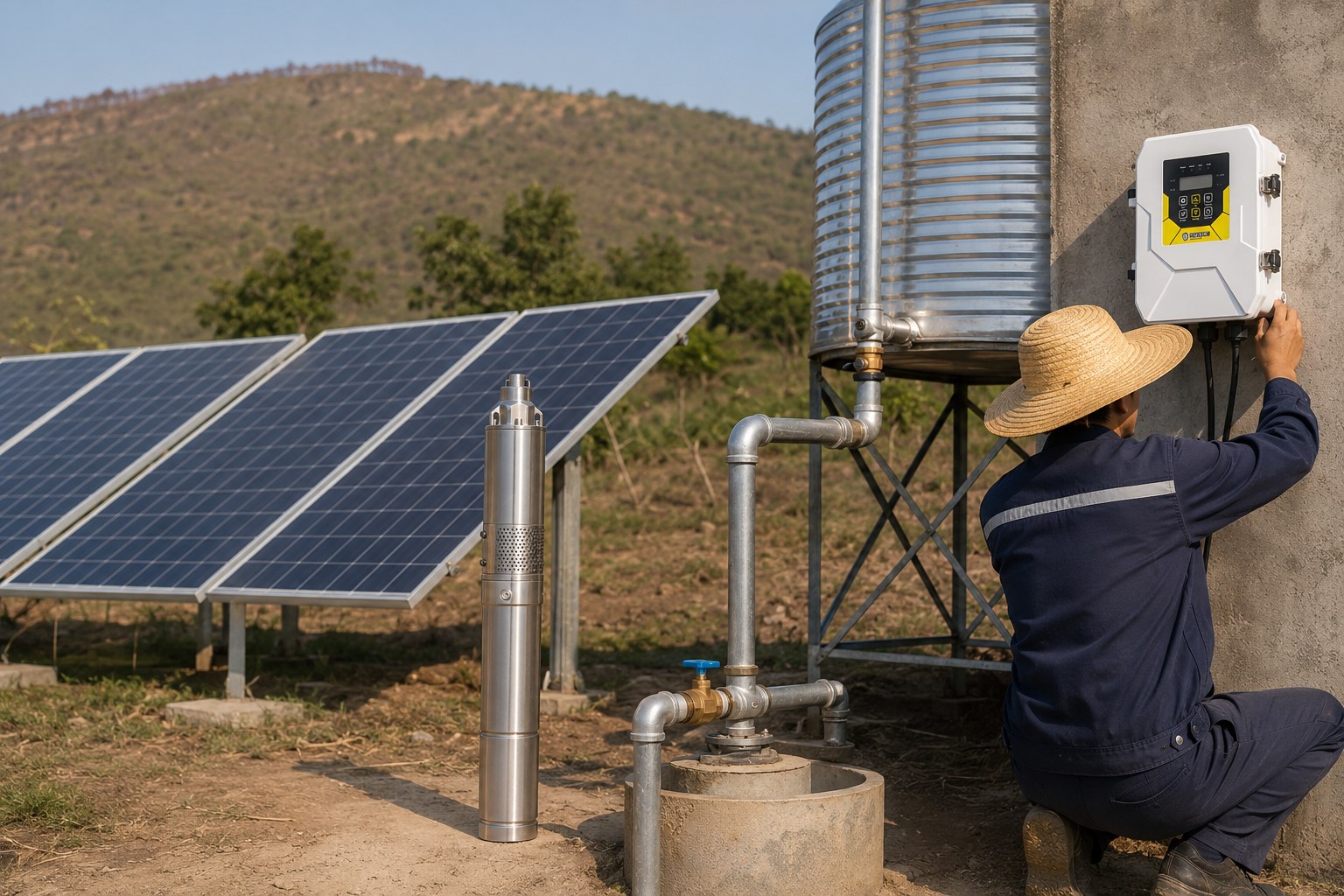
The strategy involves using your solar pump during the sunniest parts of the day to fill a large water storage tank.
You are essentially storing water instead of storing electricity.
The tank is typically placed on high ground or a tower.
When you need to irrigate crops or water livestock in the evening, at night, or on very dark days, you can simply open a valve.
Gravity then feeds the water wherever it needs to go.
This method is incredibly reliable and cost-effective.
It avoids the expense and complexity of batteries and provides a large, ready-to-use water reserve.
A 5,000-gallon tank can provide water for hundreds of cattle for several days.
Strategy 2: Hybrid Power Systems
For ultimate flexibility and peace of mind, hybrid power systems are the cutting-edge solution.
This technology completely eliminates any anxiety about weather conditions.
These systems use an intelligent controller that can accept power from multiple sources.
The primary power source is always the solar panels.
The controller's job is to maximize the use of this free solar energy.
However, if the solar input drops due to heavy clouds or at nighttime, the controller can automatically blend in or switch over to a secondary power source.
This backup source can be AC grid power or a connected generator.
This process is seamless and fully automatic.
It ensures the pump operates at the required speed to meet your water demands 24/7.
You can connect both solar panels and an AC source simultaneously.
The system prioritizes solar and only uses AC power when absolutely necessary, keeping your energy costs to a minimum while guaranteeing a constant water supply.
This makes it the perfect solution for critical applications.
Are Solar Pumps Reliable and Easy to Maintain?
Traditional pumps mean constant refueling trips and regular servicing.
This downtime and extra cost always seem to happen when you can least afford them.
It's a cycle of labor and expense that many farmers are tired of.
Solar pumps are extremely reliable and require minimal maintenance.
There are no fuel runs and far fewer moving parts to service. The main task is simply wiping the solar panels clean to ensure they produce the maximum amount of energy.
One of the most celebrated advantages of solar water pumps is their incredible ease of use.
Once installed, they do their job quietly and efficiently without demanding constant attention.
This frees up your valuable time and energy for other important tasks on the farm.
Compared to fossil fuel pumps, the difference in labor and maintenance is night and day.
You will never again have to run to the gas station in a panic because your pump ran dry while your crops are thirsty.
The Power of Brushless Motors
The core of a modern solar pump's reliability lies in its motor.
Most high-quality systems use a BLDC (Brushless DC) permanent magnet motor.
Unlike older motor designs, these have no carbon brushes that wear out and need replacement.
This single design choice dramatically increases the motor's lifespan and virtually eliminates internal maintenance.
Furthermore, these motors are incredibly efficient, with some converting over 90% of the electrical energy into mechanical power to move water.
This high efficiency means you get more water pumped for every watt of solar energy produced.
It also means the motor runs cooler and with less stress, contributing to a service life that can exceed 15-20 years.
This can reduce your annual maintenance time by up to 95% compared to a diesel pump.
Simple On-Farm Servicing
While internal motor maintenance is rare, what about other issues?
Manufacturers understand that their pumps are used in remote locations.
Solar surface pumps (which are not submerged in water) are especially designed for easy maintenance.
Because they don't need to be perfectly watertight, they are often repairable with a basic toolkit you already have on your farm.
For submersible pumps, which operate deep inside a well, pulling the pump can be more work.
However, their robust construction means this is an infrequent task.
Many leading brands offer comprehensive warranties, some as long as 10 years.
This provides a decade of worry-free irrigation and peace of mind.
The only regular task is to wipe dust and dirt off your solar panels, which takes just a few minutes and ensures your system continues to produce maximum power.
Which Solar Pump is Right for My Application?
Not all wells and water needs are the same.
Choosing the wrong pump can lead to poor performance, inefficiency, and premature failure.
You need to match the pump technology to the job you need it to do.
The right pump depends on your specific needs.
Use a screw pump for deep wells requiring high lift but low flow. Choose a plastic impeller pump for high-volume irrigation. Opt for a stainless steel impeller pump for durability in corrosive water.
To build a competitive and flexible product portfolio, it's essential to understand the different types of solar pumps and their unique strengths.
Each is engineered to excel in a specific scenario.
All are powered by the same highly efficient BLDC motor technology, but the pump-end mechanism determines their performance characteristics.
This allows you to meet diverse market needs, from a small home in Latin America to a large ranch in Australia.
For Deep Wells: Solar Screw Pumps
These pumps are the specialists for high-lift applications.
A solar screw pump uses a helical stainless steel rotor (the screw) that turns inside a rubber stator.
This action creates sealed cavities that move water upward through compression.
This design allows them to generate immense pressure, making them ideal for pushing water up from very deep wells (over 1,000 feet / 300 meters).
Their trade-off is a lower flow rate.
They are also highly resistant to sand and sediment, which would quickly damage other pump types.
- Best For: Deep domestic wells, livestock watering in arid regions, high-elevation water transfer.
For High-Volume Irrigation: Plastic Impeller Pumps
When you need to move a lot of water for applications like farm irrigation or filling large reservoirs, a multi-stage centrifugal pump is the answer.
These pumps use a series of impellers that spin at high speed to propel water.
Models with durable, wear-resistant plastic impellers offer an excellent balance of performance and value.
They deliver high flow rates at a medium head (lift).
They are lightweight and more economical, making them a popular choice for large-scale agriculture in Africa and the Americas.
Their excellent resistance to fine sand is another key advantage.
- Best For: Farm irrigation, pasture water supply, filling ponds, and home gardens.
For Harsh Water Conditions: Stainless Steel Impeller Pumps
In some regions, the water itself is the biggest challenge.
Water with high acidity (low pH) or alkalinity (high pH) can corrode and destroy standard pumps in a short time.
For these environments, a premium pump with stainless steel impellers is the only reliable choice.
These models use SS304 stainless steel for the impellers, pump body, and other components that contact the water.
This provides superior corrosion resistance and ensures a long, reliable service life.
While they have a higher initial cost, they are the most durable and cost-effective solution for challenging water quality.
- Best For: Acidic or alkaline water, coastal areas with saltwater intrusion, high-end homes and ranches demanding maximum durability.
| Pump Type | Key Feature | Ideal Application | Flow Rate | Head (Lift) |
|---|---|---|---|---|
| Solar Screw Pump | High Head, Sand Resistant | Deep Wells, Domestic Water | Low | Very High |
| Plastic Impeller Pump | High Flow, Economical | Farm Irrigation, High Volume | High | Medium |
| Stainless Steel Impeller | Corrosion Resistant, Durable | Harsh Water, Premium Homes | High | Medium-High |
Conclusion
Solar pumps are an excellent investment.
They offer massive long-term savings, incredible reliability, and environmental benefits.
With a versatile portfolio of options, there is a solar pump to suit any water need.
FAQs
How long do solar water pumps last?
A quality solar pump system can last 15-20 years. The brushless motor often has a long lifespan, while the solar panels are typically warrantied for 25 years of production.
Can a solar pump fill a large tank?
Absolutely. You just need to size the pump and solar panel array correctly for the tank volume. The system will then work throughout the day to fill the tank automatically.
Do solar pumps work in winter?
Yes, solar pumps work in winter, but their output is reduced due to shorter days and a lower sun angle. An oversized panel array can help compensate for this.
How deep can a solar pump pull water from?
It varies by pump type. Solar screw pumps are designed for deep wells and can lift water from over 1,000 feet (300+ meters), while centrifugal pumps are for shallower applications.
What size solar pump do I need?
Sizing depends on your well's total dynamic head (lift + friction loss) and your required daily water volume. It is best to consult with a supplier for precise sizing.
Can I run a solar pump on a generator?
Yes. Many modern systems feature hybrid controllers that allow you to connect a generator or grid power as a backup for 24/7 operation, regardless of the weather.