Is your engine suddenly overheating or making strange noises?
A failing water pump could be the culprit, leading to serious damage.
Key signs include coolant leaks appearing as green puddles, high engine temperature readings, and a low-pitched grinding sound from the engine that gets higher as you accelerate.
These warning signs are your engine's cry for help.
Ignoring them can turn a manageable repair into a catastrophic engine failure, leaving you stranded with a massive bill.
While these symptoms are common in vehicles, the fundamental principles of pump failure and the critical need for reliability extend to all water pump systems.
This is especially true for solar water pumps used in agriculture, livestock, and domestic water supply in off-grid locations.
Understanding these signs is the first step, but choosing the right pump technology from the start is the ultimate solution for long-term dependability.
Let's explore the symptoms, causes, and technologies behind water pumps to ensure you make the most informed decision for any application.
What Is a Water Pump, and How Long Should It Last?
Are you wondering about the lifespan of your water pump?
This component is vital for circulating fluid to prevent overheating, whether in a car's engine or a solar water system.
A car's water pump circulates coolant to prevent the engine from overheating.
Modern automotive pumps can last over 100,000 miles.
Older models may need replacement between 60,000 and 100,000 miles.
However, these components can fail prematurely due to bad bearings or leaks.
The concept of pump longevity takes on a different dimension when we shift from automotive applications to essential water supply systems, like solar deep well pumps.
While a car pump's failure is an inconvenience, a failure in a solar pump providing water for a farm or a remote household can be a crisis.
The expected service life and performance metrics are drastically different and are tailored to specific, often harsh, environmental conditions.
Lifespan Comparison: Automotive vs. Solar Pumps
An automotive water pump operates in a relatively stable, sealed environment, circulating a clean coolant mixture.
Its lifespan is measured in miles, typically ranging from 60,000 to over 100,000 miles, which translates to about 2,000 to 3,500 hours of operation.
In contrast, solar deep well pumps are designed for continuous, daily operation, often running for 6-8 hours per day, every day.
Their lifespan is measured in years or thousands of operating hours and is heavily dependent on the pump type and water quality.
| Pump Type | Typical Automotive Lifespan | Typical Solar Pump Lifespan | Key Influencing Factors |
|---|---|---|---|
| General | 60,000-100,000+ miles | 5-10+ years | Maintenance, fluid/water quality |
| Automotive | (Approx. 2,000-3,500 hours) | N/A | Bearing wear, seal failure |
| Solar Screw Pump | N/A | 5-8 years | Sand content, rubber stator wear |
| Solar Plastic Impeller | N/A | 4-7 years | Abrasives in water, water chemistry |
| Solar S.S. Impeller | N/A | 8-15+ years | Water corrosivity, proper sizing |
Factors Influencing Solar Pump Longevity
The durability of a solar water pump is not a single number; it's a result of its design, materials, and the environment it operates in.
-
Pump Type and Materials: A solar screw pump offers incredible sand resistance due to its stainless steel screw and rubber stator design, making it durable in wells with high sediment. However, the rubber stator will eventually wear. A plastic impeller pump is economical and handles fine sand well, but its longevity can be compromised in highly abrasive or corrosive water. The premium stainless steel impeller pump is built for the toughest conditions, offering superior resistance to corrosion and wear, promising a service life that can exceed 15 years in the right application.
-
Motor Technology: The driving force behind modern solar pumps is the high-efficiency Brushless DC (BLDC) motor. These motors feature permanent magnets and have no brushes to wear out, drastically increasing their lifespan compared to traditional DC motors. With efficiencies often exceeding 90%, they run cooler and are sealed for life, requiring zero maintenance. This core technology is a primary contributor to the system's overall longevity.
-
Water Quality: The single most significant factor is the water itself. High sand or silt content will abrade pump components, while acidic or alkaline water will corrode them. This is why a water analysis is crucial before selecting a pump. A stainless steel impeller pump is a higher initial investment but provides a far better total cost of ownership in corrosive water environments, preventing premature failures that would plague lesser pumps.
Signs of a Bad Water Pump
Worried your water pump is failing?
Spotting the signs early can save you from a complete system breakdown and costly, extensive damage.
The most common signs are fluid leaks under the front of the vehicle, a sharp rise in the engine temperature gauge, and strange noises.
A whining or grinding sound that increases with engine speed strongly suggests a failing water pump bearing or pulley.
The symptoms of failure—leaks, overheating, and noise—are universal.
However, how they manifest in a solar deep well pump system is different from a car and requires a different diagnostic approach.
An "overheating engine" warning light is clear, but a struggling solar pump might just show a subtle drop in water pressure at the tap.
Understanding these nuanced signs is key to maintaining a reliable water supply.
Translating Symptoms from Automotive to Solar Pumps
The core principles of failure are the same, but the context changes everything.
Here’s how to interpret the classic signs of a bad pump in a solar deep well system.
-
Coolant Leaks vs. Reduced Water Flow: In a car, a green or orange puddle is a dead giveaway of a coolant leak from a failing seal. In a solar pump system, a "leak" isn't a puddle you can see. Instead, it presents as a noticeable decrease in water flow or pressure. This indicates that internal seals may be failing or that impellers are worn, reducing the pump's efficiency. You're not losing fluid from the system; you're losing the ability to pump it effectively. A 20-30% drop in expected flow rate is a significant red flag.
-
Overheating Engine vs. Overheating Motor: When a car's water pump fails, the engine temperature skyrockets, triggering a warning light. A solar pump's BLDC motor can also overheat, but for different reasons. This can be caused by running dry (pumping air instead of water), a blockage in the line causing excessive load, or an electrical fault. Modern solar pump controllers have built-in protections. They monitor motor temperature and amperage draw, and will automatically shut the pump off to prevent permanent damage, a feature that saves the motor from burnout.
-
Unusual Noises and Their Meanings: A grinding noise in a car's pump usually points to a failing bearing. In a solar pump, the sound can be more specific.
- A grinding or rumbling noise in a centrifugal (impeller) pump can indicate that the bearings are worn or, more seriously, that the pump is cavitating (water is vaporizing due to low pressure), which can quickly destroy impellers.
- In a screw pump, a change in the typical humming sound or a new squeal can suggest that the rubber stator is worn or has been damaged by running dry, reducing its ability to form a seal with the screw.
-
Corrosion and Deposit Build-Up: Rust or crusty residue around a car's pump housing signals a slow leak. On a submersible deep well pump, you won't see this until the pump is pulled for service. However, the effects are far more severe internally.
- Corrosion: In acidic or alkaline water (common in parts of Australia and the Americas), internal metal components can be eaten away. This is why a stainless steel (SS304) impeller pump is the superior choice, offering a lifespan up to 3 times longer than a standard pump in corrosive conditions.
- Deposits: Mineral-rich water can lead to calcium or iron build-up on the impellers, reducing efficiency by up to 15-20% before total failure. This buildup unbalances the impellers, leading to vibration and premature bearing wear.
How Does a Water Pump Work?
Ever wondered about the mechanism that powers a water pump?
This device uses force to move fluid through a system, a simple concept with sophisticated applications.
Most car water pumps are driven by the engine's timing or serpentine belt.
This rotation spins an impeller, which uses centrifugal force to push coolant from the radiator through the engine block.
Some modern vehicles use electric pumps for greater efficiency and control.
While the goal of moving fluid is the same, the technology driving solar water pumps is a world apart from the belt-driven pumps in most cars.
Solar pump systems are engineered for maximum efficiency, durability, and autonomy.
They rely on advanced motors and specialized pump-end designs to convert sunlight into a reliable water supply, operating for years in remote locations with no maintenance.
This is where the true innovation lies—not just in pumping water, but in doing so sustainably and intelligently.
The Core of Performance: BLDC Motor Technology
At the heart of every modern, high-performance solar pump is a Brushless DC (BLDC) permanent magnet motor.
This isn't just an electric motor; it's a piece of high-efficiency technology that defines the system's overall performance and reliability.
Compared to older brushed motors, BLDC motors are a revolutionary leap forward.
Their efficiency regularly exceeds 90%, whereas traditional motors might only reach 60-70%.
This massive efficiency gain means that up to 30% more of the sun's energy is converted into water flow.
From a practical standpoint, this allows for the use of fewer solar panels, reducing the initial system cost by a significant margin.
Technically, these motors use powerful rare-earth magnets (like 40SH neodymium iron boron) on the rotor and electronically controlled electromagnets on the stator.
Because there are no physical brushes to wear out, the motor's lifespan is dramatically extended, and it becomes virtually maintenance-free.
The design is also inherently more compact and lightweight—often up to 47% smaller and 39% lighter than a conventional motor of the same power output.
This makes installation, especially in deep wells, far easier and less labor-intensive.
Matching the Pumping Mechanism to the Application
The BLDC motor provides the power, but the pump end does the work.
The choice of pump end is critical and depends entirely on the well's depth and the required water volume.
| Pump Mechanism | Primary Application | Flow Rate | Head (Pressure) | Key Advantage |
|---|---|---|---|---|
| Solar Screw Pump | Deep wells, domestic use, livestock | Low | Very High | Excellent sand resistance; ideal for high-head/low-flow needs. |
| Solar Plastic Impeller | Farm irrigation, gardens | High | Medium | Economical and lightweight; good wear resistance to fine sand. |
| Solar S.S. Impeller | Corrosive water, high-end homes | High | Medium-High | Superior corrosion resistance; maximum durability and lifespan. |
-
Solar Screw Pump (Progressing Cavity): This design uses a single helical stainless steel screw rotating inside a rubber stator. As it turns, it creates sealed cavities of water that are "pushed" up the pipe. This mechanism is not about high speed; it's about power. It generates very high pressure (head), making it perfect for pushing water up from very deep wells (over 100 meters). Its ability to handle sandy or silty water without rapid wear is a major advantage in many regions of Africa and Latin America.
-
Solar Plastic Impeller Pump (Multi-stage Centrifugal): This is the workhorse for high-volume applications like irrigation. It uses a series of impellers, each in its own chamber (stage). Water enters the first stage, is spun outward by the impeller to increase its pressure, and then guided to the center of the next impeller. Each stage adds more pressure. Using durable, wear-resistant plastic for the impellers makes the pump lightweight and cost-effective, offering a great balance of performance and price for farms and pastures.
-
Solar Stainless Steel Impeller Pump (Multi-stage Centrifugal): This is the premium, high-durability option. It functions just like the plastic impeller pump but uses SS304 stainless steel for all components that touch water (impellers, diffusers, pump body). This makes it virtually immune to rust and highly resistant to corrosion from acidic or alkaline water. It's the ideal, long-term solution for regions with aggressive water, such as the alkaline soils of Australia or coastal areas, ensuring reliability and clean water for decades.
What Is Involved in Water Pump Replacement?
Facing a pump replacement?
The complexity and cost can vary dramatically depending on the type of pump and where it’s located.
Replacing a car's water pump is often a complex job best left to professionals.
The pump may be buried deep in the engine bay, requiring 2-3 hours of labor and special tools.
At a dealership, the average cost is around $900, with labor accounting for up to two-thirds of the bill.
Replacing a submersible deep well pump presents an entirely different set of challenges and considerations compared to an automotive repair.
It's less about navigating a cramped engine bay and more about safely lifting hundreds of feet of pipe and cable from deep underground.
The cost analysis also shifts.
Instead of just a repair bill, it’s an evaluation of long-term investment, operational costs, and the value of an uninterrupted water supply.
This is where planning and technology choices, like a hybrid controller, play a huge role in the total cost of ownership.
The Replacement Process for a Deep Well Pump
Swapping out a submersible pump is a significant undertaking that requires planning and the right equipment.
Unlike a car pump that's accessible under the hood, a well pump may be hundreds of feet down a narrow casing.
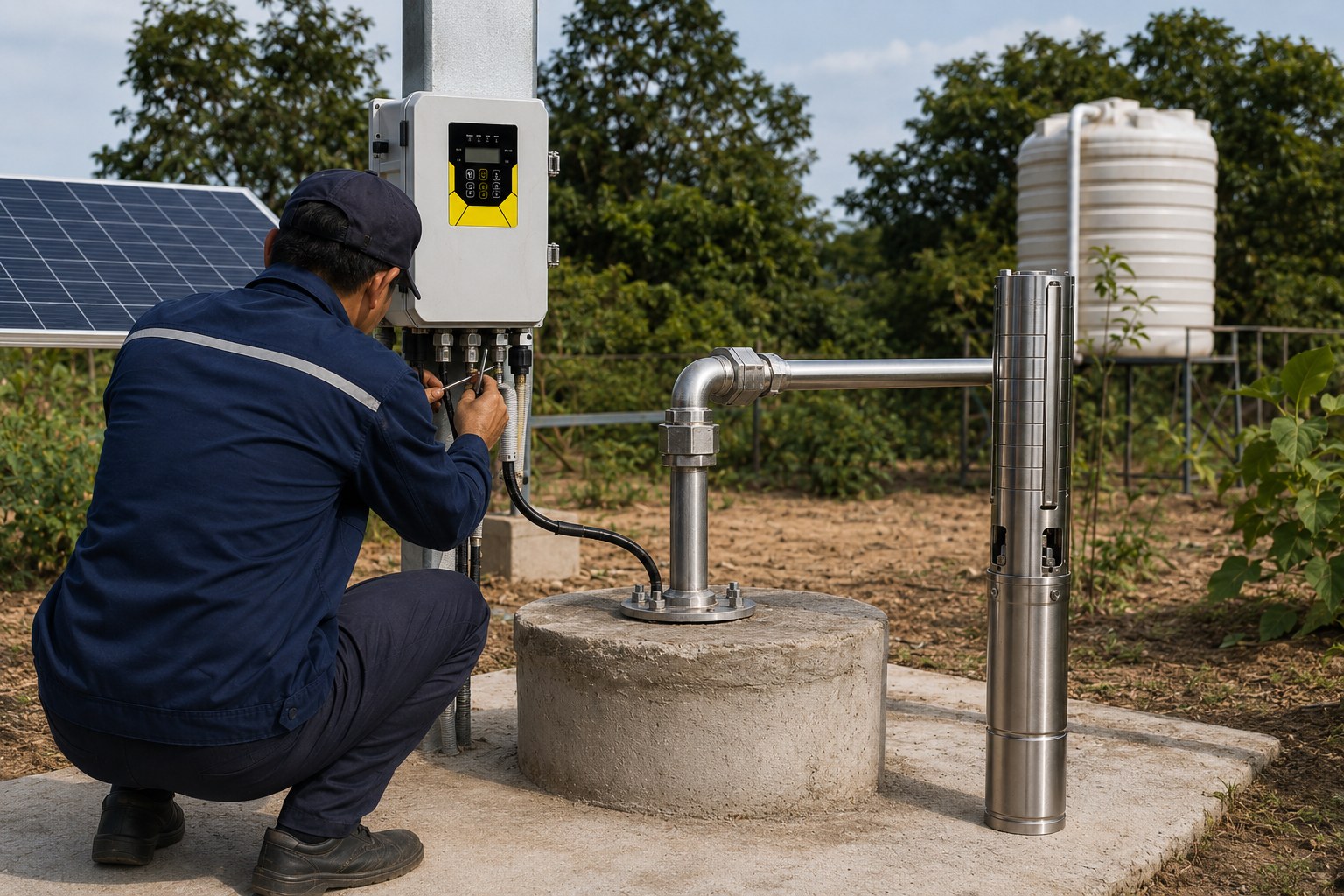
- Safety First: The first step is always to disconnect all power to the pump at the controller and circuit breaker.
- Lifting Equipment: A tripod hoist and winch are typically set up over the wellhead. The drop pipe, electrical cable, and pump are far too heavy and awkward to lift by hand, especially from depths greater than 100 feet.
- Extraction: The pitless adapter or well seal is disconnected, and the entire assembly—pump, motor, drop pipe, and cable—is slowly and carefully winched out of the well. As the pipe is raised, it's disconnected in sections.
- Installation: The new pump is attached to the drop pipe and electrical cable, and the process is reversed. Great care is taken to ensure the cable is secured to the pipe and doesn't get abraded against the well casing on the way down.
- Testing: Once installed, the system is re-pressurized and tested to ensure proper flow rate and amperage draw, confirming the new pump is operating according to its specifications.
Cost Analysis: Automotive vs. Solar Pump Replacement
The financial breakdown for replacing a solar pump is fundamentally different from a car repair.
| Cost Component | Automotive Pump Replacement | Solar Pump Replacement | Key Considerations |
|---|---|---|---|
| Parts Cost | $200 - $400 | $300 - $1,500+ | Solar pump cost varies greatly by type (plastic, screw, SS) and size. |
| Labor Cost | $400 - $600 (2-3 hours) | $500 - $1,000+ (variable) | Labor depends on well depth, accessibility, and need for heavy equipment. |
| Total One-Time Cost | ~$900 | $800 - $2,500+ | Averages are difficult due to wide variability in solar systems. |
| Total Cost of Ownership | Repair-driven cost | Investment-driven cost, factoring in longevity and energy savings. | Choosing a durable SS pump in corrosive water saves money over replacing cheaper pumps multiple times. |
A $900 car repair is a sunk cost.
In contrast, investing $2,000 in a high-quality stainless steel solar pump system that lasts for 15 years and eliminates electricity bills for water pumping offers a significant return on investment.
The decision is less about the immediate replacement cost and more about securing the lowest cost per gallon of water over the system's entire lifespan.
The Strategic Role of Hybrid AC/DC Controllers
To further maximize longevity and ensure a 24/7 water supply, advanced AC/DC hybrid solar pump controllers are a game-changer.
This technology adds a layer of intelligence and flexibility to the system.
The controller has inputs for both solar DC power and grid/generator AC power.
Its primary logic is to use 100% of available solar power first.
If clouds reduce solar input, its hybrid function can blend AC power with the available DC power to maintain pump speed and water flow, maximizing the use of free solar energy.
When there is no solar input at all (e.g., at night or on very overcast days), it automatically switches over to full AC power.
This ensures you have water whenever you need it, without interruption.
Crucially, it also protects the pump motor from the stress of frequent starting and stopping in low-light conditions, further extending its operational life.
Conclusion
Recognizing pump failure signs is crucial, but true reliability comes from choosing the right technology.
A robust pump and an efficient motor minimize downtime and ensure long-term, cost-effective operation.
Frequently Asked Questions (FAQs)
What is the first sign of a bad water pump?
Often, the first sign is a high-pitched whining or low-pitched grinding sound from the engine, or a small puddle of green or orange coolant on the ground.
Can you drive with a bad water pump?
It is highly inadvisable.
Doing so can quickly cause the engine to overheat, leading to severe and very expensive damage like a blown head gasket.
How much does it cost to fix a water pump?
In a car, expect to pay around $900 at a dealership.
For solar well pumps, the cost varies widely based on pump type, well depth, and labor.
What does a bad water pump sound like?
It typically makes a rhythmic whining or grinding noise that gets louder and higher in pitch as you accelerate the engine, indicating a worn-out bearing.
How do you test a water pump?
A mechanic can perform a pressure test on the cooling system to check for leaks.
They will also visually inspect for leaks and listen for bearing noise.
Is it hard to replace a water pump?
For most cars, yes.
The pump is often hard to access and requires special tools.
For submersible well pumps, it requires specialized lifting equipment to pull from the well.
Does the water pump run all the time?
In a car, the water pump runs whenever the engine is on.
A solar water pump runs whenever there is sufficient sunlight or when activated by its controller.