A sudden pump failure can stop your entire operation.
This costs you valuable time and money.
What if you could prevent most of these breakdowns before they even happen?
The most common reasons for pump failure are mechanical seal and bearing failures. These issues often stem from deeper problems like improper lubrication, shaft misalignment, or cavitation. Proactive maintenance and, most importantly, selecting the correct pump for the application are the keys to preventing costly downtime.
Understanding the root cause of a failure is the first step toward building a more reliable and efficient system.
A pump is more than just a piece of equipment; it is the heart of your water supply, irrigation, or manufacturing process.
When it fails, the consequences ripple outward, causing production delays, crop loss, or lack of essential water.
However, most pump failures are not random events.
They are predictable and preventable.
Let's explore the most common failures in detail.
By breaking down each issue, we can reveal how to prevent it, ensuring your operations run smoothly and without interruption.
What causes mechanical seal and gasket leaks?
A small, persistent drip from your pump is a serious warning sign.
Ignoring a leaking seal can quickly escalate into catastrophic failure.
This can damage equipment and create significant safety hazards.
Seal and gasket leaks are commonly caused by normal wear over time, chemical incompatibility with the pumped fluid, or improper installation. The seal material must be correctly matched to the fluid's temperature, pressure, and chemical composition to ensure a long service life.
A mechanical seal is one of the most vulnerable parts of any pump.
It is designed to contain high-pressure fluid while a shaft rotates at thousands of revolutions per minute.
This demanding job means that even small mistakes can lead to big problems.
The Critical Role of Material Selection
Choosing the right seal material is your first line of defense.
A seal material that works perfectly for clean water may degrade in a matter of hours when exposed to abrasive or corrosive liquids.
For example, a standard NBR (Nitrile) seal is excellent for oils and water up to about 100°C (212°F).
However, it will quickly fail in the presence of acidic water or high temperatures.
In contrast, a Viton (FKM) seal offers superior resistance to chemicals and higher temperatures, but at a greater cost.
| Seal Material | Common Applications | Temperature Range | Strengths |
|---|---|---|---|
| NBR (Nitrile) | General purpose, water, oils | -35°C to 100°C | Cost-effective, good wear resistance |
| EPDM | Water, steam, alkalis | -50°C to 150°C | Excellent for water-based fluids |
| Viton (FKM) | Chemicals, acids, fuels | -20°C to 200°C | High chemical and heat resistance |
Installation Errors and Sealant Misuse
Improper installation is another leading cause of premature seal failure.
Even a tiny nick or misalignment during assembly can compromise the seal face, leading to an immediate leak.
Furthermore, the improper use of liquid sealants is a frequent mistake.
Applying too much sealant can cause the excess to squeeze into the pump housing.
This hardened material can block the vent hole, preventing the escape of coolant vapor and causing pressure to build up behind the seal.
It can also contaminate the seal faces, creating a path for leaks and destroying the bearing with leaking fluid.
System Conditions Matter
The pump does not operate in a vacuum.
System-wide issues can directly lead to seal failure.
For instance, if the overpressure valve on a radiator or tank is defective, the pressure inside the cooling system can exceed the seal's design limits, forcing it to fail.
Similarly, a blown cylinder head gasket in an engine can force high-pressure combustion gases into the cooling circuit, creating pressure spikes that destroy the water pump seal.
Regularly inspecting the entire system, not just the pump, is essential for prevention.
Why do pump bearings fail?
Your pump is getting louder and starting to vibrate.
This is not just normal operational noise.
It is a clear warning of bearing failure, a critical issue that can cause the entire pump to seize.
Bearing failure is most often caused by improper lubrication. This includes using too little, too much, or the wrong type of lubricant. Contamination from leaking seals and shaft misalignment also place excessive stress on bearings, leading to premature wear and failure.
Bearings are the foundation of smooth pump operation, supporting the rotating shaft.
When they fail, the damage is often extensive and costly.
Preventing bearing failure starts with a commitment to precision in maintenance and installation.
The Lubrication Goldilocks Zone
Lubrication is a science.
It is not enough to simply add grease; you must use the right amount of the right lubricant at the right time.
- Under-lubrication is a common mistake. It causes increased friction and heat, leading to rapid wear of the bearing races and balls. This accounts for an estimated 36% of premature bearing failures.
- Over-lubrication is just as damaging. Too much grease can cause the rolling elements to churn through the lubricant, generating excessive heat. This heat can degrade the grease, reducing its effectiveness and leading to failure. It can also blow out the bearing seals.
Contamination: The Silent Killer
Even with perfect lubrication, bearings will fail if they become contaminated.
A leaking mechanical seal is a primary source of contamination.
When fluid escapes the pump housing, it can wash the grease out of the bearings, leaving them unprotected.
Abrasive particles from the pumped fluid can also enter the bearing housing, grinding away at the precision surfaces and causing catastrophic failure.
This is why addressing seal leaks immediately is so important.
The Impact of Misalignment
A misaligned pump shaft is another major cause of bearing failure.
When the motor shaft and the pump shaft are not perfectly aligned, it creates significant radial and axial forces on the bearings.
These forces are far beyond what the bearings are designed to handle.
The result is increased vibration, heat, and a drastically reduced service life.
Using laser alignment tools during installation can improve accuracy by over 70% compared to traditional straightedge methods, ensuring bearings are not subjected to unnecessary stress from the start.
How does an impeller get damaged?
Your pump's performance is declining.
Water flow is down, and it can no longer reach the pressure it used to.
The problem could be a damaged impeller, the heart of your pump, which is quietly eroding and losing efficiency.
Impeller damage is typically caused by three main factors: abrasion from solids like sand, corrosion from aggressive chemicals, or cavitation. Debris entering the pump from an unfiltered source can also cause immediate and significant physical damage to the impeller vanes.
The impeller is responsible for converting the motor's rotational energy into fluid movement.
Any damage to its vanes directly impacts the pump's flow and pressure output.
Protecting the impeller means selecting the right pump for the water conditions from the very beginning.
Abrasion vs. Corrosion
It is important to understand the different ways an impeller can wear down.
- Abrasion is physical wear caused by hard particles, like sand or grit, striking the impeller surfaces. This is common in deep well and borehole applications.
- Corrosion is chemical wear caused by the fluid itself. This occurs in acidic or alkaline water conditions, which can eat away at the impeller material over time.
Choosing the Right Impeller for the Job
The best way to prevent impeller damage is to choose a pump with an impeller designed for your specific application.
A one-size-fits-all approach does not work.
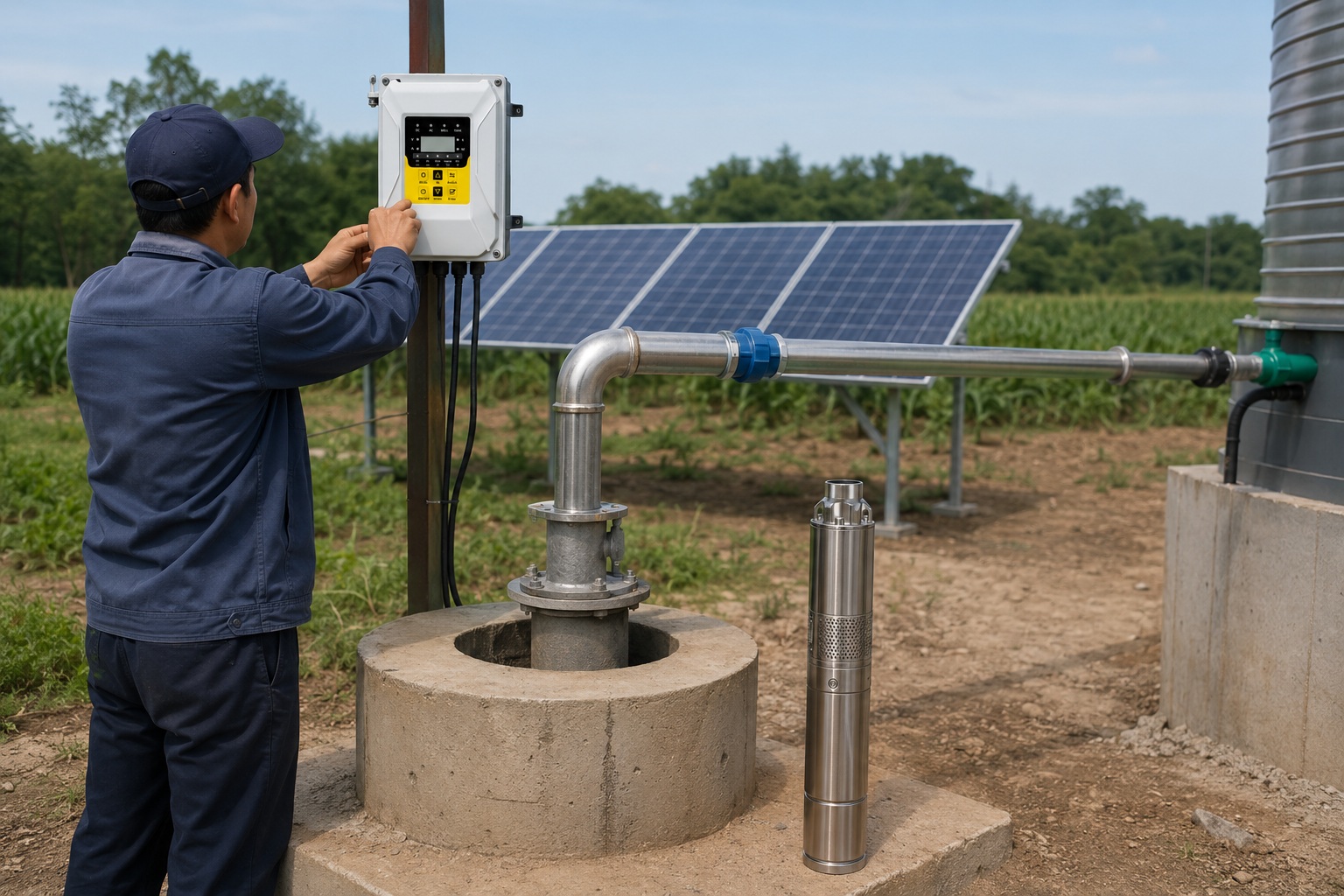
- For High Sand Content: A solar screw pump is an excellent choice. Instead of a traditional impeller, it uses a stainless steel helical rotor inside a rubber stator. This design is highly resistant to abrasion from sand and can handle harsh water conditions, making it ideal for deep wells in Africa and Latin America.
- For High Flow and Fine Sand: A solar pump with a plastic impeller offers a great balance of performance and durability. These impellers are engineered to be wear-resistant against fine sand and can deliver high flow rates for farm irrigation and pasture water supply. They are a lightweight and economical solution widely used in the Americas and Africa.
- For Corrosive Water: A solar pump with a stainless steel impeller is the premium choice. The SS304 stainless steel impeller and pump body are specifically designed to resist corrosion in acidic or alkaline water. This is essential for applications in alkaline soil regions in Australia or for high-end homes where water quality is paramount.
Here is a simple comparison:
| Impeller/Pump Type | Best For | Key Advantage | Common Application |
|---|---|---|---|
| Screw Pump | Deep wells, high sand | High sand resistance, high head | Domestic water, livestock drinking |
| Plastic Impeller | High flow, moderate sand | High flow rate, economical | Farm irrigation, home gardens |
| Stainless Steel Impeller | Corrosive water | High corrosion resistance, long life | Alkaline soil regions, high-end homes |
By matching the pump type to the water source, you can dramatically extend the life of the impeller and maintain peak performance.
What is pump cavitation and how can you prevent it?
Your pump is making a loud rattling noise, like it is pumping gravel.
This dangerous sound is cavitation.
It is a destructive force of imploding vapor bubbles that erodes internal components from the inside out.
Cavitation happens when the pressure at the pump inlet drops too low, causing the liquid to form vapor bubbles. These bubbles collapse violently as they move to higher-pressure areas inside the pump, chipping away at the impeller and housing.
Cavitation is one of the most destructive yet misunderstood pump problems.
It not only creates noise and vibration but also causes a significant drop in efficiency and can lead to complete failure in a short time.
Understanding NPSH
Prevention starts with understanding Net Positive Suction Head (NPSH).
In simple terms, there are two types of NPSH:
- NPSH Available (NPSHa): This is the absolute pressure at your pump's suction inlet. It is determined by your system's design, including the depth of the well and the length and diameter of the suction pipe.
- NPSH Required (NPSHr): This is the minimum pressure required by the pump to avoid cavitation. This value is determined by the pump manufacturer.
To prevent cavitation, NPSHa must always be greater than NPSHr. A good rule of thumb is to have at least a 10-15% margin.
Common Causes of Low Suction Pressure
Several factors can cause the suction pressure to drop and trigger cavitation:
- Clogged Suction Lines: A blocked intake strainer or filter is a primary cause. It restricts flow and creates a vacuum.
- Poor Piping Design: Using a suction pipe that is too long, too narrow, or has too many sharp bends increases friction and lowers the available pressure at the pump inlet.
- Operating at High Speed: Running a pump faster than its design speed can cause it to try and pull in more water than the suction line can provide, leading to cavitation.
How Smart Pump Selection and Control Prevents Cavitation
Choosing the right pump and control system is a proactive way to prevent cavitation.
For deep wells where suction conditions are challenging, a solar screw pump is inherently designed to operate under high-suction-lift conditions.
Furthermore, using a Variable Frequency Drive (VFD) or an intelligent MPPT controller allows you to precisely control the pump's speed.
If you notice signs of cavitation, you can slow the pump down to reduce the NPSHr and bring the system back into a stable operating range.
This is far more efficient and less damaging than a fixed-speed pump running under stressful conditions.
What makes a pump motor overheat?
You place a hand on your pump motor and it is alarmingly hot.
You might even smell a faint burning odor.
This is a critical sign of overheating that can lead to sudden, expensive motor failure and unexpected downtime.
Motors primarily overheat from being overloaded, which is often a result of improper pump sizing for the specific job. Other common causes include unstable voltage, poor electrical connections, and inadequate ventilation that prevents the motor from cooling itself effectively.
A pump motor is designed to operate within a specific load and temperature range.
Pushing it beyond these limits causes the internal insulation to break down, leading to a drop in efficiency and eventual burnout.
However, modern motor technology offers powerful solutions to this problem.
The Power of an Efficient Motor
The single most effective way to prevent overheating is to use a highly efficient motor.
Efficiency is the measure of how much electrical energy is converted into useful work versus wasted heat.
- A standard motor with 80% efficiency wastes 20% of its energy as heat.
- A high-efficiency motor with 92% efficiency wastes only 8% of its energy as heat.
This represents a 60% reduction in waste heat generation, making the high-efficiency motor far less likely to overheat.
Modern solar pumps utilize advanced BLDC (Brushless DC) permanent magnet motors that can achieve efficiencies exceeding 90%.
These motors use powerful 40SH neodymium iron boron permanent magnets in their rotors.
This design creates a strong magnetic field that generates high torque with less electrical current, significantly reducing heat production and making them both more powerful and more reliable.
This technology also results in a motor that is up to 47% smaller and 39% lighter than a traditional motor of the same power, further improving cooling and simplifying installation.
Stable Power and Proper Ventilation
Even the best motor will overheat if the electrical supply is unstable or it cannot breathe.
Voltage sags or spikes put immense stress on motor windings.
It is crucial to ensure the electrical connections are tight and the voltage supplied is within the motor's specified range (+/- 10% is a common standard).
An intelligent controller, like an MPPT solar pump controller, plays a vital role here.
It conditions the power from the solar panels, providing the motor with a stable DC voltage and protecting it from electrical fluctuations.
Ventilation is also critical.
Ensure the motor's cooling fins are clean and that there is adequate space around the motor for air to circulate, especially in hot or enclosed environments.
How does improper installation cause pump failure?
You invested in a high-quality pump, but it started vibrating and leaking just months after installation.
The pump itself might not be the problem.
The culprit is often improper installation, which creates hidden stresses that wear out components with surprising speed.
Misalignment is the most common and destructive installation error. It forces the shaft to flex with every rotation, putting extreme stress on bearings and mechanical seals. A poor foundation that allows for vibration or settling over time is another root cause of failure.
A successful pump installation is built on a foundation of precision.
From the base it sits on to the alignment of its shaft, every detail matters.
Getting it right from the start is the most cost-effective way to ensure a long and reliable service life.
The Importance of a Solid Foundation
The pump and motor must be mounted on a solid, level, and rigid foundation.
A weak or uneven base will not be able to absorb the natural vibrations of the machine.
Instead, it will amplify them, transferring that stress directly to the pump's bearings and seals.
Over time, a settling foundation can also cause the pump and motor to fall out of alignment, leading to the same destructive forces.
The foundation should be designed to be at least twice the weight of the pump and motor assembly to provide adequate stability.
Precision Matters: The Case for Laser Alignment
Achieving perfect alignment between the motor and pump shaft is non-negotiable.
For decades, technicians used straightedges and feeler gauges, but this method is highly dependent on skill and can be inaccurate.
Modern laser alignment tools have revolutionized this process.
They can measure misalignment down to 0.001 inches, an impossible feat for the naked eye.
Investing in a professional laser alignment during installation pays for itself many times over by preventing premature bearing and seal failures.
Studies have shown that pumps aligned with laser systems can have a service life up to 50% longer than those aligned by traditional methods.
Don't Forget the Post-Startup Check
Alignment should not be a one-time event.
It is essential to re-check the alignment after the pump has been running for a short period.
This allows all components to reach their normal operating temperature and settle into their final positions.
Thermal expansion can slightly alter alignment, so this final check is crucial for long-term reliability.
Why does operating a pump outside its design range cause failure?
You are using a valve to drastically reduce the flow from your powerful pump.
You might be forcing it to do a job it was never designed for.
This is not just inefficient; it wastes energy, accelerates wear, and is a guaranteed path to premature failure.
Pumps are engineered to be most efficient at a specific point on their performance curve, known as the Best Efficiency Point (BEP). Operating too far from this point causes hydraulic instability, vibration, and excessive radial thrust on the shaft, leading to rapid wear on seals and bearings.)
Matching the pump to the system's actual requirements is one of the most overlooked aspects of ensuring reliability.
A mismatched pump is an unhappy pump, and it will fail sooner rather than later.
The Inefficiency of Throttling
A common mistake is to buy an oversized pump and then use a throttling valve on the discharge line to control the flow rate.
While this works, it is incredibly wasteful and damaging.
The pump is still working hard to generate high pressure, but that energy is being burned off as heat and turbulence at the valve.
This is like driving your car with one foot on the accelerator and the other on the brake.
The excessive pressure and vibration created by throttling puts immense stress on the entire pump assembly.
The Smart Solution: Variable Speed Control
A far better approach is to control the pump by adjusting its speed.
A Variable Frequency Drive (VFD) or an intelligent MPPT solar controller does exactly this.
Instead of running the motor at a constant high speed, the controller adjusts the speed to deliver the precise flow and pressure required by the system at that moment.
This ensures the pump always operates at or near its BEP, maximizing efficiency and minimizing stress.
Using a VFD can reduce energy consumption by up to 50% compared to a throttled system.
Ensuring 24/7 Reliability with Hybrid Power
For applications that require water around the clock, reliance on solar power alone can be a limitation.
What happens on cloudy days or at night?
This is where an AC/DC hybrid controller provides a game-changing solution.
These advanced controllers have inputs for both DC power from solar panels and AC power from the grid or a generator.
- When there is sufficient sunlight, the controller powers the pump using free solar energy.
- When solar power is insufficient, the controller can automatically blend AC power with the available DC power to maintain operation.
- When there is no sunlight, it automatically switches entirely to the AC power source.
This ensures the pump can meet the system's demands 24 hours a day, providing worry-free water access without ever compromising on efficiency or reliability.
Conclusion
Most pump failures are preventable.
By addressing root causes like seal leaks, bearing wear, and motor overheating, you can build a more reliable system.
Proactive maintenance and, most importantly, selecting the right equipment for the job are fundamental to operational success.
Frequently Asked Questions
How do I know if my water pump is failing?
Common signs include unusual noises like grinding or rattling, visible leaks, a sudden drop in water pressure or flow, and the motor running hotter than usual.
What is the life expectancy of a water pump?
This varies widely by type and usage, but a well-maintained, properly selected pump can last for 15-20 years.
Proactive maintenance is the key to maximizing its lifespan.
Can a water pump be repaired?
Yes, many components like seals, bearings, and impellers are replaceable.
However, you should always assess if a full replacement is more cost-effective, especially for older units.
How often should a water pump be serviced?
Follow the manufacturer's recommended schedule.
As a general rule, perform a monthly visual inspection for leaks or noise and a more thorough annual service.
What happens if you run a pump dry?
Running a pump dry is catastrophic.
The mechanical seals will overheat and crack within seconds, causing major leaks.
This can also lead to bearing failure and impeller damage.
Why is my pump making a loud noise?
Loud noises can indicate several problems.
A rattling or gravelly sound often points to cavitation, while a high-pitched whining or grinding usually signals failing bearings.