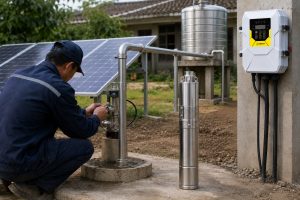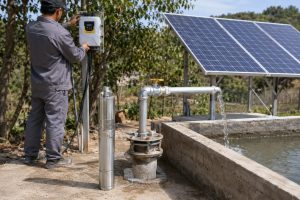
Struggling with unreliable water in off-grid areas?
A solar pump is the solution, but the question of power storage often creates confusion and adds perceived cost.
The vast majority of solar water pump systems do not require batteries.
Most modern systems, over 85% in fact, are "direct-drive."
They use an intelligent controller to run the pump motor directly from solar panel power, making them simpler, more reliable, and significantly more cost-effective.
Understanding whether you need batteries comes down to understanding your specific water needs.
For most agricultural, livestock, or tank-filling applications, storing water is far more economical and practical than storing electricity.
However, certain situations, like providing pressurized water for an off-grid home, may necessitate an energy storage solution.
This guide will break down the different system types, helping you determine the most efficient and cost-effective setup for your application.
How Solar Pumps Work Without Batteries: The Power of Direct Drive
Wondering how a solar pump provides a steady water supply without a battery to store power?
The secret lies in a simple yet highly efficient design.
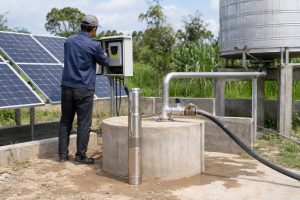
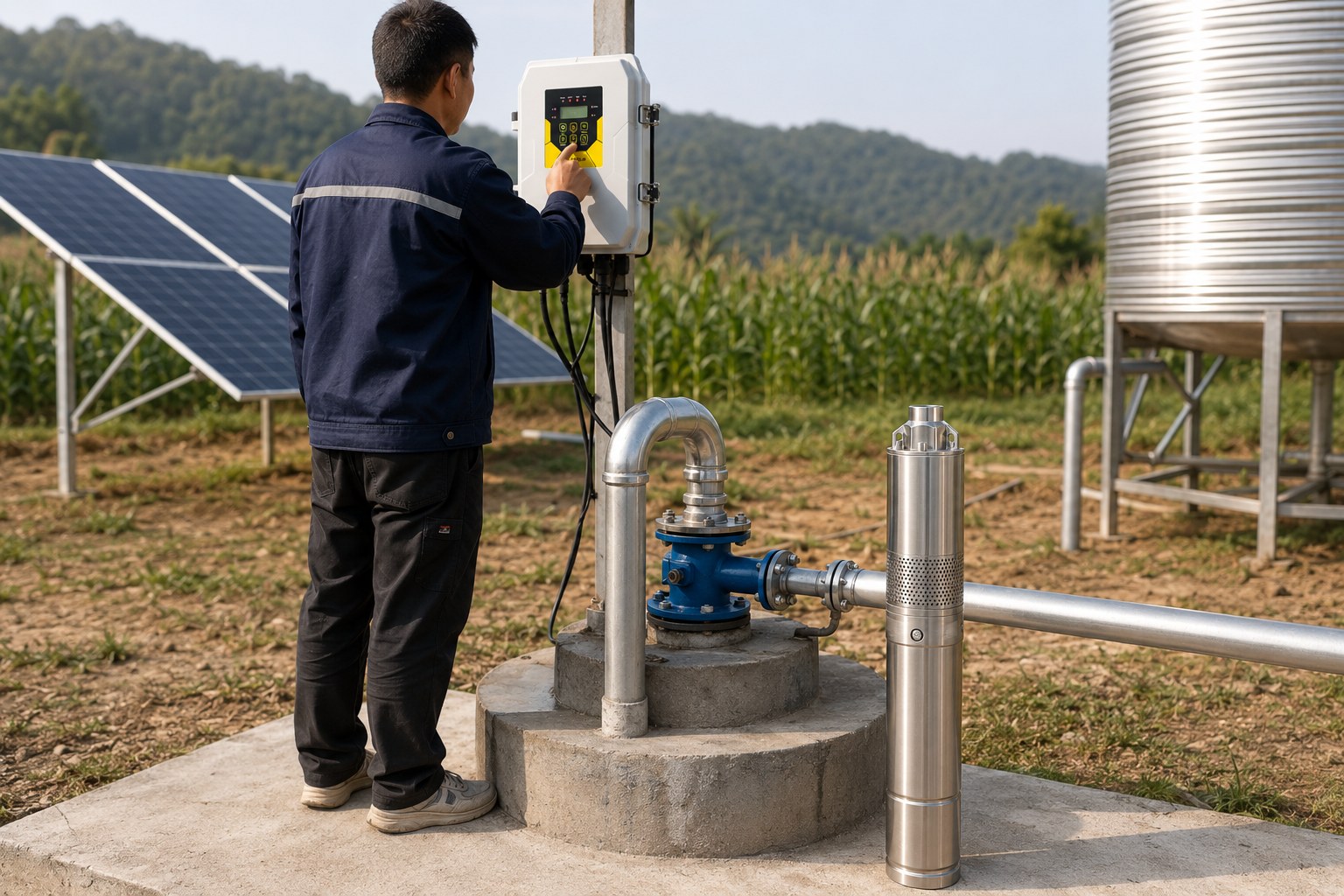
Direct-drive systems connect solar panels directly to the pump motor via an intelligent controller.
This controller dynamically adjusts the motor's speed to match the available sunlight, maximizing water output throughout the day without needing expensive and maintenance-heavy energy storage.
The direct-drive method represents a significant leap forward in solar pumping technology.
It prioritizes simplicity and efficiency, removing the battery as a potential point of failure and a recurring cost.
This approach leverages two key components: an advanced motor controller and the practical strategy of water storage.
By converting solar energy directly into the kinetic energy of pumping water, the system operates at peak efficiency during sunny hours.
The "storage" then happens in a tank, not in a chemical battery, providing a reliable water buffer for nights or cloudy days.
The Role of the Intelligent Controller
The controller is the brain of the entire operation.
Modern controllers utilize a technology called Maximum Power Point Tracking (MPPT).
This feature continuously analyzes the output of the solar panels and the needs of the pump motor.
It adjusts the electrical parameters to ensure the maximum amount of power is extracted from the panels at any given moment.
An MPPT controller can boost the system's overall water output by as much as 30% compared to a system without one.
It essentially ensures no sunlight is wasted.
Matching Solar Power to Motor Speed
Instead of a simple on/off switch, the controller provides a "soft start."
In the morning, as the sun rises, the controller slowly ramps up the motor's speed.
As sunlight intensity increases towards noon, the pump reaches its maximum revolutions per minute (RPM) and flow rate.
If a cloud passes over, the controller doesn't shut the system down.
Instead, it intelligently reduces the pump's speed to match the lower available power.
This variable speed operation ensures the pump is always running at the most efficient speed possible for the given solar conditions, resulting in more water pumped over the course of an entire day.
Energy Storage vs. Water Storage
For most applications, the debate isn't whether to store energy, but how.
Storing electricity in batteries is inefficient and costly, while storing water in a tank is simple and economical.
| Feature | Battery Storage | Water Tank Storage |
|---|---|---|
| Initial Cost | High ($500 - $5,000+) | Low to Medium ($200 - $2,000+) |
| Lifespan | 3-7 years | 20+ years |
| Maintenance | Regular checks, potential replacement | Minimal to none |
| Efficiency Loss | 10-20% loss in charging/discharging | ~0% loss |
| Best For | Pressurized systems, nighttime water | Livestock, irrigation, gravity-fed systems |
Storing just 2-3 days' worth of water in a stock tank or cistern is often thousands of dollars cheaper over the life of the system than maintaining a battery bank.
This strategy provides a reliable water buffer, ensuring access to water even during extended periods of cloudy weather or at night, all without the complexity of batteries.
What Happens on Cloudy Days or at Night? Ensuring 24/7 Water Access
Worried that a few clouds in the sky will leave your fields dry or your livestock thirsty?
This is a common myth that often stems from experiences with older, less sophisticated solar technology.
Modern solar pumps do not simply shut off in cloudy weather.
They are designed to continue operating, albeit at a reduced flow rate.
On an overcast day, a system might still produce 40-60% of its peak-sun output, and backup power options are available for guaranteed 24/7 operation.
The fear of having no water during inclement weather is a major concern for potential users.
Fortunately, modern solar pumping systems are designed with multiple layers of redundancy to address this exact issue.
The primary method, as discussed, is water storage, which decouples water availability from immediate sunlight.
However, for applications requiring uninterrupted pumping, two powerful technological solutions exist: battery backups and AC/DC hybrid power systems.
These advanced options ensure that water is available on demand, day or night, rain or shine, transforming a solar pump from a daytime-only device into a round-the-clock water solution.
Pumping in Overcast Conditions
The myth that a single cloud shuts down a solar pump is false.
High-quality photovoltaic (PV) panels can generate electricity from diffuse sunlight, not just direct rays.
The MPPT controller is key here.
It senses the drop in voltage from the panels and adjusts the load to keep the motor turning efficiently.
For example, a pump rated for 10 gallons per minute (GPM) in full, direct sun might still deliver 4-6 GPM on a gray, overcast day.
For many irrigation and livestock applications, this reduced flow is more than sufficient to continue topping off a tank or watering a field.
The Battery Backup Option
For some applications, storing water isn't enough.
If you have an off-grid home with a pressure tank for showers and faucets, you need on-demand water pressure, even at 3 a.m.
This is where batteries become necessary.
In this setup, the solar panels power the pump and charge a battery bank during the day.
At night or on very cloudy days, the pump draws power from the batteries.
It's important to note that adding batteries adds complexity and cost.
You will typically need to increase the size of your solar array by 30-50% to have enough power to both run the pump and adequately charge the batteries.
The AC/DC Hybrid Solution
A more advanced and flexible solution is the AC/DC hybrid controller.
This technology offers the best of all worlds.
The controller has inputs for both DC power from the solar panels and AC power from the utility grid or a generator.
The system is programmed to prioritize solar power first.
When solar energy is abundant, it uses 100% free power from the sun.
If clouds roll in and solar output drops, the controller can seamlessly blend in AC power to maintain the required pump speed and pressure.
If the sun goes down completely, it automatically switches over to full AC power.
This ensures 100% water availability without the cost, maintenance, and limited lifespan of batteries.
| System Type | Best Application | Cost | Reliability | Maintenance |
|---|---|---|---|---|
| Direct Drive | Agriculture, Livestock, Ponds | Low | High (with water storage) | Very Low |
| Battery Backup | Off-Grid Homes (Pressurized) | High | Medium | High (Battery Replacement) |
| AC/DC Hybrid | Critical Applications, Homes | Medium | Very High | Low |
The Core of Efficiency: Understanding the Motor and Pump Types
Not all solar pumps are created equal.
While panels capture the sunlight, the real heart of the system—the component that dictates its efficiency, reliability, and lifespan—is the motor.
High-efficiency brushless DC (BLDC) permanent magnet motors are the gold standard in modern solar pumps.
With operational efficiencies exceeding 90%, they convert more of the sun's energy into pumped water, effectively reducing the number of solar panels needed by up to 40%.
The pump system is a combination of this high-tech motor and the "wet end," which is the mechanical pump that moves the water.
The synergy between an ultra-efficient motor and a pump end designed for a specific task is what creates a truly competitive and effective water solution.
Understanding this core technology is crucial for distributors looking to offer a versatile product portfolio and for end-users who want the most value and performance for their investment.
The motor's efficiency directly impacts the system's initial cost and long-term performance.
Why BLDC Motors Dominate
The technological advantages of BLDC permanent magnet motors are substantial.
Unlike older brushed motors, they have no physical brushes to wear out, making them virtually maintenance-free with a much longer service life.
Their design allows for incredible efficiency, often above 90%, compared to the 60-70% efficiency of their predecessors.
This high efficiency means they can produce more power from a smaller package.
A modern BLDC solar pump motor can be up to 47% smaller and 39% lighter than a traditional motor of equivalent power.
This not only lowers shipping costs but also makes installation significantly easier, which is a critical factor in remote locations.
Choosing the Right Pump End for Your Well
The motor provides the power, but the pump end does the work.
Matching the right pump type to the water source and application is critical for system longevity and performance.
There are three primary types used in solar deep well applications.
| Pump Type | Best For | Flow Rate | Head/Pressure | Key Advantage |
|---|---|---|---|---|
| Solar Screw Pump | Very deep wells, sandy water | Low | Very High | Exceptional sand resistance, high lift capability |
| Solar Plastic Impeller Pump | Farm irrigation, high volume needs | High | Medium | Excellent flow rate, wear-resistant, cost-effective |
| Solar SS Impeller Pump | Corrosive water, premium quality | High | Medium-High | Superior corrosion resistance, ultimate durability |
The Solar Screw Pump uses a stainless steel helical rotor inside a rubber stator. This design acts like a screw, pushing water upward. It's perfect for low-flow, high-head applications, such as providing domestic water from a very deep well. Its ability to handle water with high sand content makes it ideal for harsh conditions found in parts of Africa and Latin America.
The Solar Plastic Impeller Pump is a multi-stage centrifugal pump. It uses a series of durable, wear-resistant plastic impellers to move large volumes of water. This pump type offers an excellent balance of high flow and moderate head, making it the workhorse for farm irrigation and livestock watering in places like the Americas and Australia.
The Solar Stainless Steel (SS) Impeller Pump is the premium option. Built with SS304 or SS316 components, it is designed for environments with acidic, alkaline, or otherwise corrosive water. It offers high flow and high reliability, making it the go-to choice for high-value applications or regions with challenging water chemistry.
Is a Battery-Free System Right for You? Making the Final Decision
Deciding between a direct-drive and a battery-based system can seem complex.
However, the choice becomes clear when you focus on your specific water requirements.
Choose a direct-drive system if you can store water in a tank and do not need pressurized water at night.
This is the most common, reliable, and cost-effective setup for over 90% of agricultural, livestock, and pond-filling applications.
Opt for batteries or a hybrid system only for residential off-grid living that relies on a standard pressure tank.
The best system is the one that is designed for its purpose.
Over-engineering a system with unnecessary batteries adds cost, complexity, and points of failure.
Under-engineering a system for a home can lead to frustration with a lack of water pressure when it's needed most.
By walking through a few common scenarios, you can easily identify which setup aligns with your goals and provides the most value for your investment.
Scenario 1: Livestock Watering in a Remote Pasture
This is the perfect application for a direct-drive system.
A solar pump, often a durable screw pump or plastic impeller pump, runs during daylight hours.
It pumps water into a large stock tank.
The tank is sized to hold 3-5 days' worth of water for the herd.
This simple, robust setup provides complete water security.
The cattle have water day and night, rain or shine, from the stored reserve in the tank.
The system has very low initial costs, zero energy costs, and virtually no maintenance.
Scenario 2: Large-Scale Farm Irrigation
For irrigating crops, the goal is maximum water volume during peak growing season.
A direct-drive system with a high-flow plastic impeller pump is the ideal solution.
The system is designed to pump the most water during the sunniest parts of the day, which is when crops need it most.
The water can be used to directly irrigate fields or, more commonly, to fill a large reservoir or pond.
This stored water can then be distributed as needed.
The focus is on moving the maximum volume of water for the lowest cost per gallon, a task at which direct-drive systems excel.
Scenario 3: Off-Grid Home Water Supply
This is the primary scenario where batteries or hybrid systems should be considered.
Most modern homes use a pressure tank to provide instant water pressure when a faucet is opened.
A direct-drive pump can't pressurize this tank at night.
- Option A (Battery-Free): If the home's layout allows, a direct-drive pump can fill a large, elevated "header" tank during the day. The home's water system is then fed by gravity from this tank. This provides silent, reliable pressure 24/7 without batteries.
- Option B (With Power Backup): If a gravity-fed system isn't feasible, you need a system that can run on demand. A battery backup system will maintain pressure at night but comes with high costs and maintenance. The superior choice is often an AC/DC hybrid controller, which runs on solar when possible and your backup generator or grid connection when needed, offering ultimate reliability.
Conclusion
Most solar water pumps do not need batteries.
They leverage efficient direct-drive technology and the simple strategy of storing water, not electricity.
The best system is always the one tailored to your specific application.
Frequently Asked Questions (FAQs)
How long do solar water pumps last?
A well-maintained solar pump system can last for over 20 years. The brushless motor and pump end can last 10+ years, while solar panels are often warrantied for 25 years.
Can a solar pump run a sprinkler system?
Yes, but it requires careful design. The pump must provide enough pressure and flow for the sprinklers, which may necessitate a battery or hybrid system for consistent on-demand operation.
How deep can a solar pump go?
Solar screw pumps are designed for very deep wells and can lift water from depths exceeding 600 feet (180 meters), depending on the specific model and power available.
Do solar pumps work in the winter?
Yes, solar pumps work in winter, though water output will be lower due to shorter days and lower sun angles. The main concern is protecting the external plumbing from freezing.
What size solar pump do I need?
Sizing depends on your daily water requirement, the vertical distance you need to lift the water (total dynamic head), and your location's peak sun hours.
How much does a solar water pump system cost?
Costs vary widely, from a few hundred dollars for a small surface pump to several thousand for a high-capacity deep well system. Direct-drive systems are the most cost-effective.