Struggling with maintaining your pond's health during the harsh winter months?
You're likely worried about the performance of your pump and the impact on your electricity bills.
A solar-powered solution could be the key to sustainable and cost-effective pond management.
Yes, solar pond pumps can work in winter, but their performance is significantly reduced. Shorter daylight hours and weaker sunlight mean less power is generated, leading to lower flow rates. Success depends on having an oversized panel, battery backup, or a hybrid system for consistent operation.
Understanding the capabilities and limitations of solar technology during colder seasons is crucial.
The question isn't just if they work, but how well they work and what you need for reliable performance.
This guide will delve into the science behind solar pumps, the different types available, and how to ensure your water features operate effectively, even when the temperature drops.
Let's explore the factors that determine winter success for your solar-powered water systems.
The Winter Performance Challenge
The appeal of using free energy from the sun for your pond is undeniable.
But when winter sets in, the reality of reduced sunlight can be a major concern for pump owners.
A solar pump's performance in winter can decrease by over 50% due to shorter days and a lower sun angle. This reduction in solar irradiance directly impacts the pump's ability to generate power, leading to inconsistent flow and shorter operating times.
To truly grasp the challenge, we need to look at the science of solar energy during winter.
The effectiveness of a solar panel is not just about brightness; it's about solar irradiance, the measure of solar power per unit area.
Understanding Solar Irradiance
In winter, the sun sits lower in the sky.
This means its rays travel through more of the Earth's atmosphere before reaching your solar panel.
This atmospheric filtering, combined with fewer daylight hours, drastically reduces the total energy available.
Cloud cover further compounds the issue, scattering and blocking the sun's rays.
For example, a location might receive 6-7 peak sun hours in summer but only 1-2 in deep winter.
This means a pump that runs for 8 hours a day in July might only run for 2-3 hours in January.
The Impact on Pump Operation
This reduction in power has a direct effect on the pump's motor.
A solar pump requires a minimum voltage and current to start up.
On a bleak winter day, the panel may not generate enough power to overcome this initial threshold.
Even if it does start, the flow rate will be significantly lower than its rated capacity.
A pump rated for 2,500 liters per hour (LPH) in full summer sun might only produce 800-1,000 LPH on a bright winter day.
This can be insufficient for proper pond aeration or filtration.
| Season | Average Peak Sun Hours (Mid-Latitudes) | Expected Pump Performance (vs. Rated) | Key Challenges |
|---|---|---|---|
| Summer | 6-8 Hours | 100% | Overheating (for some components) |
| Autumn | 4-5 Hours | 60-80% | Shorter operating window |
| Winter | 1-3 Hours | 25-50% | Insufficient power to start, low flow |
| Spring | 4-6 Hours | 70-90% | Inconsistent weather, variable power |
Therefore, planning for winter operation requires a system designed for the worst-case scenario, not the best.
This often means investing in a larger solar panel or a more efficient pump system from the outset.
How Solar Pumps Fundamentally Operate
Have you ever wondered about the mechanics behind turning sunlight into flowing water?
The process seems like magic, but it's based on straightforward, elegant technology that powers water systems worldwide.
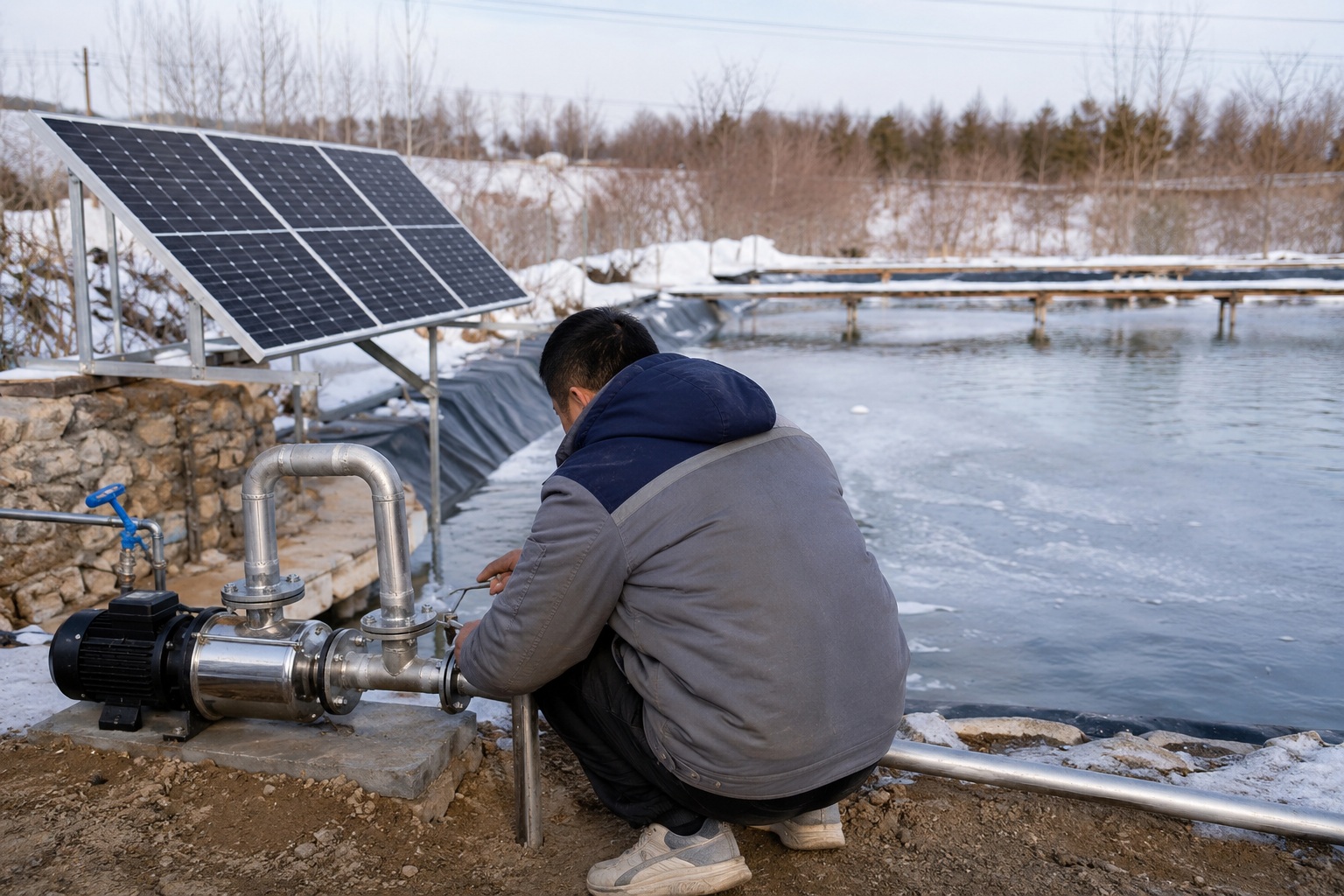
Solar pumps work by using a photovoltaic (PV) panel to convert sunlight into DC electricity. This electricity powers a motor, which in turn drives the pump to move water. More advanced systems use a controller to optimize power and a battery to store energy.
At the heart of every solar water system are three core components working in unison.
Understanding each part is key to appreciating the system's efficiency and potential.
This technology has become essential in regions across Africa, the Americas, and Asia for both its sustainability and its independence from traditional power grids.
The Photovoltaic (PV) Panel
The process begins with the solar panel.
These panels are made of many photovoltaic cells, typically crafted from silicon.
When sunlight, specifically ultraviolet (UV) energy, strikes these cells, it excites electrons, creating a direct current (DC) of electricity.
The size of the panel and the number of cells determine the total amount of power it can generate.
The Controller
The electricity from the panel doesn't usually go straight to the pump.
It first passes through an intelligent controller, often one with Maximum Power Point Tracking (MPPT) technology.
The MPPT controller is the "brain" of the system.
It constantly adjusts the electrical load to maximize the amount of power extracted from the solar panel.
This is especially vital in low-light conditions, like those in winter or on cloudy days, as it can boost energy harvesting by up to 30%.
The Pump Unit
The final component is the pump itself, which consists of a motor and a pump end.
The controller delivers optimized electricity to the motor.
The motor's job is to convert this electrical energy into mechanical, rotational energy.
This rotation drives the pump end (which can be an impeller, screw, or diaphragm), creating pressure and moving water.
The most advanced and efficient systems utilize a Brushless DC (BLDC) permanent magnet motor, which we will explore in more detail later.
These motors are crucial for maximizing the limited power available in winter.
The Critical Role of Pump Type in Winter
Not all solar pumps are created equal, a fact that becomes glaringly obvious when winter arrives.
Choosing the right pump type is not just about flow rate; it's about matching the technology to your specific water needs and environmental conditions.
The right solar pump for your winter needs depends on your goals. A solar screw pump excels at high-head, low-flow applications like deep wells. A plastic impeller pump offers a high-flow, economical choice, while a stainless steel impeller pump provides ultimate durability in harsh water.
To make an informed decision, especially for challenging winter applications, it's essential to understand the distinct advantages and limitations of each major pump type.
The choice you make will directly impact your system's reliability, efficiency, and longevity.
Let's break down the three most popular designs used in modern solar water systems.
Solar Screw Pumps: The Low-Flow, High-Head Specialist
This design, also known as a progressing cavity pump, is an engineering marvel for specific situations.
It uses a single helical stainless steel screw rotating inside a rubber stator.
As the screw turns, it forms a series of sealed cavities that move water upward through compression.
This mechanism produces a relatively low flow rate but can generate exceptionally high pressure, or "head".
This makes it perfect for lifting water from very deep wells, a common requirement in arid regions of Africa and Latin America.
A key advantage is its outstanding resistance to sand and grit, which would quickly destroy other pump types.
It can operate effectively in harsh water conditions, making it a reliable choice for domestic and livestock water supply where water quality is poor.
However, its limited flow makes it unsuitable for large-scale irrigation.
Solar Plastic Impeller Pumps: The High-Flow, Economical Choice
For applications requiring more volume, the multi-stage centrifugal pump is the standard.
This model uses a stack of impellers that spin at high speed, pushing water outwards and upwards through centrifugal force.
The plastic impeller variant is lightweight, wear-resistant, and highly economical.
It delivers a high flow rate at a medium head, making it ideal for farm irrigation, pasture water supply, and filling large ponds.
Its excellent resistance to fine sand makes it a workhorse in many agricultural settings in the Americas and Africa.
The main limitation is its durability.
In highly corrosive water or very deep well applications where pressure is extreme, the plastic components may degrade or fail over time.
Solar Stainless Steel Impeller Pumps: The Premium, Corrosion-Resistant Solution
This pump is the top-tier option for durability and reliability.
It uses the same centrifugal principle as the plastic impeller pump but constructs the impellers, diffusers, and pump body from high-grade SS304 stainless steel.
This design is specifically for environments with corrosive water, such as those with high acidity or alkalinity.
It's the preferred choice for alkaline soil regions in Australia, parts of the Americas, and for high-end homes where water quality and system longevity are paramount.
The stainless steel construction ensures a long service life and high reliability, but it comes at a higher initial cost and increased weight.
| Feature | Solar Screw Pump | Solar Plastic Impeller Pump | Solar Stainless Steel Impeller Pump |
|---|---|---|---|
| Primary Use | Deep Well Lifting | High-Volume Transfer | Corrosive Environments |
| Flow Rate | Low | High | High |
| Head (Lift) | Very High | Medium | Medium-High |
| Sand Resistance | Excellent | Good (fine sand) | Fair |
| Cost | Medium | Low | High |
| Ideal For | Domestic water, livestock | Farm irrigation, large ponds | Alkaline water, premium homes |
Ultimately, selecting the right pump is a strategic decision.
For winter pond aeration, a high-flow impeller pump might be best, but only if you have a system capable of powering it.
The Engine Driving Winter Efficiency: The BLDC Motor
The pump end gets the attention, but the motor is the unsung hero of any solar water system.
In the low-light conditions of winter, the efficiency of the motor is the single most important factor determining whether your pump works or not.
High-efficiency Brushless DC (BLDC) motors are the core of modern solar pumps, converting over 90% of electricity into motion. This efficiency is critical in winter, allowing the pump to start and run effectively on minimal sunlight, reducing overall system costs.
The shift from older, less efficient motor types to BLDC technology has been a game-changer for the solar pump industry.
This core technology is what allows a compact, modern solar pump to outperform a larger, older system, especially when the sun is weak.
Let's examine why this motor is so pivotal.
What Makes BLDC Motors Superior?
A Brushless DC motor is a marvel of modern engineering.
Unlike traditional brushed motors that use physical contacts (brushes) to transfer power, BLDC motors use an electronic controller.
This eliminates friction and energy loss associated with brushes, immediately boosting efficiency.
Advanced BLDC motors used in top-tier solar pumps feature a rotor made of high-strength permanent magnets, often 40SH neodymium iron boron.
This design creates powerful torque and allows the motor to be significantly smaller and lighter.
Quantifiable Advantages
The technical benefits of a BLDC motor translate into real-world value.
- High Efficiency: With efficiencies exceeding 90%, these motors waste very little energy as heat. A conventional motor might only be 60-70% efficient, meaning 30-40% of your precious solar energy is lost. In winter, this difference is everything.
- Compact Power: The high power density of BLDC motors means they are significantly smaller and lighter than their predecessors. On average, a BLDC-powered pump can be up to 47% smaller and 39% lighter than a traditional pump with the same output. This simplifies installation and reduces shipping costs.
- Long Lifespan: With no brushes to wear out, BLDC motors are virtually maintenance-free and have a much longer operational life.
The Strategic Value in Winter
The high efficiency of a BLDC motor directly addresses the main winter challenge: low power.
Because it requires less energy to run, a BLDC-powered pump can:
- Start earlier in the morning when sunlight is weak.
- Run later into the evening as the sun sets.
- Continue operating on overcast or cloudy days when other pumps would fail.
This superior performance means you can achieve your water-moving goals with a smaller, less expensive solar panel array.
The motor's efficiency reduces the total system cost and provides more reliable year-round operation.
To Run or Not to Run: The Winter Pond Dilemma
You've selected the perfect, high-efficiency solar pump.
Now you face the fundamental question that perplexes many pond owners: should you even run it during the winter?
While running a pump can prevent surface ice, it can also dangerously super-cool the water, harming fish. The safest approach is often to shut down the main pump and use a dedicated de-icer and a small aerator to maintain a gas exchange hole.
The common saying "running water does not freeze" is a dangerous oversimplification when it comes to the delicate ecosystem of a pond.
You must balance the need for oxygen with the risk of extreme cold.
The Dangers of Super-Cooling
Your koi and other pond fish are cold-blooded.
Their body temperature matches the water they inhabit.
During winter, they enter a state of reduced metabolism, resting in the deepest, warmest part of the pond, which is typically around 4°C (39°F) at the bottom.
Running your main waterfall pump takes this warmer water from the bottom, exposes it to the freezing winter air, and returns it to the pond as near-freezing water.
This process constantly churns and lowers the overall water temperature, eliminating the warmer thermal layer at the bottom.
This extreme cold can stop your fish's immune system entirely, leaving them vulnerable to bacteria and parasites come spring.
Structural and Equipment Risks
Beyond the health of your fish, running a pump in freezing weather poses other risks:
- Ice Dams: Water splashing from a waterfall can freeze, creating ice dams. These dams can redirect flowing water outside the pond liner, causing significant water loss and ground sinking around the edges.
- Water Loss: Any water that freezes outside the pond (as ice sculptures on rocks, for example) is water lost from the system until it melts. This lowers the pond's water level.
- Pump Burnout: If the water level drops below the intake of your pump (especially in a skimmer), it will begin to suck air. This can cause the pump to run dry and burn out its motor in a very short time if it goes unnoticed.
The Recommended Winter Strategy
For the health of your fish and the integrity of your pond system, the best practice is generally:
- Shut Down the Main Pump: Disconnect and pull the main waterfall pump for the winter. Clean it and store it in a bucket of distilled water in a location where it won't freeze.
- Install a Pond De-Icer: Use a thermostatically controlled de-icer. This low-wattage unit floats on the surface and uses minimal electricity to keep a small hole open in the ice.
- Run an Aeration System: Keep your pond aeration system running, but move the air stones or diffusers from the bottom of the pond to about half the depth. This keeps oxygen levels up without disturbing the warm water layer at the bottom.
This strategy ensures that toxic gases from fish waste can escape and oxygen can enter, all without risking the health of your fish by super-cooling their environment.
Hybrid Systems: The All-Weather Solution
What if you could have the environmental and cost benefits of solar power without the anxiety of winter performance?
This is where the next evolution of solar pump technology provides a definitive answer.
AC/DC hybrid systems offer unparalleled reliability by combining solar and grid power. The system intelligently prioritizes free solar energy but automatically switches to or supplements with AC power on cloudy days or at night, guaranteeing 24/7 water access.
For critical applications where a pump must run regardless of the weather—such as livestock watering, essential aeration, or domestic water supply—a solar-only system carries an inherent risk.
A hybrid system eliminates this risk entirely, providing the ultimate peace of mind.
This technology represents the pinnacle of combining sustainability with unwavering reliability.
How Hybrid Controllers Work
The genius of the system lies in its sophisticated controller.
HYBSUN, for example, has developed an advanced AC/DC controller with dual power inputs.
You can connect both your solar panel array and a standard AC power source (from the grid or a generator) to the controller simultaneously.
The controller's internal logic is programmed to always prioritize solar power.
Intelligent Power Management
- Full Sun Operation: On a sunny day, the controller draws 100% of its power from the photovoltaic panels. The AC input is on standby, and you are using free, clean energy.
- Low Light / Cloudy Day Operation: When clouds roll in and solar power drops, the intelligent controller detects the reduced input. It then begins to blend AC power with the available solar power to maintain the pump's required speed and flow rate. This maximizes every bit of available solar energy before drawing from the grid.
- Night / No Sun Operation: When there is no photovoltaic input, the controller automatically and seamlessly switches over to the AC power supply. The pump continues to run at its designated speed, ensuring you have worry-free water access 24 hours a day.
This automatic switching ensures that your water system never fails.
You get the maximum possible savings from solar without ever having to compromise on performance or reliability.
For distributors, offering a hybrid solution allows you to meet the needs of a wider range of customers, from the eco-conscious homeowner to the demanding agricultural enterprise.
For the end-user, it's simply the most robust and practical way to power a water system.
Conclusion
Winter challenges solar pumps, but modern technology offers robust solutions.
High-efficiency motors, proper pump selection, and hybrid AC/DC systems ensure reliable, year-round water management, blending sustainability with performance.
Frequently Asked Questions
Do solar pond aerators work in winter?
Yes, they can work and are beneficial. Since they require less power than a large pump, a well-sized solar aerator can often function even on shorter winter days to maintain a hole in the ice.
Can a pond pump be left on all winter?
It is generally not recommended. Running a large pump can super-cool the water, stressing or killing fish. Using a de-icer and a small aerator is a safer alternative.
How do you winterize a solar pond pump?
For most systems, you should disconnect the pump, clean it, and store it in a frost-free location submerged in a bucket of water. The solar panel can typically be left in place.
Do solar pumps work on cloudy winter days?
They may operate at a significantly reduced capacity or not at all. Performance depends on the density of the cloud cover, panel size, and the efficiency of the motor and controller.
How much sun does a solar pump need to work?
Most solar pumps need direct, unobstructed sunlight to perform optimally. They require a minimum level of solar irradiance to start; a high-efficiency system will start with less sun than a standard one.
Do all solar pumps have batteries?
No, most basic solar pond pumps do not include batteries. Systems with batteries store energy for night or cloud cover but are more expensive and complex.
What is the best way to keep a hole in pond ice?
A floating pond de-icer is the most energy-efficient and safest method. It uses a thermostat to only turn on when temperatures drop to freezing, keeping a small area of the surface ice-free.
Can I run my waterfall in the winter?
Running a waterfall risks creating ice dams that can divert water out of the pond, causing leaks and pump damage. It also dangerously chills the water for fish.