Struggling with the cost and hassle of running power to your garden pond?
A stagnant pond is an unhealthy one, threatening your fish and plants.
Solar pumps provide a clean, grid-free, and cost-effective solution to keep your water moving.
The best solar pump for a fish pond is one that guarantees 24/7 circulation, which is vital for fish health.
This means choosing a system with an AC/DC hybrid controller or a sufficient battery backup, a flow rate that turns over your pond's volume hourly, and a durable, high-efficiency motor.
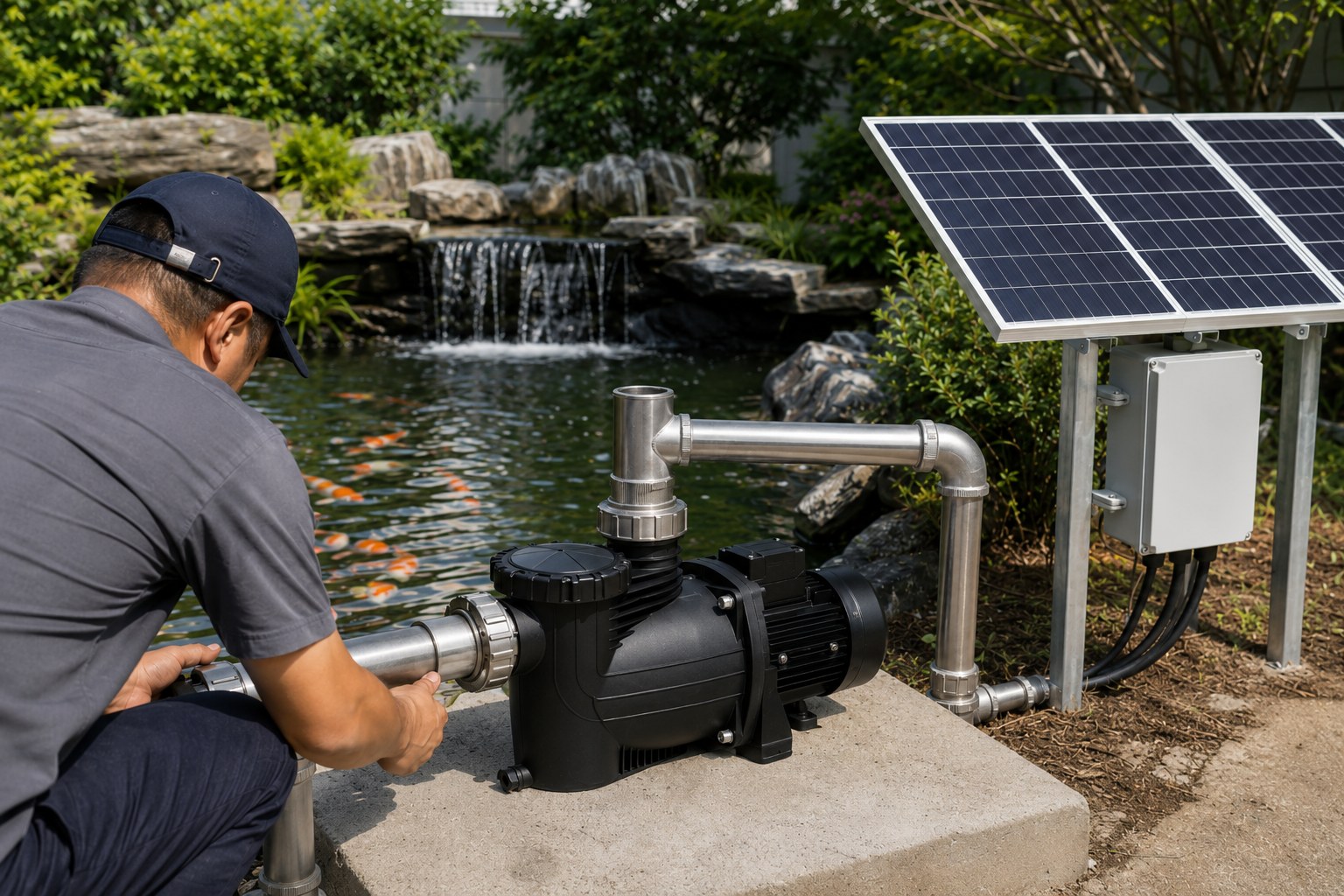
Choosing the right solar pump goes beyond simply picking one off the shelf.
It's about creating a reliable life support system for your aquatic ecosystem.
The wrong choice can lead to poor water quality and potential disaster, while the right one ensures a thriving, healthy pond powered by the sun.
Let’s explore the critical factors that separate a simple water feature from a robust, 24/7 pond circulation system.
How Do Solar Pond Pumps Work and What Are Their Limitations?
You see solar pumps advertised as the perfect eco-friendly solution.
But you're rightfully skeptical if they have enough power for a real fish pond.
Let's clarify how they work and what to realistically expect from them.
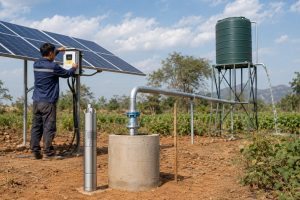
Solar pumps use a photovoltaic (PV) panel to power a low-voltage DC pump, creating a fountain or circulating water.
While wonderfully sustainable, their performance is tied to sunlight.
Basic models only work in direct sun, making them unsuitable for fish life support, which requires constant oxygenation.
Core Components: The Power Trio
Understanding the three essential parts of a solar pump system is key to selecting a high-performance unit.
The quality of the panel, motor, and controller directly determines the system's efficiency, reliability, and lifespan.
A well-matched system ensures you get the most power from every ray of sunlight.
-
Solar Panel: This is the engine of your system.
It uses photovoltaic cells to convert sunlight into DC electrical energy.
The panel's wattage must be greater than the pump's power requirement to compensate for less-than-ideal sun conditions.
Look for high-efficiency monocrystalline panels, as they perform better in lower light and take up less space.
Remember that panel efficiency decreases in extreme heat, with optimal performance around 77°F (25°C).
-
Pump & Motor: The heart of the operation is the pump, driven by its motor.
The most advanced and reliable systems use a Brushless DC (BLDC) permanent magnet motor.
These motors achieve efficiencies exceeding 90%, a significant jump from older brushed motors.
This high efficiency means they convert more solar energy into water movement, requiring smaller, less expensive solar panels.
Their brushless design eliminates the most common point of failure, resulting in a maintenance-free, long-service-life unit that is up to 39% lighter and 47% more compact than traditional motors.
-
Controller: The brain of the system is the controller.
A Maximum Power Point Tracking (MPPT) controller is crucial, as it intelligently adjusts the electrical load to extract up to 30% more power from the solar panel, especially during variable light conditions like cloudy mornings or evenings.
For fish ponds, an even more advanced AC/DC hybrid controller is the gold standard.
It automatically draws power from the solar panel when available and seamlessly switches to AC grid power when sunlight is insufficient, guaranteeing uninterrupted 24/7 operation.
Overcoming the "Solar-Only" Limitation
A basic solar pump that only runs when the sun is shining is not a life support system; it's a daytime water feature.
For a healthy fish pond, continuous water circulation is non-negotiable as it provides essential oxygen.
When circulation stops at night or on heavily overcast days, oxygen levels can plummet, stressing or even killing your fish.
This is why systems with energy storage or backup power are essential.
The table below compares the reliability of different system types, highlighting why a hybrid solution offers the most security for a precious fish stock.
| System Type | Daytime Operation (Full Sun) | Cloudy Day Operation | Night Operation | Recommended for Fish Ponds? |
|---|---|---|---|---|
| Basic Solar (Direct) | 100% | 20-50% | 0% | No (Unreliable) |
| Solar + Battery | 100% | 80-100% (uses battery) | 100% (uses battery) | Yes (Good) |
| Solar AC/DC Hybrid | 100% | 100% (blends solar/AC) | 100% (uses AC) | Yes (Excellent) |
How to Match Pump Specifications to Your Pond's Needs?
Picking the wrong size pump is a costly mistake that can starve your pond of oxygen.
An underpowered pump fails to circulate water effectively, while an oversized one wastes energy.
Let's master the two key metrics—flow rate and head height—to ensure a perfect match.
To size your pump correctly, first calculate your pond's total volume.
As a rule, choose a pump with a max flow rate (in Gallons Per Hour or Liters Per Hour) that can circulate the entire volume at least once every hour.
Also, check the maximum vertical head specification.
Calculating Required Flow Rate (GPH/LPH)
The most critical factor for pond health is the water turnover rate.
A sufficient flow rate ensures that all the water is aerated and sent through the filtration system regularly, preventing stagnant zones where harmful bacteria can thrive.
The general rule of thumb is to circulate the entire pond volume at least once per hour.
To calculate your pond's volume, use this simple formula:
Length x Width x Average Depth x 7.5 = Volume in Gallons
(For metric: Length x Width x Average Depth x 1000 = Volume in Liters)
For example, a pond that is 10 feet long, 8 feet wide, and has an average depth of 2 feet has a volume of 1,200 gallons (10 x 8 x 2 x 7.5).
Therefore, you need a pump with a minimum flow rate of 1,200 GPH.
For ponds with a heavy fish load or those located in hot climates, it is advisable to increase the turnover rate to 1.5 or even 2 times per hour to ensure superior oxygenation.
Decoding Max Vertical Head
Max Vertical Head (or Max Lift Height) is one of the most misunderstood specifications.
It indicates the maximum vertical height the pump can push water, measured from the surface of the pond.
It is not measured from the bottom of the pond where the pump sits.
This is a crucial distinction for planning waterfalls or fountains.
A pump's flow rate diminishes significantly as it pushes water higher, approaching zero at its maximum head height.
If your waterfall is 5 feet high, a pump with a 5.5-foot max head will only produce a weak trickle.
As a professional guideline, select a pump with a max head that is at least 30-40% greater than your required height to guarantee a strong, visually appealing flow.
The table below illustrates how flow rate decreases as the pumping height increases for a sample pump.
| Pumping Height | Flow Rate (GPH) | Percentage of Max Flow |
|---|---|---|
| 0 ft (at outlet) | 320 GPH | 100% |
| 2 ft | 250 GPH | 78% |
| 5 ft | 150 GPH | 47% |
| 7 ft | 50 GPH | 16% |
| 7.5 ft (Max Head) | 0 GPH | 0% |
Which Pump Internals Guarantee Long-Term Performance?
A cheap pump that fails after one season is no bargain, especially when it leaves your pond life at risk.
The messy job of replacing a submerged pump is a frustration no one wants.
Focusing on the quality of the internal components is the best way to ensure you choose a durable, reliable model.
The long-term performance of a solar pump hinges on two core components: its motor and its impeller.
A high-efficiency Brushless DC (BLDC) motor is the non-negotiable foundation.
For impellers, durable plastic offers a great balance of performance and value, while stainless steel provides ultimate corrosion resistance for demanding environments.
The Heart of the System: The BLDC Motor
The motor is the engine of your pump, and a Brushless DC (BLDC) permanent magnet motor is the pinnacle of current technology.
Unlike older brushed motors that wear out and fail, a BLDC motor offers a significantly longer, maintenance-free operational life.
Its primary advantage is its efficiency, which regularly exceeds 90%.
This incredible efficiency has a direct impact on the total system cost.
Because the motor requires less power to do the same amount of work, it can be paired with a smaller, less expensive solar panel.
This translates into a system that is more compact, easier to install, and more affordable for the end-user.
Motors built with high-grade components, such as powerful neodymium iron boron magnets, deliver higher torque and more reliable performance over tens of thousands of hours.
Impeller Materials: Plastic vs. Stainless Steel
The impeller is the component that physically moves the water.
Its material composition is critical for durability, especially in ponds that may contain debris or have unique water chemistry.
-
Durable Plastic Impellers: For most residential and commercial fish ponds, a high-quality, wear-resistant plastic impeller is an excellent choice.
It provides a fantastic balance of performance and cost-effectiveness.
These impellers are engineered to handle the fine sand and small organic debris commonly found in ponds without sustaining significant damage, ensuring a reliable flow for years.
-
SS304 Stainless Steel Impellers: For the most demanding applications or for clients who require the absolute highest level of durability, a pump with an SS304 stainless steel impeller is the premium choice.
This material offers superior resistance to corrosion, making it ideal for ponds with slightly acidic or alkaline water conditions.
While the initial investment is higher, the extended service life and unwavering reliability in harsh environments provide exceptional long-term value and peace of mind.
Critical Feature: Dry Run Protection
One of the quickest ways to destroy a pump is to let it run without water.
This is known as running dry, and it can cause the motor to overheat and burn out in minutes.
Dry run protection is an essential safety feature that automatically shuts the pump off if the water level drops too low, such as during a drought or if there is a leak in the pond liner.
Many entry-level pumps lack this feature, making them a high-risk investment.
A professional-grade solar pump should always include integrated dry run protection.
It’s a simple feature that safeguards the motor, prevents costly replacements, and ensures the long-term reliability of the entire system.
Conclusion
The best solar pump for a fish pond ensures 24/7 reliability with an AC/DC hybrid system, is sized for hourly turnover, and is built with durable, high-efficiency BLDC motor technology.
FAQs
Can a solar pump run a pond 24/7?
Yes, but only with a battery backup or an AC/DC hybrid controller. A basic solar pump without these features will only operate when the sun is directly shining on the panel.
What size solar pump do I need for my pond?
Calculate your pond's volume in gallons or liters. Choose a pump that can circulate that entire volume at least once per hour to ensure adequate aeration and filtration for fish.
Do solar pond pumps oxygenate the water?
Yes, by moving water. The surface agitation created by a fountain or waterfall allows oxygen from the air to dissolve into the water, which is essential for fish.
How long do solar pond pumps last?
A high-quality solar pump with a brushless motor can last for over 20,000 hours or more. The solar panel itself typically has a lifespan of 20-25 years.
Do solar pumps work on cloudy days?
They work at a reduced capacity. A high-efficiency panel and MPPT controller will maximize output, but flow will be lower. A battery or hybrid system is needed for full power.
Are solar pumps powerful enough for a waterfall?
Yes, larger models are. Check the pump's "max head" specification and choose one with a rating at least 30% higher than your waterfall's height for a strong flow.
Can I use a solar pump for a fish filter?
Yes, provided the pump runs 24/7 (with battery or AC/DC hybrid) and its flow rate matches the requirements of your biological filter to maintain the beneficial bacteria colony.