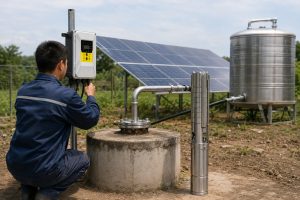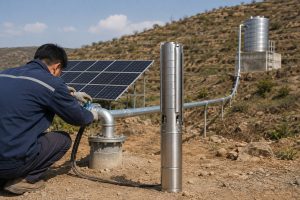
Do you want a beautiful pond fountain without the high electricity bills and complex wiring?
Mains power is expensive and can be dangerous to install near water.
A correctly sized solar pump is your eco-friendly and cost-effective solution.
Sizing a solar pond pump depends on your pond's volume, the fountain height you desire, and your local sun conditions.
For a small decorative feature, a pump in the 150 to 1,600 Litres Per Hour (LPH) range with a matching solar panel is a great starting point.
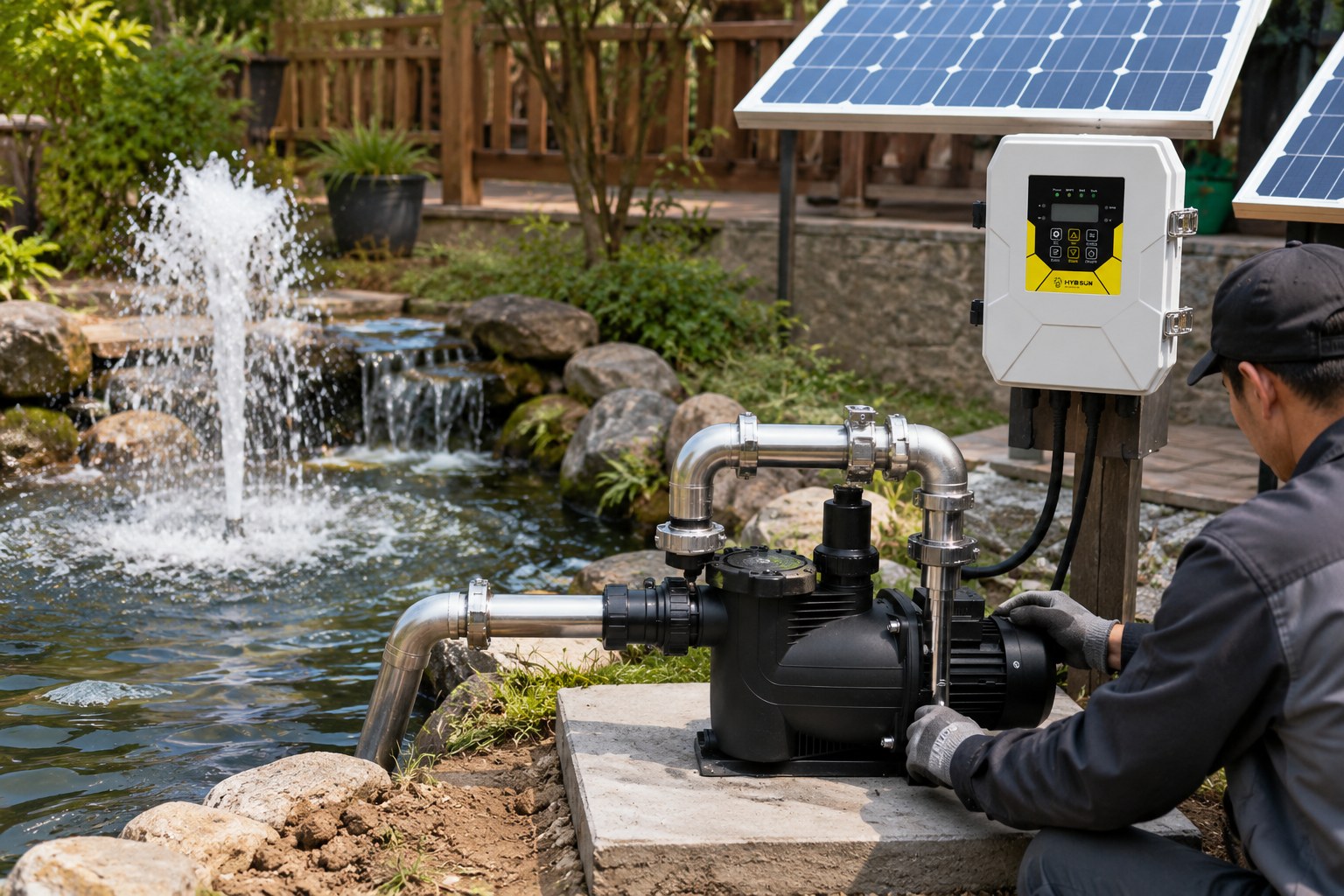
Choosing the right size is more than just picking a number from a box.
It requires understanding how these systems work, what their limitations are, and what components you truly need.
Getting it wrong can lead to a weak, disappointing water feature or a pump that fails prematurely.
Let's dive into the key factors to ensure you select the perfect solar pump that brings your pond to life, powered by the sun.
How Do Solar Pond Pumps Work and What Are Their Limitations?
Solar pumps seem wonderfully simple, but their performance can sometimes be disappointing if you don't understand the basics.
You imagined a lively fountain, but on a cloudy day, you just get a sad little dribble.
Understanding how they work and knowing their limits is the key to setting realistic expectations and making a wise purchase.
Solar pumps use a panel to convert sunlight into electricity, which powers a small pump directly or charges a battery for later use. Their biggest limitation is their complete dependence on sunlight. Performance drops significantly on cloudy days, and most are not powerful enough for 24/7 filtration or large waterfalls.
To get the most out of solar power for your pond, you need to look beyond the marketing claims and understand the mechanics.
The performance you see on a perfect, sunny day is often the "best-case scenario".
Your daily experience will depend on your location, the time of year, and the specific components of your system.
Let's break down how these systems function and what that means for your pond.
The Core Components
A basic solar-powered pond pump system has three main parts.
First is the solar panel, which captures energy from the sun.
Second is the pump itself, which is submerged in the water.
Third is the cable that connects the panel to the pump.
The panel is placed in an area of full, direct sun in your garden.
The pump is placed in your pond or water feature.
When the sun shines on the panel, it generates DC electricity, which travels through the cable to power the pump, creating a water flow.
Understanding Flow Rate and Fountain Height
Solar fountain pumps are rated by their flow rate, usually in litres per hour (LPH).
This number tells you how much water the pump can move in an hour under ideal conditions.
These pumps can range from about 150 LPH to over 1,600 LPH.
The flow rate directly impacts the potential fountain height.
| Pump Flow Rate (LPH) | Typical Max Fountain Height | Best Suited For |
|---|---|---|
| 150 - 300 LPH | 20cm - 40cm | Small bird baths, tiny water features |
| 300 - 800 LPH | 40cm - 90cm | Small to medium ponds, decorative fountains |
| 800 - 1600+ LPH | 90cm - 1.8m | Medium to large ponds, more dramatic displays |
It is crucial to remember these are maximums.
These heights are achieved on the brightest days with a new, perfectly clean pump.
The Reality of Performance Limitations
The obvious advantage of solar is zero running cost.
However, their performance is not constant.
In a very sunny location like Dubai, you might see maximum performance all day, every day.
In a place with more variable weather like the UK, performance will drop as soon as a cloud covers the sun.
For this reason, you should always position your solar panel facing south (in the northern hemisphere) to catch the maximum amount of sunlight throughout the day.
Most importantly, standard solar pond pumps are not yet a solution for critical life support systems.
A biological filter for a fish pond requires uninterrupted, 24-hour water circulation.
A solar-only pump cannot guarantee this.
Therefore, use solar pumps for decorative, part-time water features, not as the primary filter pump for a pond with fish.
They are also generally not designed to power waterfalls, which require more consistent power and pressure.
What Size Solar Panel Do I Need?
A great pump is useless if it doesn't have the right power source.
Mismatching your solar panel and your pump will lead to weak performance or even a shortened lifespan for the motor.
You must correctly match the panel's wattage to the pump's power requirements to unlock its full potential.
The solar panel's size, measured in watts, must be sufficient to meet the pump's power demand. A 50-watt pump needs at least a 50-watt panel, but oversizing the panel by 25-30% is highly recommended to compensate for cloudy days and ensure more consistent operation.
The relationship between the panel and the pump is the heart of your solar water system.
It's not just about having enough power on a perfect day; it's about having a resilient system that performs well even when conditions aren't ideal.
A larger panel acts as an insurance policy against cloudy weather, capturing more ambient light and keeping your water feature running longer.
Let's explore the technical details of sizing your panel correctly.
Understanding Watts and Volts
Every pump has a power rating in watts (W) and a voltage rating in volts (V).
The solar panel array you choose must match the pump's voltage and meet or exceed its wattage requirement.
For example, a 24V pump requires a solar panel array that produces 24V.
If the pump is rated at 150W, you need panels that provide at least 150W at 24V.
Failing to provide enough wattage means the pump will run slower or not at all.
Failing to match the voltage can damage the pump's motor or controller.
The Power of High-Efficiency Motors
Not all pump motors are created equal.
The efficiency of the motor plays a huge role in how much solar power you actually need.
Modern pumps often use Brushless DC (BLDC) permanent magnet motors.
These motors can have efficiencies exceeding 90%.
A traditional motor might only be 50-60% efficient.
This means a high-efficiency 100W BLDC pump can do the same amount of work as a less efficient 150W pump.
Choosing a pump with a high-efficiency motor means you can achieve your desired water flow with a smaller, less expensive solar panel array.
This can reduce the total system cost by 15-20% and makes installation easier.
Oversizing Your Panel Array
Experts strongly recommend "oversizing" your solar panel array.
This means installing more wattage than the pump's rating.
A common rule of thumb is to add 25-30% more panel capacity.
For a 200W pump, you would install 250W to 260W of solar panels.
Why do this?
- Cloudy Day Performance: On an overcast day, a panel might only produce 20-30% of its rated power. An oversized array will capture more of this diffuse light, allowing the pump to continue operating, albeit at a reduced speed.
- Morning and Evening Operation: It allows the pump to start earlier in the morning and run later into the evening when the sun's angle is low.
- Future-Proofing: Solar panels degrade slightly over time, losing about 0.5% of their efficiency per year. Oversizing ensures you still have sufficient power a decade from now.
Typical solar panel systems for water pumps use either multiple 100W panels or fewer, larger 300-375W panels to achieve the total required wattage.
The choice depends on the available space and system voltage.
Choosing the Right Type of Solar Pump for Your Application
Not all solar pumps are built the same.
Choosing the wrong type of pump is a common mistake that leads to wasted money and a system that simply doesn't do the job you need it to.
To get it right, you must match the pump's internal mechanism to your specific water-moving task.
For small, decorative pond fountains, a simple centrifugal fountain pump is usually sufficient. For creating a high jet or lifting water up to a waterfall, a "high head" screw pump is better. For moving large volumes of water for circulation, a "high flow" multi-stage impeller pump is the ideal choice.
The terms "flow" and "head" are critical here.
"Flow" is the volume of water moved in a period (LPH or GPM).
"Head" is the vertical height the pump can lift the water.
Some pumps are designed for high flow but low head, while others are designed for low flow but high head.
There is always a trade-off between these two metrics.
Understanding this trade-off is the key to selecting a pump that is perfectly engineered for your pond, stream, or waterfall project.
The "Low Flow, High Head" Specialist: The Solar Screw Pump
This pump type uses a different mechanism than most pond pumps.
It features a metal rotating screw inside a rubber stator.
As the screw turns, it creates sealed cavities of water that are pushed upward with great force.
This design results in lower flow rates but a very high head.
It can push water much higher than a standard centrifugal pump of the same power.
- Best Applications: Ideal for deep ponds where the pump sits far below the surface, or for powering a tall, single-jet fountain. It's also the best choice for pumping water from the pond up to the start of a high waterfall or stream.
- Key Advantage: Excellent resistance to sand and silt. If your pond has a natural, sandy bottom, a screw pump is far more durable and less likely to clog or wear out than an impeller pump.
The "High Flow, Medium Head" Workhorse: The Plastic Impeller Pump
This is a type of multi-stage centrifugal pump.
It uses a series of stacked plastic impellers (vaned discs) that spin at high speed.
Each impeller adds energy to the water, increasing its pressure and flow.
This design is engineered to move a large volume of water efficiently at low to medium head heights.
- Best Applications: Perfect for general pond circulation, supplying water to a wide, multi-tiered waterfall, or powering a decorative aerator that moves a lot of surface water. Its high output makes it great for larger ponds that need significant water movement.
- Key Advantage: These pumps are often lightweight and more economical than their stainless steel counterparts. Modern, wear-resistant plastics provide excellent durability against fine sand and sediment.
The "Premium, Corrosion-Resistant" Option: The Stainless Steel Impeller Pump
This pump operates on the same multi-stage centrifugal principle as the plastic impeller model.
However, its key components—the impellers, pump body, and shaft—are all constructed from SS304 or SS316 stainless steel.
This makes it exceptionally durable and resistant to corrosion.
- Best Applications: Essential for ponds in areas with acidic water or for saltwater features. It's also the premium choice for high-end installations where longevity and reliability are the top priorities, even in normal water conditions. If your water source is from a well with unusual pH or mineral content, stainless steel is the safest bet.
- Key Advantage: Unmatched service life and reliability. It can withstand harsh water chemistry that would degrade or destroy lesser pumps over time, justifying its higher initial cost.
| Pump Type | Primary Design | Best For | Flow | Head | Key Advantage |
|---|---|---|---|---|---|
| Solar Screw Pump | Progressing Cavity | Tall Fountains, High Waterfalls | Low | Very High | Sand Resistance |
| Plastic Impeller Pump | Multi-stage Centrifugal | General Circulation, Large Ponds | High | Medium | Economical & Wear-Resistant |
| Stainless Steel Pump | Multi-stage Centrifugal | Corrosive Water, Longevity | High | Medium-High | Corrosion Resistance & Durability |
Can I Run My Pump on Cloudy Days or at Night?
Your beautiful solar fountain is the highlight of your garden, but it stops the moment the sun goes down.
A pond that goes still and silent at night or on a gray, overcast day can feel lifeless.
You can achieve 24/7 operation by exploring systems that store energy or use a backup power source.
Yes, you can absolutely run a pump without direct sun by using a system with a battery backup or a hybrid AC/DC controller. A battery stores excess solar energy for use at night or on cloudy days. A hybrid controller automatically switches to your home's mains power when sunlight is insufficient.
The simple, panel-to-pump solar systems are great for basic daytime water features.
But if you want consistent performance for aesthetics or for a critical application like aeration, you need a more advanced setup.
The solution lies in adding either energy storage (batteries) or an alternative power source (AC grid power).
Let's look at how these technologies can give you the reliable, round-the-clock water circulation you need.
The Power of Battery Backup
Some solar pump kits come with an integrated lithium battery.
This is the most straightforward way to achieve after-dark operation.
During the brightest part of the day, the solar panel's output is split.
Part of the energy runs the pump, while the excess energy is used to charge the battery.
When the sun gets low or is blocked by clouds, the system's controller automatically draws power from the battery to keep the pump running.
The total runtime on battery power depends on the battery's capacity (measured in Amp-hours or Ah) and the pump's power draw.
A larger battery will provide a longer runtime.
For decorative fountains, this can provide several hours of evening ambiance.
The Ultimate Flexibility: Hybrid AC/DC Controllers
For true 24/7, worry-free operation, a hybrid AC/DC system is the ultimate solution.
This system is built around a sophisticated controller with two power inputs: one for the DC power from your solar panels and one for the AC power from your home's electrical grid (or a generator).
The controller's job is to use solar power whenever possible.
It intelligently prioritizes the free energy from the sun.
When sunlight is strong, the pump runs entirely on solar.
As clouds pass over or as evening approaches, the controller can even blend power, using all available solar and supplementing the rest with just enough AC power to maintain pump speed.
When there is no solar input at all (at night), it will automatically switch over to 100% AC power.
This guarantees your pump runs continuously, while still maximizing your use of free solar energy and minimizing your electricity bill.
Don't Forget the MPPT Controller
Whether you use a battery or a hybrid system, a vital component is the Maximum Power Point Tracking (MPPT) controller.
This is the "brain" of the solar power system.
The voltage and current produced by a solar panel change constantly with the light conditions.
An MPPT controller constantly analyzes the panel's output and adjusts the electrical load to harvest the absolute maximum amount of power available at any given moment.
Compared to simpler PWM controllers, an MPPT controller can boost your system's energy harvest by up to 30%.
This means your pump runs faster in low light and your batteries charge more quickly.
It is an essential piece of technology for any serious solar pumping application.
Conclusion
Choosing the right solar pump means matching flow, head, panel size, and pump type to your pond's needs.
Considering advanced motor and controller technology ensures you get a system that is efficient, reliable, and powerful.
Frequently Asked Questions
Can a solar pump run 24/7?
Yes, but only with a hybrid AC/DC controller that uses grid power as a backup, or with a sufficiently large solar panel and battery bank system.
Do solar pond pumps work on cloudy days?
Yes, they can work on cloudy days but at a significantly reduced flow rate. Oversizing your solar panel helps improve performance in low-light conditions.
How long do solar pond pumps last?
A quality solar pump with a brushless motor can last for many years. The solar panels themselves are typically warrantied for 20-25 years.
What is a good LPH for a pond pump?
For a small decorative pond, 500-1000 LPH is good. For fish ponds, you should aim to circulate the entire pond volume at least once every hour.
Do you need a battery for a solar water pump?
You do not need a battery if you only want the pump to run when the sun is shining directly on it. A battery is required for operation at night or on cloudy days.
How high can a solar pump push water?
This varies greatly by model. Small fountain pumps may only push water 1-2 feet high, while specialized "high head" solar pumps can push water over 100 feet high.
Are solar air pumps any good?
Yes, solar air pumps are a great, zero-cost way to add vital oxygen to a pond on hot, sunny days when oxygen levels are lowest.