Struggling with complex wiring and rising electricity bills for your garden pond?
A solar pump seems like the perfect, eco-friendly fix.
But do they actually work as promised?
Yes, modern solar pond pumps are excellent for many situations. Thanks to advancements in solar panel efficiency, motor technology, and battery storage, today's pumps are far more powerful and reliable than older models, providing a viable, eco-friendly solution for small to medium-sized ponds and water features.
To decide if a solar pump is the right investment for your specific needs, it's important to look beyond the simple promises.
The performance you get depends heavily on the type of pump, the size of your pond, your climate, and your expectations for flow consistency.
Let's dive into the details of how they work, their true advantages and disadvantages, and what to look for to ensure you make the best choice for your outdoor space.
How Do Solar Pumps Work?
Ever wondered how a simple panel can bring a pond to life?
The technology seems futuristic, but it's grounded in a straightforward and elegant process.
Understanding this process is the first step to appreciating its potential.
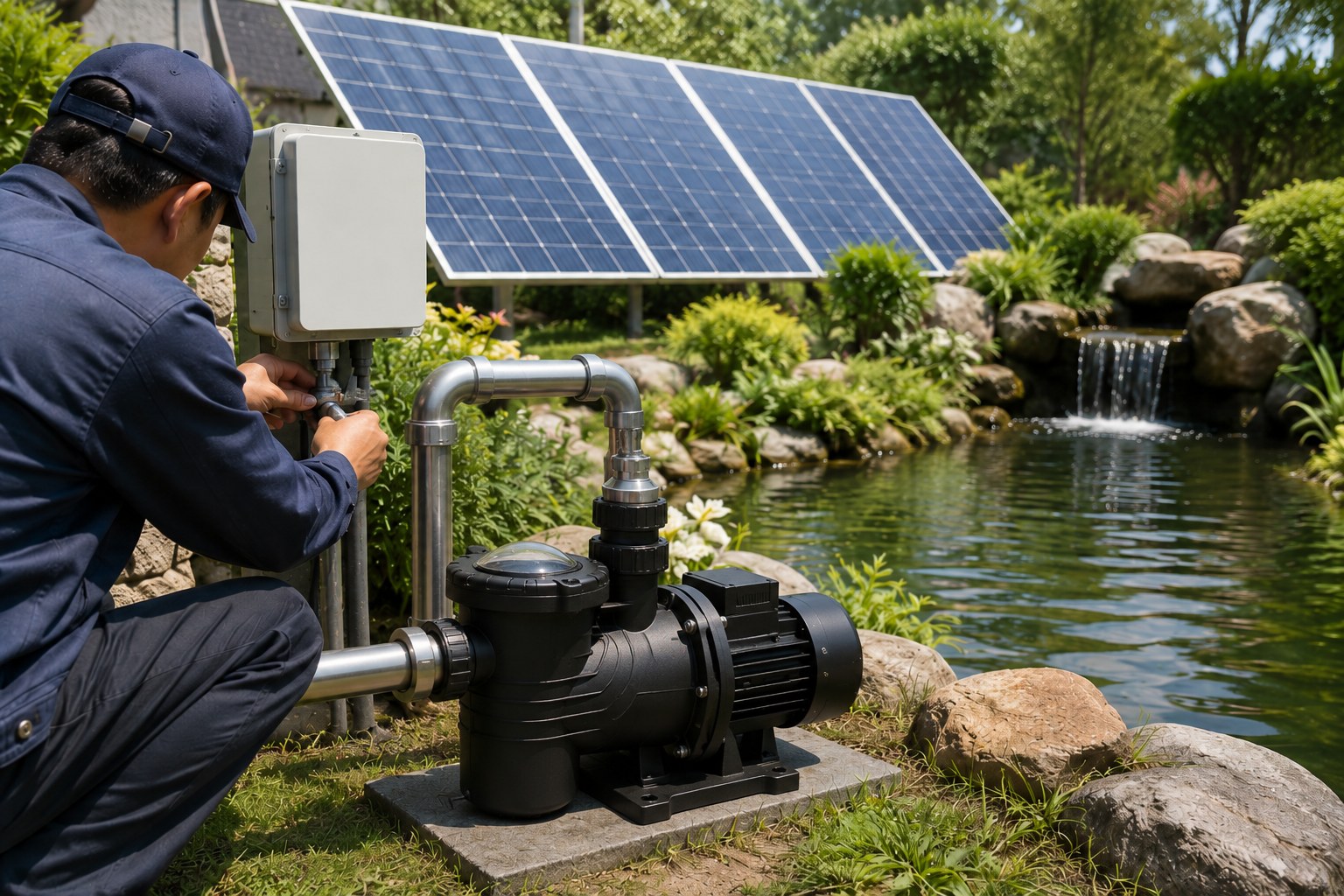
A solar pump works by using a photovoltaic (PV) panel to capture sunlight and convert it into DC electrical energy. This electricity powers a small motor, which in turn drives the pump to circulate water. More advanced systems include a battery to store excess energy for use at night or on cloudy days.
The magic of a solar pump lies in its self-contained ecosystem.
It’s an off-grid solution that transforms sunlight directly into water movement.
Let's break down the components and processes that make this happen.
The Core Components of a Solar Pump System
A typical solar pump system is made up of four key parts working in harmony.
- The Solar Panel: This is the engine of the operation. It's composed of photovoltaic (PV) cells, which are responsible for capturing photons from sunlight.
- The Motor: The electricity generated by the panel powers the motor. The efficiency of this motor is a critical factor in the pump's overall performance.
- The Pump Unit: Connected to the motor, this is the part that physically moves the water. It can be a surface pump that sits outside the water or a submersible pump that goes directly into the pond.
- The Battery (Optional): Many modern systems include a lithium-ion battery. The solar panel charges the battery during the day, allowing the pump to run after sunset or during overcast periods.
Advanced Motor Technology: The BLDC Advantage
The biggest leap in solar pump performance has come from motor technology.
Older pumps used brushed motors, which were inefficient and prone to wear.
Today, high-quality solar pumps use a Brushless DC (BLDC) permanent magnet motor.
This technology is a game-changer.
BLDC motors have an efficiency rate that often exceeds 90%, compared to the 60-75% efficiency of older motors.
This means they convert significantly more of the sun's energy into pumping power.
They are also smaller, lighter, and have no brushes to wear out, giving them a much longer, maintenance-free lifespan.
This superior efficiency is what allows a modern solar pump to produce impressive flow rates even with a compact solar panel.
Surface vs. Submersible Pumps
Solar pumps for ponds generally fall into two categories.
Submersible pumps are placed directly into the pond.
They are quiet, hidden from view, and efficient because they push water rather than pulling it.
This is the most common type for pond circulation and fountains.
Surface pumps are located on dry land.
They use an intake hose to pull water from the pond.
These are less common for small garden ponds but are sometimes used for larger water features or irrigation tasks where the pump needs to be easily accessible.
What Are The Advantages Of Solar Water Pumps For Ponds?
Are you looking for a way to beautify your garden without increasing your carbon footprint or your monthly bills?
Solar pumps offer a unique combination of benefits that address these exact concerns.
The primary advantages are financial and environmental. They have zero running costs after the initial purchase, are incredibly easy to install without professional help, and run on 100% clean energy. Their low-voltage operation also makes them significantly safer for use around water, pets, and children.
The benefits of going solar extend beyond just "free energy."
They offer a level of freedom and simplicity that traditional electric pumps can't match.
Let's explore these pros in more detail.
Long-Term Cost-Effectiveness
While solar pumps can have a higher initial purchase price, the total cost of ownership is often much lower.
A conventional electric pump is a constant, year-round drain on your electricity bill.
Let's look at a simple comparison.
| Feature | Conventional Electric Pump (50W) | Solar Pump (Equivalent Performance) |
|---|---|---|
| Initial Cost | $150 - $300 | $250 - $500 |
| Annual Running Cost (24/7) | ~$100 - $150 (at $0.25/kWh) | $0 |
| 3-Year Total Cost | $450 - $750 | $250 - $500 |
| 5-Year Total Cost | $650 - $1050 | $250 - $500 |
As the table shows, a solar pump can pay for itself in just 2-3 years.
Over a 5-year period, the savings become substantial, turning the initial investment into a smart financial decision.
Unmatched Installation Freedom
Perhaps the most liberating advantage is the complete lack of wires.
You don't need to hire an electrician, dig trenches for armored cables, or worry about the distance to the nearest outdoor outlet.
You can place your pond, fountain, or water feature anywhere in your garden that receives sunlight.
This opens up a world of design possibilities, allowing you to create a focal point in a remote corner of your yard or add a birdbath far from the house with zero fuss.
Installation is typically a simple plug-and-play process that takes minutes, not hours.
Environmental and Wildlife Friendly
Choosing a solar pump is a tangible way to reduce your household's environmental impact.
It generates no greenhouse gases and relies on a completely renewable resource.
Furthermore, the systems run on safe, low DC voltage.
This eliminates the risk of electric shock to people, pets, or wildlife that might come into contact with the pond or its equipment.
The quiet operation of the brushless motors also ensures that the gentle sounds of moving water are not overpowered by a mechanical hum, preserving the natural tranquility of your garden.
What Are The Disadvantages Of Solar Water Pumps For Ponds?
While the benefits are clear, solar pumps aren't a perfect solution for every situation.
Ignoring their potential drawbacks can lead to disappointment and a pond that doesn't meet your expectations.
It's vital to have a realistic understanding of their limitations.
The main disadvantages are directly tied to their power source: the sun. Performance is inconsistent and drops significantly on cloudy days, they have lower overall power than electric pumps of a similar price, and basic models will not run at night, which can be crucial for pond health.
These disadvantages are not necessarily deal-breakers, but they are crucial factors to consider.
The success of a solar pump depends on aligning its capabilities with your specific needs and environment.
Let's examine these cons so you can make an informed decision.
The Inconsistent Flow Rate
A solar pump's performance is directly proportional to the intensity of the sunlight hitting its panel.
On a bright, sunny day, it will run at 100% of its rated capacity.
However, on an overcast day, its output can easily drop by 50-70%.
During heavy cloud cover or rain, it may stop working altogether.
This inconsistency can be a problem for ponds that require constant filtration to stay healthy, especially those with a high fish load.
While models with batteries mitigate this issue, the battery itself has a finite capacity and may not last through extended periods of poor weather.
Power and Price Point Limitations
Solar technology is powerful, but it comes at a price.
When comparing pumps based on their flow rate (Litres Per Hour), solar pumps are significantly more expensive than their electric counterparts.
- A high-performance 2,500 LPH solar pump with a quality panel and motor might cost $600 - $750.
- A conventional 2,500 LPH electric pump with a similar build quality might only cost $250 - $300.
You are paying a premium of more than 2.5x for the off-grid convenience.
Furthermore, solar pumps are generally not suitable for very large ponds (over 10,000 litres) or features requiring a high "head height," like a tall waterfall.
The power required for these applications is often beyond the reach of affordable solar pond pump kits.
The Battery Backup Dilemma
The obvious solution to inconsistency and nighttime operation is a battery backup.
However, this adds another layer of cost and complexity.
A system with an integrated battery can be 30-50% more expensive than one without.
The battery also becomes a point of failure; like all rechargeable batteries, it has a limited lifespan of 3-5 years and will eventually need to be replaced, adding a future maintenance cost.
You must weigh the benefit of consistent operation against this significant increase in upfront and long-term expense.
What Size Solar Pump Do I Need For My Pond?
Choosing the wrong size pump is the most common mistake new pond owners make.
A pump that's too small will fail to keep the water clean and oxygenated.
A pump that's too large is a waste of money and can create an unnaturally turbulent environment.
To size your pump correctly, you must first calculate your pond's total volume. As a rule of thumb, you should choose a pump with a flow rate (in Litres per Hour) that can circulate the entire volume of your pond at least once every two hours. For ponds with fish, aim for once every hour.
Sizing a pump involves a bit of simple math, but getting it right is the key to a healthy and beautiful water feature.
Let's walk through the three essential steps: calculating volume, understanding flow rate, and accounting for head height.
Step 1: Calculate Your Pond's Volume
First, you need to know how much water your pond holds.
Use a tape measure to get the dimensions in metres.
For an irregular shape, estimate the average length and width.
Pond Volume (Litres) = Average Length (m) x Average Width (m) x Average Depth (m) x 1000
Example: A pond that is 2.5m long, 1.5m wide, and has an average depth of 0.5m has a volume of:
2.5 x 1.5 x 0.5 x 1000 = 1,875 Litres
Step 2: Determine Your Required Flow Rate
The flow rate, measured in Litres Per Hour (LPH), tells you how much water the pump can move.
- For general circulation and small fountains: Your pump's LPH should be at least 50% of your pond's volume. (For our 1,875L pond, you'd need a pump with a flow rate of at least ~940 LPH).
- For ponds with fish or connected to a filter: You need more circulation to manage waste and provide oxygen. Your pump's LPH should be equal to or greater than 100% of your pond's volume. (For our 1,875L pond, you'd need a pump rated for at least 1,875 LPH).
Step 3: Account for Head Height
This is the most critical and often overlooked factor.
"Head height" is the vertical distance from the surface of the pond to the highest point the water will reach (e.g., the top of a waterfall or fountain).
Every pump has a maximum head height, and its flow rate decreases dramatically as it pushes water higher.
A pump's advertised flow rate is always its output at zero head height.
Check the manufacturer's performance chart to see the actual flow rate at your required head height.
Example Pump Performance Chart
| Head Height | Actual Flow Rate |
|---|---|
| 0m | 2,500 LPH |
| 0.5m | 2,000 LPH |
| 1.0m | 1,400 LPH |
| 1.5m | 600 LPH |
| 2.0m | 0 LPH (Max Head) |
If our 1,875L pond needed a 1.0m fountain, a pump advertised as 2,500 LPH would only deliver 1,400 LPH, which is insufficient for the fish load.
We would need to choose a more powerful model to achieve the required flow at that height.
Alternatives To Solar Powered Pond Pumps
What if a solar pond pump just doesn't seem to fit your needs?
Perhaps your pond is too large, in a shady location, or you require 24/7 reliability for a precious koi collection.
There are excellent alternatives that might be a better match.
The most direct alternative is a conventional electric pump, which offers unmatched power and reliability at a lower initial price. For demanding off-grid situations, advanced solar systems originally designed for deep wells now offer robust, high-power solutions that far exceed the capabilities of a simple pond pump.
Your choice of pump should be driven by performance requirements, not just a desire for a particular technology.
Let's explore the strengths of these alternatives to see where they shine.
The Reliability of Conventional Electric Pumps
Sometimes the traditional solution is still the best.
Modern electric pumps are highly-engineered devices that provide a consistent, powerful flow rate day and night, regardless of the weather.
- Unmatched Power: For the same price, an electric pump will always be more powerful than a solar pump, making it the clear choice for large ponds, high waterfalls, and multi-tier cascades.
- Absolute Reliability: If you have valuable fish, you cannot afford to have your filtration system shut down. An electric pump provides the peace of mind that your pond's life support system is always on.
- Energy Efficiency: While they do use electricity, many modern pumps use highly efficient motors that minimize power consumption, keeping running costs lower than you might expect.
High-Performance Solar Systems
What if you need off-grid power but a standard pond pump is too weak?
The technology used in the professional agriculture and domestic water supply sectors offers a glimpse into the true potential of solar power.
These systems use the same advanced BLDC motors but are scaled up for serious work.
| Pump Type | Best For | Flow Profile | Head Profile | Key Advantage |
|---|---|---|---|---|
| Solar Screw Pump | Deep Wells | Low Flow | Very High Head | Lifts water from extreme depths |
| Solar Plastic Impeller | Irrigation, Farms | High Flow | Medium Head | Moves large volumes efficiently |
| Solar Stainless Steel Impeller | Corrosive Water | High Flow | Med-High Head | Ultimate durability in harsh water |
While overkill for a small garden pond, this technology demonstrates that solar can handle almost any pumping task.
It’s perfect for large agricultural ponds, filling livestock tanks, or powering extensive irrigation systems, all without a grid connection.
The Ultimate Solution: Hybrid AC/DC Systems
For those who want both sustainability and absolute reliability, hybrid systems offer the perfect compromise.
These systems are built around an intelligent controller that can accept power from two sources: solar panels (DC) and the grid or a generator (AC).
The controller is programmed to prioritize solar power.
It will run the pump using 100% free solar energy whenever it's available.
If cloud cover reduces solar input, it seamlessly blends in just enough AC power to maintain the required flow rate.
If the sun goes down or the panels are covered, it automatically switches over to full AC power.
This ensures your pump runs 24/7 in the most energy-efficient way possible, giving you the environmental benefits of solar without ever sacrificing performance.
Conclusion
Solar pond pumps are a fantastic, viable solution for many garden owners.
They are perfect for small to medium decorative ponds, offering beauty and tranquility without the running costs or installation hassle of electric models.
However, for larger projects or critical applications, it's wise to consider powerful electric pumps or advanced hybrid solar systems.
Frequently Asked Questions
Do solar pond pumps work in winter?
Yes, but their performance is significantly reduced due to shorter days and a lower sun angle. They will run for fewer hours and with less power.
Do solar pond pumps work at night?
Only models equipped with a battery backup system can work at night. Basic solar pumps without a battery will stop when the sun goes down.
How high can a solar pump lift water?
This varies widely. Small pond pumps may only lift water 1-2 metres. Powerful deep well solar systems, however, can lift water over 200 metres.
Can you run a pond pump on solar power?
Absolutely. The key is to correctly size the solar panel and pump to match your pond's volume and the demands of any features like fountains or filters.
How long do solar pond pumps last?
A quality pump with a brushless motor should last 3-5 years or more. The solar panel itself can last for decades, but the pump and battery are the components that will eventually need replacing.
Are solar pumps strong enough for a waterfall?
They can power small waterfalls, typically under one meter in height. For larger, more dramatic waterfalls, a conventional electric pump is usually the more practical and cost-effective choice.
Is a bigger solar panel always better?
A bigger panel provides more power, but it's only effective if the pump's motor is designed to handle that power. An oversized panel on an undersized pump is inefficient and can even cause damage.
What maintenance do solar pumps require?
Maintenance is minimal. It typically involves wiping the solar panel clean periodically and ensuring the pump's water intake is clear of leaves and debris to prevent clogging.