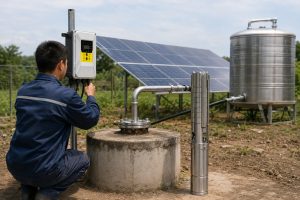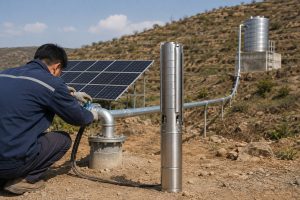
Struggling with unreliable water access for your farm or home?
You need a consistent water supply, but grid power is expensive or unavailable, and fuel costs keep rising.
The best solar water pump depends entirely on your specific needs.
For deep wells with high lift, a solar screw pump is ideal.
For high-volume farm irrigation, a plastic impeller pump is best.
For corrosive water, choose a stainless steel impeller pump.
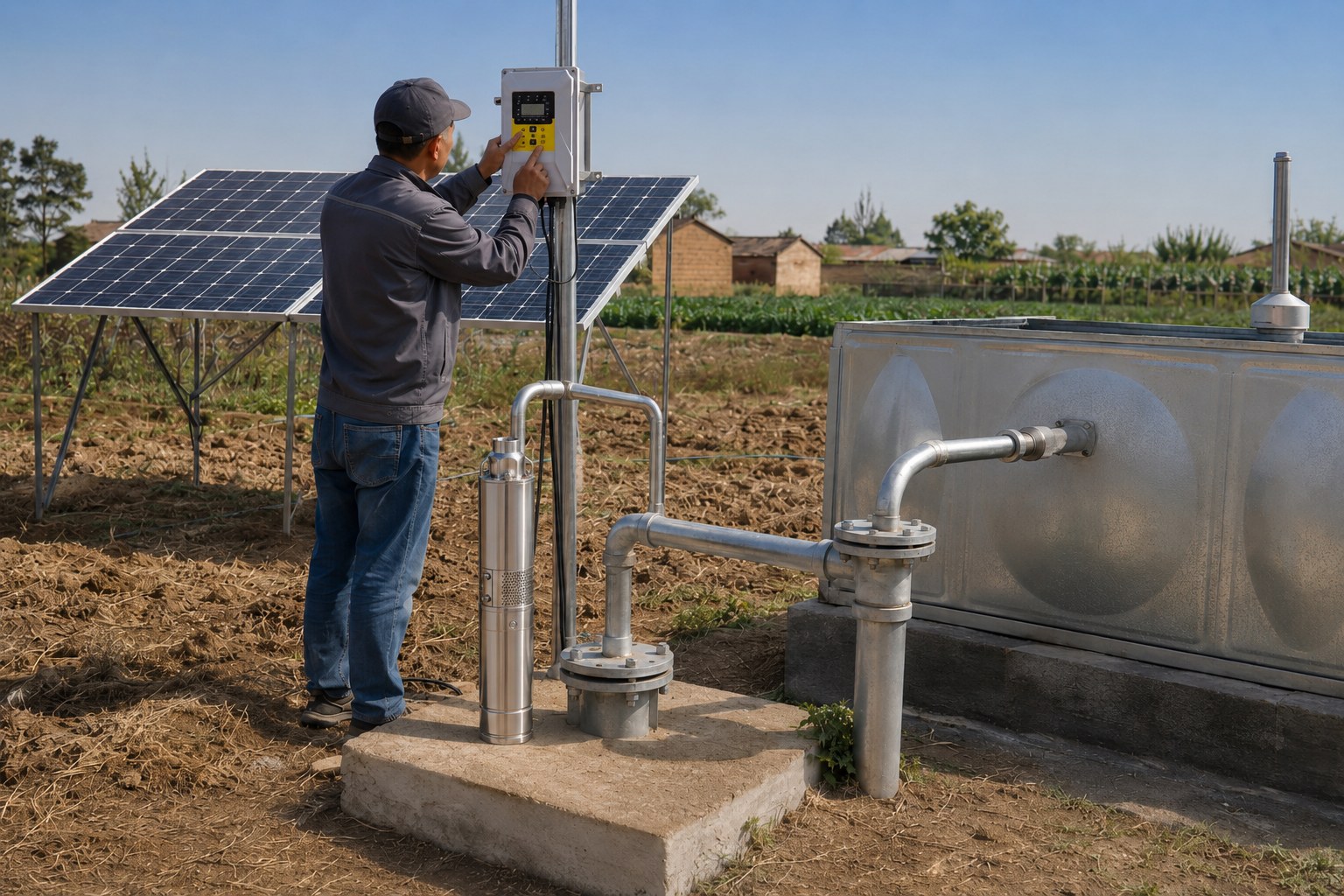
Choosing the right pump can feel overwhelming with all the technical terms and options available.
However, understanding a few key factors will empower you to select a system that delivers reliable, cost-effective water for years to come.
This guide breaks down everything you need to know, from assessing your site's needs to comparing the core pump technologies that drive the industry.
Let's dive into the details to find the perfect solar pump solution for you.
First, Understand Your Needs: Key Factors to Consider
Are you trying to pump water from a source that seems too deep or far away?
Calculating your needs incorrectly can lead to buying a pump that is either too weak or unnecessarily expensive.
To choose the right pump, you must first define your requirements.
Consider your water source depth, the total vertical height you need to pump (head), and the daily volume of water required (flow rate).
These factors are non-negotiable for sizing a successful system.
To ensure you select a pump that performs efficiently, you need to analyze your specific situation.
This process isn't complicated, but it is critical.
Getting these numbers right from the start prevents the common problem of a pump underperforming on cloudy days or failing to meet your peak water demand.
It's the difference between a reliable water source and a constant headache.
Let’s break down the essential metrics.
Water Source: Surface vs. Submersible
Your first decision is based on your water source's location.
Surface pumps are placed on the ground near the water.
They are perfect for sources like ponds, streams, or shallow wells where the water level is no more than about 7-8 meters (or 25 feet) below the pump.
They are generally optimized for higher flow rates.
Submersible pumps are designed to be placed entirely underwater.
These are the solution for deep wells or boreholes, as they push water up from below rather than sucking it from above.
If your water is deeper than 8 meters, you will need a submersible pump.
Total Vertical Lift (Max Head)
This is one of the most critical specifications.
The "max vertical head" or "total lift" is the maximum vertical distance the pump can move water.
It is calculated from the water level in your well or pond all the way up to the final outlet point (like a storage tank).
For example, if your well water is 70 feet deep and you are pumping to a tank that sits on a stand 10 feet high, your total vertical head is at least 80 feet.
A pump rated for a 50-foot max head will not work in this scenario.
Always choose a pump with a max head rating at least 20-30% greater than your calculated need to account for pipe friction and ensure strong performance.
Required Flow Rate (GPH/LPD)
Flow rate measures how much water the pump can move in a given time, usually in Gallons Per Hour (GPH) or Liters Per Day (LPD).
For livestock, you need to calculate the daily water consumption per animal.
For irrigation, the calculation is your land area multiplied by the crop's water requirement.
It's wise to plan for 3-4 days of water storage in a tank.
This provides a buffer during extended cloudy periods, a strategy many successful off-grid users employ.
Remember that a pump's flow rate decreases as the vertical lift increases.
Always check the pump’s performance chart, which shows its flow rate at different head heights.
| Factor | Description | Recommendation |
|---|---|---|
| Pump Type | Where the pump is placed relative to the water. | Surface: Water < 8m deep. Submersible: Water > 8m deep. |
| Max Vertical Head | Total vertical distance water is moved. | Calculate (Depth to water) + (Height above ground) + 25% buffer. |
| Max Flow Rate | Volume of water moved per hour/day. | Calculate daily needs (crops/livestock) and check pump performance chart. |
| Water Quality | Presence of sand, silt, or minerals. | Choose sand-resistant pumps (screw) or corrosion-resistant (stainless steel) accordingly. |
The Core of the System: Comparing Solar Deep Well Pump Types
Choosing between pump models seems complex with options like "screw" and "centrifugal".
Each design is engineered for a specific job, and picking the wrong one means poor performance and a shorter lifespan.
The three most competitive solar deep well pumps are screw pumps, plastic impeller pumps, and stainless steel impeller pumps.
Each uses a different mechanism to move water, making them suitable for different applications, from deep wells to large farms.
The pump's internal design directly impacts its performance characteristics, such as flow, pressure, and durability.
While all are powered by the sun, their methods of moving water are fundamentally different.
A screw pump excels at creating high pressure to lift water from great depths.
In contrast, a centrifugal impeller pump is designed to move large volumes of water at lower pressure.
Understanding these core differences is key to matching the right pump technology to your water needs.
Solar Screw Pump: The Deep Well Specialist
A solar screw pump operates using a positive displacement mechanism.
It features a single helical screw (the rotor) that turns inside a flexible rubber housing (the stator).
As the screw rotates, it creates sealed cavities of water that are pushed progressively up towards the outlet.
This design is incredibly effective at building high pressure.
This makes it the undisputed champion for deep wells.
It provides a consistent, albeit lower, flow rate but can achieve a very high head (lift).
It is ideal for domestic water supply, livestock watering from deep boreholes, and small-scale drip irrigation where high pressure is needed.
A major advantage is its exceptional resistance to sand and grit, as the rubber stator can pass small solids without damage.
This makes it highly reliable in the often harsh water conditions found in Africa and Latin America.
Solar Plastic Impeller Pump: The High-Volume Workhorse
This pump is a multi-stage centrifugal pump.
It uses a series of impellers, which are rotating disks with vanes, to move water.
Water enters the center of the first impeller and is thrown outward by centrifugal force.
It then moves to the next impeller, gaining more pressure at each stage.
This design is built for moving large volumes of water.
It delivers a high flow rate at a medium head, making it perfect for applications that demand a lot of water.
This includes farm irrigation, filling large livestock troughs, and supplying water to home gardens.
The impellers are made of durable, wear-resistant engineering plastics, offering excellent resistance to the fine sand often found in agricultural wells.
Their lightweight construction and economical price point make them a popular choice for farmers in Africa and the Americas.
However, their durability may be limited in very deep wells or highly corrosive water.
Solar Stainless Steel Impeller Pump: The Premium Durability Choice
This model operates on the same multi-stage centrifugal principle as the plastic impeller pump.
The key difference is its construction.
Both the impellers and the pump housing are made from high-grade SS304 stainless steel.
This material provides superior durability and, most importantly, exceptional corrosion resistance.
This pump is specifically designed for challenging water environments.
It thrives in acidic or alkaline water conditions that would quickly degrade lesser materials.
This makes it the go-to solution for regions with alkaline soils, such as parts of Australia and the Americas.
It is also used for high-end homes and commercial ranches where reliability and long service life are paramount.
While its initial cost and weight are higher, it offers unmatched longevity and peace of mind in corrosive water, justifying the investment for niche and high-end markets.
| Pump Type | Mechanism | Best For | Key Advantage | Limitation |
|---|---|---|---|---|
| Solar Screw Pump | Positive Displacement Screw | Deep Wells (High Head, Low Flow) | Handles sandy water exceptionally well. | Limited flow rate. |
| Plastic Impeller Pump | Multi-stage Centrifugal | High Volume (High Flow, Medium Head) | Economical and wear-resistant. | Less durable in deep or corrosive wells. |
| Stainless Steel Impeller | Multi-stage Centrifugal | Corrosive Water (High Flow, Med-High Head) | Superior corrosion resistance and lifespan. | Higher initial cost and weight. |
The Unseen Hero: Why the Motor Dictates Performance and Cost
Do you think the pump itself is the only part that matters?
Many users overlook the motor, yet it's the heart of the entire system, and a poor motor will cripple even the best pump.
The driving force behind all high-performance solar pumps is a brushless DC (BLDC) permanent magnet motor.
An efficient motor uses less power, which directly translates into needing fewer solar panels and a lower total system cost.
The motor is not just an accessory; it is the core determinant of the system's overall efficiency and long-term value.
Modern BLDC motors have achieved efficiencies exceeding 90%, a significant leap from older motor technologies.
This incredible efficiency means that nearly all the solar energy captured by the panels is converted into useful water-pumping power.
This technological advantage has a massive impact on both the initial investment and the ongoing performance of your water system.
The Power of High-Efficiency Design
The secret to this performance lies in the motor's design.
These motors use a rotor made of powerful rare-earth magnets, such as 40SH neodymium iron boron.
Unlike traditional brushed motors that lose energy to friction and heat, a BLDC motor's brushless design eliminates this waste.
This results in more power, higher torque for starting under load, and a much longer service life with virtually no maintenance.
Tangible Market Value
What does this mean for you, the end-user?
A high-efficiency motor makes the entire system more compact and affordable.
Because the motor requires less power, you can run the pump with a smaller, less expensive solar panel array.
For example, a pump with a 90% efficient motor might only need two solar panels, whereas a 60% efficient system might need three or four to do the same job.
This directly reduces upfront costs.
Advanced motor designs are also significantly smaller and lighter.
Modern BLDC motors can be up to 47% smaller and 39% lighter than their predecessors, which dramatically simplifies transportation and installation, a key benefit for remote locations.
The Strategic Role of the Motor
Ultimately, the motor acts as the brain and muscle of the operation.
It is paired with an intelligent MPPT (Maximum Power Point Tracking) controller that constantly optimizes the power drawn from the solar panels.
This ensures the pump runs efficiently even in partial sun or changing weather conditions.
When evaluating a solar pump system, don't just look at the pump's GPH or head.
Insist on a high-efficiency BLDC permanent magnet motor.
It is the single most important component for ensuring you get an energy-saving, cost-effective, and durable water solution.
Beyond the Pump: Powering Your System for 24/7 Reliability
What happens when the sun doesn't shine?
A common fear is that a solar pump is useless on cloudy days or at night, leaving you without water when you need it most.
While basic systems only run in direct sun, advanced solutions offer 24/7 reliability.
These include battery backups or, more effectively, AC/DC hybrid controllers that can switch to grid or generator power automatically.
The goal of any water system is reliability.
Relying solely on direct sunlight is a viable strategy in very sunny climates, but it has its limitations.
To overcome this, the industry has developed sophisticated power management solutions.
This ensures that whether you're watering livestock or supplying a home, you have access to water around the clock, regardless of the weather.
Let's explore the evolution from simple DC systems to intelligent hybrid power.
Direct DC vs. Battery Storage
The simplest solar pump systems connect the pump directly to the solar panels.
They run when the sun is out and stop when it's not.
The common strategy here is to pump water into a large storage tank during sunny hours.
You then use gravity to supply water whenever needed.
This is simple and cost-effective.
Another option is to use batteries.
The solar panels charge a battery bank, and the pump runs off the batteries.
This allows for pumping at night or on cloudy days.
However, it adds significant cost and complexity.
Batteries have a limited lifespan and require a charge controller to prevent damage.
For many users, the cost and maintenance of batteries are a major drawback.
The Ultimate Solution: AC/DC Hybrid Controllers
The most advanced and flexible solution is an AC/DC hybrid system.
Modern controllers are designed with inputs for both solar (DC) and grid/generator (AC) power.
The controller's intelligence is key.
It automatically prioritizes solar power whenever it's available.
When there is enough sunlight, the photovoltaic panels will be used for power supply.
When there is not enough photovoltaic input, the hybrid function maximizes the use of available solar energy by blending it with AC power.
When there is no photovoltaic input at all, such as at night or during heavy storms, it will automatically switch to the AC power source.
This ensures you have worry-free water use 24 hours a day without the expense and maintenance of a battery bank.
This technology offers the best of both worlds: the free energy of solar and the constant reliability of the grid or a generator.
Conclusion
The best solar pump is a complete system where the pump type, motor efficiency, and intelligent controller work together to meet your specific water head and flow needs reliably and cost-effectively.
FAQs
How deep will a solar water pump work?
A solar pump's depth depends on its type.
Submersible screw pumps are best for very deep wells, capable of lifting water from over 270 feet (80+ meters) or more.
How much water can a solar-powered water pump move?
This varies widely.
Small fountain pumps move around 65 GPH, while large agricultural pumps can move thousands of gallons per hour, depending on the pump size and solar array.
How much do solar pumps cost?
Costs range from under $100 for small fountain pumps to several thousand dollars for complete deep-well systems for agriculture.
A typical farm kit costs around $2,000-$3,000.
Do solar pumps work on cloudy days?
Yes, but at a reduced flow rate.
Systems with AC/DC hybrid controllers or battery backups can provide full power even on cloudy days by using an alternate power source.
Can you use a solar pump for a house?
Absolutely.
A properly sized solar pump system with a pressure tank can provide a reliable, off-grid water supply for an entire household.
What maintenance do solar water pumps require?
Maintenance is minimal.
You should periodically clean the solar panels and check the pump's inlet for debris.
High-quality BLDC motors are maintenance-free.
How do I size a solar water pump?
You need to calculate your total vertical lift (head) and your required daily water volume (flow).
Use these two figures to choose a pump from its performance chart.