Struggling with high electricity bills for water pumping or living completely off-grid?
Traditional pumps are costly to run, but solar pumps have their own challenges.
Let's explore them.
The main disadvantages of solar water pumps are the high initial investment, dependence on sunlight which affects consistent water supply, and the potential need for regular maintenance like cleaning solar panels. These issues, however, can be managed with proper system design, storage solutions, and new hybrid technologies.
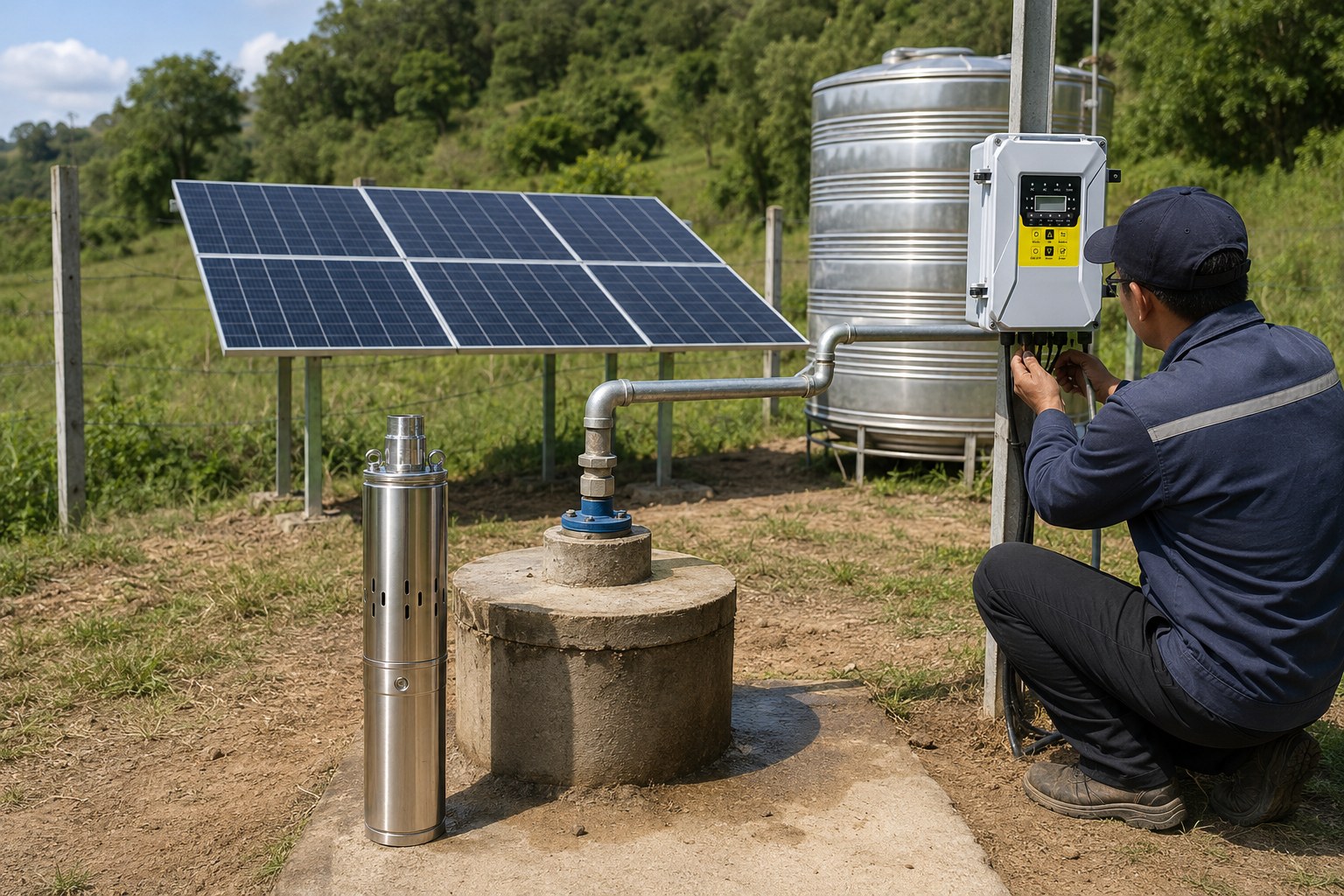
While the promise of free energy from the sun is incredibly appealing, it's crucial to understand the practical drawbacks before investing.
These challenges aren't deal-breakers.
In fact, understanding them is the first step toward building a reliable and cost-effective solar pumping system that serves you for decades.
This guide will break down each disadvantage and explore the modern solutions that turn these potential problems into manageable variables.
We'll look at the numbers, the technology, and the strategies that make solar water pumping one of the most viable long-term solutions available today.
The Initial Investment: A Major Hurdle?
Budgeting for a new water system can be stressful.
The high initial price tag on a complete solar pump kit can seem discouraging compared to a standard AC pump.
But does the upfront cost tell the whole story?
A complete solar pump system costs more initially because it includes not just the pump, but also solar panels and a specialized controller. An AC pump's price doesn't include the significant, often hidden, cost of running grid power to a remote site or the ongoing monthly electricity bills.
Let's dissect this initial financial barrier to see if it's as big as it appears.
The upfront cost is often the most cited disadvantage, and for good reason.
You aren't just buying a pump.
You are buying a self-contained power plant for your water needs.
This includes the pump itself, a high-efficiency motor, an intelligent controller, and, most significantly, the solar panels.
When you purchase a conventional 1 HP AC submersible pump for around $300-$500, that's only the beginning of your expenses.
The real cost emerges when you need to power it.
Breaking Down the True Costs
The sticker price of a solar pump system is transparent; it represents the majority of your total investment over the system's life.
In contrast, the true cost of an AC pump is often spread out over years, making it seem cheaper at first glance.
Let's look at a realistic scenario.
Cost Comparison: Solar vs. Grid Power
Consider a situation where you need to power a pump 300 meters from the nearest grid connection.
Bringing in utility power can be shockingly expensive.
Industry estimates place the cost of extending a power line at anywhere from $50 to over $150 per meter, depending on the terrain and local utility company regulations.
| Expense Category | Solar Pump System | Grid-Powered AC Pump |
|---|---|---|
| Pump & Controller | $700 - $1,500 | $300 - $500 |
| Power Source | $400 - $800 (Solar Panels) | $15,000 - $45,000 (Grid Extension) |
| Installation Labor | DIY or $500 | Included in Extension Cost |
| Ongoing Energy Cost | $0 | ~$250-$500 / year |
| Total 5-Year Cost | $1,600 - $2,800 | $16,550 - $48,000 |
This comparison makes it clear that for any remote application, the "high upfront cost" of solar is actually a massive saving of over 90% compared to the alternative.
The return on investment (ROI) for a solar pump that replaces a grid-powered pump is also compelling.
If an existing AC pump costs $250 annually in electricity, a $1,500 solar system pays for itself in just six years.
Given that solar panels are warrantied for 20-25 years, you get nearly two decades of free water pumping after the breakeven point.
This transforms the initial disadvantage into a significant long-term financial advantage.
Sunlight Dependency: What Happens on Cloudy Days?
You rely on having water available 24/7.
The idea of your water supply shutting down because of a few cloudy days is a legitimate concern.
How can a solar-powered system provide reliable water without constant sunshine?
Solar pumps are entirely dependent on sunlight, meaning their performance drops on cloudy days and ceases at night. This disadvantage is overcome by incorporating water storage, such as a large tank, or by using a hybrid AC/DC controller that can switch to grid or generator power automatically.
The intermittent nature of solar power is a fundamental challenge, but one that engineers have successfully solved through simple, effective strategies.
A common misconception is that you need a constant, direct electrical feed to your pump, similar to how household appliances work.
For water pumping, this isn't true.
The goal is not to pump water on demand, but to ensure water is available on demand.
This subtle shift in thinking opens up powerful solutions.
Solution 1: Water Storage is Energy Storage
The most common and cost-effective way to ensure a consistent water supply is to pump more water than you need when the sun is shining and store it.
A water tank acts as a battery, but it's cheaper, simpler, and has a much longer lifespan.
A typical recommendation is to have 3 to 5 days of water storage capacity.
This buffer covers you during extended periods of stormy or overcast weather.
Planning Your Water Storage
Calculating your storage needs is straightforward.
First, determine your daily water consumption.
| Usage Type | Daily Water Need | Required 3-Day Storage | Required 5-Day Storage |
|---|---|---|---|
| Small Household (4 people) | 1,500 Liters | 4,500 Liters | 7,500 Liters |
| Livestock (20 cattle) | 1,000 Liters | 3,000 Liters | 5,000 Liters |
| Small-Scale Irrigation | 10,000 Liters | 30,000 Liters | 50,000 Liters |
By sizing your pump and panels to fill this tank during average sunlight hours, you decouple your water access from the immediate weather conditions.
Water is then delivered to your home, troughs, or fields by gravity or a smaller, on-demand booster pump.
This design makes the system more resilient and reliable than one that pumps directly to the point of use.
Solution 2: The Power of Hybrid Technology
For critical applications where a water tank might not be practical or for users who already have a grid or generator connection, hybrid controllers are a game-changer.
These advanced controllers can accept both DC power from solar panels and AC power from the grid or a generator.
The controller's smart logic prioritizes solar power.
It will use 100% of available solar energy first.
If a cloud passes and the solar input drops, it seamlessly supplements the remaining need with AC power, ensuring the pump never stops or slows down.
When solar input is zero (at night or during heavy storms), it automatically switches over to 100% AC power.
This provides the best of both worlds: you save the maximum amount of money by using solar whenever possible, but you retain the 24/7 reliability of a traditional power source as a guaranteed backup.
System Complexity and Potential Failure Points
Your current water pump is simple, but it keeps breaking down.
You worry a more complex solar system means more things can go wrong.
Is the technology reliable enough for your critical water needs?
While a solar pump system has more components—panels, controller, pump, and wiring—modern designs using high-quality materials are exceptionally reliable. The key is understanding how different pump types and motors are suited for specific water conditions to prevent premature failure and ensure a long service life.
The reliability of a solar water pump system is not a matter of luck; it's a function of correct system design and component selection.
A major source of failure in imported, low-cost pumps is a mismatch between the pump's capabilities and the specific application.
Let's explore the core components and how choosing the right ones for your well and water quality can lead to a system that lasts for decades.
The Heart of the System: The Motor
At the core of every modern solar pump is a Brushless DC (BLDC) permanent magnet motor.
These motors are a massive leap forward from older brushed DC or standard AC motors.
Their efficiency often exceeds 90%, compared to 60-70% for their AC counterparts.
This high efficiency means you can pump more water with fewer solar panels, directly reducing the system's upfront cost by 20-30%.
They are also virtually maintenance-free, with operational lifespans of 20,000 to 30,000 hours, which is 6 to 10 times longer than brushed motors.
Choosing the Right Pump End for Your Water
The motor provides the power, but the "pump end" does the work of moving water.
The three main types of solar deep well pump ends are each designed for different conditions.
Choosing the wrong one is a primary cause of system failure.
Pump Type Comparison
| Feature | Solar Screw Pump | Solar Plastic Impeller Pump | Solar Stainless Steel Impeller Pump |
|---|---|---|---|
| Best For | High Head, Low Flow | High Flow, Medium Head | High Flow, Corrosive Water |
| Ideal Application | Deep domestic wells, livestock | Farm irrigation, pasture supply | Acidic/alkaline water, high-end homes |
| Sand Resistance | Excellent | Good (for fine particles) | Moderate |
| Primary Limitation | Limited flow rate | Not for deep corrosive wells | Higher initial cost |
-
Solar Screw Pump: This pump uses a helical rotor inside a rubber stator. It excels at creating high pressure, making it perfect for very deep wells where you need to lift water a long distance, but a high volume of water isn't required. Its design is also highly tolerant of sandy or silty water that would quickly destroy other pump types.
-
Solar Plastic Impeller Pump: For applications needing high volumes of water like irrigation, this multi-stage centrifugal pump is ideal. Modern engineered polymers used for the impellers are lightweight, efficient, and surprisingly wear-resistant, offering a great balance of performance and cost.
-
Solar Stainless Steel Impeller Pump: In areas with aggressive water—either acidic or alkaline—or for users demanding the longest possible service life, this is the premium choice. The SS304 stainless steel construction resists corrosion that would degrade plastic or cast iron components over time, ensuring reliability in harsh environments.
By matching the pump type to your well depth, required flow rate, and water quality, you eliminate the biggest risk factor and build a system designed for longevity.
Conclusion
The disadvantages of solar pumps—cost, sun dependency, and complexity—are manageable with proper planning and modern technology, making them a superior long-term investment.
Frequently Asked Questions
Do solar water pumps work on cloudy days?
Yes, they work on cloudy days but at a reduced flow rate, typically 10-30% of their peak output. Water storage tanks are used to ensure supply during these times.
How long do solar water pumps last?
A well-maintained solar water pump system can last for decades. The solar panels are warrantied for 20-25 years, and brushless DC motors have a lifespan of over 20,000 hours.
Do you need a battery for a solar pump?
No, batteries are not typically recommended. Storing water in a tank is far more cost-effective and durable than storing electricity in batteries for most water pumping applications.
Can a solar pump run 24 hours?
A solar-only pump cannot run for 24 hours. However, a hybrid AC/DC solar pump system can run 24/7 by automatically switching to grid or generator power at night.
What maintenance do solar water pumps require?
Maintenance is minimal. The primary task is cleaning the solar panels a few times per year to remove dust and debris, which ensures they operate at maximum efficiency.
How deep can a solar water pump go?
Solar pumps can service a wide range of depths. Solar screw pumps are designed for high-head applications and can pump efficiently from wells hundreds of meters deep.
Can solar pumps be used for irrigation?
Yes, high-flow solar pumps, like plastic or stainless steel impeller models, are excellent for farm and garden irrigation, providing large volumes of water during peak sunlight hours.
What size solar pump do I need?
The correct size depends on your daily water requirement, well depth (total dynamic head), and average daily sunlight hours in your location. It's best to use a sizing calculator.