High electricity bills from your pool pump can be frustrating.
Solar power offers a silent, cost-effective solution.
However, the setup can seem complex.
Yes, you can absolutely run a pool pump with solar panels.
You have two main options.
First, a dedicated DC solar pump system that operates off-grid.
Second, powering your existing AC pump with a larger, grid-tied home solar system.
Both offer significant savings and environmental benefits.
Choosing the right solar solution for your pool is a critical decision.
It impacts your initial investment, long-term savings, and overall system efficiency.
To make the best choice, it's essential to understand the different technologies available.
Let's explore how these systems work, their costs, and which approach is right for your pool.
Understanding the technology will help you make a smart investment.
What Are the Options for Solar-Powered Pool Pumps?
Deciding how to power your pool pump with solar can be confusing.
Do you need a whole new system or can you use your existing setup?
The choice you make will determine your project's cost and complexity.
You have two primary choices.
First, an off-grid DC solar pump with its own dedicated panels.
Second, using your existing AC pump powered by a larger, grid-connected solar system for your whole house.
Each has distinct advantages depending on your needs.
Let's dive deeper into these two popular methods.
Both paths lead to energy savings, but they take different routes to get there.
One involves installing a specialized, self-contained system.
The other leverages an existing or new whole-home solar installation.
Your specific situation, including local regulations and roof space, will influence the ideal choice.
Option 1: The Dedicated Off-Grid DC Pump System
A dedicated DC pump system is a completely independent setup.
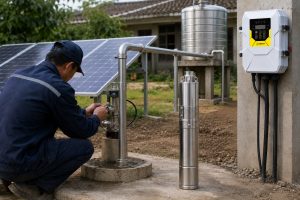
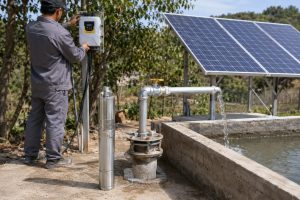
It consists of a few solar panels wired directly to a special DC (Direct Current) pool pump.
A controller is placed between the panels and the pump to manage the power flow.
This system is not connected to your home's electrical grid.
It operates exclusively on the solar energy it generates.
When the sun shines, your pump runs.
When it's dark, the pump stops.
The key advantage is its simplicity and independence.
You will never pay for grid electricity to power your pool pump again.
This can result in 100% savings on your pump's running costs.
Since the panels are not connected to the grid, you often don't need permission from your utility company to install them.
This setup also doesn't affect any premium feed-in tariffs you might have from an older home solar system.
However, this option requires you to replace your existing AC pump with a DC model.
Additionally, any excess solar energy generated by the panels that the pump can't use is wasted.
It cannot be used to power other appliances in your home.
Option 2: The Grid-Connected AC Pump System
This approach uses your standard AC (Alternating Current) pool pump.
It remains connected to your home's main electrical supply.
The power to run it comes from a larger, grid-tied solar system installed on your roof.
This system is designed to power your entire house, not just the pump.
To maximize savings, you set your pool pump's timer to run during peak sunlight hours.
This is typically between 10 a.m. and 3 p.m.
During this time, the solar panels generate more than enough electricity to run the pump and other household appliances.
The main benefit is efficiency.
You don't need to buy a new, specialized pump.
All the solar power your panels generate gets used.
It either powers your appliances or is exported back to the grid for a credit, depending on your local utility's policy.
The downside is that on very overcast days, your pump might draw some power from the grid.
This will result in a small charge on your electricity bill.
This option is most effective if you have a large enough solar system, typically 6kW or more, to cover both your pump and household energy needs.
Comparing the Two Approaches
Choosing between a dedicated DC system and a grid-tied AC setup depends on your goals.
The table below breaks down the key differences to help you decide.
| Feature | Dedicated DC Pump System | Grid-Tied AC Pump System |
|---|---|---|
| Pump Type | Requires new DC pump | Uses existing AC pump |
| Grid Connection | Off-grid; independent | Grid-tied; integrated |
| Excess Energy | Wasted | Powers other appliances or is exported |
| Component Cost | New pump, panels, controller | Solar panels, inverter for whole home |
| Grid Permission | Usually not required | Required |
| Cloudy Day Power | Pump stops or slows down | Draws from the grid if needed |
| Best For | Limited roof space; preserving feed-in tariffs | Maximizing total solar energy use |
A dedicated DC system offers energy independence for your pool.
A grid-tied system offers maximum efficiency and utility for your entire home.
What Are the Costs and Payback Period?
Investing in solar technology always raises questions about cost.
How much will the equipment cost upfront?
Most importantly, how long will it take to pay for itself through energy savings?
The initial investment for a DIY solar pool pump system can be under $1,000.
This typically includes panels, the DC pump, and wiring.
Based on average electricity rates, the payback period can be as short as 3 to 4 years, making it a financially attractive upgrade.
Understanding the return on investment (ROI) is crucial.
Let's break down the numbers for a typical dedicated DC solar pump installation.
This will provide a clear picture of the financial benefits.
The calculation is straightforward: divide the total initial cost by the annual savings on your electricity bill.
Calculating the Initial Investment
The total cost depends on the components you choose.
A do-it-yourself (DIY) project is the most cost-effective route.
Here is a sample cost breakdown based on real-world examples:
- Solar Panels: Two 400-watt panels can cost around $440.
- DC Pool Pump: A 500-watt DC pump can be found for about $350.
- Wiring and Components: Cabling, mounts, and a timer can add another $100.
The total initial investment for this DIY setup would be approximately $890.
This figure does not include professional installation, which would increase the upfront cost but may be necessary for those uncomfortable with electrical and plumbing work.
Calculating Annual Energy Savings
To find your savings, you must first know how much your old AC pump costs to run.
Let's assume you have a standard 1-horsepower (hp) AC pump.
A 1 hp pump uses about 746 watts, or 0.746 kilowatts (kW).
If you run it for 7 hours a day, the daily energy use is:
0.746 kW x 7 hours = 5.222 kWh per day
The average electricity cost in the U.S. is about $0.17 per kWh.
The daily cost to run the pump is:
5.222 kWh x $0.17/kWh = $0.88 per day
The annual cost is:
$0.88 x 365 days = $321.20 per year
Since the new DC solar pump runs for free on sunlight, your annual saving is the full $321.20.
Determining the Payback Period
Now, we can calculate the payback period.
Divide the total investment by the annual savings.
$890 (Total Investment) / $321.20 (Annual Savings) = 2.77 years
In this example, the system pays for itself in less than three years.
After that, the energy is completely free for the life of the system.
Given that a quality DC brushless motor can last for 20,000 hours or more, it could operate for over 8 years.
This makes the long-term ROI extremely compelling.
What Are the Challenges with Current Solar Pumps?
While the potential for solar pool pumps is huge, the technology is not without its flaws.
Many available models are imports with inconsistent quality.
This can lead to early failure and a frustrating experience for homeowners.
Current solar pumps, primarily from Asia, face three main challenges.
First, they often have a "cycling glitch," where the motor rapidly turns on and off in low light, causing stress and premature failure.
Second, the installation manuals are poorly written.
Third, customer support is often nonexistent.
These issues are holding back the widespread adoption of a very promising technology.
Fortunately, some of these problems can be managed with a little extra effort.
Understanding these challenges before you buy can help you make a more informed decision and potentially avoid common pitfalls.
Let's examine each of these issues in more detail.
The On-Off Cycling Glitch
The most significant technical issue is how the pump's controller handles variable sunlight.
On days with scattered clouds, the solar panel output can fluctuate rapidly.
Many current controllers react almost instantly to these changes.
When a cloud passes, the voltage from the panels drops.
If it drops below a certain threshold, the controller shuts the pump off completely.
A few seconds later, the sun reappears, the voltage jumps back up, and the controller restarts the pump.
This start-stop cycle can repeat every 10 to 20 seconds.
This process, known as rapid cycling, puts immense stress on the DC motor and its electronic components.
It is a leading cause of the premature failures reported in many online reviews.
A simple workaround is to install a digital timer between the solar panels and the controller.
The timer can be set to cut power in the late afternoon when the sun is weak and inconsistent, preventing the pump from cycling itself to death.
Poor Documentation and Technical Support
Another major frustration is the lack of clear instructions.
The user manuals provided with many imported pumps are often poorly translated and lack detail.
They may contain confusing diagrams or omit crucial troubleshooting information.
This leaves homeowners to figure out the installation through trial and error.
One user of a $1,000 pump noted the documentation was "horrible or non-existing."
This problem is compounded by a near-total lack of customer support.
If you run into a problem, getting help from the manufacturer is nearly impossible.
This is a significant risk, especially when dealing with a product that combines water, electricity, and plumbing.
Buyers must be prepared to be self-reliant and source information from online forums and videos.
Market and Pricing Instability
The market for DC solar pool pumps is still developing.
As a result, there is no consistent pricing structure.
You can find two pumps with nearly identical specifications priced hundreds of dollars apart.
One 500-watt model might sell for $350, while a similar one costs nearly $1,000.
The product descriptions rarely provide enough technical detail to justify the massive price difference.
This price chaos makes it difficult for consumers to gauge the true value of a product.
It suggests that some retailers may be taking advantage of an emerging market.
A cheaper pump may have a better sustainability story with its faster payback period.
However, a more expensive model might (or might not) contain higher-quality components.
Without industry standards and transparent specifications, buyers are often rolling the dice.
What is the Core Technology Driving Solar Pumps?
The true innovation behind modern solar pumps isn't just the solar panels.
It's the highly efficient motor that runs the pump.
This advanced motor technology is what makes direct-solar power for water pumping so effective and reliable.
The heart of a modern solar pump is the Brushless DC (BLDC) permanent magnet motor.
This motor technology is extremely efficient, with some designs exceeding 90% electrical-to-mechanical energy conversion.
This high efficiency is crucial for maximizing the water pumped using limited solar energy.
Understanding the motor is key to appreciating the entire system's performance.
A superior motor means the pump can do more work with less power.
This reduces the number of solar panels needed, lowering the overall system cost and simplifying installation.
Let's explore the specific advantages of BLDC motors and how they contribute to a better solar pumping solution.
Unpacking the BLDC Motor Advantage
The BLDC motor represents a significant leap forward from older brushed motors.
Here are the technical advantages that set it apart:
- High Efficiency: BLDC motors are fundamentally more efficient. They don't have brushes, which create friction and energy loss in traditional motors. Efficiencies over 90% are common, compared to 75-80% for brushed motors. This 10-15% gain means more water pumped per watt of solar power.
- Longer Lifespan: Brushes are the primary wear-and-tear component in a traditional motor. By eliminating them, a BLDC motor's lifespan increases dramatically. A brushed motor may last 2,000 to 5,000 hours. A BLDC motor can last 20,000 to 30,000 hours, offering 6 to 10 times the operational life.
- Maintenance-Free: With no brushes to replace, BLDC motors are virtually maintenance-free. This is a huge benefit for a piece of equipment that needs to run reliably for hours every day.
- Compact and Lightweight: The design of BLDC motors, often using powerful neodymium magnets, allows them to be much smaller and lighter than traditional motors of the same power output. Some designs are up to 47% smaller and 39% lighter, making installation easier.
The Role of the Intelligent Controller
The motor's performance is optimized by an intelligent controller.
This electronic brain sits between the solar panels and the motor.
Its primary job is Maximum Power Point Tracking (MPPT).
Solar panel output varies with sunlight intensity.
MPPT technology continuously adjusts the electrical load to ensure the panels are operating at their peak efficiency point.
This can boost the energy harvest by up to 30% compared to a simple controller.
This means the pump can start earlier in the day, run later in the afternoon, and perform better during overcast conditions.
Advanced controllers can also offer hybrid power inputs.
They can automatically switch between solar DC power and grid AC power.
When solar power is abundant, the pump runs on free energy from the sun.
If clouds roll in or you need to run the pump at night, the controller can seamlessly switch to AC power from the grid or a generator.
This ensures you have worry-free water circulation 24 hours a day, maximizing the use of solar energy while providing the reliability of a grid connection.
This hybrid functionality represents the best of both worlds.
Conclusion
Running a pool pump with solar is a smart, achievable goal.
It offers significant cost savings and environmental benefits.
The technology is ready, but choosing the right solution and components is key to a successful project.
FAQs
Can solar panels run a pool pump directly?
Yes, a DC solar pool pump can be run directly from solar panels through a controller. This creates an off-grid system independent of your home's electricity.
How many solar panels are needed to run a pool pump?
Typically, two to four panels are sufficient. For a 1 hp pump, about 800 watts to 1200 watts of solar panels are recommended for reliable performance.
Is it cheaper to run a pool pump at night?
No, unless you have special time-of-use electricity rates that are significantly lower at night. For most people, running it during the day with solar is cheapest.
Do solar pool pumps work on cloudy days?
Yes, they still work on cloudy days, but at a reduced speed and flow rate. The pump's performance is directly proportional to the amount of sunlight available.
Can you add a battery to a solar pool pump?
Yes, you can add batteries to store solar energy for running the pump at night or on cloudy days. However, this significantly increases the system's cost and complexity.
What is the lifespan of a solar pool pump?
A quality DC solar pool pump with a brushless motor can last for 20,000 to 30,000 hours. This translates to 8-10 years of typical seasonal use.
Can I use my existing AC pool pump with solar?
Yes, you can power your existing AC pump using a whole-home, grid-tied solar system. You would set a timer to run the pump during peak sun hours.