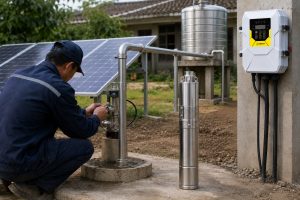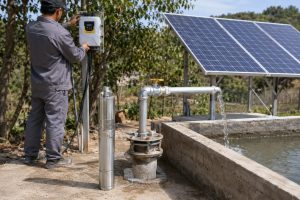
Your pool pump is a huge energy drain.
It runs for hours every day, significantly increasing your electricity bill.
What if you could run it for free using the sun?
Yes, you can absolutely power a pool pump with solar energy.
There are two main ways to do this.
You can use a dedicated DC solar pump system or power a standard AC pump using a grid-tied home solar system.
Both methods significantly cut your energy costs.
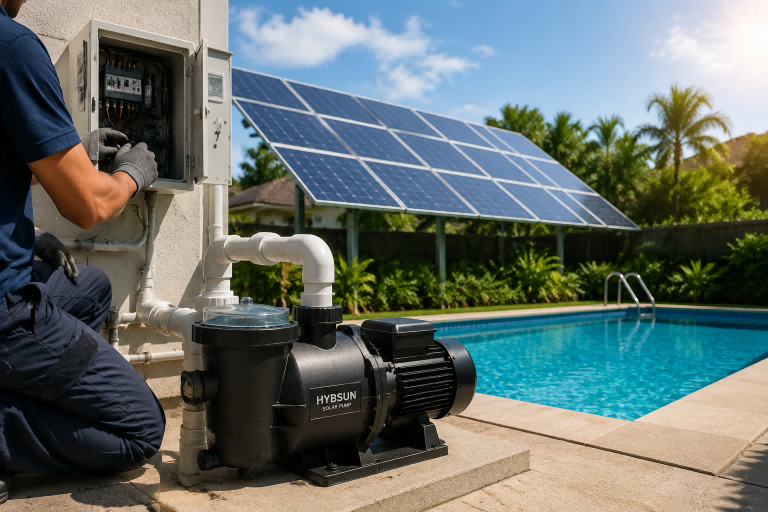
Understanding how to power your pool with solar is crucial.
Many homeowners and distributors are exploring this technology.
They want to find the most efficient and cost-effective solution.
Let's examine the different methods available.
This will help you decide which approach best fits your needs.
We will explore dedicated solar pumps and integrated home solar systems.
How Do Solar Pool Pumps Work?
Your traditional pool pump costs a fortune to run.
It’s often the second-biggest energy user in your home.
Relying on the grid means you are paying for every hour it operates.
A solar pool pump runs on DC electricity generated by solar panels.
A controller manages the power from the panels to the pump motor.
This allows your pool to circulate water using free energy from the sun, completely independent of the utility grid.
A deeper look reveals two main types of solar pump setups.
Each has distinct components and operational principles.
Understanding them is key to choosing the right system.
The Two Main System Types
There are two primary configurations for solar pool pumps.
Each system addresses different needs and budgets.
-
Solar Direct Systems: This is the most common and simplest setup.
It includes solar panels, a controller, and a DC pump.
The pump's speed changes with the intensity of the sunlight.
More sun means faster pumping.
This system does not use batteries.
It is less expensive and requires minimal maintenance. -
Battery-Based Systems: This system adds batteries to the solar direct setup.
The solar panels charge the batteries.
The pump then runs on consistent power from the batteries.
This allows for operation at night or on cloudy days.
However, these systems are significantly more expensive.
They are also more complex and require battery maintenance and eventual replacement.
For most residential applications, the solar direct system is the preferred choice.
It provides the core benefit of free pool circulation without the high cost and complexity of batteries.
The Core Components
A typical solar direct pump kit includes several key parts that work together seamlessly.
- Solar Panels: Usually 2 to 6 panels are used.
They capture sunlight and convert it into DC electricity.
The number of panels depends on the pool size and required water turnover. - DC Pump: The heart of the system is a pump with a high-efficiency brushless DC (BLDC) motor.
These motors are known for their longevity and low energy use.
They are designed to run on the variable power produced by solar panels. - MPPT Controller: The Maximum Power Point Tracking (MPPT) controller is the brain.
It optimizes the electrical output from the solar panels.
It boosts the current to maximize pump performance throughout the day.
It also includes safety features to protect the motor.
The table below summarizes the function of each component.
| Component | Function | Key Benefit |
|---|---|---|
| Solar Panels | Convert sunlight into DC electricity. | Provides free, clean energy for the pump. |
| DC Pump (BLDC) | Circulates pool water using a DC motor. | Highly efficient and durable, with a long lifespan. |
| MPPT Controller | Manages power from panels to the pump. | Maximizes energy use and protects the equipment. |
This integrated system is designed to be a self-contained solution.
It takes your pool pump "off-grid," eliminating its impact on your utility bill.
What Are the Benefits of a Solar Pool Pump?
High electricity bills from your pool pump are a constant headache.
You feel trapped by rising utility rates.
You also worry about your pool's operation during power outages after a storm.
The primary benefit is saving money every month on your electric bill.
You also gain energy independence, hedge against rate hikes, and can run your pool after a storm.
Plus, there are often tax credits and exemptions that reduce the initial cost.
The financial savings are compelling, but the advantages go far beyond just money.
A solar pool pump system offers a collection of benefits.
These benefits enhance your lifestyle and contribute to a more sustainable home.
Let's break down exactly what you stand to gain.
Financial and Environmental Advantages
Installing a solar pool pump is an investment with multiple returns.
It impacts your wallet, your property value, and the environment.
- Monthly Savings: A typical 1 HP single-speed pump can cost over $550 per year to operate in many regions.
A solar pump eliminates this cost entirely, saving you that money every year. - Tax Incentives: Many governments offer significant financial incentives.
For example, a 30% federal tax credit in the U.S. can dramatically lower the net cost of the system.
State and local rebates or exemptions for sales tax may also apply. - Property Tax Exemption: Solar energy equipment is often exempt from property tax assessments.
This means you can increase your home's value without increasing your tax burden. - Hedge Against Rate Increases: Utility electricity rates consistently rise over time.
By generating your own power for your pool, you lock in your energy costs at zero for the life of the system.
You are no longer vulnerable to unpredictable rate hikes.
Operational and Resilience Benefits
Beyond the numbers, a solar pump improves how your pool functions.
It adds a layer of resilience that grid-tied systems cannot offer.
- Energy Independence: Your pool pump operates completely off-grid.
Its performance is tied to the sun, not the utility company. - Storm Resilience: After a hurricane or major storm, power outages can last for days or weeks.
During this time, a stagnant pool can quickly turn green and become a health hazard.
A solar pump will continue to run as long as there is daylight.
It will keep your water circulated and sanitary when your neighbors' pools are failing. - Quiet Operation: The brushless DC motors used in solar pumps are famously quiet.
They eliminate the loud humming noise associated with traditional AC pumps.
This creates a more peaceful and relaxing poolside environment. - Longer Lifespan: Brushless DC motors have a much longer operational life than conventional brushed AC motors.
A brushed motor may last 2,000 to 5,000 hours.
A brushless DC motor can last 20,000 to 30,000 hours.
This translates to 6 to 10 times the lifespan, reducing replacement costs over time.
These combined benefits make a strong case for switching to a solar-powered solution.
The return on investment extends well beyond the simple payback period.
It offers peace of mind, reliability, and a commitment to sustainability.
Why Should You Avoid a Solar Pool Pump?
The idea of free pool circulation sounds perfect.
You imagine eliminating a major household expense forever.
But what if "free" comes with hidden costs and limitations that make it a poor choice?
You should avoid a solar pump if you need consistent, high-pressure flow.
Its performance is weather-dependent, it can't run at night, and it often lacks the power for heaters, spas, or water features, making it unsuitable for many modern pools.
While the benefits of solar pumps are clear, the drawbacks are significant.
They are not a one-size-fits-all solution.
For many pool owners, especially those with complex pool systems, a dedicated solar pump can be a frustrating and inadequate choice.
It's critical to understand these limitations before making a decision.
Performance and Functionality Issues
The biggest problems with solar direct pumps are tied to their reliance on the sun's variable intensity.
- Weather-Dependent Circulation: Pool sanitation depends on adequate water turnover.
Solar pumps slow down on cloudy days and stop in the rain.
During extended periods of adverse weather, circulation can be insufficient.
This can lead to algae growth and a green pool.
Many installers recommend keeping your old AC pump plumbed in as a backup, adding complexity and cost. - Poor Flow for Pool Features: Modern pools often have features that demand strong, consistent water flow.
A solar pump typically cannot provide the invigorating flow needed for spa jets.
Waterfalls, fountains, and deck jets will operate with variable, often unsatisfying, flow rates. - Inability to Run at Night: Without a costly battery bank, solar pumps do not work after sunset.
This makes evening spa use or running water features for nighttime ambiance impossible. - Incompatibility with Heaters: Both solar pool heaters and traditional gas or electric heat pumps require a specific, consistent flow rate to function correctly.
The variable and often low flow from a solar pump is not sufficient.
It will prevent solar heaters from optimizing heat transfer.
It will cause the low-flow safety sensors on conventional heaters to trip, shutting them down.
Financial and Technical Considerations
Beyond performance, there are other practical issues to consider.
- Payback vs. Warranty: An average system can cost around $5,000 before tax credits.
With annual savings of about $550, the payback period is over 6 years.
However, the warranty period for some components, particularly the pump or controller, may be shorter.
If a key part fails before the system has paid for itself, your return on investment is severely compromised.
We have seen pump failures that add significant unexpected expenses. - The "Cycling" Glitch: Many imported, lower-cost solar pumps have a design flaw in their controllers.
On partly cloudy days, as the sun comes and goes, the controller may cycle the motor on and off rapidly.
This start-stop action every few seconds puts immense stress on the motor.
It can lead to premature failure in just a few months, explaining many of the negative reviews online.
The table below starkly contrasts the promise with the reality for pools with advanced features.
| Feature | Requirement | Solar Pump Reality |
|---|---|---|
| Spa Jets | High, consistent pressure | Weak, variable flow. |
| Waterfalls | Strong, steady flow | Trickles or surges with the sun. |
| Gas/Electric Heater | Minimum GPM flow rate | Insufficient and variable flow; causes shutdowns. |
| Night Use | Ability to run after dark | Cannot run without expensive batteries. |
For these reasons, for many pool owners in regions like Florida, a dedicated solar pool pump is not the best investment.
The compromises in functionality are simply too great.
What Are the Best Alternatives?
You want to save energy on your pool.
But a dedicated solar pump has too many drawbacks for your needs.
You feel stuck between high bills and a solution that doesn't work for you.
The best alternative is pairing a variable-speed pump (VSP) with a grid-tied solar electricity system.
This gives you massive energy savings while maintaining full functionality of your pool, spa, and heaters.
It's the superior choice for balancing efficiency and performance.
The conversation about pool energy savings has evolved.
While dedicated solar pumps have their niche, modern technology offers a more powerful and flexible approach.
By thinking about your home's energy system as a whole, you can achieve far greater results than by focusing on the pool pump alone.
The Power of Variable-Speed Pumps (VSPs)
Variable-speed pumps have become the industry standard, driven by new energy codes.
They offer a smarter way to circulate water.
- How They Work: Unlike single-speed pumps that run at full power all the time, VSPs use advanced permanent magnet motors, similar to those in electric cars.
You can program them to run at very low speeds for basic circulation and ramp up to high speeds only when needed for cleaning or using features. - The Energy Savings Principle: The key is a law of physics known as the "Pump Affinity Law."
It states that if you halve the speed of the pump, you reduce your energy consumption by eight times.
By running at a low speed for longer periods, a VSP can circulate more water than a single-speed pump while using up to 90% less electricity.
This provides drastic savings on your utility bill. - Full Functionality: A VSP can deliver the high flow rates needed for spa jets, heaters, and water features on demand.
You don't have to sacrifice performance for efficiency.
You have complete control over your pool's operation, day or night. - Lower Initial Cost: The initial investment for a VSP is typically less than a third of a complete solar pump system, making it much more accessible.
The payback period is often very short, sometimes under two years.
The Ultimate Solution: VSP + Grid-Tied Solar
For the ultimate synergy of savings and performance, combine a VSP with a traditional grid-interactive solar photovoltaic (PV) system for your home.
- Install a VSP: This immediately slashes your pool's energy consumption by up to 90%.
- Install a Solar PV System: Size a rooftop solar array to offset your home's total electricity usage, including the now-efficient pool pump.
This integrated approach has several key advantages over a dedicated solar pump:
- Whole-Home Savings: The solar panels power everything in your house, not just the pool pump.
When the pump isn't running, the solar energy is used by your air conditioner, refrigerator, and other appliances.
Any excess power is sent back to the grid, often for a credit on your bill (known as net metering).
This maximizes the value of every kilowatt-hour you generate. - Expandability: You can start with a system sized for your pool and other needs, and easily add more panels later to cover more of your home's energy use or charge an electric vehicle.
- No Compromises: Your pool, spa, and heaters work perfectly, any time of day or night.
You are simply powering them with cheaper, cleaner energy you produce yourself.
The table illustrates why this combination is superior.
| Factor | Dedicated Solar Pump | VSP + Grid-Tied Solar |
|---|---|---|
| Energy Savings | High (for pump only) | Very High (for whole home) |
| Night Operation | No (without batteries) | Yes |
| Heater/Spa Use | No / Poor | Yes, full performance |
| Initial Cost | High | Higher, but better overall ROI |
| Energy Use | All solar energy used or wasted | All solar energy is used or exported for credit |
While a standalone solar pump makes sense in truly off-grid situations or areas with extreme electricity rates, for most homeowners, the VSP and grid-tied solar combination is the most logical and effective path forward.
What is the best solar water pump for off-grid applications?
You need a reliable water source in a remote area.
The power grid is unavailable or unreliable.
You are looking for a sustainable, low-maintenance solution for your home, farm, or livestock.
The best solar pump depends on your specific needs for flow and pressure (head).
A portfolio of pumps, including screw pumps for deep wells, plastic impeller pumps for high flow, and stainless steel pumps for corrosive water, offers the most versatile solution.
When you move beyond pools to general water pumping, the technology becomes even more critical.
For off-grid applications like deep well water supply, livestock watering, and small-scale irrigation, a dedicated solar pump is not just an option—it's a game-changer.
The selection of the correct pump type is essential for success.
All these advanced pumps share a common core: a high-efficiency brushless DC (BLDC) permanent magnet motor.
The Core Technology: BLDC Motors
The engine driving modern solar pumps is the BLDC motor.
Its design is what makes these systems so efficient and reliable.
- Exceptional Efficiency: BLDC motors achieve efficiencies exceeding 90%.
This means more of the sun's energy is converted into useful water pumping work. - Powerful and Compact: They deliver high torque in a compact design.
A BLDC motor can be 47% smaller and 39% lighter than a traditional motor of similar power.
This reduces material costs and simplifies installation. - Durability: With no brushes to wear out, these motors are virtually maintenance-free and have a very long service life.
This is critical for pumps installed in remote or hard-to-reach locations. - Market Value: The high efficiency of a BLDC motor reduces the number of solar panels needed to run the pump.
This lowers the total system cost and provides a faster return on investment for the end user.
Choosing the Right Pump for the Job
No single pump is perfect for every situation.
A well-designed product portfolio allows distributors to meet diverse market needs.
-
Solar Screw Pump:
- Principle: Uses a stainless steel helical screw rotating within a rubber stator.
It pushes water upwards through compression. - Best For: Low Flow, High Head (pressure).
Ideal for lifting water from very deep wells. - Applications: Domestic water supply in remote homes, drinking water for livestock, and micro-irrigation.
- Advantages: Excellent for deep wells and can handle water with a higher sand content than other types.
- Principle: Uses a stainless steel helical screw rotating within a rubber stator.
-
Solar Plastic Impeller Pump:
- Principle: A multi-stage centrifugal pump that uses a series of wear-resistant plastic impellers.
- Best For: High Flow, Medium Head.
Designed to move large volumes of water. - Applications: Farm irrigation, filling cattle troughs, and large residential garden systems.
- Advantages: Delivers high water output, is lightweight, and is more economical.
It offers good resistance to fine sand.
-
Solar Stainless Steel Impeller Pump:
- Principle: A premium multi-stage centrifugal pump with SS304 stainless steel impellers and housing.
- Best For: High Flow, High Corrosion Resistance.
- Applications: Pumping water in acidic or alkaline conditions, or in coastal areas with saltwater intrusion risk.
Perfect for high-end homes and ranches where water quality is a concern. - Advantages: Superior durability and reliability in harsh water environments, ensuring a long service life.
This comparison table helps clarify the ideal use case for each pump type.
| Pump Type | Key Characteristic | Dominant Application | Primary Market |
|---|---|---|---|
| Screw Pump | Low Flow + High Head | Deep Well Domestic Supply | Africa, Latin America |
| Plastic Impeller | High Flow + Wear Resistance | Agricultural Irrigation | Africa, The Americas |
| SS Impeller | High Flow + Corrosion Resistance | Special/Harsh Water Quality | Australia, High-End Homes |
For a distributor, offering this complete portfolio is a powerful strategic advantage.
It allows you to serve a wide range of customers, from a small homeowner with a deep well to a large-scale agricultural operation.
The Hybrid AC/DC Advantage
What happens on cloudy days or when you need water at night?
The most advanced systems solve this with a hybrid AC/DC controller.
- Automatic Switching: The controller accepts both DC power from solar panels and AC power from the grid or a generator.
- Solar Priority: It is designed to prioritize solar power.
It will use 100% solar energy whenever it is sufficient. - Hybrid Function: When solar input is low (e.g., on a cloudy day), the controller intelligently blends AC power with the available DC power.
This maximizes the use of free solar energy before drawing from the grid. - AC Backup: When there is no solar input at all (e.g., at night), it automatically switches to the AC power source.
This intelligent control ensures a reliable, 24/7 water supply.
It gives the user the best of both worlds: maximum energy savings from solar with the non-stop reliability of a grid connection.
Conclusion
Powering your pool or well with solar is an excellent strategy.
It saves money and provides energy independence.
The best method depends on your specific needs for performance, reliability, and budget.
FAQs
What is the best solar pump for a swimming pool?
For pools, a variable-speed pump paired with a grid-tied home solar system is often best.
It offers huge savings without sacrificing the performance of spas or heaters.
Can a solar pump run 24 hours?
Not on its own.
A standard solar-direct pump only runs in daylight.
To run 24/7, you need a large, expensive battery bank or a hybrid AC/DC controller.
How many solar panels does it take to run a pool pump?
A dedicated solar pool pump typically requires 2 to 6 panels (around 800W to 2400W).
The exact number depends on the pump size and local sun conditions.
How long does a solar pool pump last?
The pump motor itself, if it's a quality brushless DC type, can last 20,000-30,000 hours.
The controller and panels also have long lifespans, but low-quality units can fail much sooner.
Is a solar pool pump worth it in Florida?
It can be, but often isn't the best choice.
Frequent cloud cover and the high use of pool heaters and spas make a variable-speed pump with a whole-home solar system more practical.
Do solar pool pumps work on cloudy days?
Yes, but at a reduced speed.
The pump's output is directly proportional to the amount of sunlight the panels receive.
During heavy cloud cover, they may stop completely.
Can you get a tax credit for a solar pool pump?
Yes, in many places.
In the United States, solar pool pump systems often qualify for the 30% federal solar tax credit, significantly reducing the upfront cost.
What size solar pump do I need?
Sizing depends on your pool's volume and desired turnover rate.
Consult with a professional to calculate the required flow rate and match it with the right pump and panel combination.