Tired of your pool pump driving up your electricity bill every month?
With energy costs constantly rising, this expense is only getting worse, but solar power offers a permanent solution.
Yes, you can absolutely run your pool pump on solar panels.
You have two primary options.
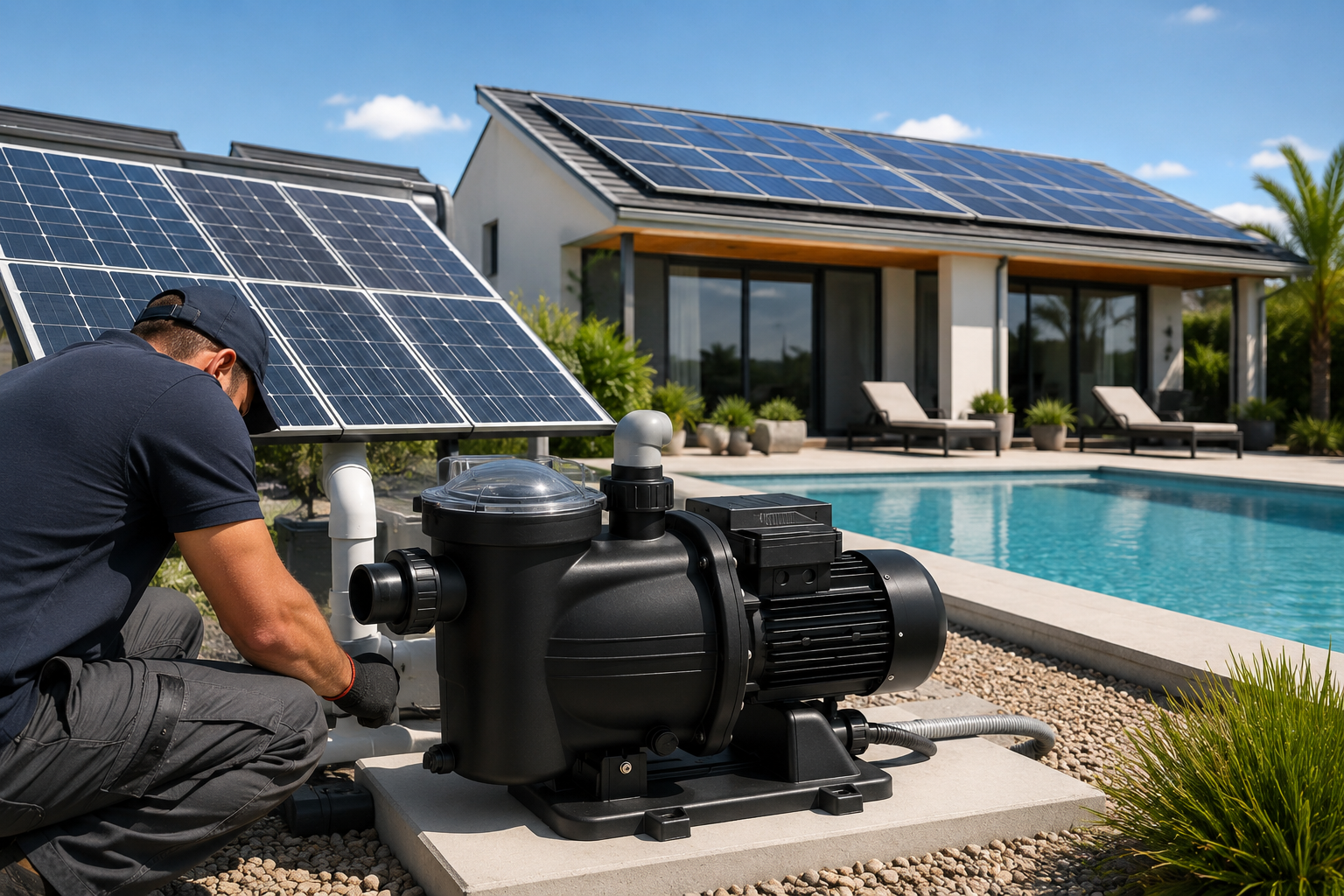
First, install a dedicated DC solar pool pump with its own panels.
Second, power your existing AC pump using a grid-connected home solar system.
Each has distinct advantages.
Choosing the right solar solution for your pool pump can feel complex.
The best path depends on your budget, your pool's features, and your long-term energy goals.
This guide will break down the options, costs, and benefits in detail.
We'll provide the clear data you need to make an informed decision and slash your pool's running costs for good.
The Mechanics of Solar Pool Pumps What's Under the Hood? **
Confused by the different types of solar pump systems available?
The technical jargon can seem overwhelming when you're just looking for a simple solution.
We'll clarify how these systems work.
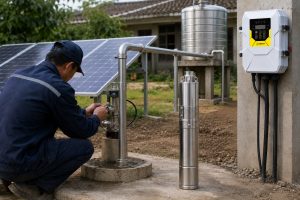
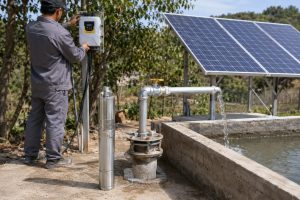
A solar pool pump system uses photovoltaic (PV) panels to generate DC electricity directly from sunlight.
This power flows to a specialized controller, which optimizes the current and voltage before sending it to a high-efficiency DC pump motor, circulating your pool water without using grid power.
The core of a modern solar pump is its motor and controller technology.
Understanding these components is key to appreciating their efficiency and reliability.
The primary goal is to convert sunlight into water movement as effectively as possible, and the system's design is focused entirely on this task.
Solar Direct vs. Battery Systems
The most common and cost-effective setup is a "solar direct" system.
Here, the pump's speed varies with the intensity of the sunlight.
More sun means faster pumping.
This eliminates the need for expensive and high-maintenance batteries.
Battery-based systems provide consistent power day or night but add significant complexity and cost.
Installation costs for battery systems can be 50-70% higher, and batteries typically need replacement every 5-10 years, creating a recurring expense.
| Feature | Solar Direct System | Battery-Based System |
|---|---|---|
| Initial Cost | Lower | Significantly Higher (50%+) |
| Complexity | Simple | High |
| Maintenance | Minimal | High (Battery monitoring & replacement) |
| Night Operation | No | Yes |
| Efficiency | High (Direct power conversion) | Lower (Losses from charging/discharging) |
| Best For | Daytime circulation, cost-savings | 24/7 operation, off-grid homes |
The Power of BLDC Motors
At the heart of these pumps is a Brushless DC (BLDC) permanent magnet motor.
These motors are a game-changer for efficiency, converting over 90% of the electrical energy into mechanical power.
This is a stark contrast to traditional AC pool pump motors, which often operate at only 60-70% efficiency.
This efficiency gain means you need fewer solar panels to do the same amount of work, reducing the system's overall footprint and cost by up to 25%.
The motor's design is also inherently more durable, with lifespans of 20,000-30,000 hours compared to the 2,000-5,000 hours of older brushed motors.
Smart Control with MPPT
The system's "brain" is the Maximum Power Point Tracking (MPPT) controller.
This device constantly monitors the voltage and current from the solar panels.
It adjusts the electrical load to ensure the panels are always operating at their peak efficiency point.
An MPPT controller can boost the energy harvest from your panels by up to 30%, especially during partly cloudy conditions or in the early morning and late afternoon.
This ensures your pump starts earlier, runs longer, and provides more consistent water turnover throughout the day.
Calculating the Cost and Savings Is a Solar Pump a Good Investment? **
Worried that a solar pool pump is too expensive to justify?
The initial investment can seem high, but the long-term savings are often overlooked.
Let's see how the numbers add up over time.
A dedicated solar pool pump system can pay for itself in 3-7 years through electricity savings.
With a federal tax credit of 30%, the return becomes even faster.
It offers a significant return on investment by eliminating a major household energy expense.
To understand the full financial picture, we need to compare the upfront cost against the daily expense of running a traditional pump.
Many homeowners are shocked when they see how much their old, inefficient pump costs them annually.
A typical single-speed pump is often the second-largest energy consumer in a home after the air conditioner.
Investment vs. Payback Period
Let's break down a typical scenario.
A standard 1 HP single-speed pool pump running 8 hours a day consumes about 6 kWh of electricity.
At an average U.S. rate of $0.17 per kWh, that costs approximately $1.02 per day, or $372 per year.
In states with higher electricity rates like California or Hawaii, this annual cost can easily exceed $700.
A complete solar pool pump kit, including 3-4 panels, a controller, and the pump, typically costs between $2,500 and $5,000.
Let's use a midpoint of $3,500 for our calculation.
The 30% Federal Solar Tax Credit reduces this upfront cost by $1,050, bringing your net investment down to $2,450.
- Annual Savings: $372
- Net Investment: $2,450
- Payback Period: $2,450 / $372 = 6.6 years
In areas with higher electricity rates (e.g., $0.30/kWh), the annual savings jump to $657, and the payback period drops to just 3.7 years.
This represents an annual return on investment of over 15%, far exceeding most traditional investments.
The Problem with Standalone Systems
While a dedicated solar pump offers "free" energy, it has limitations.
Its performance is entirely dependent on the sun.
On consecutive cloudy days, your pool may not get the circulation it needs for proper sanitation, risking algae growth.
You also lose the ability to run features like waterfalls, spa jets, or heaters at full power or at night.
These systems are not powerful enough to run most solar pool heaters, which require high, consistent flow rates to function correctly.
Therefore, a standalone solar pump is best for simple, filtration-only pools where consistent, high-pressure flow is not a primary concern.
The Superior Alternative A Variable Speed Pump Plus a Home Solar System **
Think a dedicated solar pump is the only way to go solar?
This approach has major performance drawbacks that can harm your pool.
There is a much more flexible and powerful solution.
Combining a modern, energy-efficient variable speed pump (VSP) with a grid-tied home solar system is the best option.
This setup dramatically cuts energy use while maintaining full functionality, using excess solar power to offset other home electricity costs.
This integrated approach addresses all the shortcomings of a standalone solar pump.
It delivers massive energy savings without sacrificing the performance you need to run heaters, cleaners, and water features.
It also turns your roof into a power plant for your entire home, not just the pool.
Unmatched Efficiency and Control
Variable speed pumps are an engineering marvel.
They use highly efficient permanent magnet motors, similar to those in electric vehicles.
The key principle is the "Pump Affinity Law," which states that if you reduce a pump's speed by half, you cut its energy consumption by nearly 88%.
A VSP can be programmed to run at a very low speed for long hours for basic filtration, using as little as 100-200 watts.
This is a 90% reduction compared to a single-speed pump that runs at full power (1,500+ watts) all the time.
You can then ramp up the speed for short periods when you need high flow for vacuuming, backwashing, or running a heater.
Synergy with a Grid-Tied Solar System
When you power a VSP with a grid-tied solar system, you create the most efficient combination possible.
During the day, your solar panels will generate more than enough electricity to run the VSP at its low, energy-sipping filtration speed.
Any excess solar energy generated doesn't go to waste as it would with a dedicated pump.
Instead, it flows into your home to power other appliances or is exported to the grid for credit on your utility bill.
On overcast days or at night, the pump can seamlessly draw a small amount of power from the grid to ensure your pool stays clear.
This gives you all the benefits of solar without any of the performance compromises.
| Feature | Dedicated Solar Pump | VSP + Home Solar System |
|---|---|---|
| Energy Savings | High (for the pump only) | Very High (for the whole home) |
| Performance | Variable, weather-dependent | Consistent, high-powered when needed |
| Night Operation | No | Yes |
| Heater/Feature Use | Poor / Not possible | Excellent |
| Excess Energy Use | Wasted | Powers home or earns grid credit |
| Overall Value | Good | Excellent |
Choosing the Right Pump Type and Motor Tailoring the Solution for Your Water Needs **
Do you think all solar pumps are the same?
Many factors, like well depth and water quality, demand different pump designs.
Choosing the wrong type leads to inefficiency and premature failure.
The ideal solar pump—be it screw, plastic impeller, or stainless steel impeller—is determined by the application's required flow and head.
All high-quality models are powered by highly efficient BLDC motors, which are the true core of the system's performance and reliability.
While pool pumps are a specific application, the technology is rooted in solar water pumping for wells and irrigation.
Understanding these pump types provides insight into the engineering behind them.
The choice of pump "wet end" is matched to the water source, while the motor and controller provide the universal power and intelligence.
For Deep Wells and High Lift: Solar Screw Pumps
When you need to lift water from great depths, a solar screw pump is the perfect tool.
It uses a stainless steel helical rotor spinning inside a rubber stator.
This design creates sealed cavities that move water upward with each rotation.
This mechanism generates very high pressure (head) but at a lower flow rate.
It’s ideal for deep wells supplying water for a home or livestock troughs.
A key advantage is its durability; the design can handle water with a higher sand content (up to 3%) than centrifugal pumps without significant wear, making it a robust choice for rugged environments.
For High Volume and Irrigation: Solar Impeller Pumps
When the goal is moving a large volume of water, a multi-stage centrifugal impeller pump is the answer.
These pumps use a series of impellers to gradually build pressure and flow.
They come in two main varieties:
- Plastic Impeller Pumps: These offer an excellent balance of performance and cost. They are lightweight, wear-resistant, and ideal for farm irrigation or residential water supply where water quality is good and the well is not excessively deep. They deliver high flow at a medium head.
- Stainless Steel Impeller Pumps: For demanding conditions, such as corrosive water (acidic or alkaline) or applications requiring maximum longevity, stainless steel is the premium choice. The SS304 construction resists corrosion and abrasion, ensuring a long service life and high reliability, making them suitable for high-end residential systems or challenging agricultural regions.
AC/DC Hybrid: The Ultimate in Flexibility
What happens when you need water on cloudy days or at night?
This is where hybrid AC/DC pump controllers provide a failsafe solution.
These intelligent controllers can accept power from both DC solar panels and an AC source like the grid or a generator.
The controller prioritizes solar power, automatically drawing from the PV panels whenever sunlight is sufficient.
If solar power wanes, the hybrid function can blend AC and DC power to maintain operation.
If there is no solar input, it seamlessly switches over to the AC source.
This ensures a reliable, 24/7 water supply, making it perfect for critical applications in homes, farms, and businesses.
Conclusion
Running your pool pump with solar is not only possible but also a financially smart decision.
A variable speed pump combined with a home solar system offers the best blend of efficiency, performance, and value.
FAQs
Can I run my existing pool pump on solar?
Yes, you can power a standard AC pump with a grid-tied home solar system.
The system's inverter converts DC solar power into AC power for your home, including the pump.
How many solar panels does it take to run a pool pump?
A dedicated DC solar pump typically requires 3 to 6 panels (1,200 to 2,400 watts).
A variable speed pump running on a home system needs much less power for daily filtration.
Is a solar pool pump worth it in Florida?
In a sunny state like Florida, the payback period is often short, from 4 to 7 years.
However, a variable speed pump with a whole-home solar system offers superior value and performance.
Do solar pool pumps work on cloudy days?
Solar direct pumps will run at a much slower speed on cloudy days, or not at all if it's too dark.
Systems with AC/DC hybrid controllers or grid-tied systems are unaffected.
How long do solar pool pumps last?
A quality DC solar pump with a brushless motor can last for 20,000+ hours, or over 10 years of typical use.
The solar panels themselves are warrantied for 25 years.
Can a solar pump run a pool heater?
No, a dedicated solar direct pump typically lacks the consistent high flow rate required to operate a gas heater, heat pump, or solar pool heater effectively.
What maintenance do solar pool pumps require?
The system is very low-maintenance.
You need to keep the solar panels clean, and the pump and controller require minimal attention, similar to a standard pool pump.