Struggling with high electricity bills from your water pump?
You're looking for a cost-effective, off-grid solution but don't know where to start.
The idea of free water powered by the sun is tempting.
Technically, you can connect some pumps directly to a solar panel, but you absolutely should not. This setup is inefficient and dangerous for the pump's motor. Without a controller, the pump receives unstable power, leading to poor performance, frequent stalling, and a drastically shortened lifespan.
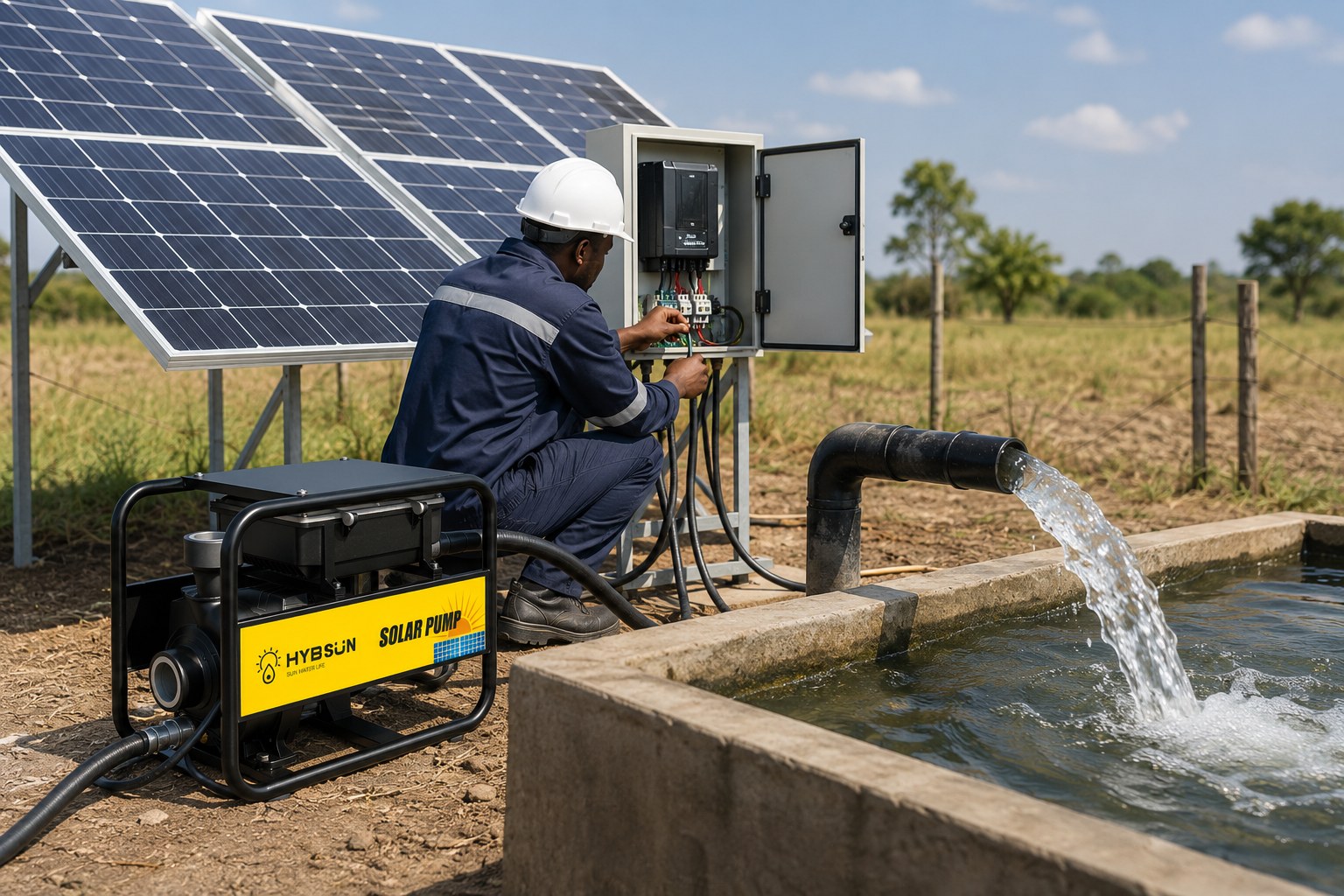
Connecting a solar panel straight to a pump seems like the simplest way to get free water.
It's a common question we hear from people new to solar water solutions.
They imagine a single wire connecting the sun's power to their water source.
However, this simplicity is deceptive and leads to significant problems down the line.
Understanding why this direct connection fails is the first step toward building a reliable and long-lasting solar pumping system.
Let's explore the critical component that makes solar pumping truly effective.
Why is a direct connection a bad idea?
Your pump motor is burning out too quickly from inconsistent power.
The constant stalling and restarting under low light conditions cause irreversible damage, forcing you to buy replacements far too often.
A direct connection provides no power regulation. The pump receives erratic voltage and current as sunlight changes, causing the motor to struggle and overheat. This leads to component failure, voids most warranties, and ultimately costs you more in the long run.
To understand the risk, you need to know how pump motors and solar panels work.
A pump motor, especially upon startup, requires a significant and stable amount of electrical current.
Solar panels, on the other hand, produce a variable amount of power that fluctuates with the sun's intensity.
This mismatch is the root of the problem.
The Problem of Inrush Current
When a motor starts, it draws a massive initial surge of power known as "inrush current."
This can be 3 to 8 times its normal running current.
A solar panel operating in anything less than perfect, direct, midday sun simply cannot provide this surge.
The result is a stuttering start-stop cycle.
The pump tries to turn on, fails, and tries again, repeatedly.
Each attempt heats the motor's internal windings.
This process, called "motor stalling" or "chugging," quickly burns out a brushed motor, often within a year or less.
Even advanced brushless motors suffer damage from this unstable power supply.
Inefficiency Throughout the Day
Solar panels rarely operate at their peak "nameplate" wattage.
Their output changes constantly due to:
- Time of day (low light in the morning and evening)
- Weather (clouds, rain, haze)
- Seasonal changes (lower sun angle in winter)
- Shading (trees, buildings)
Take a typical 400-watt solar panel.
It might only produce 80 watts in the early morning and over 420 watts at peak noon sun.
A pump connected directly to it will run slowly, stall, or run too fast, but it will never run optimally.
This inefficiency means you are getting significantly less water than your system is capable of producing.
This table illustrates the performance drop-off:
| Time of Day / Condition | Solar Panel Output (Approx. % of Peak) | Direct Connection Pump Performance |
|---|---|---|
| Early Morning (7 AM) | 15-20% | Fails to start, stalls repeatedly |
| Mid-Morning (10 AM) | 60-70% | Runs slowly, inefficient flow |
| Solar Noon (12 PM) | 95-100% | Runs at near-peak speed |
| Overcast Day | 10-30% | Fails to start or runs erratically |
Without a way to manage this variable power, you're sacrificing up to 70% of potential pumping time and water volume each day.
What is the correct way to connect a solar pump?
You want a system that works reliably from sunrise to sunset.
You need a solution that protects your investment and maximizes water output, even on cloudy days.
The correct method is to use a solar pump controller between the panels and the pump. A quality controller, especially one with Maximum Power Point Tracking (MPPT), acts as the brain of the system. It optimizes power, protects the motor, and maximizes water flow.
Think of the controller as a smart intermediary.
It takes the wild, fluctuating DC power from the solar panels and conditions it into a stable and usable form for the pump's motor.
This single component transforms an unreliable setup into a professional-grade water solution.
It is not an optional accessory; it is an essential part of any modern solar pumping system.
The difference in performance and longevity is night and day.
The Role of the MPPT Controller
A Maximum Power Point Tracking (MPPT) controller is the industry standard for efficient solar pumping.
Its job is to constantly monitor the voltage and current from the solar panels.
It then adjusts the electrical load to find the "maximum power point" – the perfect balance of voltage and amperage that extracts the most possible energy from the panels at any given moment.
This process has two huge benefits:
- Wider Operating Window: An MPPT controller allows the pump to start earlier in the morning and run later in the evening. It can operate the pump effectively even in low-light conditions when a direct connection would fail, increasing your daily water output by over 30%.
- Motor Protection: The controller provides a "soft start" function. Instead of hitting the motor with a sudden jolt of power, it gradually ramps up the speed. This eliminates the damaging inrush current and mechanical shock, significantly increasing the motor's lifespan.
Advanced Controller Features
Beyond MPPT, modern controllers offer a suite of protective and automated features that make your system smarter and more durable.
- Low-Water Protection: The controller can use sensors placed in the well to automatically shut off the pump if the water level drops too low. This prevents the pump from running dry, which would cause immediate and catastrophic damage.
- Tank-Full Shutoff: Similarly, sensors in a storage tank can tell the controller to stop pumping when the tank is full. This prevents water waste and unnecessary wear on the pump.
- Variable Speed Control: Many controllers allow you to manually dial down the pump's speed. This is useful for matching the pump's flow rate to the well's recovery rate, preventing over-pumping in low-yield wells.
- Diagnostics and Fault Codes: Onboard LEDs or digital displays provide real-time status and error codes, making troubleshooting simple. You can immediately identify issues like low power, high voltage, or sensor faults.
This table compares a system with and without a controller:
| Feature | Direct Connection | System with MPPT Controller | Benefit of Controller |
|---|---|---|---|
| Efficiency | Low; only works in ideal sunlight | High; optimizes power for a 30%+ increase in output | More water per day from the same solar panels. |
| Operating Hours | 4-5 hours on a sunny day | 8-10 hours, even on partly cloudy days | Doubles the effective pumping time. |
| Motor Lifespan | Typically < 1 year due to burnout | 10+ years with proper protection | Drastically reduces replacement costs and downtime. |
| System Protection | None; vulnerable to damage | Dry-run, tank-full, over-voltage, and thermal protection | Protects the entire investment automatically. |
| Backup Power Option | None | Yes, with an AC/DC hybrid controller | Ensures water availability 24/7. |
Ultimately, forgoing a controller is a classic case of being "penny wise and pound foolish."
The small initial cost of a quality controller is paid back many times over in increased water output, system longevity, and peace of mind.
What are the best pump and motor combinations for solar?
You understand the need for a controller, but now face a dizzying array of pump types.
How do you choose the right pump for your specific well depth and water needs?
The best systems pair a high-efficiency Brushless DC (BLDC) motor with a pump type matched to the application. The three leading options are solar screw pumps for high head, plastic impeller pumps for high flow, and stainless steel impeller pumps for durability.
The pump's "wet end"—the part that actually moves the water—is just as important as the motor and controller.
Choosing the right one is a matter of balancing your required flow rate (GPM/LPM), total dynamic head (the vertical distance you need to lift the water plus friction loss), and water quality.
Let's break down the optimal choices for different scenarios.
Core Technology: The BLDC Motor
At the heart of every modern solar pump is a Brushless DC (BLDC) permanent magnet motor.
These motors are a technological leap over older brushed designs.
Their efficiency often exceeds 90%, compared to 60-70% for traditional motors.
This high efficiency is crucial for solar applications.
It means the motor can do more work with less power.
This allows you to either get more water from the same number of solar panels or use a smaller, less expensive solar array to achieve your target flow rate.
A system with a 90% efficient BLDC motor might require four solar panels, while a competing system with a 70% efficient motor would need five or six panels to deliver the same amount of water.
This directly translates to a 20-33% savings on the cost of the solar array and mounting hardware.
Pump Type 1: The Solar Screw Pump
This design uses a helical stainless steel rotor (the "screw") that spins inside a rubber stator.
It works by pushing pockets of water upward through compression.
- Best For: Deep wells with high head requirements (e.g., lifting water over 300 feet / 100 meters).
- Performance: Low flow, high pressure.
- Key Advantage: Excellent sand resistance. The design can handle gritty, sandy water that would quickly destroy other pump types. It's a workhorse for challenging water conditions often found in parts of Africa and Latin America.
- Limitation: Limited flow rate makes it unsuitable for large-scale irrigation.
Pump Type 2: The Plastic Impeller Centrifugal Pump
This is a multi-stage centrifugal pump.
It uses a series of stacked, wear-resistant plastic impellers to spin and force water upward.
- Best For: Medium-depth wells where high flow is needed for applications like farm irrigation or livestock watering.
- Performance: High flow, medium head.
- Key Advantage: Offers the best balance of performance and cost. It's lightweight, economical, and provides a high volume of water, making it a popular choice for agriculture in the Americas and Africa.
- Limitation: Less durable in highly corrosive water or very deep wells where pressure is extreme.
Pump Type 3: The Stainless Steel Impeller Centrifugal Pump
This is the premium option, utilizing impellers and a pump body made from high-grade SS304 or SS316 stainless steel.
- Best For: Corrosive water conditions (acidic or alkaline) or applications demanding maximum durability and longevity.
- Performance: High flow, medium-to-high head.
- Key Advantage: Superior corrosion resistance and robust construction. It's the go-to choice for coastal regions, areas with "hard" water, and high-end residential or commercial projects where reliability is paramount.
- Limitation: Higher initial cost and weight compared to plastic impeller models.
Here is a guide to help you choose:
| Application | Well Depth | Water Quality | Recommended Pump Type | Why? |
|---|---|---|---|---|
| Household water for a cabin | > 300 ft / 100 m | Sandy | Solar Screw Pump | Handles the high lift and sand with ease. |
| Small-scale farm irrigation | < 300 ft / 100 m | Generally Clean | Plastic Impeller Centrifugal | Provides high flow at an economical price point. |
| Livestock watering in an alkaline soil region | < 450 ft / 135 m | High mineral content | Stainless Steel Impeller Centrifugal | Resists corrosion from the water, ensuring a long service life. |
By matching the wet end to your specific needs and powering it with a high-efficiency BLDC motor and MPPT controller, you create a perfectly optimized system.
This portfolio approach ensures there is an reliable and efficient solar solution for nearly any water challenge, anywhere in the world.
What if I need water at night or on cloudy days?
You're worried that relying solely on the sun will leave you without water when you need it most.
A string of rainy days or the need for nighttime irrigation could disrupt your entire operation.
For 24/7 water security, you need a hybrid system. An AC/DC hybrid solar pump controller allows the system to automatically switch to an AC power source—like the grid or a generator—when solar energy is insufficient. This gives you the best of both worlds.
A standard solar-direct system stops working the moment the sun goes down.
While battery-based systems are an option, they add significant cost, complexity, and maintenance, including expensive battery replacements every few years.
For most users who have access to any form of AC power, a hybrid controller is a far more practical and cost-effective solution for ensuring a constant water supply.
How Hybrid Controllers Work
A hybrid controller is designed with two power inputs: one for DC power from solar panels and one for AC power.
The controller's internal logic always prioritizes solar power to maximize your savings.
- Sufficient Sunlight: When the solar panels are producing enough power, the controller runs the pump using 100% free solar energy. The AC input is on standby.
- Insufficient Sunlight: On a cloudy day or when solar output drops, the controller automatically supplements the DC power with AC power. It intelligently blends the two sources to maintain the desired pump speed, always using as much solar as possible.
- No Sunlight: At night or during extended periods of bad weather, the controller seamlessly switches over to run the pump entirely on AC power.
The transition is automatic and requires no manual intervention.
You get an uninterrupted water supply without having to think about it.
Comparing Backup Solutions
Let's look at the pros and cons of the main backup options for a typical 1 HP pump system.
| Backup Solution | Initial Cost | Complexity & Maintenance | Lifespan & Replacement Cost | Ideal Use Case |
|---|---|---|---|---|
| AC/DC Hybrid Controller | Low | Very Low; plug-and-play | 10+ years; no replacement parts | Anywhere with access to grid power or a generator. The most common and practical choice. |
| Battery Bank | High | High; requires charge controller | 3-7 years; batteries are a major recurring expense ($1,000+) | Truly remote, off-grid locations with no access to any AC power source. |
| Elevated Storage Tank (Gravity-Fed) | Medium | Low once installed | 20+ years for the tank | Applications where water demand can be met by gravity pressure (e.g., livestock troughs). |
As the data shows, for the vast majority of users, the hybrid controller offers the most sensible and economical path to 24/7 water security.
It leverages the cost savings of solar during the day while providing the reliability of grid power when needed, all managed by one intelligent device.
This approach eliminates "range anxiety" for your water supply, guaranteeing that you have water whenever you need it, powered by the most cost-effective source available at that moment.
Conclusion
Directly connecting a pump to a solar panel is a recipe for failure.
A complete system—pairing a high-efficiency BLDC motor, a suitable pump end, and an intelligent MPPT or hybrid controller—is the only way to achieve a reliable, efficient, and long-lasting solar water solution.
FAQs
How many solar panels does it take to run a well pump?
It depends on the pump's horsepower (HP) and voltage. A small 1/2 HP pump might need two to four panels, while a 2 HP pump could require eight to twelve panels.
Are solar well pumps worth it?
Yes, for the right application. They eliminate electricity costs, work in remote locations, and have low maintenance, offering a return on investment in 3-5 years in many regions.
How long will a solar pump last?
A quality solar pump system with a brushless motor and controller can last over 10 years. The solar panels themselves are often warrantied for 25 years of production.
Can a solar pump fill a pressure tank?
Yes, most solar pump controllers are designed to work with a standard pressure tank. A pressure switch is wired to the controller to automatically turn the pump on and off.
Do you need a battery for a solar water pump?
No, a battery is not required for daytime operation. Most systems use a solar-direct controller, and a hybrid AC/DC controller is a better option for nighttime use if grid power is available.
What is the maximum depth for a solar water pump?
This varies by pump type. Solar screw pumps are designed for deep wells and can lift water from over 1,000 feet (300 meters), while centrifugal pumps are better suited for shallower depths.
Can a solar well pump run a house?
Yes, a properly sized solar pump system connected to a pressure tank can provide all the water needed for a typical household, including showers, laundry, and kitchen use.
How do I choose a solar water pump?
You need to know your Total Dynamic Head (lift + friction), required daily water volume, well diameter, and water quality. Using this data, you can select the right pump model.