Running a pool pump can be expensive due to high electricity consumption.
The cost continues to rise, but a solar solution offers a sustainable and cost-effective alternative.
Typically, a 1 HP pool pump needs 4 to 6 solar panels (300-400 watts each) to run for 8 hours a day.
This number varies based on your pump's efficiency, daily runtime, and the amount of sunlight your location receives.
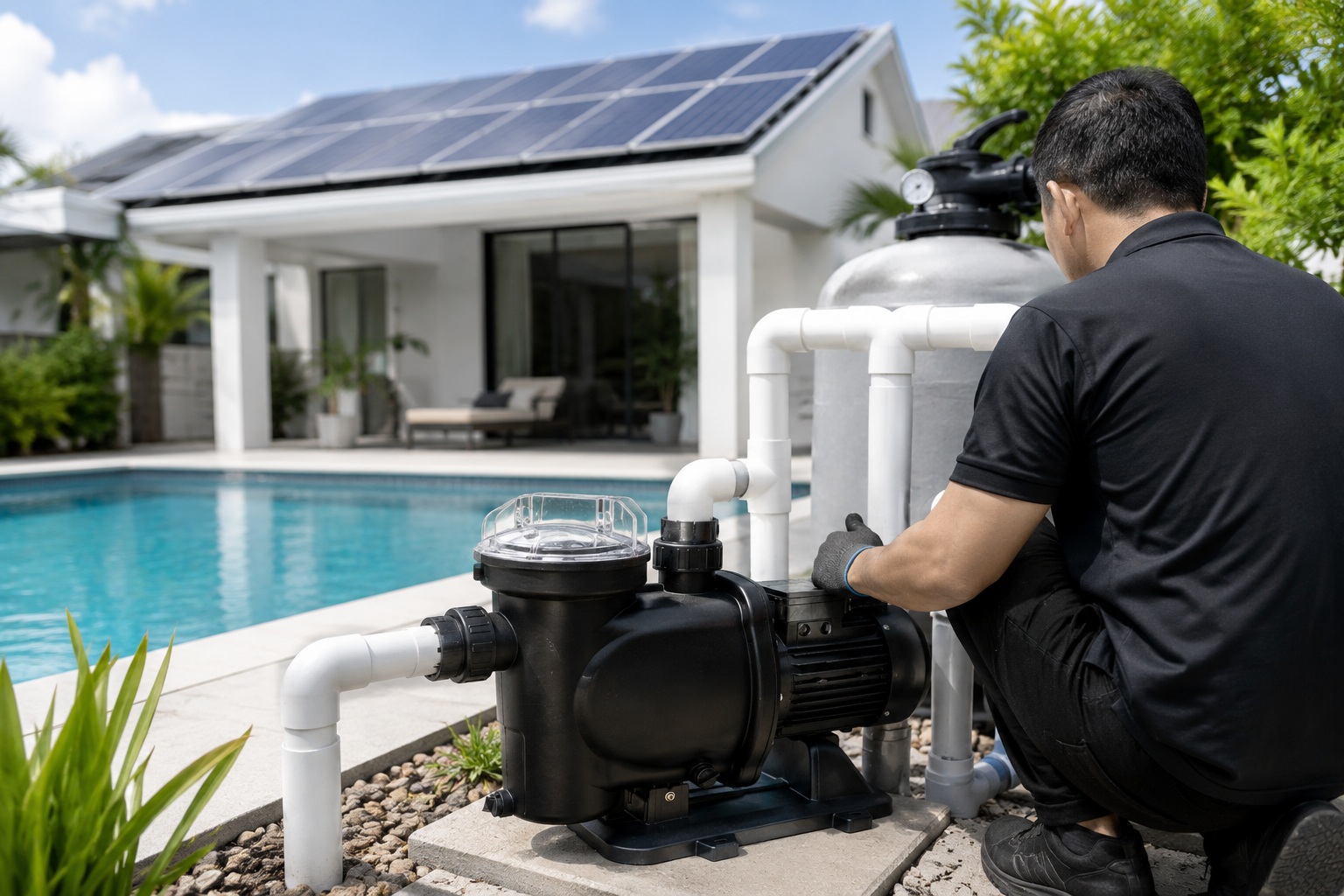
While that provides a quick estimate, selecting the right number of panels is crucial for reliable performance and avoiding common pitfalls.
The true answer depends on a detailed look at your specific pump, location, and performance expectations.
Let's explore the factors you must consider to size your system correctly and understand the best technology available for the job.
## Understanding Your Pool Pump’s Energy Requirements
Your pool pump is a major energy user, often the second biggest in your home.
Understanding its consumption is the first step toward finding a cost-effective solar solution.
A pump's energy needs are defined by its horsepower (HP), efficiency, and how many hours it runs daily.
A typical 1 HP pump uses about 750 watts, consuming 6 kilowatt-hours (kWh) over an 8-hour cycle.
To properly size a solar power system, you must first quantify your pump's exact energy appetite.
This calculation goes beyond the simple horsepower rating on the motor.
It involves understanding the relationship between power, time, and efficiency, which directly impacts the number of solar panels required.
Calculating Power Consumption
The most important factor is the pump's power rating, measured in watts (W) or kilowatts (kW).
A common approximation is that 1 horsepower (HP) equals roughly 750 watts.
However, this can vary based on the motor's efficiency.
An older, less efficient 1 HP motor might draw over 1,000 watts, while a modern, high-efficiency model could use less.
The total energy consumed is calculated in kilowatt-hours (kWh).
The formula is:
Energy (kWh) = (Power in Watts × Hours of Operation) / 1000
For example, a 1 HP (750W) pump running for 8 hours a day uses:
(750 W × 8 hours) / 1000 = 6 kWh per day.
This daily energy target is what your solar panel array must be designed to produce.
The Impact of Pump Type
The type of pump you own dramatically affects energy usage.
There are three main categories:
- Single-Speed Pumps: These run at a single, high speed and are the least energy-efficient. They are often the "energy hogs" that lead homeowners to seek solar solutions.
- Dual-Speed Pumps: These offer a high and low-speed setting, allowing for energy savings during filtration cycles.
- Variable-Speed Pumps (VSPs): These are the most efficient, consuming up to 90% less energy than single-speed pumps. They allow you to fine-tune the flow rate, using only the power necessary for the task.
The table below illustrates the potential energy and cost differences.
| Pump Type | Average Power Draw (1.5 HP Pool) | Daily Energy Use (8 hours) | Estimated Annual Cost (@$0.15/kWh) |
|---|---|---|---|
| Single-Speed | 1,500 Watts | 12 kWh | $657 |
| Dual-Speed (Low) | 400 Watts | 3.2 kWh | $175 |
| Variable-Speed | 250 Watts | 2 kWh | $109 |
A variable-speed pump can significantly reduce your daily energy needs, which in turn reduces the number of solar panels required, lowering the total system cost.
## Calculating the Number of Solar Panels Needed
Calculating solar panels feels complex.
You are worried about buying too few and having poor performance, or too many and wasting money.
To find the right number of panels, divide your pump's daily energy usage (in kWh) by the daily energy production of a single solar panel.
A 400-watt panel produces about 2 kWh per day with 5 peak sun hours.
This simple formula is the foundation for designing your system.
However, the "daily energy production of a single panel" is a variable number that depends on several crucial environmental and technical factors.
Let's break down how to get a realistic estimate for your specific situation.
The Three-Step Calculation
You can determine your panel requirements with a straightforward process.
1. Determine Daily Energy Needs (kWh):
As established in the previous section, calculate your pump's daily kWh consumption.
Let's use a 1.5 HP variable-speed pump running efficiently and using 3 kWh per day.
Daily Pump Energy = 3 kWh
2. Calculate Daily Panel Production (kWh):
This depends on the panel's wattage and your location's "peak sun hours."
Peak sun hours are not just the number of daylight hours; it is an equivalent measure of how many hours the sun is at its peak intensity (1,000 W/m²).
A 400-watt solar panel in a location with 5 peak sun hours produces:
Daily Panel Production = (400 Watts × 5 Hours) / 1000 = 2 kWh
3. Calculate the Number of Panels:
Now, divide the pump's needs by the panel's production.
Number of Panels = Daily Pump Energy / Daily Panel Production
Number of Panels = 3 kWh / 2 kWh = 1.5
Since you can't have half a panel, you would round up to 2 panels.
This calculation shows that for a modern, efficient pump, the solar array can be surprisingly small and affordable.
Factors That Change the Calculation
- Location and Sunlight: The number of peak sun hours varies dramatically by geography. Arizona might get 6-7 hours, while a northern European location might only get 3-4.
- Shading: Any shading from trees or buildings will reduce panel output significantly. The system must be designed for the worst-case scenario.
- Panel Orientation and Tilt: For maximum production, panels should face the equator (south in the Northern Hemisphere) and be tilted at an angle that optimizes sun exposure throughout the year.
- System Inefficiencies: Power is lost during the conversion from DC (solar panels) to AC (for some pumps) and through wiring. It's wise to add a buffer of 15-20% to your panel count to account for these losses and for cloudy days.
| Location Factor | Effect on Solar Production | Design Consideration |
|---|---|---|
| High Peak Sun Hours (e.g., Desert Regions) | Higher energy output per panel | Fewer panels needed for the same pump |
| Low Peak Sun Hours (e.g., Northern Regions) | Lower energy output per panel | More panels needed to meet daily demand |
| Frequent Overcast Weather | Reduced and inconsistent output | Oversize the array or add battery/grid backup |
| Partial Shading | Significantly reduces output of entire string | Use microinverters or power optimizers |
## Are Solar-Direct Pumps The Best Choice For Pools?
Solar-direct pumps seem perfect—free energy straight from the sun.
But what happens on a cloudy week, or when you want to run the spa jets at night?
Solar-direct pumps are often a poor choice for residential pools.
Their variable flow struggles with heaters and water features, they don't work at night, and their payback period may exceed the warranty.
While the concept of "free" pumping is appealing, the devil is in the details.
For most pool owners, especially in regions with variable weather, a solar-direct system introduces more problems than it solves.
The performance trade-offs often conflict with the reasons people own a pool in the first place—for relaxation and fun.
The Problem with Weather-Dependent Circulation
A pool requires consistent water turnover for proper filtration and chemical sanitation.
If the water doesn't circulate enough, the pool can quickly turn green with algae.
A solar-direct pump's speed is entirely dependent on the intensity of the sun at that moment.
- Cloudy Days: On overcast days, the pump runs at a very low speed or not at all. A few consecutive cloudy days can be a disaster for water quality.
- Morning and Evening: The pump runs slowest when the sun is low in the sky, reducing total daily circulation time.
To guarantee adequate turnover, you would need to grossly oversize the solar array, adding significant cost.
A more practical approach is to keep the existing AC pump plumbed in parallel as a backup, but this adds complexity and defeats the purpose of a single, simple solution.
Incompatibility with Modern Pool Features
Modern pools are more than just basins of water.
They have features that rely on specific, robust flow rates.
- Spas and Jets: A solar-direct pump will not provide the vigorous flow needed for satisfying spa jets.
- Waterfalls and Fountains: These features will have a weak, variable flow that is unsatisfying and may not function correctly.
- Heaters: Both gas and electric heat pumps have minimum flow rate sensors. A solar pump's variable and often weak flow will cause the heater to constantly trip or fail to activate, making it useless.
- Solar Pool Heaters: Ironically, solar-direct pumps often lack the power to efficiently push water up to roof-mounted solar heating panels.
A Better Approach: Combining Technologies
Instead of relying on a compromised solar-direct pump, a far superior solution is to pair a variable-speed pump (VSP) with a grid-tied solar photovoltaic (PV) system.
This approach offers the best of both worlds:
- Massive Energy Savings: The VSP reduces the pump's energy consumption by up to 90%.
- Full Functionality: You have all the power you need, whenever you need it, to run heaters, spas, and other features.
- Overall Home Savings: The solar panels on your roof produce electricity for your entire home, not just the pump. When the pump is off, that solar energy is still reducing your utility bill or earning you credits.
- 24/7 Operation: You can run the pump at night or on cloudy days, drawing seamlessly from the grid when solar is unavailable.
| Feature | Solar-Direct Pump | VSP + Grid-Tied Solar |
|---|---|---|
| Energy Cost | Free (when sunny) | Very Low / Zero (net) |
| Night Operation | No | Yes |
| Heater/Spa Use | No / Poor | Yes |
| Weather Reliability | Poor | Excellent |
| Initial Cost | High | Higher (but powers whole home) |
| Overall Value | Low | Very High |
## Optimizing Your System with Advanced Pump Technology
The pump itself is just one part of the system.
The real breakthroughs in efficiency and reliability come from the motor and control technology that drives it.
The core of a modern solar pump is a high-efficiency Brushless DC (BLDC) permanent magnet motor.
These motors achieve over 90% efficiency, drastically reducing the number of solar panels needed and lowering overall system cost.
Focusing only on the number of solar panels misses the most important factor: reducing the demand for power in the first place.
An advanced motor paired with an intelligent controller creates a system that is not only energy-efficient but also durable, adaptable, and "smart," capable of maximizing every watt of solar energy produced.
The Power of the BLDC Motor
At the heart of every top-tier solar water pump—whether for a pool, a well, or irrigation—is a BLDC permanent magnet motor.
Compared to traditional AC motors or brushed DC motors, their advantages are immense.
- Extreme Efficiency: BLDC motors convert over 90% of electrical energy into mechanical motion, compared to 50-70% for older motor types. This means a pump can do the same amount of work with 30-40% less power.
- Higher Power Density: They are significantly smaller and lighter for the same power output. This makes installation easier and reduces material costs. A typical design is 47% smaller and 39% lighter.
- Enhanced Reliability: With no brushes to wear out, these motors have a very long, maintenance-free service life, which is critical for pumps installed in remote or hard-to-reach locations.
- High Torque: They provide strong power even at low speeds, which is ideal for starting the pump under load.
This core efficiency is the key to a cost-effective solar pump system.
By reducing the motor's power demand, the size (and cost) of the required solar array shrinks dramatically.
The Role of the Intelligent MPPT Controller
The motor is only as good as the controller that runs it.
Modern solar pump systems use a Maximum Power Point Tracking (MPPT) controller.
This device acts as the brain of the system.
The MPPT controller constantly analyzes the output from the solar panels and the conditions at the motor.
It adjusts the electrical load to ensure the solar panels are always operating at their peak efficiency point, or "maximum power point."
This can boost the overall energy harvest by up to 30% compared to a simple controller, especially during periods of low light like early morning, late evening, or on cloudy days.
Hybrid AC/DC Functionality: The Ultimate Solution
The most advanced systems address the primary weakness of solar: what happens when there is no sun?
Hybrid AC/DC controllers provide the ultimate in reliability by incorporating two power inputs.
- Solar DC Input: This is the primary power source. The controller prioritizes using free solar energy whenever it is available.
- Grid/Generator AC Input: This is the backup power source.
The controller automatically manages the power sources.
When the sun is shining, it runs the pump on 100% solar power.
If clouds reduce the solar input, the hybrid function can blend in a small amount of AC power to maintain pump speed.
When the sun goes down or on very dark days, it seamlessly switches over to AC power.
This ensures you have worry-free water 24 hours a day, without any manual intervention, while still maximizing your use of free solar energy.
This hybrid technology provides all the benefits of solar without any of the compromises.
Conclusion
Sizing a solar system for a pool pump requires matching panels to an efficient pump, not just buying more panels.
The best solution combines a variable-speed pump, a BLDC motor, and a grid-tied or hybrid system for ultimate savings and reliability.
Frequently Asked Questions
How many solar panels does it take to run a 2 HP pool pump?
A 2 HP pump needs roughly 8-10 solar panels (400W each).
This assumes 8 hours of runtime and depends heavily on your pump's actual power draw and local sun conditions.
Can you run a pool pump directly from a solar panel?
Yes, this is called a solar-direct system.
However, performance is inconsistent as it varies with sun intensity, and it won't work for heaters or at night.
Is it cheaper to run a pool pump at night?
It depends on your utility's rate structure.
If you have "time-of-use" billing with cheaper rates overnight, it can be cheaper.
With solar, it's always cheapest to run during peak sun hours.
Can a solar pump run without a battery?
Yes, most solar pump systems are designed to run directly from the panels during the day without batteries.
Batteries add significant cost and complexity.
How long will a solar pool pump last?
A quality solar pump system should last for many years.
The solar panels are typically warrantied for 25 years, while the pump and motor may last 5-10 years before requiring service.
Can I get a tax credit for a solar pool pump?
In the U.S., you may be eligible for a federal tax credit for solar energy equipment.
This can cover the pump, panels, and installation, reducing your net cost significantly.
What happens to a solar pump on cloudy days?
On cloudy days, a solar pump's output will be greatly reduced.
It will run at a slower speed or may not run at all, highlighting the need for a properly sized system or a backup power source.