Struggling with unreliable water access and high energy bills for your farm or home?
You need a dependable off-grid solution that saves money.
The cost of a solar-powered water pump system varies widely, from a few hundred to several thousand dollars.
The final price depends on the pump type, motor power, required water flow and pressure, and the quality of system components like solar panels and controllers.
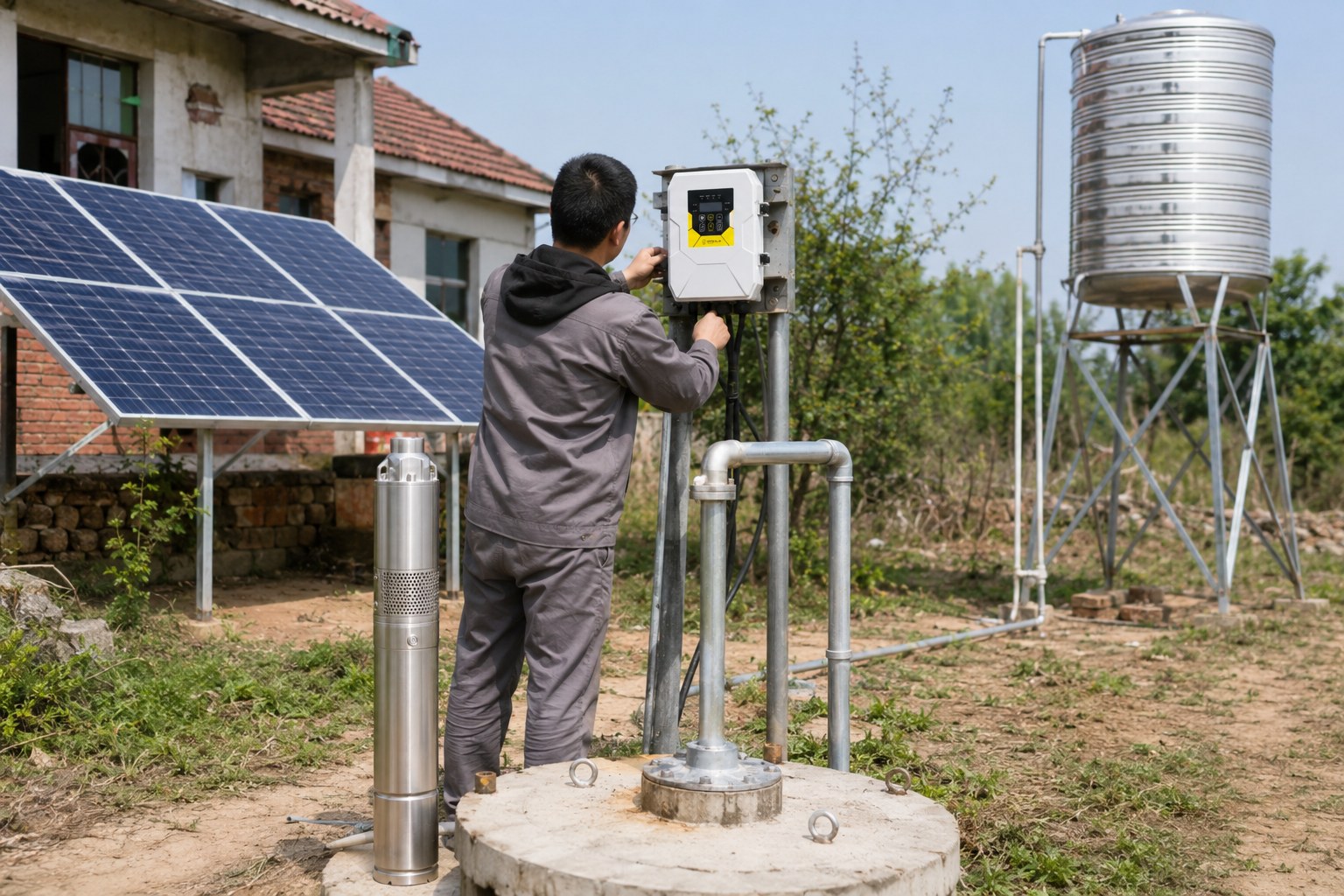
The initial investment in a solar water pump can seem high compared to traditional pumps.
However, the true value isn't just in the sticker price.
It's in the long-term savings on electricity or fuel, the low maintenance needs, and the ability to secure a water supply in even the most remote locations.
To understand the cost, you must first understand the components that make up the system and how they are tailored to different needs.
Let's dive deeper into the specific factors that determine the price and performance of a solar water pump system, helping you make an informed decision for your distribution business or personal use.
Understanding the Core Components: What Drives the Price?
Wondering what parts of a solar pump system have the biggest impact on its price?
The cost is primarily driven by three core components: the pump itself, the motor that powers it, and the controller that manages the energy.
A solar water pump system is more than just a pump.
It's an integrated solution where each part plays a critical role in performance, durability, and, ultimately, cost.
The three main elements you'll be paying for are the pump's "wet end," the electric motor, and the electronic controller.
The wet end is the part that physically moves the water.
Its design and materials dictate the pump's suitability for different water sources and applications.
The motor converts electrical energy from the solar panels into the mechanical force that drives the pump.
The controller acts as the brain, optimizing power from the panels to the motor and protecting the system.
The Key Cost Drivers
The price of a complete system is a sum of its parts, but the value comes from how they work together.
Pump Wet End: Different applications require different pump designs.
A pump for a deep well with a low flow rate will be engineered differently and have a different cost than a pump designed for moving large volumes of water for irrigation.
The materials used, such as plastic or stainless steel, also significantly affect price and durability.
Motor Technology: The motor is the heart of the system.
High-efficiency motors, such as Brushless DC (BLDC) permanent magnet motors, are a significant factor in the overall cost.
While they may have a higher upfront price, their efficiency, which can exceed 90%, means you need fewer solar panels to achieve the same water output.
This can dramatically lower the total system cost.
Controller and Electronics: An intelligent controller with Maximum Power Point Tracking (MPPT) technology is crucial.
This technology constantly adjusts the electrical operating point of the motor to extract the maximum possible power from the solar panels, even in low-light conditions.
Advanced controllers can also offer features like dry-run protection, over-voltage protection, and even hybrid power inputs, all of which add to the system's cost but also to its reliability and lifespan.
Understanding these components is the first step to evaluating the true cost and value of a solar water pump.
Choosing the Right Pump Type: A Cost-Benefit Analysis
Choosing the wrong pump type can lead to poor performance and wasted money.
You need a pump that matches your specific water needs and conditions.
The three most popular types are solar screw pumps, plastic impeller pumps, and stainless steel impeller pumps.
Each offers a different balance of flow, pressure, and sand resistance, directly impacting their cost and suitability.
The selection of a pump is not a one-size-fits-all decision.
The ideal choice depends entirely on the application, from providing drinking water for a home to irrigating vast agricultural fields.
This choice is the primary determinant of the pump's performance and has a significant impact on the overall system cost.
Let's break down the three main types of solar deep well pumps to understand their specific advantages, limitations, and ideal use cases.
Solar Screw Pump: Low Flow, High Head
Solar screw pumps, also known as progressing cavity pumps, are a specialized solution.
They use a single helical stainless steel rotor that rotates inside a rubber stator.
This action creates sealed cavities that move water upward through compression.
This design makes them exceptionally good at producing very high pressure, or "head."
They can lift water from very deep wells.
However, this high pressure comes at the cost of flow rate, which is relatively low.
Their key advantage is their remarkable resistance to sand and grit in the water.
The rubber stator can handle abrasive particles that would quickly destroy other pump types.
This makes them ideal for domestic water supply, livestock watering, and small-scale irrigation in regions with deep wells or poor water quality, such as parts of Africa and Latin America.
Their main limitation is the low volume of water they can deliver, making them unsuitable for large farms or high-demand applications.
Solar Plastic Impeller Pump: High Flow, Wear-Resistant
This is a multi-stage centrifugal pump.
It uses a series of rotating plastic impellers to push water.
Each stage adds more pressure, allowing it to achieve a medium head.
Its primary strength is its ability to deliver a high volume of water.
The impellers are made from durable, wear-resistant engineering plastics.
This gives them excellent resistance to fine sand, making them a versatile workhorse for many applications.
These pumps are widely used for farm irrigation, pasture water supply, and residential garden systems in Africa and the Americas.
Their high water output, lightweight design, and more economical price point make them a very popular choice.
However, they are less suited for extremely deep wells or for use in highly corrosive water environments, where the plastic components could degrade over time.
Solar Stainless Steel Impeller Pump: Premium Quality, Corrosion Resistance
This model represents the premium end of the spectrum.
It is also a multi-stage centrifugal pump, but its impellers and pump body are constructed from SS304 or higher-grade stainless steel.
This design is specifically for challenging water conditions where corrosion is a major concern.
It delivers high flow rates and can be configured for medium-to-high head applications.
These pumps are the go-to solution for pumping water with acidic or alkaline properties.
They are often used in the alkaline soil regions of Australia, parts of the Americas with specific water chemistry, and for high-end residential and commercial properties where reliability and long service life are paramount.
Their primary advantage is superior corrosion resistance, which translates to unmatched durability and reliability.
The tradeoff is a higher initial cost and greater weight compared to plastic impeller models, positioning them for more niche, high-value markets.
| Pump Type | Flow Rate | Head (Pressure) | Key Advantage | Best Application | Relative Cost |
|---|---|---|---|---|---|
| Screw Pump | Low | Very High | Excellent sand resistance | Deep wells, domestic use, livestock | Medium |
| Plastic Impeller | High | Medium | High flow, economical, wear-resistant | Farm irrigation, general purpose | Low-Medium |
| SS Impeller | High | Medium-High | Excellent corrosion resistance | Corrosive water, high-end use | High |
The Powerhouse Behind the Pump: Why the BLDC Motor Matters
Is the pump's motor just another part, or does it define the entire system's performance?
A cheap, inefficient motor will cost you more in the long run.
The core of a modern solar pump is a high-efficiency Brushless DC (BLDC) permanent magnet motor.
This technology directly impacts system cost, not by being cheap, but by being powerful and efficient, which reduces the need for expensive solar panels.
The motor is the engine of your solar water pump system.
Its efficiency determines how much of the precious solar energy is converted into useful water pumping.
All three pump types—screw, plastic impeller, and stainless steel impeller—are at their best when driven by a superior motor.
The leading technology in this space is the BLDC permanent magnet motor, which serves as the core power source and a key competitive advantage.
Unpacking a High-Efficiency BLDC Motor
What makes this motor technology so special?
It's all about the design and materials.
Unlike traditional brushed motors that lose energy to friction, BLDC motors are brushless, which dramatically increases their efficiency and lifespan.
Top-tier motors achieve efficiencies exceeding 90%.
This means over 90% of the electricity from the solar panels goes directly into pumping water.
The rotor, which is the rotating part of the motor, is often made from high-strength permanent magnets like 40SH neodymium iron boron (NdFeB).
These powerful magnets create a strong magnetic field, generating high torque in a very compact design.
As a result, these motors are significantly smaller and lighter than their traditional counterparts.
For example, a modern BLDC motor can be up to 47% smaller and 39% lighter than an older motor with the same power output.
The Market Value of a Superior Motor
How does a better motor translate to a better price for the end user?
The answer lies in total system cost.
Reduced Solar Panel Requirement: A highly efficient motor requires less power to do the same amount of work.
This means you can run the pump system with fewer solar panels.
Since solar panels can account for a significant portion of the total system cost, this efficiency directly leads to substantial savings on the initial investment.
Lower Operating Costs: By maximizing the energy from the sun, the pump can operate for more hours per day and perform better during cloudy weather, delivering more water over its lifetime.
Simplified Installation: The smaller size and lighter weight of the motor make the entire pump unit easier to handle and install, reducing labor costs.
Long, Maintenance-Free Life: The brushless design means there are no brushes to wear out and replace.
This creates a virtually maintenance-free motor with a very long service life, reducing the total cost of ownership.
The motor is not just a component; it's the strategic heart of the system that dictates overall efficiency and cost-effectiveness.
What Is the Life Expectancy of a Solar Water Pump?
Worried that your investment in a solar pump won't last?
A cheap system might fail in just a couple of years, costing you more in the end.
A well-designed solar water pump system is built for longevity.
High-quality solar panels are rated for 25 years, while the pump and motor can last 10-20 years with proper care, ensuring a reliable and long-term water solution.
When evaluating the cost of a solar pump, it's essential to consider its lifespan.
A lower upfront cost is meaningless if the system needs to be replaced every few years.
A quality solar water pump is a long-term investment designed for many years of dependable operation.
The lifespan of the system can be broken down by its main components, and it is heavily influenced by operating conditions and maintenance.
Component Lifespan Breakdown
A complete system has different parts with different expected lifespans.
Solar Panels: The solar panels are the most durable part of the system.
They have no moving parts and are typically rated to maintain at least 80% of their original efficiency for 25 years.
After this period, their efficiency decreases slowly, but they remain perfectly usable for many more years.
Solar Pump and Motor: The pump and motor unit should last between 10 and 20 years.
This range depends heavily on the use case and the specific pump model.
Factors like water quality and daily operating hours play a significant role.
For example, a pump running 24/7 in sandy water will have a shorter observed lifetime than one used intermittently for 6-8 hours a day in clean water, which is considered normal use.
Warranty and Spare Parts: Reputable manufacturers back their products with solid warranties.
A two-year warranty is a good standard to look for.
This ensures that if anything fails early on, replacement parts will be provided.
Some high-quality pump kits also include an extra helical rotor pumping mechanism as a standard accessory.
This part can wear down over time in wells with very dirty or sandy water.
Having a spare on hand means you can easily restore the pump to full production yourself, avoiding costly downtime.
Factors That Affect Longevity
Several factors can either extend or shorten the life of your pump.
-
Water Quality: Clean water is best.
Sand, silt, or debris can cause abrasive wear on internal components like impellers or gaskets.
-
Maintenance: Regular maintenance is simple but crucial.
This includes cleaning the solar panels to ensure maximum sunlight absorption and checking the pump's intake to ensure it's free from blockages.
-
Operating Hours: Continuous, 24/7 operation will naturally lead to more wear than intermittent use.
Most systems are designed for normal daytime operation.
-
Build Quality: This is paramount.
Pumps made from low-cost, inferior plastics or with unsealed motors will fail quickly.
Look for pumps constructed with durable, outdoor-proven materials, such as UV-stabilized plastics and corrosion-resistant stainless steel.
Understanding these factors helps you not only to select a durable pump but also to operate it in a way that maximizes its lifespan and your return on investment.
Maximizing Uptime: The Role of Intelligent Controllers
Are you concerned about your pump stopping every time a cloud passes by?
A basic system won't make the most of the available sunlight.
An intelligent controller with MPPT and hybrid AC/DC capabilities is the key.
It maximizes solar energy use and provides a backup power option, ensuring you have a reliable water supply 24 hours a day, rain or shine.
The true competitive advantage of a modern solar water pump system lies not just in the pump or motor, but in the intelligence of its control system.
The controller is the brain that optimizes performance, protects the equipment, and ultimately ensures you get the most water for your investment.
For distributors, offering systems with advanced control features provides a significant edge.
For end users, it means a more reliable, efficient, and cost-effective solution.
The Power of MPPT
Maximum Power Point Tracking (MPPT) is a critical technology for any serious solar pump system.
Solar panels have a complex relationship between voltage and current, which changes with the amount of sunlight and temperature.
There is a specific "maximum power point" where the panels produce the most energy.
An MPPT controller constantly monitors the panel's output and adjusts the electrical load of the motor to operate at this optimal point.
This can boost the water output by up to 30% compared to a system without MPPT, especially during early morning, late afternoon, and on overcast days.
This intelligence maximizes your use of solar energy, ensuring the pump starts earlier, runs longer, and delivers more water.
Hybrid AC/DC Systems for 24/7 Operation
What happens when you need water at night or during extended periods of cloudy weather?
This is where advanced hybrid controllers provide a game-changing solution.
Leading manufacturers have developed controllers that can accept both DC power from solar panels and AC power from the grid or a generator.
These hybrid systems are designed with simultaneous power inputs.
The controller's logic is programmed to prioritize solar power.
When there is enough sunlight, the system runs entirely on free energy from the photovoltaic panels.
If solar power is insufficient, the hybrid function can blend AC power with the available DC power to maintain operation, still maximizing the use of any available solar energy.
When there is no solar input at all, such as at night, the controller automatically switches over to the AC power source.
This ensures a completely uninterrupted, worry-free water supply 24 hours a day.
This capability transforms a solar pump from a daytime-only device into a full-time, mission-critical water solution for homes, farms, and livestock operations.
Conclusion
The true value of a solar pump isn't its price but its system efficiency.
A balanced portfolio of pump types, powered by efficient motors and smart controllers, delivers reliable, energy-saving water solutions for any need.
FAQs
How much does a solar water pump cost?
The cost ranges from a few hundred to several thousand dollars.
Price depends on the pump's power, flow rate, pressure capabilities, and overall system quality.
Is a solar water pump worth it?
Yes, especially in off-grid areas.
The initial cost is offset by long-term savings from eliminating electricity or fuel bills, making it a very worthwhile investment.
How long will a solar pump last?
A quality system is very durable.
Solar panels typically last over 25 years, and the pump and motor can operate for 10-20 years with proper maintenance.
Can a solar pump run at night?
Not on solar power alone.
However, hybrid AC/DC systems can automatically switch to grid or generator power at night, ensuring 24/7 operation.
What size solar pump do I need?
This depends on your daily water requirement (gallons per minute) and the total dynamic head (the vertical and horizontal distance the water must be pumped).
A professional consultation is best.
Do solar pumps require a lot of maintenance?
No, they are known for being low-maintenance.
Periodic cleaning of the solar panels and checking the pump's intake for debris is generally all that is required.
Can solar pumps work on cloudy days?
Yes, but at a reduced output.
Systems with high-efficiency panels and MPPT controllers are designed to maximize performance even in low-light, overcast conditions.
What is the main disadvantage of a solar water pump?
The primary disadvantages are the higher initial investment cost compared to conventional pumps and its dependence on sunlight, which can be inconsistent without a hybrid or battery backup system.