Frustrated by a sudden breakdown or a huge repair bill?
Your water pump might be the culprit, but replacement costs can be confusing and vary wildly.
The average cost to replace a water pump depends heavily on its type. An automotive water pump replacement typically costs $300 to $800. In contrast, replacing a well water pump is a larger job, usually ranging from $900 to $3,000, with some complex installations exceeding $5,000.
Understanding what kind of water pump you have is the first step to getting an accurate cost estimate.
This guide breaks down the costs for both automotive and well water pumps.
We explore the factors that influence the price.
We will also help you decide between a DIY approach and professional installation.
Let's dive into the specifics to demystify these costs.
Cost to Replace an Automotive Water Pump
Is your car overheating or leaking coolant?
A failing water pump could be the problem.
The repair cost can catch you off guard if you are not prepared.
Expect to pay between $300 and $800 for an automotive water pump replacement. Labor makes up a significant portion of this cost, often $200-$500. The part itself can range from $50 to $300 depending on your vehicle's make and model.
The final bill for an automotive water pump replacement is a tale of two components: the part and the labor.
The complexity of the job is the single biggest variable.
An easily accessible, externally-mounted pump on an older 4-cylinder engine might only take 1-2 hours of labor.
In contrast, a water pump driven by the timing belt on a transverse-mounted V6 engine can take 4-6 hours to access.
This is because the mechanic must first remove engine mounts, belts, and the timing cover.
Key Factors Influencing Automotive Water Pump Cost
The price on your final invoice can swing by hundreds of dollars based on a few key details.
Your vehicle's make and model are primary drivers.
A pump for a common domestic vehicle might cost $50, while one for a high-end European car could be over $300.
Labor rates also vary significantly by region, with urban areas typically having higher shop rates than rural locations.
The choice between Original Equipment Manufacturer (OEM) parts and aftermarket parts will also impact the cost.
OEM parts are generally more expensive but guarantee a perfect fit, while quality aftermarket parts can offer significant savings.
| Cost Component | Typical Price Range | Notes |
|---|---|---|
| Water Pump Part | $50 - $300 | Varies by vehicle make, model, and part manufacturer (OEM vs. Aftermarket). |
| Labor | $200 - $500+ | Depends on pump location (1-2 hours for easy access, 4-6 hours for timing-belt driven). |
| Coolant | $40 - $100 | Includes a full system flush and refill with the correct coolant type. |
| Related Parts | $50 - $250+ | Often includes a new thermostat, gaskets, and potentially a serpentine or timing belt. |
| Total Estimated Cost | $300 - $800+ | The total cost is highly dependent on labor complexity. |
The Timing Belt Connection: A Critical Cost-Saving Factor
On many modern engines, the timing belt drives the water pump.
This design reality creates a crucial maintenance decision.
Since accessing the water pump requires removing the timing belt, the labor is virtually identical for both jobs.
Reputable mechanics will always recommend replacing the water pump whenever the timing belt is serviced.
The additional cost for the pump part is minor compared to paying for the same 3-5 hours of labor a second time if the old pump fails later.
Ignoring this advice is a costly gamble.
If the old water pump's bearing seizes, it can shred the new timing belt.
On an "interference" engine—which represents over 85% of modern cars—a broken timing belt allows pistons to collide with valves, causing thousands of dollars in catastrophic engine damage.
A $150 water pump replacement during a timing belt service prevents a potential $4,000+ engine rebuild.
7 Warning Signs Your Car's Water Pump is Failing
Catching a failing water pump early can save your engine from a disastrous overheating event.
Here are the signs, from early warnings to imminent failure:
-
Coolant Leak: A puddle of green, orange, or pink fluid under the front-center of your engine is the classic sign. This is often from the pump's "weep hole," a designed feature to signal a failing internal seal.
-
Engine Running Hot: If your temperature gauge reads consistently higher than normal, even if not in the red, the pump may be losing its ability to circulate coolant efficiently.
-
Whining or Grinding Noise: A high-pitched whine or rough grinding sound from the front of the engine that changes with RPM points to a failing bearing inside the pump.
-
Steam From Under the Hood: This indicates coolant is leaking onto hot engine parts and vaporizing. It means the leak is significant and you are losing coolant rapidly.
-
Rust or Deposits: Corrosion or gunk built up around the pump body or pulley indicates a slow, long-term leak that has been occurring for some time.
-
Dropping Coolant Level: If you constantly have to top off your coolant reservoir but see no puddles, you may have a slow leak that is evaporating before it hits the ground.
-
Engine Overheating: If your temperature gauge is in the red, this is an emergency. Pull over immediately, turn off the engine, and call for a tow to prevent permanent engine damage.
Average Cost to Replace a Well Water Pump
Suddenly have no water at home?
A failed well pump is a major disruption.
Understanding the replacement costs is crucial for getting your water supply back online quickly.
The average well pump replacement cost ranges from $900 to $3,000. This price depends on the pump type (jet vs. submersible), well depth, and labor. Deeper wells and more powerful pumps will be at the higher end of this range.
Unlike a car repair, replacing a well pump is a significant home infrastructure project.
The cost is influenced by factors both above and below ground.
The primary cost driver is whether you have a shallow well or a deep well system.
Shallow wells (less than 25 feet deep) use above-ground jet pumps, which are less expensive and easier to access.
Deep wells rely on submersible pumps, which are installed hundreds of feet down inside the well casing.
Replacing a submersible pump is a much more labor-intensive job.
It requires specialized equipment to pull hundreds of feet of pipe and electrical wire out of the ground.
How Pump Type Affects Replacement Cost
The type of pump your system uses has the largest single impact on the total replacement cost.
Each is designed for a specific well depth and has a corresponding price point for both the equipment and the installation labor.
A shallow well jet pump is the most affordable to replace, as the unit is located above ground and easily accessible.
Submersible pumps are the most common for modern residential wells and represent a mid-range cost.
The most advanced—and expensive—systems are constant pressure well pumps, which use variable speed drives to maintain steady water pressure throughout the home, regardless of demand.
These offer premium performance at a premium price.
| Pump Type | Average Replacement Cost | Key Characteristics |
|---|---|---|
| Shallow Well Jet Pump | $900 – $1,800 | For wells less than 25 feet deep. Pump is above ground. |
| Deep Well Jet Pump | $1,000 – $2,500 | For wells up to about 100 feet deep. Pump is above ground. |
| Submersible Well Pump | $1,500 – $3,000 | Most common type. For wells deeper than 25 feet. Pump is inside the well. |
| Constant Pressure Pump | $2,500 – $5,000 | Uses a variable frequency drive (VFD) for consistent pressure. |
Factors That Drive Up Well Pump Costs
Beyond the pump itself, several other factors can increase the final bill.
Well Depth is a major one.
A pump set at 400 feet requires more powerful lifting equipment, more labor hours, and longer runs of expensive pipe and wire than one set at 100 feet.
A 50% increase in depth can lead to a 25-35% increase in labor costs.
Pump Size, rated in horsepower (HP), is another factor.
A 1/2 HP pump may be sufficient for a shallow well, but a deep well or a home with high water demand may require a 1.5 HP or 2 HP pump, which can cost 50-100% more for the unit itself.
Finally, a pump failure can often reveal other aging components.
Your technician may recommend replacing the pressure tank ($800 - $2,500), the pressure switch ($50 - $200), or the underground electrical wiring ($100 - $500) at the same time.
Bundling these repairs saves on future service calls.
Detailed Look: Submersible Pump Replacement Costs
Replacing a submersible well pump is the most common scenario for homeowners.
The cost can be broken down into two main categories: equipment and labor.
The pump unit itself typically costs between $400 and $1,500, depending on its horsepower, flow rate (gallons per minute), and brand.
Labor is often the more significant expense, ranging from $500 to $1,500.
This covers the technician's time, the use of a pump-pulling rig or boom truck, and the skilled work of disconnecting and reconnecting plumbing and electrical systems deep within the well.
For a standard 200-foot deep well, a homeowner can expect the total replacement to fall in the $1,500 to $3,000 range.
However, if the well is particularly deep (400+ feet) or if complications arise, like a broken pipe or a stuck pump, costs can climb higher.
DIY vs. Professional Well Pump Installation: A Cost Analysis
Thinking of replacing your well pump yourself to save money?
While tempting, the risks and complexity can be high.
Let's weigh the costs and benefits of each option.
A professional installation for a well pump costs between $2,800 and $6,000, including parts and labor from a local installer. A DIY approach, by sourcing parts directly from a customer-direct company, can reduce the total cost to between $625 and $2,600, potentially saving you over $3,000.
The decision to tackle a well pump replacement yourself is primarily a financial one, but it comes with significant trade-offs in time, risk, and physical effort.
A professional installer brings experience, specialized tools, and insurance.
They can diagnose complex problems and ensure the job is done to code.
However, this expertise comes at a premium.
Installers often purchase pumps through a distributor network, with markups at each stage that can double or triple the pump's base cost before it even gets to you.
The DIY route offers massive potential savings by cutting out the middle-men and labor costs.
However, it requires mechanical aptitude, knowledge of plumbing and electrical work, and a willingness to take on the physical challenge of handling hundreds of feet of pipe.
The Pros and Cons of DIY Replacement
For the handy homeowner, replacing your own well pump is an achievable weekend project that can save thousands.
The process involves splicing wires, connecting plumbing fittings, and carefully lowering the assembly into the well.
The primary benefit is cost savings, which can be 50-70% compared to a professional quote.
You also gain valuable knowledge about your home's most critical resource.
The downside is the risk.
Dropping the pump down the well is a catastrophic and expensive mistake.
Improperly wiring the pump can damage the motor or create an electrical hazard.
And if something goes wrong, you are your own troubleshooter.
| Factor | DIY Installation | Professional Installation |
|---|---|---|
| Total Cost | $625 - $2,600 | $2,800 - $6,000+ |
| Savings | Up to 70% | None |
| Time Required | 4-8 hours of your time | 2-5 hours, done by others |
| Risk | High (damage, injury) | Low (insured professionals) |
| Special Tools | May need to rent or rig | All tools provided |
| Knowledge | Learn your water system | No new skills learned |
When is Professional Installation Necessary?
While DIY is feasible for many, there are situations where hiring a professional is the only safe and practical option.
The most significant factor is well depth.
Most people can safely handle a pump installation by hand in wells up to 300 feet deep.
Beyond that, the combined weight of the pump, water-filled pipe, and wiring becomes too heavy and unwieldy to manage without a boom truck or a specialized lift.
Attempting a deep-well installation by hand risks losing control of the assembly, which can damage the well casing or result in a dropped pump that is nearly impossible to retrieve.
If your well is deeper than 300 feet, or if you are not physically confident in handling a 150+ pound load, calling a professional is the wise choice.
They have the equipment to lower the pump gently and safely, ensuring a successful installation without risk to you or your well.
A Pro Tip for Saving Money with an Installer
Even if you need to hire a professional, you can still save a significant amount of money.
You are not required to buy the pump from your installer.
Local installers can mark up pumps by as much as 200-300% over the direct-from-manufacturer price.
The best strategy is to purchase the pump and all necessary components (pipe, wire, fittings) yourself from a reputable direct-to-consumer pump company.
Then, you can simply hire the installer for their time and expertise to perform the installation.
This "labor-only" approach allows you to get a high-quality pump at a fair price while still benefiting from a professional, insured installation.
You could save $1,000 or more with this hybrid strategy.
Understanding Different Types of Solar Well Pumps
Looking for an off-grid, sustainable water solution?
Solar well pumps are a game-changer.
But choosing the right type is key to performance and long-term value.
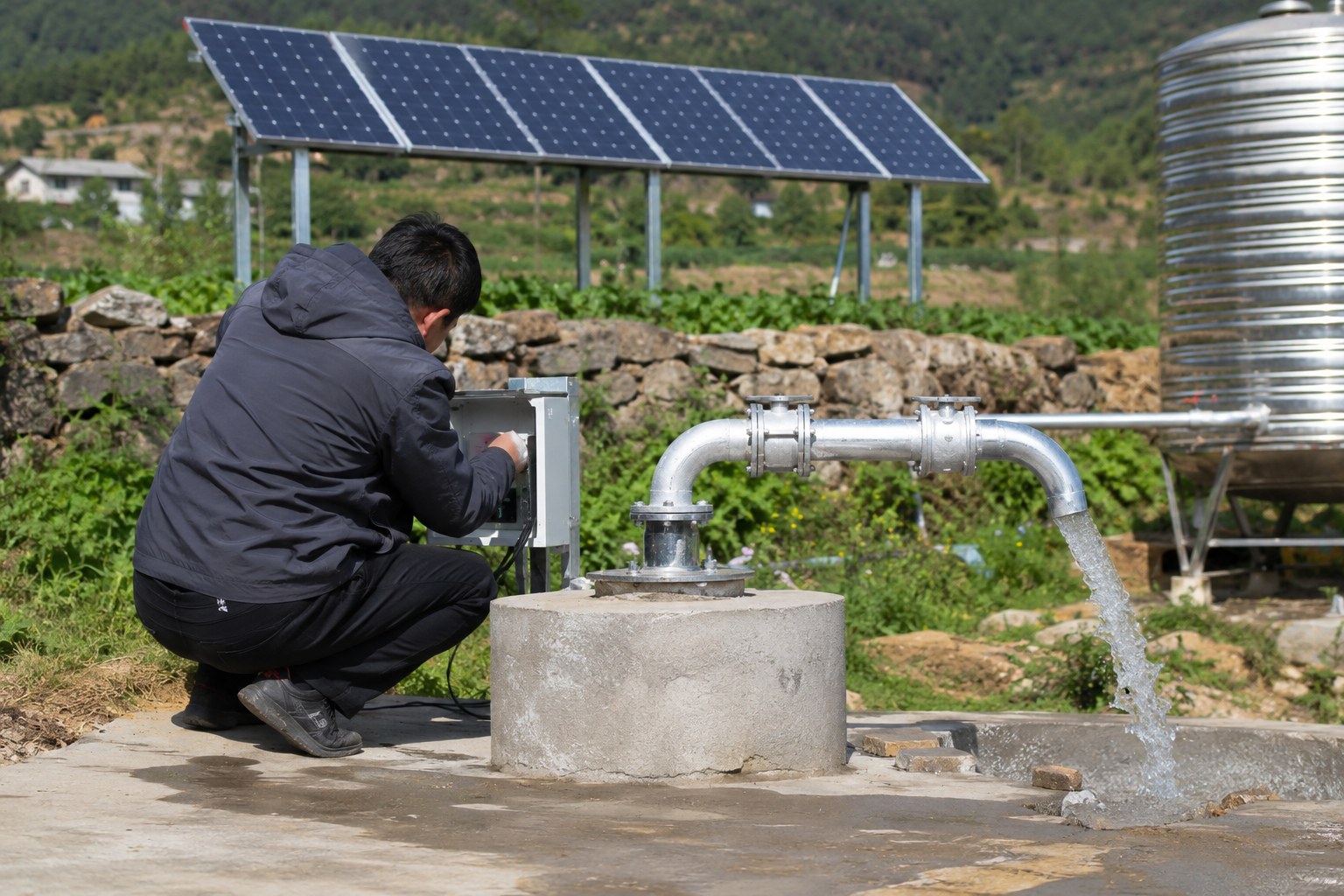
Solar well pumps come in three main types to meet diverse needs. Screw pumps offer high head for deep wells. Plastic impeller pumps provide high flow for irrigation. Stainless steel impeller pumps deliver durability in corrosive water, all powered by efficient BLDC motors.
As the world moves toward sustainable solutions, solar-powered water pumps have become a vital technology, especially in off-grid areas.
They operate independently of the electrical grid, have zero carbon emissions, and offer significant long-term cost savings.
The pump's design, or "pump end," determines its ideal application.
By understanding the three primary types of solar deep well pumps, distributors can build a competitive portfolio, and end-users can select the perfect solution for their water needs.
Each type is engineered for a specific balance of flow rate (how much water) and head (how high it can lift water).
Solar Screw Pump: The Deep Well Specialist
The solar screw pump, also known as a progressing cavity pump, is an engineering marvel for deep wells.
It uses a single helical stainless steel rotor (the screw) that rotates inside a flexible rubber stator.
This action creates sealed cavities of water that are pushed progressively up the pump.
This mechanism generates extremely high pressure, allowing it to lift water from great depths (high head).
However, the volume of these cavities is small, resulting in a lower flow rate.
This makes screw pumps ideal for domestic water supply, livestock watering troughs, and small-scale drip irrigation where consistent pressure from a deep source is more important than high volume.
Their simple, robust design is also highly resistant to sand and sediment, giving them a significant advantage of up to 50% more durability in harsh water conditions compared to other pump types.
Solar Plastic Impeller Pump: The High-Flow Workhorse
When the goal is moving a lot of water for applications like flood irrigation or filling large tanks, the multi-stage centrifugal pump with plastic impellers is the go-to choice.
This pump uses a series of stacked impellers that spin at high speed.
Each impeller adds energy to the water, increasing its pressure and flow.
By using durable, wear-resistant plastic for the impellers, these pumps provide an excellent balance of high performance and affordability.
They are designed for high flow rates at a medium head, making them perfect for farm irrigation, pasture water supply, and larger home and garden needs.
Their lightweight construction also makes them easier to handle and install, reducing labor costs by an estimated 20-30%.
While highly effective, they are less suited for very deep wells or water with high levels of corrosive elements.
Solar Stainless Steel Impeller Pump: The Premium Choice
For the ultimate in durability and reliability, the solar stainless steel impeller pump stands at the top.
This pump operates on the same centrifugal principle as the plastic impeller model but uses impellers and a pump body constructed from high-grade SS304 stainless steel.
This construction gives it superior resistance to corrosion from acidic or alkaline water, as well as abrasion from sand.
This makes it the only viable choice for wells in regions with challenging water chemistry, such as the alkaline soils of Australia or coastal areas with saltwater intrusion risk.
While the initial cost is higher—often 30-50% more than a plastic impeller model—its extended service life in harsh conditions provides a lower total cost of ownership.
It is the preferred solution for high-end homes, critical agricultural operations, and any application where long-term reliability is non-negotiable.
| Solar Pump Type | Best For | Flow Rate | Head (Lift) | Sand Resistance | Relative Cost |
|---|---|---|---|---|---|
| Screw Pump | Deep Wells, Homes | Low | Very High | Excellent | $$ |
| Plastic Impeller | Irrigation, Farms | High | Medium | Good | $ |
| Stainless Steel Impeller | Corrosive Water | High | Medium-High | Very Good | $$$ |
The Core Technology: How Motors and Controllers Impact Performance and Cost
The pump itself is only half the story.
The motor and controller are the brains and brawn of the system.
Their efficiency directly impacts your long-term costs and reliability.
High-efficiency BLDC permanent magnet motors, with over 90% efficiency, are the core of modern solar pumps. They reduce the number of solar panels needed by up to 47%, saving significant upfront costs. Intelligent controllers further maximize energy use for 24/7 reliability.
A pump is only as good as the motor that drives it.
In the world of solar water pumping, the shift to Brushless DC (BLDC) permanent magnet motors has been a revolutionary leap forward.
This core technology, combined with intelligent controllers, is what truly unlocks the potential of a solar water system.
It transforms a simple pump into an efficient, reliable, and cost-effective water delivery machine.
Understanding the role of the motor and controller is essential for appreciating the total value and long-term savings of a modern solar pump system.
It's the technology behind the scenes that determines both upfront investment and ongoing performance.
The Power of the BLDC Permanent magnet Motor
Traditional motors often waste a significant amount of energy as heat.
Modern solar pumps utilize BLDC permanent magnet motors, which operate at efficiencies exceeding 90%.
This is a massive improvement over older motor types that might hover around 60-70% efficiency.
This high efficiency has a direct and dramatic impact on cost.
A more efficient motor requires less power to do the same amount of work.
This means you can power the pump with a smaller, less expensive solar array.
For example, a system with a 92% efficient motor might require 47% fewer solar panels than a system with a 65% efficient motor to achieve the same water output.
This can translate to hundreds or even thousands of dollars in upfront savings on panels alone.
These motors also offer higher torque, a longer lifespan, and are significantly more compact—often 39% lighter and 47% smaller than their traditional counterparts, simplifying installation.
Intelligent Control Systems: Maximizing Every Drop of Sunlight
The controller is the brain of the solar pump system.
An advanced controller uses Maximum Power Point Tracking (MPPT) technology.
MPPT constantly analyzes the output of the solar panels and adjusts the electrical load to ensure the pump is always operating at its peak efficiency, extracting up to 30% more power from the panels compared to basic controllers.
This means the pump can start earlier in the morning, run later in the evening, and perform better on cloudy days.
For ultimate reliability, hybrid AC/DC controllers offer the best of both worlds.
These smart controllers can be connected to both solar panels and an AC power source (grid or generator) simultaneously.
The system automatically prioritizes free solar power.
If the sunlight is insufficient, it can blend in AC power to maintain operation or switch over completely to AC at night.
This guarantees a worry-free, 24/7 water supply, making solar a viable primary water source for any home or farm.
| Motor/Controller Feature | Impact on Cost and Performance |
|---|---|
| High-Efficiency BLDC Motor (>90%) | Reduces solar panel requirement by up to 47%, lowering initial system cost. |
| MPPT Controller | Increases daily water output by up to 30% from the same solar array. |
| Hybrid AC/DC Controller | Ensures 24/7 water supply, eliminating the need for a separate backup pump system. |
Conclusion
Water pump replacement costs vary greatly by type and complexity.
Understanding your specific needs, from car engines to off-grid wells, ensures you make a cost-effective and reliable choice.
Frequently Asked Questions
How do you know if you need a new water pump?
Common signs include low or no water pressure, the pump running continuously, sputtering faucets, or for cars, coolant leaks, engine overheating, and grinding noises from the engine bay.
Can a water pump be repaired instead of replaced?
Generally, no. The critical components like bearings and seals are inside a sealed unit. Once they fail, the entire pump assembly must be replaced for reliable, long-term operation.
How long does a water pump replacement take?
An automotive water pump replacement can take 1 to 6 hours. A well water pump replacement is a bigger job, typically taking a professional 3 to 5 hours.
Is it worth replacing a water pump?
Yes, absolutely. For a car, it prevents catastrophic engine damage. For a well, it is essential for your home's water supply. The cost of replacement is far less than the alternative.
Should I replace my thermostat when I replace my water pump?
Yes. For both automotive and some well systems, the thermostat is an inexpensive part that is easily accessible during the pump replacement. Replacing it proactively prevents future failures.
What is the most expensive part of a water pump replacement?
For both automotive and well pumps, labor is often the most expensive component, especially for complex installations that require significant time to access the pump.
How much does it cost to replace a 300 ft well pump?
Replacing a submersible pump in a 300-foot well typically costs between $2,000 and $4,000. The depth increases labor time and requires a more powerful, expensive pump.
Is a noisy water pump an emergency?
Yes. A grinding or squealing noise from a water pump indicates a failing bearing. The pump could seize at any moment, causing much greater damage to your car's engine or well system.