Struggling with weak showers and trickling taps?
Low water pressure is a frustrating problem that can disrupt your entire household.
The right pressure pump can transform your water system instantly.
The "best" water pressure pump isn't about a single brand, but the one whose specifications perfectly match your needs.
Key factors include flow rate, pressure requirements, water source, and motor efficiency.
Choosing a pump with the right technology for your application is crucial for performance and longevity.
Choosing a water pump can feel overwhelming with so many types and features available.
This guide will break down everything you need to know.
We will explore different pump technologies, key performance indicators, and how to select the perfect model for your home, garden, or farm.
By the end, you'll be able to make a confident and informed decision.
What Is a Pressure Pump?
Tired of water merely trickling from your tap?
This lack of force can make simple tasks like washing dishes or taking a shower frustratingly slow.
A pressure pump is the solution.
A pressure pump is a device that increases the pressure of water from a storage tank or a low-pressure municipal line.
It ensures water flows with consistent and sufficient strength through your taps, showers, and appliances, making your water supply reliable and functional.
A pressure pump is more than just a motor.
It is the heart of a system designed to deliver water on demand and at the right pressure.
Understanding its core components helps you appreciate its function and importance in both residential and agricultural settings.
Let's dive deeper into what makes these systems work so effectively.
How a Pressure Pump System Works
A typical pressure pump system is not a single unit but an assembly of critical parts.
The main component is the pump unit itself, which contains the motor and the mechanism (like impellers or a screw) that moves the water.
This is connected to a pressure switch or an electronic controller.
This controller is the brain of the operation.
It senses when pressure in the pipes drops, which happens when you open a tap.
The controller then signals the pump to turn on.
When you close the tap, the pressure builds back up, and the controller shuts the pump off.
This automation prevents the pump from running constantly, saving energy and reducing wear.
Core Components and Their Functions
To better understand the system, let's look at the components.
| Component | Function | Importance |
|---|---|---|
| Pump Unit | The mechanical device that moves water. | The primary driver of flow and pressure. Its size and type determine the system's capacity. |
| Motor | Powers the pump. | Motor efficiency directly impacts electricity costs and overall performance. Modern BLDC motors offer over 90% efficiency. |
| Pressure Controller | Automates pump operation based on pressure. | Provides convenience, protects the pump from dry running, and saves energy by preventing constant operation. |
| Pressure Tank | A small tank that holds pressurized water. | Reduces pump cycling for small water uses (e.g., washing hands), which extends the pump's lifespan. |
| Piping & Fittings | Connect the pump to the water source and outlets. | Proper sizing and installation are critical to prevent pressure loss and leaks, ensuring efficient water delivery. |
This integrated system ensures that from the moment water leaves your tank, it is delivered with enough force to power a shower, run an irrigation system, or fill a washing machine efficiently.
Why Use a Water Tank Pump?
Is your rainwater tank just sitting there, its water inaccessible?
Without a pump, the stored water has no pressure and is practically useless for most household tasks.
A water tank pump unlocks its full potential.
A pump is essential for a water tank when you need to supply water to taps, toilets, showers, or irrigation systems.
It provides the necessary pressure, especially if the tank is below the house or if multiple taps will be used simultaneously, ensuring a strong, consistent flow.
Simply having a water tank is only half the solution for water independence.
The real value is realized when that water can be used just like a municipal supply.
A pressure pump makes this possible.
It bridges the gap between stored water and usable water.
Let's explore the specific scenarios where a water tank pump becomes not just a convenience, but a necessity.
Ensuring Consistent Household Pressure
For a home, consistent water pressure is a standard expectation.
A good household system should operate at a pressure of around 300 kPa (or 43.5 PSI) or more.
Without a pump, water from a tank relies on gravity alone.
This results in weak showers, toilets that take ages to refill, and washing machines that may not function correctly.
A pressure pump takes the low-pressure water from the tank and boosts it to a level that ensures all your appliances and fixtures operate at peak performance.
For a multi-story house, a pump is even more critical, as it has to push water vertically against gravity.
Powering Garden and Irrigation Systems
Gardens and agricultural properties require significant water flow and pressure to operate sprinklers and irrigation lines effectively.
A standard sprinkler head might need at least 20-30 PSI to create a proper spray pattern.
A gravity-fed system can rarely achieve this.
A pressure pump can be sized to deliver the exact flow rate (measured in liters per minute or gallons per minute) needed to run multiple sprinklers at once.
This ensures your entire garden receives even water coverage, promoting healthy plant growth and making watering a simple, automated task rather than a manual chore.
Overcoming Elevation Challenges
The physical location of your water tank relative to your house is a major factor.
If the tank is at the same level as or lower than the house, gravity will not provide any useful pressure.
In these common scenarios, a pump is the only way to move water from the tank to your taps.
The pump does the work of lifting the water and pressurizing it for delivery throughout the property, overcoming any difference in elevation with ease.
Types of Pressure Pumps for Water Tanks
Choosing a pump seems complex with terms like "submersible" and "centrifugal".
Using the wrong type can lead to poor performance, noise, or premature failure.
Understanding the main types helps you match the pump to the job.
The main types of pressure pumps are submersible, which operate quietly inside the tank, and external (or surface) pumps, which are easier to access.
Booster pumps increase existing pressure, while advanced solar pumps offer off-grid, sustainable solutions for various needs.
The type of pump you choose is one of the most important decisions in designing your water system.
Each is engineered for a specific environment and application.
Some are built for silence and efficiency, others for raw power and accessibility.
And with modern technology, a new generation of solar-powered pumps offers solutions that are both powerful and eco-friendly.
Let's dive into the specifics of each type to see which is right for you.
Submersible Pumps
Submersible pumps are installed directly inside the water tank.
Because they are underwater, they are extremely quiet during operation.
They work by pushing water up and out of the tank, which is generally more energy-efficient than pulling it.
This design also keeps the pump primed and cool, extending its lifespan.
They are a great choice for residential homes where noise is a concern and for systems requiring high efficiency.
External (Surface) Pumps
External pumps, also known as surface pumps, are installed outside the water tank.
They sit on a dry, level surface and draw water from the tank through a suction hose.
Their main advantage is accessibility.
Maintenance, inspection, and repairs are much easier because you don't have to remove the pump from the tank.
They are ideal for situations where the pump needs to be housed in a shed or pump house near the tank.
Booster Pumps
Booster pumps are designed to increase the pressure in an existing water line.
They can be used with a municipal water supply that has low pressure or in conjunction with another pump.
For example, if your existing system pressure is 30 PSI and your booster pump adds 40 PSI, your new total system pressure will be 70 PSI.
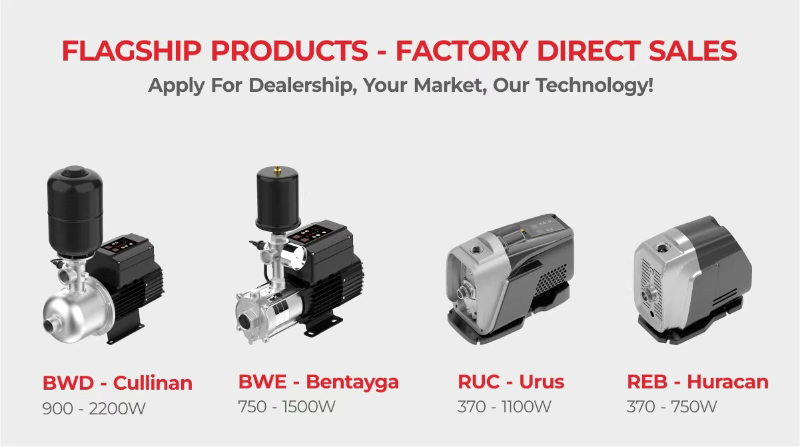
Variable Frequency Drive (VFD) pumps are an advanced type of booster pump that automatically adjusts their speed to maintain constant pressure, regardless of how many taps are open.
This saves energy and prevents pressure fluctuations.
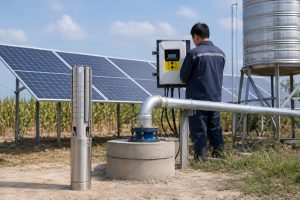
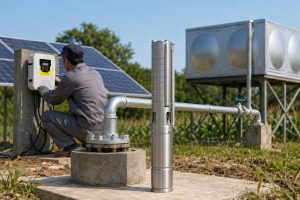
Advanced Solar-Powered Pumps
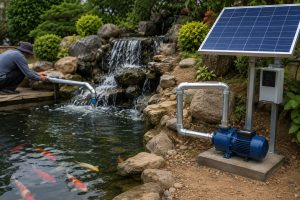
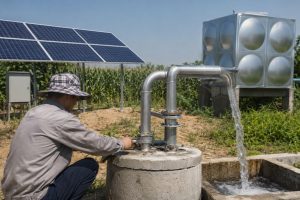
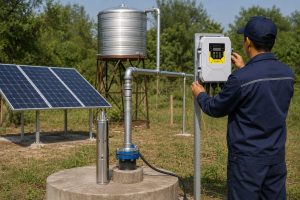
For off-grid or eco-conscious applications, solar pumps are the ultimate solution.
They are driven by high-efficiency brushless DC (BLDC) permanent magnet motors that can achieve over 90% efficiency.
This product family provides a complete portfolio for diverse needs.
| Solar Pump Type | Mechanism | Best For | Key Advantage | Limitation |
|---|---|---|---|---|
| Solar Screw Pump | A stainless steel screw rotates in a rubber stator. | Deep wells, domestic water, low-flow needs. | High head (pressure), excellent sand resistance. | Limited flow rate. |
| Plastic Impeller Pump | Multi-stage centrifugal impellers made of durable plastic. | Farm irrigation, high-flow needs, medium head. | High flow, wear-resistant, lightweight, economical. | Less durable in highly corrosive water. |
| Stainless Steel Impeller Pump | Multi-stage impellers made of SS304 stainless steel. | Corrosive water (acidic/alkaline), high-end homes. | Superior corrosion resistance, long service life. | Higher initial cost and weight. |
These solar pumps, paired with intelligent MPPT controllers, maximize the use of solar energy, providing reliable water solutions for homes, farms, and livestock in any location.
Key Features to Look for in a Pressure Pump
Not sure what "dry run protection" or "flow rate" means?
Buying a pump without understanding these key features can lead to a purchase that doesn't meet your needs or fails quickly.
Knowing what to look for is essential.
Look for a pump with the right pressure (PSI/kPa) and flow rate (LPM/GPM) for your needs.
Crucial features include automatic control to turn the pump on/off, dry run protection to prevent damage, and durable, corrosion-resistant materials for longevity.
The specifications on a pump's label are not just numbers; they are promises of performance.
Each feature is designed to solve a specific problem, from protecting the pump motor to ensuring you have a steady stream of water.
A pump is a long-term investment, and understanding these features will help you choose a model that is efficient, reliable, and built to last.
Let's break down the most important ones.
Pressure and Flow Rate
These are the two most fundamental performance metrics of a pump.
- Pressure, measured in pounds per square inch (PSI) or kilopascals (kPa), is the force at which water is delivered. You need enough pressure to lift water to the highest point in your home and operate appliances. A typical home requires 40-60 PSI.
- Flow Rate, measured in liters per minute (LPM) or gallons per minute (GPM), is the volume of water the pump can move. You need enough flow to run multiple taps at once. A small house might need 20-30 LPM, while a larger one could require 50+ LPM.
Motor Technology: The Power Within
The motor is the engine of your pump, and its technology has a massive impact on performance and cost.
Traditional AC motors are common, but modern Brushless DC (BLDC) Permanent Magnet Motors are superior.
These motors, often used in high-end solar pumps, can be over 90% efficient, compared to 60-75% for many standard motors.
This high efficiency means they require significantly less power to run.
For example, a BLDC motor can be up to 47% smaller and 39% lighter than a traditional motor with the same output.
This reduces the number of solar panels needed, lowers operating costs, and simplifies installation.
Automatic Control and Protection
Modern pumps are intelligent devices with built-in safeguards.
- Automatic Pressure Control: This feature uses a pressure switch or an electronic controller to automatically start the pump when a tap is opened and stop it when it's closed. This is essential for convenience and energy savings.
- Dry Run Protection: This is one of the most critical protective features. It automatically shuts off the pump if the water source runs dry. Without it, the pump would continue to run, overheat, and destroy its internal seals, leading to catastrophic failure.
- Thermal Overload Protection: This protects the motor from damage by shutting it down if it begins to overheat due to a jam or excessive load.
Material and Durability
A pump is constantly exposed to water and the elements, so its materials matter.
For parts in contact with water, look for corrosion-resistant materials like stainless steel or high-grade composites.
This is especially important in areas with acidic or alkaline water.
The pump's housing should be robust and, for external pumps, have UV resistance to withstand sun exposure without becoming brittle, which is crucial in places like Australia.
How to Choose the Right Pressure Pump
Faced with a wall of pumps at the store, how do you pick one?
Choosing based on price or horsepower alone is a common mistake that can leave you with the wrong tool for the job.
A systematic approach ensures you get the perfect match.
To choose the right pump, first calculate your demand for pressure (PSI) and flow rate (GPM).
Then, ensure the pump is compatible with your water tank and power source (grid, solar, or hybrid).
Finally, balance the initial cost with long-term value and reliability.
Choosing a pressure pump doesn't have to be a guessing game.
It's a process of matching the pump's capabilities to the specific demands of your property.
By considering your water usage, your system's physical layout, and your power supply, you can narrow down the options to find a pump that will serve you reliably for years.
Let's walk through the key decision-making steps.
Step 1: Match the Pump to Your Demand
First, evaluate your water needs.
Are you supplying a small cabin with one bathroom, or a large two-story home with three bathrooms and a garden?
- For Households: Add up the flow rates of all fixtures you might use simultaneously. A typical shower uses 9 LPM, a faucet 5 LPM, and a toilet 6 LPM per flush. If you expect to run a shower and a faucet at the same time, you need a pump that can deliver at least 14 LPM while maintaining adequate pressure.
- For Irrigation: Calculate the total flow rate required by your sprinkler system. If you have five sprinkler heads that each require 10 LPM, you need a pump with a flow rate of at least 50 LPM.
| Application | Required Flow Rate (Approx.) | Required Pressure (Approx.) |
|---|---|---|
| Small Home (1-2 people) | 20-30 LPM | 40-50 PSI |
| Large Home (4+ people) | 40-60 LPM | 50-60 PSI |
| Garden Irrigation | 30-80 LPM | 30-50 PSI |
| Farm/Livestock | 50-100+ LPM | 40-70 PSI |
Step 2: Check Compatibility with Your System
Your pump must work with your existing or planned infrastructure.
- Tank Outlets: Ensure the pump's inlet connection matches the outlet fitting on your water tank. Common sizes are 1" or 1.25". Using the wrong size can restrict flow.
- Power Source: What is your power source?
- Grid Power: Standard 115v or 230v AC pumps are common.
- Off-Grid (Solar): DC solar pumps are designed to run directly from solar panels.
- Hybrid Systems: The most versatile option is an AC/DC hybrid pump. These systems can run on solar power during the day and automatically switch to an AC grid or generator power at night or on cloudy days, ensuring a 24/7 water supply.
Step 3: Consider Long-Term Value
The cheapest pump is rarely the best value.
Consider the total cost of ownership.
A highly efficient pump, like one with a BLDC motor, may have a higher upfront cost but can save you hundreds of dollars in electricity over its lifespan.
Likewise, a pump made from durable materials like stainless steel will outlast a cheaper plastic model, saving you on replacement costs.
Prioritize pumps with features like dry-run protection and a strong warranty, as this indicates the manufacturer's confidence in their product's longevity.
Installation and Maintenance Basics
You've bought the perfect pump, but now what?
Improper installation can damage your new pump and void its warranty, while neglecting maintenance will surely shorten its life.
Following basic best practices is key to performance.
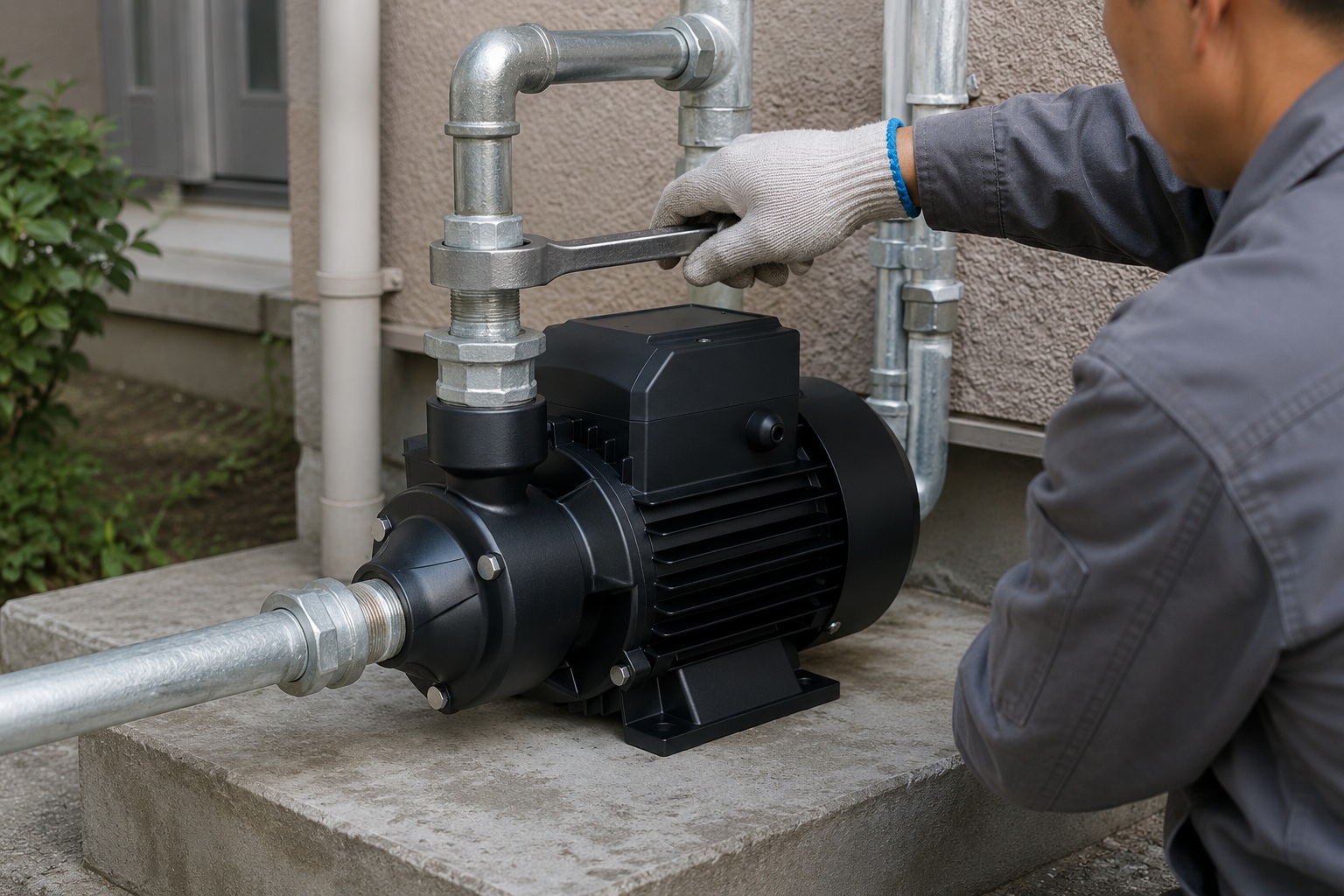
For installation, always mount the pump on a level surface, follow manufacturer wiring instructions, and check for leaks.
For maintenance, regularly clean inlet filters and inspect connections annually to ensure your system runs smoothly and efficiently for years to come.
Your water pressure pump is a hardworking piece of machinery.
Proper installation is the foundation for its performance, and regular maintenance is the key to its longevity.
While a complex whole-of-home installation is best left to a licensed plumber, understanding the basics will help you ensure the job is done right and empower you to perform simple upkeep tasks.
Let's review the essential steps for installation and a simple checklist for maintenance.
Installation Checklist
A successful installation ensures the pump operates efficiently and safely.
- Secure Mounting: Mount the pump on a flat, level, and vibration-free surface. This prevents stress on the pump housing and pipes. For external pumps, a concrete pad is ideal.
- Proper Pipe Connections: Use suction and delivery hoses that match the pump's inlet/outlet diameter. A smaller hose will restrict flow and strain the pump. Ensure all connections are airtight to prevent the pump from losing its prime.
- Install a Check Valve: A check valve (or non-return valve) on the suction line prevents water from flowing back into the tank, keeping the pump primed and ready to go.
- Safe Electrical Wiring: All electrical work must comply with local codes. It's highly recommended to have a licensed electrician connect the pump, especially for 230v systems. The pump should be connected to a dedicated circuit with an appropriate circuit breaker.
- Protect from Elements: If the pump is outdoors, it should be protected by a weather-proof pump cover. This shields it from direct sun and rain, which can degrade its components over time.
Routine Maintenance for Longevity
A few simple checks can dramatically extend your pump's life.
- Clean Inlet Filters (Monthly): The filter or screen on the suction line inside the tank prevents debris from entering and damaging the pump. Check it monthly and clean it as needed.
- Inspect for Leaks (Quarterly): Walk around the pump and check all fittings and connections for any drips or signs of moisture. A small leak can cause the pump to cycle frequently and waste water.
- Check Pressure Tank (Annually): If your system has a pressure tank, check its air pressure annually. It should typically be set to 2 PSI below the pump's cut-in pressure. Incorrect air pressure can cause the pump to cycle too often.
- Ensure Ventilation (Always): Make sure the area around the pump motor is clear of leaves, grass, and other debris. The motor needs airflow to stay cool.
By following these simple guidelines, you can ensure your investment continues to pay dividends in the form of reliable, high-pressure water for many years.
Conclusion
Choosing the best water pressure pump means matching the right technology to your specific needs.
From household boosting to off-grid solar solutions, the ideal pump delivers reliable performance, efficiency, and durability.
FAQs
What is a good brand of water pressure pump?
A good pump is defined by its features, not its brand.
Look for pumps with dry-run protection, durable materials like stainless steel, and high-efficiency motors to ensure quality and longevity.
What is the best pump to increase water pressure?
A booster pump is designed specifically for this.
For consistent pressure across multiple taps, a Variable Frequency Drive (VFD) pump is the best choice as it adjusts its speed to meet demand.
How do I choose a water pressure pump?
First, determine your required flow rate and pressure.
Then, consider your water source, power availability (grid or solar), and choose a pump with protective features like automatic shut-off.
What is a good PSI for a house water pump?
A good pressure range for most homes is between 40 and 60 PSI.
This ensures strong flow for showers and appliances without putting excessive strain on your plumbing.
How long should a water pressure pump last?
A quality, well-maintained water pump should last 8 to 15 years.
Lifespan depends on usage, water quality, and features like dry-run protection that prevent premature wear.
What is the difference between a booster pump and a pressure pump?
The terms are often used interchangeably.
However, a "booster" specifically increases existing pressure, while a "pressure pump" is a broader term for any pump that delivers pressurized water from a source like a tank.
Is higher HP better for a water pump?
Not necessarily.
Horsepower (HP) is a measure of the motor's power, but efficiency is more important.
A high-efficiency pump can deliver the same flow and pressure with a lower HP, saving energy.