Struggling to find the right pump for your application?
The choice can be overwhelming.
Making the wrong decision leads to inefficiency and higher costs.
The two main types of suction pumps are end suction pumps and horizontal split-case pumps.
These centrifugal pumps are distinguished by their casing design and impeller configuration.
End suction pumps are versatile for general use, while split-case pumps excel in high-capacity, demanding applications.
Choosing the right pump is crucial for any fluid transfer system.
The pump you select directly impacts performance, operational costs, and long-term reliability.
While many pump variations exist, understanding the fundamental differences between the most common types is the first step toward an optimal solution.
In this guide, we will explore the characteristics of two workhorse categories: end suction and horizontal split-case pumps.
We will also look at specialized pumps for harsh conditions and the critical role of modern motor technology.
This will provide you, as an importer or distributor, with the knowledge to build a competitive and effective product portfolio.
End Suction Pumps: The Versatile Workhorse
Need a reliable, cost-effective pump for a wide range of applications?
End suction pumps are often the default choice.
But their limitations in high-pressure or variable-flow scenarios can lead to performance issues.
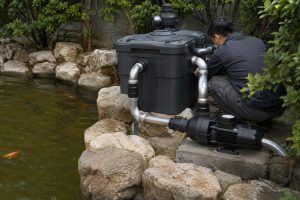
An end suction pump is a type of centrifugal pump with a casing where the suction nozzle is on the opposite side of the casing from the shaft.
This straightforward, single-stage design makes it highly versatile and easy to maintain for moderate flow and pressure requirements.
Construction and Design Features
End suction pumps are defined by their simplicity and efficiency in design.
The core of the pump is a single impeller that rotates on a shaft.
Fluid enters through the "end" of the casing, along the same axis as the shaft, and is then accelerated radially outward by the impeller.
It exits through a discharge port located at the top of the casing, perpendicular to the suction inlet.
This design is often referred to as "overhung," as the impeller is mounted on the end of the shaft, supported by bearings only on the motor side.
Key features include:
- Single-Stage Impeller: A single impeller generates the centrifugal force.
- Simple Casing: The volute-shaped casing is typically a single piece, making it robust.
- Flanged Connections: Standardized flanges on the inlet and outlet allow for easy and secure connection to piping systems.
- Material Variety: Casings and impellers can be made from cast iron, stainless steel, or bronze to match fluid compatibility and durability needs.
This simple construction results in a pump that is not only cost-effective to manufacture but also easier to install and service in the field, reducing labor costs and downtime for end-users.
A Modern Evolution: Solar Deep Well Pumps
The fundamental principles of centrifugal force used in end suction pumps have been adapted for one of the world's most critical applications: off-grid water supply.
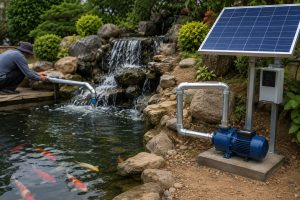
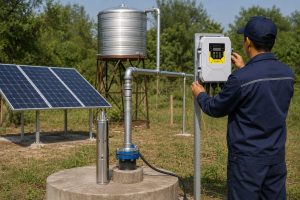
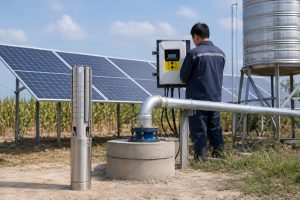
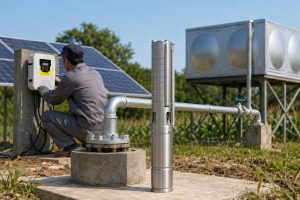
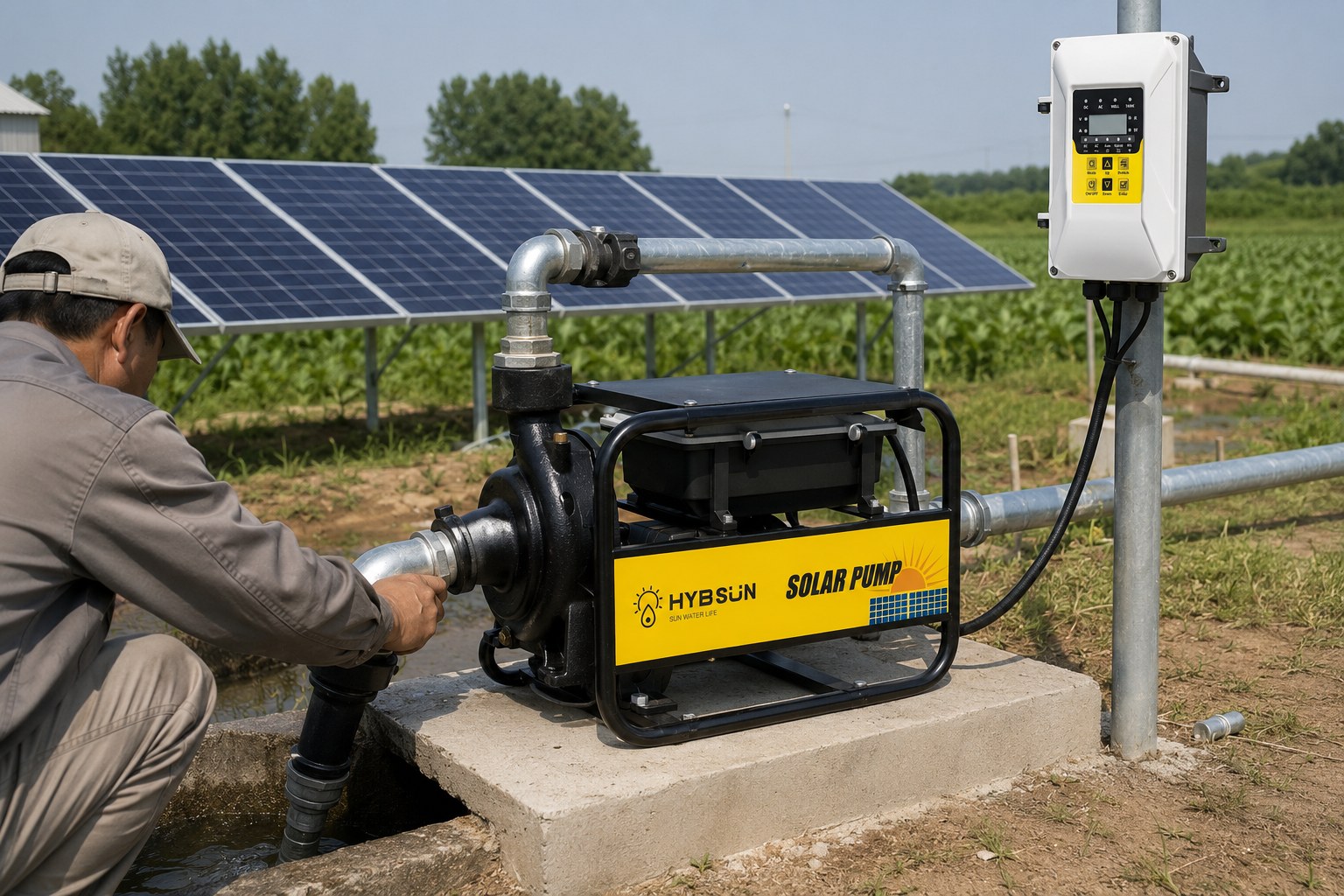
Solar deep well pumps represent a significant evolution, integrating specialized pump ends with advanced motor technology to provide water in remote locations.
These systems are not traditional end suction pumps but share the core purpose of moving water efficiently.
The real innovation lies in the system's core: the motor.
Modern solar pumps are powered by high-efficiency Brushless DC (BLDC) permanent magnet motors.
These motors achieve efficiencies exceeding 90%, a massive improvement over the 60-75% efficiency of standard AC motors.
This high efficiency is critical.
It means that for a given amount of solar power, the pump can produce more water.
This directly reduces the number of solar panels required by up to 30%, lowering the initial system cost and making it more accessible.
The rotor is constructed from high-grade 40SH neodymium iron boron magnets, providing strong and consistent torque.
This advanced motor design is also significantly more compact, being up to 47% smaller and 39% lighter than a traditional motor of equivalent power.
This makes installation, especially in deep wells, far easier and less labor-intensive.
To meet diverse water needs, from household use to small-scale irrigation, three main types of solar pump ends have emerged.
| Pump Type | Flow Rate | Head Pressure | Key Advantage | Ideal Application |
|---|---|---|---|---|
| Solar Screw Pump | Low (e.g., 1-5 m³/hr) | Very High (up to 200m+) | High sand resistance | Deep domestic wells, livestock watering |
| Plastic Impeller Pump | High (e.g., 5-20 m³/hr) | Medium (up to 100m) | Cost-effective, wear-resistant | Farm irrigation, garden water supply |
| Stainless Steel Impeller Pump | High (e.g., 5-20 m³/hr) | Medium-High (up to 150m) | High corrosion resistance | Corrosive water, high-end homes |
This portfolio approach allows distributors to cater to a wide spectrum of market demands, from a farmer in Africa needing to irrigate crops to a rancher in Australia with alkaline water conditions.
Horizontal Split-Case Pumps: The High-Performance Powerhouse
Are your customers facing large-scale water transfer projects that demand high flow and unwavering reliability?
Standard pumps can't handle the pressure.
They often suffer from cavitation and inefficiency under such heavy loads.
A horizontal split-case pump features a casing that is split horizontally into two halves.
This design allows for a double-suction impeller, which significantly increases flow capacity, improves efficiency, and enhances stability, making it ideal for demanding industrial and municipal applications.
Construction and Design Features
The defining feature of a horizontal split-case pump is its two-part casing.
The casing is split parallel to the shaft, allowing the top half to be removed for easy access to the pump's internal components—the impeller, shaft, and bearings.
This is a major advantage for maintenance, as it can be done without disturbing the motor or the suction and discharge piping.
The impeller in a split-case pump is typically a double-suction design.
This means that water enters the impeller from both sides simultaneously.
This design has two critical benefits:
- It balances the hydraulic axial thrust on the shaft, which reduces wear on the bearings and increases the pump's lifespan and reliability.
- It lowers the required Net Positive Suction Head (NPSHr), reducing the risk of damaging cavitation, especially at high flow rates.
The suction and discharge nozzles are cast into the same half of the casing (usually the bottom half), in a side-by-side configuration, which provides a stable and robust piping setup.
Performance and Cost Analysis
When choosing between a general-purpose end suction pump and a high-performance split-case pump, the decision comes down to a trade-off between initial cost and long-term performance.
Split-case pumps have a significantly higher upfront capital cost.
However, their superior design provides tangible benefits in the right application.
Their efficiency is notably higher, often reaching 85-92%, compared to the 60-80% range typical for end suction pumps.
In high-flow, continuous-duty applications like municipal water distribution or large-scale industrial cooling, this 10-15% efficiency gain translates directly into substantial energy savings over the pump's lifecycle.
These savings can often pay back the higher initial investment in just a few years.
Let's compare the two on key decision-making factors.
| Feature | End Suction Pump | Horizontal Split-Case Pump |
|---|---|---|
| Initial Cost | Lower | Higher (up to 2-3x) |
| Efficiency | Moderate (60-80%) | High (85-92%) |
| Flow Rate | Medium to High | Very High |
| Head Pressure | Medium | High |
| Footprint | Smaller, more compact | Larger, requires more space |
| Maintenance | Simple, but may require pipe removal | Complex, but allows access without disturbing pipes |
| Lifecycle Cost | Higher due to lower efficiency | Lower due to energy savings |
For distributors, offering both types is essential.
End suction pumps serve the broad, price-sensitive market for general applications.
Split-case pumps cater to high-spec, performance-driven projects where reliability and long-term operating costs are the primary concerns.
Specialized Suction Pumps: Dredge Pumps for Abrasive Materials
What happens when you need to pump more than just water?
Standard pumps will clog, wear out, and fail quickly.
Moving slurries, sand, and solids requires a pump built for extreme punishment.
A dredge pump is a heavy-duty centrifugal pump specifically designed to transport abrasive and dense materials.
Featuring an open impeller and a highly durable body, it can grind through and move large volumes of rocks, sludge, and sand that would destroy conventional pumps.
How Dredge Pumps Work
A dredge pump operates on the same centrifugal principle as other pumps, but everything is amplified for durability and power.
A powerful motor drives a specially designed impeller.
As the impeller spins, it creates a powerful vacuum that sucks in a mixture of water and solids—known as a slurry.
The key is the design of the impeller and the pump casing.
The impeller is typically an "open" or "semi-open" design with large passages.
This allows large solids to pass through without clogging the pump.
Furthermore, the clearance (the space between the impeller and the casing) is much wider than in a clean-water pump.
This high tolerance allows for the easy passage of gritty and abrasive materials that would otherwise cause a standard pump to seize.
Once inside, the material is thrown outward by centrifugal force and directed into the discharge pipe for transport.
Some dredge pumps are also equipped with agitators or cutter heads near the suction inlet to break up compacted material and feed it more effectively into the pump.
Unique Construction for Extreme Durability
The construction of a dredge pump is what sets it apart.
These pumps are built to withstand constant, intense abrasion.
The main wear components—the casing and the impeller—are not made from standard cast iron or stainless steel.
Instead, they are constructed from high-chrome alloys.
These materials have an extremely high hardness rating, often exceeding 600 on the Brinell hardness scale.
This makes them exceptionally resistant to the grinding and erosive action of sand, gravel, and other abrasive particles.
This ultimate wear protection ensures the pump has a long service life with minimal downtime, even in the most demanding applications like:
- Dredge Mining: Extracting sand, gravel, and other resources from riverbeds and ponds.
- Sediment Removal: Maintaining the depth of ports, marinas, and canals for safe navigation.
- Tailings Management: Pumping waste slurry in mining operations.
- Industrial Sludge: Cleaning out settling tanks and lagoons in industrial facilities.
The ability to handle solids is also relevant in the solar pump world.
For example, a solar screw pump, with its rubber stator and stainless steel rotor, can handle a much higher sand content than centrifugal impeller pumps, making it a more durable choice for wells in sandy regions.
The Core of Modern Pump Systems: Motor and Control Technology
Is the pump itself the only thing that matters?
Many focus solely on the pump end.
But this overlooks the two components that truly define a system's efficiency and intelligence: the motor and the controller.
The motor is the heart of any pump system, directly determining its energy consumption and power output.
The controller is the brain, optimizing performance and protecting the system, especially in advanced applications like solar pumping where energy is a precious resource.
The BLDC Permanent Magnet Motor Advantage
The biggest leap forward in pump technology in recent years hasn't been in hydraulics, but in motor design.
The shift to Brushless DC (BLDC) permanent magnet motors has revolutionized the industry, particularly for solar-powered systems.
A standard AC induction motor, which powers most conventional pumps, typically operates at an efficiency of 60-75%.
This means that up to 40% of the electrical energy is lost as heat and noise, never contributing to the work of pumping water.
In contrast, a BLDC motor boasts an efficiency of over 90%.
This dramatic improvement is due to its design.
It uses powerful permanent magnets (like 40SH neodymium iron boron) on the rotor, eliminating the energy loss required to create a magnetic field in a conventional motor.
This efficiency has a powerful ripple effect on the entire system.
A 90%-efficient motor needs significantly less power to do the same amount of work as a 75%-efficient motor.
For a solar pump, this means the system can run longer on cloudy days and can operate with a smaller, less expensive solar panel array.
The benefits extend beyond efficiency:
- Higher Torque: BLDC motors provide high starting torque, which is excellent for overcoming inertia and pumping viscous fluids.
- Compact Design: Without the bulky windings of an AC motor, BLDC motors can be up to 47% smaller and 39% lighter, simplifying transport and installation.
- Longer Lifespan: With no brushes to wear out, these motors are virtually maintenance-free and offer exceptional long-term reliability.
For a distributor, highlighting the motor's superior efficiency is a powerful selling point that speaks directly to lower operating costs and a better return on investment for the end-user.
Intelligent Control for Maximum Efficiency
An advanced motor requires an intelligent controller to unlock its full potential.
In solar pumping systems, this is the role of the Maximum Power Point Tracking (MPPT) controller.
Solar panels produce a variable amount of voltage and current depending on the intensity of the sunlight.
The MPPT controller constantly analyzes the output from the solar panels and adjusts the electrical load of the motor to ensure that the panels are always operating at their peak efficiency point.
This process can boost the water output of a solar pump system by as much as 30% over the course of a day compared to a system without MPPT.
The controller also provides crucial protective functions, such as dry-run protection, over-voltage protection, and thermal shutdown, safeguarding the pump and motor from damage.
The latest innovation in control technology is the AC/DC hybrid controller.
This design provides ultimate flexibility and ensures a 24/7 water supply.
It has inputs for both DC power from solar panels and AC power from the grid or a generator.
The controller's logic is designed to prioritize solar power.
When the sun is shining, the pump runs entirely on free solar energy.
If clouds reduce the solar input, the controller can blend in AC power to maintain the required pump speed.
When there is no solar input at all, such as at night, it automatically switches over to the AC source.
This hybrid functionality guarantees water is always available, while maximizing the use of renewable energy to keep operating costs at an absolute minimum.
Conclusion
Choosing the right pump requires looking beyond just the pump type.
While end suction and split-case pumps serve different needs, modern efficiency is driven by the motor and intelligent control systems.
FAQs
What is the main difference between a suction pump and a submersible pump?
A suction pump is installed above the water level and pulls water up. A submersible pump is placed directly in the water and pushes it up, which is generally more efficient for deep sources.
How do I choose the right size suction pump?
You must calculate your required flow rate (GPM or m³/hr) and total dynamic head (the vertical and horizontal distance plus friction loss). Use a pump curve to match a pump to these requirements.
Can a suction pump run dry?
No, running a suction pump without water (running dry) will quickly damage the mechanical seal and impeller due to overheating. Most modern systems include dry-run protection to prevent this.
What is pump cavitation and how can I prevent it?
Cavitation is the formation and collapse of vapor bubbles inside a pump, which causes noise, vibration, and severe damage. It can be prevented by ensuring adequate suction head (NPSH) and proper pipe sizing.
What are the advantages of a stainless steel pump?
Stainless steel offers superior resistance to corrosion and abrasion compared to cast iron. It is ideal for pumping acidic or alkaline water and ensures a longer service life in harsh environments.
Why is motor efficiency so important for solar pumps?
A high-efficiency motor (like a BLDC) requires less power to operate. For a solar pump, this means fewer solar panels are needed, which significantly reduces the total system cost.
What is a dredge pump used for?
Dredge pumps are used to move abrasive slurries containing solids like sand, gravel, and sludge. They are common in mining, port maintenance, and industrial pond cleaning applications.
How does an AC/DC hybrid pump work?
An AC/DC hybrid pump uses a smart controller that can draw power from both solar panels (DC) and the grid or a generator (AC). It prioritizes solar power and automatically switches to AC when solar is unavailable.