Are you worried that running your pond pumpconstantly is driving up your electricity bill?
You might be tempted to turn it off, but this could risk the health of your pond's ecosystem.
Yes, a pond pump should run 24 hours a day, 7 days a week, especially if your pond contains fish or other aquatic life. Continuous circulation is essential for oxygenation, filtration, and preventing the buildup of harmful toxins that can endanger your pond's inhabitants.
This might sound expensive, but the reality of modern pump technology may surprise you.
The cost of continuous operation is often minimal compared to the high price of restoring a stagnant, unhealthy pond.
Let's explore why 24/7 operation is non-negotiable for a thriving pond and look at the actual costs involved.
We will also uncover advanced, energy-efficient solutions that can provide the circulation you need while significantly reducing or even eliminating your electricity costs.
Why is it crucial to run a pond pump 24/7?
You see the electricity meter spinning and think, "I could save a few dollars by turning the pond pump off at night."
But this small saving could lead to a huge disaster, turning your beautiful oasis into a toxic, lifeless puddle.
Running a pump 24/7 is vital for three reasons: it powers your filtration system to clean the water, it keeps debris from settling and fueling algae, and most importantly, it ensures a constant supply of life-sustaining oxygen for your fish and beneficial bacteria.
To truly grasp the importance of a continuously running pump, we need to look closer at the delicate ecosystem living in your pond.
A pond is not just a body of water; it's a living system where every component depends on the others.
When you turn off the pump, you're not just pausing a machine; you're shutting down the life support system for countless organisms.
The consequences can be swift and severe, creating a cascade of problems that are difficult and costly to reverse.
Let's break down the three critical functions that a pump performs around the clock.
The Role of Filtration
Your pond's filter is home to colonies of beneficial bacteria.
These microscopic helpers are essential workers that break down fish waste, uneaten food, and decaying plant matter.
They convert harmful ammonia into less toxic compounds, keeping the water safe for your fish.
When the pump stops, water flow to the filter ceases.
If the filter media dries out, these vital bacteria colonies can die off in just a few hours.
When you turn the pump back on, you'll be starting from scratch, waiting weeks for a new bacterial colony to establish itself.
During this time, your pond is highly vulnerable to toxic ammonia spikes.
Preventing Debris Buildup
A constantly moving current does more than just look nice.
It keeps small particles of debris, like leaves and fish waste, suspended in the water column.
This allows them to be pulled into the pond's skimmer and mechanical filter for easy removal.
When the pump is off, all this debris settles to the bottom of the pond.
There, it decomposes and creates a thick layer of organic sludge, or "muck."
This muck is a primary food source for algae and can lead to unpleasant odors and cloudy water.
The Oxygen Exchange Cycle
This is arguably the most critical function of a pond pump.
Fish and other aquatic life require dissolved oxygen in the water to breathe.
Stagnant water quickly becomes depleted of oxygen.
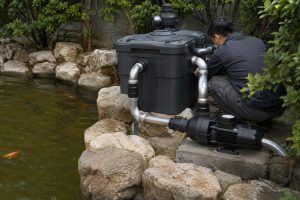
A running pump creates surface agitation, whether through a waterfall, fountain, or simply the return flow.
This movement is crucial for a process called gas exchange.
It allows harmful gases like carbon dioxide and ammonia to be released from the water into the atmosphere.
Simultaneously, it allows life-giving oxygen from the air to be absorbed into the water.
Even a few hours without this process, especially overnight when plants are not producing oxygen, can cause oxygen levels to plummet to dangerously low levels, suffocating your fish.
| Feature | Pond with 24/7 Pump | Pond with Intermittent Pump |
|---|---|---|
| Oxygen Level | Stable and high (8-12 ppm) | Fluctuates wildly, dangerously low at night |
| Water Clarity | Clear | Cloudy, prone to algae blooms |
| Ammonia Level | Low and controlled | Prone to toxic spikes |
| Debris | Removed by filter | Accumulates as sludge on the bottom |
| Fish Health | Healthy and active | Stressed, sick, or at risk of death |
Are pond pumps expensive to run continuously?
You're committed to keeping your fish healthy, but you're still worried about your electricity bill.
The thought of a machine running 24/7 can bring to mind images of a spinning energy meter and a shockingly high monthly bill.
No, modern pond pumps are surprisingly energy-efficient and are not expensive to run. Many models cost less than a dollar per day. The potential cost of replacing fish and chemicals to fix a sick pond far exceeds the small savings from turning the pump off.
The idea that pond pumps are energy hogs is a leftover from a previous era.
Decades ago, pumps were indeed inefficient and could make a noticeable impact on a household's electricity budget.
However, technology has progressed significantly.
Manufacturers understand that operating cost is a major concern for pond owners.
As a result, modern pumps are designed with a strong focus on energy efficiency, delivering powerful water flow while consuming very little electricity.
Let's put this into perspective with some real numbers.
Calculating Your Pump's Operating Cost
You don't have to guess how much your pump is costing you.
You can calculate it easily.
First, find the wattage of your pump, which is usually printed on the pump's label or in its manual.
Then, you can use a simple online electricity cost calculator.
You just need to input the pump's wattage, the number of hours you run it (which should be 24), and the price per kilowatt-hour (kWh) from your utility bill.
You'll likely find that the cost is much lower than you feared.
Comparing Pump Efficiency
The difference in operating cost between pumps can be significant.
A large, high-volume pump designed for a massive waterfall will naturally use more energy than a small pump for a tiny decorative pond.
However, even the big pumps are designed for efficiency.
For example, a powerful 9,000 Gallon Per Hour (GPH) waterfall pump might consume around 700 watts.
A smaller 600 GPH submersible pump might use as little as 40 watts.
Let's see what that means in terms of daily cost, assuming an average electricity rate of $0.15 per kWh.
| Pump Type | Power Usage (Watts) | Hours per Day | Daily Energy Use (kWh) | Estimated Daily Cost | Estimated Monthly Cost |
|---|---|---|---|---|---|
| Small Submersible | 40 W | 24 | 0.96 kWh | $0.14 | $4.20 |
| Medium Waterfall | 300 W | 24 | 7.2 kWh | $1.08 | $32.40 |
| Large Waterfall | 700 W | 24 | 16.8 kWh | $2.52 | $75.60 |
As you can see, even a large pump costs only a few dollars per day.
A smaller, more common backyard pond pump costs mere pennies.
The Hidden Costs of Intermittent Use
Now, compare that small daily cost to the potential costs of not running your pump.
A single high-quality koi can cost hundreds or even thousands of dollars.
Losing your entire fish stock to oxygen deprivation is a devastating financial and emotional blow.
Even if your fish survive, you'll likely face an uphill battle against algae blooms and toxic water.
This means spending money on algaecides, water treatments, and beneficial bacteria supplements.
You'll also spend countless hours testing water, performing large water changes, and cleaning out sludge.
When you weigh these factors, the decision becomes clear.
The small, predictable cost of running your pump 24/7 is a wise investment in the health and beauty of your pond.
What if you could eliminate electricity costs entirely?
You understand the need for 24/7 circulation, but you still want to reduce your home's energy consumption and be more environmentally friendly.
Relying on the grid means you're always subject to rising electricity prices and vulnerable to power outages that could devastate your pond.
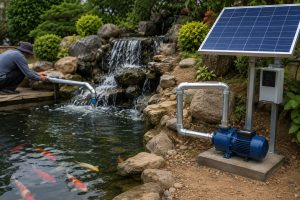
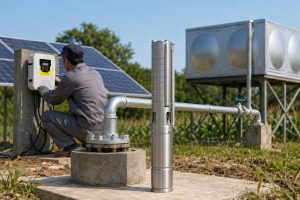
Solar water pumps offer a revolutionary solution, harnessing free, clean energy from the sun. They can completely eliminate electricity costs for water circulation, operate independently of the grid, and provide a reliable water source even in remote areas.
Imagine your pond's waterfall flowing beautifully day after day, powered entirely by the sun.
No more worrying about the electricity bill or what will happen during a blackout.
This is the power of solar technology.
Solar water pumps have become a cornerstone of sustainable water management across the globe, from farms in Australia to villages in Africa.
They represent a shift away from fossil fuels and toward a smarter, more resilient way of moving water.
Let's explore how this technology works and how it can be applied to your pond.
How Solar Water Pumps Work
The principle behind a solar water pump is simple and elegant.
Solar panels capture sunlight and convert it into direct current (DC) electricity.
This electricity is then sent to a specialized pump, which moves the water.
The entire system is clean, quiet, and has no ongoing fuel costs.
The amount of water pumped is directly related to the intensity of the sunlight, meaning the pump works hardest during the sunniest parts of the day.
The Core Components of a Solar Pumping System
A typical solar pumping system consists of three main parts.
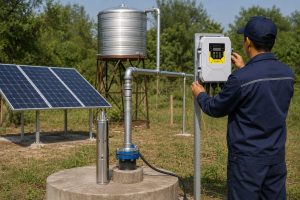
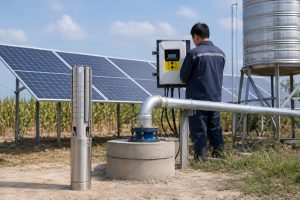
- Solar Panels: These are the "engine" of the system. They are made up of photovoltaic cells that generate electricity when exposed to sunlight. The number and size of the panels determine how much power the system can produce.
- Pump Controller: This is the "brain" of the system. It is an intelligent electronic device that manages the power flowing from the solar panels to the pump. It optimizes the pump's performance and protects it from damage due to voltage fluctuations. Advanced controllers can also manage hybrid power sources.
- Water Pump: This is the "muscle" of the system. Most solar pumps use a highly efficient DC motor designed to run directly on the power produced by the panels.
One of the main questions people have about solar pumps is what happens when the sun isn't shining.
While a basic system will only operate during daylight hours, this can be overcome.
For ponds that require 24/7 circulation, the solution is a hybrid system.
Advanced AC/DC controllers can be connected to both solar panels and the main electrical grid (or a generator).
The controller intelligently prioritizes solar power, but if sunlight is insufficient, it automatically switches to the AC power source, guaranteeing uninterrupted operation without any manual intervention.
Which type of solar pump is right for you?
You're intrigued by the idea of a solar pump, but the different types and technical terms can seem overwhelming.
Choosing the wrong pump for your specific needs can lead to poor performance, wasted money, and frustration.
The right solar pump depends entirely on your application. Submersible pumps are best for deep water sources like wells, while surface pumps are for shallow sources like ponds or rivers. The choice between different pump mechanisms depends on your required flow rate and water conditions.
To make an informed decision, it's helpful to understand the main categories of solar pumps available to distributors and end-users.
The technology has evolved to meet a wide range of water-moving needs, from providing drinking water for a single home to irrigating large agricultural fields.
For deep well applications, which require lifting water from significant depths, there are three popular and highly competitive designs.
Each is tailored for specific conditions, creating a versatile product portfolio for importers and distributors.
Let's examine these specialized deep well pumps.
Solar Screw Pump: For High Head and Low Flow
This type of pump uses a helical stainless steel screw rotating inside a rubber stator.
This mechanism works like an Archimedes' screw, pushing "pockets" of water upward through compression.
It's designed to produce a very high head (the vertical distance it can lift water) but with a relatively low flow rate.
Its ability to handle sandy or silty water without damage makes it extremely durable.
- Best Applications: Domestic water supply from deep wells, drinking water for livestock, and small-scale, high-pressure irrigation systems.
- Advantages: Excellent for very deep wells, highly resistant to sand, and reliable in harsh water conditions.
- Limitations: The flow rate is limited, making it unsuitable for applications requiring large volumes of water, like large-scale farm irrigation.
Solar Plastic Impeller Pump: For High Flow and General Use
This is a multi-stage centrifugal pump.
It uses a series of durable, wear-resistant plastic impellers that spin at high speed to push water outward and upward.
This design is optimized to deliver a high flow rate at a medium head.
It's a versatile and economical workhorse for a wide range of applications.
- Best Applications: Farm irrigation, filling livestock troughs, pasture water supply, and residential garden and lawn watering.
- Advantages: Delivers a high volume of water, offers good resistance to fine sand, is lightweight, and is more cost-effective than stainless steel models.
- Limitations: May not be as durable as stainless steel in highly corrosive water or when used in extremely deep wells.
Solar Stainless Steel Impeller Pump: For Durability and Corrosive Water
This premium model is also a multi-stage centrifugal pump, but it utilizes impellers and a pump body made from SS304 stainless steel.
This construction is specifically designed to withstand corrosive water environments, such as those with high acidity or alkalinity.
It offers high flow rates and a medium-to-high head, combined with exceptional longevity.
- Best Applications: Pumping water in regions with acidic or alkaline water, supplying water in areas with alkaline soil, and for high-end residential or commercial properties where reliability is paramount.
- Advantages: Superior corrosion resistance, very long service life, and high reliability in challenging water conditions.
- Limitations: Higher initial cost and greater weight compared to plastic impeller models, targeting a more niche, high-end market.
| Pump Type | Key Feature | Primary Use | Main Advantage | Main Limitation |
|---|---|---|---|---|
| Solar Screw Pump | High Head, Low Flow | Deep Well Drinking Water | Handles sand well | Limited water volume |
| Plastic Impeller Pump | High Flow, Medium Head | Farm & Pasture Irrigation | Economical & wear-resistant | Less corrosion resistant |
| Stainless Steel Impeller | High Flow, High Durability | Corrosive Water Environments | Extreme corrosion resistance | Higher initial cost |
What is the secret to a high-efficiency solar pump?
You've seen that different pumps are for different jobs, but what makes one solar pump better than another?
You might assume a cheaper pump is a better deal, but an inefficient motor will perform poorly, require more solar panels, and fail sooner, costing you more in the long run.
The secret to a top-tier solar pump is its motor. High-efficiency Brushless DC (BLDC) permanent magnet motors, with efficiencies often exceeding 90%, are the heart of the system. They dramatically reduce energy needs, lower overall system costs, and ensure long-term, maintenance-free reliability.
The pump itself—whether it's a screw or centrifugal design—is only half of the equation.
The motor that drives it is what determines the overall efficiency and performance of the entire system.
An efficient motor can do more work with less power.
In the world of solar pumping, this is a game-changer.
It means you can achieve your desired water flow with fewer solar panels, which is often the most expensive component of the system.
Let's dive into the technology that makes this possible.
Understanding BLDC Motor Technology
A Brushless DC (BLDC) motor is a major advancement over older brushed motors.
In traditional motors, "brushes" make physical contact to deliver power, which creates friction, heat, wear, and energy loss.
BLDC motors, as the name implies, have no brushes.
They use an electronic controller to switch the power, resulting in a much more efficient, quieter, and longer-lasting operation.
Top-quality solar pumps take this a step further by using permanent magnet rotors, often made from powerful materials like neodymium iron boron, to generate a stronger magnetic field with less energy input.
Technical Advantages of Permanent Magnet Motors
The use of this advanced motor technology provides several key advantages.
- High Efficiency: With efficiencies over 90%, very little energy is wasted as heat. This compares to older motor types that might be only 60-70% efficient. This 20-30% improvement is massive.
- High Torque: These motors deliver strong power even at low speeds, which is ideal for starting the pump under load.
- Compact and Lightweight: Advanced BLDC motors can be significantly smaller and lighter than traditional motors with the same power output. For example, they can be up to 47% smaller and 39% lighter, which simplifies installation and reduces shipping costs for distributors.
- Long Service Life: With no brushes to wear out, these motors are virtually maintenance-free and are designed to operate reliably for many years.
The Market Value for Distributors and End-Users
For a distributor, offering pumps with high-efficiency BLDC motors provides a significant competitive advantage.
You can market a system that requires fewer solar panels, lowering the total cost for the customer and making the sale easier.
The reliability and long lifespan also translate to fewer warranty claims and happier customers.
For the end-user, the benefit is clear: lower upfront costs, zero maintenance, and a system that reliably delivers water for years to come.
The efficiency of the motor is the foundation upon which the entire value proposition of a solar water pump is built.
How can a solar pump run at night or on cloudy days?
The biggest hesitation people have about solar power is its dependence on the sun.
Your pond needs circulation 24/7, which seems impossible for a pump that only runs when the sun is out.
Modern hybrid AC/DC controllers completely solve this problem. These intelligent devices automatically and seamlessly switch between solar power and a backup AC source (like the grid or a generator), guaranteeing your pump runs 24/7 without any manual effort.
The need for continuous operation in a pond and the intermittent nature of solar power seem to be in direct conflict.
In the past, the only solutions were to install a large, expensive battery bank to store solar energy or to run a separate, conventional electric pump at night.
However, technology has provided a much more elegant and cost-effective solution that offers the best of both worlds: the free energy of solar and the constant reliability of the grid.
This innovation is the key to making solar a truly viable 24/7 solution for ponds and other critical applications.
The Genius of the Hybrid AC/DC Controller
A hybrid controller is designed with two power inputs.
You can connect your solar panel array to the DC input and your home's grid power to the AC input simultaneously.
The controller's internal logic is programmed to handle both sources intelligently.
It's not just a simple switch; it's a power management system designed for maximum efficiency.
This technology ensures that you use every available watt of free solar energy before drawing any power from the grid.
How Automatic Switching Works
The process is completely automated and works in a clear hierarchy of power priority.
- Full Solar Power: On a bright, sunny day, the controller will power the pump entirely from the solar panels. The AC input is on standby, and you are using 100% free energy.
- Hybrid Power: On days with intermittent clouds or during early morning and late evening, the controller enters its hybrid mode. It will draw as much power as it can from the solar panels and supplement it with just enough AC power to keep the pump running at the desired speed. This maximizes your use of solar energy.
- Full AC Power: At night or on very dark, overcast days when there is no significant solar input, the controller will automatically and seamlessly switch over to run the pump entirely from the AC power source.
The transition between these modes is so smooth that the pump's operation is never interrupted.
The Ultimate Worry-Free Water Solution
This hybrid approach provides the ultimate peace of mind.
You get the massive cost savings of solar power during the day, reducing your electricity bill significantly.
You also get the absolute certainty that your pond's life support system will never shut down, regardless of the weather or time of day.
For a pond owner, this means healthy fish and clear water.
For a distributor, it means offering a technologically superior product that overcomes the single biggest objection to solar power.
It transforms the solar pump from a daytime-only device into a complete, 24-hour water management solution.
Conclusion
Running a pond pump 24/7 is essential for a healthy ecosystem.
Modern pumps are efficient, and advanced solar hybrid systems offer a cost-free, reliable way to ensure constant, worry-free circulation.
FAQs
Can a pond have too much circulation?
Yes, while circulation is vital, an excessively powerful pump can create a current that is too strong for fish to swim against, causing stress and exhaustion.
Is it OK to turn a pond pump off in winter?
In freezing climates, you should keep a pump or aerator running to maintain a hole in the ice for gas exchange, which is crucial for fish survival.
How do I know if my pond pump is working?
You should see visible water movement, such as from a waterfall or fountain outlet. A lack of flow or a humming noise without water movement indicates a problem.
Does a pond need a pump if it has a waterfall?
A waterfall itself requires a pump to function. The pump is what lifts the water to the top of the waterfall, creating both circulation and aeration.
What happens if a pond pump stops?
If a pump stops, water stagnates, oxygen levels drop, and toxic ammonia builds up. This can harm or kill fish and beneficial bacteria within hours.
How much aeration does a pond need?
A pond generally needs enough surface agitation to turn over its entire volume of water at least once per hour to ensure adequate oxygen levels for fish.
Can I use a solar pump for my waterfall?
Yes, solar pumps are an excellent, eco-friendly option for powering waterfalls. A hybrid AC/DC system can ensure your waterfall runs 24/7, day or night.
Do solar pumps work on cloudy days?
Solar pumps will run at a reduced speed on cloudy days. A hybrid system automatically supplements with AC power to maintain flow, ensuring consistent operation.