Choosing the wrong well pump can lead to no water, high bills, and a burned-out motor.
Getting it right from the start is crucial for a reliable water supply.
The right pump size depends on your well's Total Dynamic Head (TDH) and required Gallons Per Minute (GPM). For a quick estimate: 1/2 HP for wells under 100 ft, 3/4 HP for 100-200 ft, and 1 HP+ for deeper wells. But a full calculation is essential for accuracy.
Sizing a well pump feels complex, but it's a logical process.
Breaking it down into key factors makes it manageable.
Let's explore the critical data points you need to gather to ensure you select the perfect pump for your well, avoiding the costly pitfalls of getting it wrong.
Key Factors in Sizing Your Well Pump
Guessing your pump size is a recipe for disaster.
Low pressure or a damaged well are common results.
Let's look at the five critical factors for accurate sizing.
You must know your well depth, static water level, drawdown, GPM needs, and pressure requirements. These factors combine to determine the total workload for the pump. Missing even one can lead to selecting the wrong horsepower.
Let's break down each of these critical factors in detail.
Understanding them is the first step toward selecting a pump that will perform efficiently for years.
This knowledge empowers you to have an informed conversation with your installer or supplier.
Well Depth & Pump Setting Depth
The total drilled depth of your well is just a starting point.
The more important figure is the pump setting depth.
This is the actual depth where the pump will be installed inside the well casing.
Typically, a pump is set 10 to 20 feet above the bottom of the well to avoid pulling in sediment.
The pump's job is to lift water from this setting depth all the way to the surface.
For instance, a well drilled to 400 feet with a pump set at 380 feet requires a pump that can handle at least 380 feet of vertical lift.
This is before accounting for any other system resistance.
In some regions, well depths can vary enormously, from 200 feet to over 1,000 feet.
A 1 HP pump that works for a 250-foot well would be hopelessly undersized for a 600-foot well.
The pump setting depth is the non-negotiable foundation of your entire sizing calculation.
Static Water Level & Drawdown
The static water level is the natural level of the water in your well when the pump is not running.
This is the true starting point for the lift calculation, not the bottom of the well.
If you have a 500-foot well but the static water level is at 90 feet, the pump only needs to lift water from 90 feet, plus drawdown.
This information is recorded on your well log by the driller upon completion.
Drawdown is how much the water level drops below the static level while the pump is operating at capacity.
If the static level is 90 feet and the drawdown is 40 feet, the pumping water level is 130 feet.
This pumping water level is the correct figure to use for sizing calculations.
Wells in fractured rock formations can have significant drawdown of 50 feet or more.
Wells in sandy alluvial plains often have low drawdown, sometimes only 5 to 20 feet.
Failing to account for drawdown will result in an undersized pump that struggles to perform.
GPM (Gallons Per Minute) Requirements
GPM refers to the flow rate, or how much water your pump needs to deliver during peak demand.
A common rule of thumb is to allow 1 GPM for each water fixture in the home.
A typical 3-bedroom, 2-bathroom house has about 10-12 fixtures.
This home would require a pump capable of delivering 8-12 GPM for simultaneous use.
Larger estates with guest houses, pools, or agricultural irrigation may need 20-50+ GPM.
However, there is a critical limitation: your pump's GPM rating must not exceed the well's production rate.
If your well can only produce 5 GPM, installing a 12 GPM pump is a serious mistake.
The pump will draw water faster than the aquifer can replenish it, causing it to run dry and sustain damage.
In these low-yield well situations, the correct strategy is to use a lower GPM pump to slowly fill a large atmospheric storage tank.
A separate booster pump then provides pressure to the house from the tank.
Pressure Requirements
Most residential water systems use a pressure tank that operates on a pressure switch.
A common setting is 40/60 PSI.
The pump turns on when the pressure drops to 40 PSI and turns off when it reaches 60 PSI.
This pressure requirement adds to the pump's workload.
The energy needed to create this pressure must be converted into an equivalent height, known as "feet of head."
The conversion is simple: 1 PSI = 2.31 feet of head.
Therefore, a 60 PSI cutoff pressure adds an additional 138.6 feet (60 x 2.31) to the total head the pump must overcome.
If you desire higher pressure, like a 50/70 PSI setting, this will increase the total head and may require a larger horsepower pump.
Friction Loss from Piping
As water is forced through pipes, it encounters friction, which creates resistance.
This resistance is called friction loss, and the pump must work harder to overcome it.
Friction loss is influenced by the pipe's diameter, material, length, and the flow rate (GPM) of the water.
For example, pushing 10 GPM through 100 feet of 1-inch diameter pipe creates approximately 7.5 feet of friction loss.
If you upgrade to a 1.25-inch pipe, that loss drops to just 3 feet per 100 feet of pipe.
On a deep well with 400 feet of pipe, this difference adds up to 18 extra feet of head (4 x 7.5 = 30 ft vs. 4 x 3 = 12 ft).
This reduction in workload can significantly improve pump efficiency and longevity.
Using a wider diameter drop pipe, such as 1.25-inch or 1.5-inch, is a smart investment that pays for itself in lower energy bills and reduced wear on the pump motor.
| Pipe Diameter | Flow Rate (GPM) | Friction Loss (Feet per 100ft of Pipe) |
|---|---|---|
| 1" | 10 GPM | ~7.5 ft |
| 1.25" | 10 GPM | ~3.0 ft |
| 1.5" | 10 GPM | ~1.6 ft |
| 1.25" | 15 GPM | ~6.3 ft |
| 1.5" | 15 GPM | ~3.4 ft |
How to Calculate Your Pumping Needs
Don't rely on guesswork or simple charts.
A precise calculation is the only way to guarantee you choose the right pump.
It's simpler than it looks when you break it down.
The key is calculating Total Dynamic Head (TDH). TDH is the total work the pump must do. It's the sum of the vertical lift, friction loss, and pressure requirements. Match this TDH and your GPM to a pump's performance curve.
Let's walk through the calculation process step-by-step.
This method removes all ambiguity from the selection process.
It ensures your investment in a new pump is sound, efficient, and perfectly matched to your specific needs.
Understanding Total Dynamic Head (TDH)
Total Dynamic Head, or TDH, is the single most important concept in pump sizing.
It represents the total equivalent pressure or resistance that the pump must overcome to deliver water.
It is measured in feet.
TDH is a comprehensive value that combines the physical height the water must be lifted with all other sources of resistance in the system.
Think of it as the total workload placed on the pump.
A pump is designed to operate efficiently against a specific range of TDH.
If your actual TDH is 300 feet, but you install a pump rated for a maximum of 200 feet of TDH, it will fail to deliver adequate water and pressure.
Conversely, installing a pump rated for 400 feet of TDH on a system with only 200 feet of TDH will lead to oversizing problems like short cycling and high energy use.
Calculating TDH accurately is the foundation of a successful well system.
The TDH Formula Explained
The formula to calculate TDH is a simple addition of three components.
TDH = Vertical Lift + Friction Loss + Pressure Head
Let's define each part clearly.
-
Vertical Lift: This is the total vertical distance the water must travel. It is measured from the pumping water level (not the static level) in the well up to the height of the pressure tank inlet.
-
Friction Loss: This is the head, in feet, that is "lost" due to the friction of water moving through pipes, elbows, valves, and other fittings. This value is found using standard friction loss charts based on your pipe size and flow rate.
-
Pressure Head: This is the pressure you want at your destination, converted into feet of head. You take your pressure tank's cutoff pressure (e.g., 60 PSI) and multiply it by 2.31 to get the equivalent feet of head.
A Step-by-Step Calculation Example
Let's apply the formula to a real-world scenario.
- Static Water Level: 100 feet
- Drawdown: 40 feet
- Pumping Water Level: 100 ft + 40 ft = 140 feet
- Vertical Lift to Tank: 140 ft (pumping level) + 10 ft (tank is 10ft above ground) = 150 feet
- Pipe & Flow: 200 ft of 1.25" pipe at 10 GPM
- Friction Loss: At 10 GPM, 1.25" pipe loses ~3.0 ft per 100 ft. Total loss = (200/100) * 3.0 = 6 feet.
- Desired Pressure: 50 PSI cutoff
- Pressure Head: 50 PSI × 2.31 = 115.5 feet
- Total Dynamic Head (TDH): 150 ft (Lift) + 6 ft (Friction) + 115.5 ft (Pressure) = 271.5 feet
Using a Pump Performance Curve
Now you have the two critical numbers: a TDH of 271.5 feet and a desired flow of 10 GPM.
With this data, you can consult a manufacturer's pump performance curve.
This chart plots flow rate (GPM) on the horizontal axis against total dynamic head (TDH) on the vertical axis.
You find the point where your required GPM and TDH intersect.
The goal is to select a pump model where this intersection point falls comfortably within the pump's "Best Efficiency Range" or BER.
Operating in the BER ensures the pump is not overworked or underworked, leading to a longer lifespan, lower electricity consumption, and reliable performance.
| Pressure (PSI) | Equivalent Head (Feet) |
|---|---|
| 30 PSI | 69.3 ft |
| 40 PSI | 92.4 ft |
| 50 PSI | 115.5 ft |
| 60 PSI | 138.6 ft |
| 70 PSI | 161.7 ft |
The Dangers of an Oversized Pump
You might think "bigger is better" when it comes to pumps.
This is a common and costly mistake.
An oversized pump causes more problems than it solves.
An oversized pump fills the pressure tank too quickly, causing rapid on-off cycles (short cycling) that destroy the motor. It also wastes electricity and can damage the well itself by drawing in sand and sediment.
The consequences of oversizing are severe and can lead to premature failure of your entire water system.
It's not just about inefficiency; it's about actively damaging your investment.
Let's explore the specific ways an oversized pump can wreak havoc.
Short Cycling: The Silent Motor Killer
This is the most destructive consequence of an oversized pump.
The pump moves water so quickly that it fills the pressure tank in a very short time, sometimes less than a minute.
This causes the pressure switch to shut the pump off.
A moment later, a small amount of water use causes the pressure to drop, and the switch turns the pump back on.
This rapid on-and-off sequence is called short cycling.
Each time a motor starts, it draws an inrush current that is 3 to 5 times its normal running amperage.
This creates a massive surge of heat in the motor windings.
A properly sized pump might cycle 4-6 times per hour during use, allowing the motor to cool between runs.
An oversized pump can cycle 20 or more times per hour.
At this rate, the motor never adequately cools, causing the winding insulation to break down and leading to burnout.
A pump that should last 10-15 years can be destroyed in as little as 2-3 years due to short cycling.
Well Damage and Sand Production
When a pump's GPM rating is too high for the aquifer, it draws water down too aggressively.
This rapid drawdown creates turbulent, high-velocity flow around the well screen or perforations.
This turbulence can dislodge fine sand and sediment from the surrounding formation and pull it into the well.
This abrasive sand then flows through the pump, where it acts like sandpaper.
It erodes the pump's impellers and diffusers, drastically reducing its efficiency and lifespan.
The sand can also clog check valves and fill the bottom of the well, reducing its effective depth and storage capacity.
In severe cases, this "overpumping" can cause the geological formation around the well screen to collapse, permanently damaging the well and reducing its yield.
Wasted Energy and Higher Costs
The financial impact of an oversized pump is significant.
A larger horsepower motor naturally consumes more electricity.
For example, a 1.5 HP motor draws about 10-11 amps, while a correctly sized 3/4 HP motor might only draw 6-7 amps.
That's over 50% more electricity consumption every hour the pump runs.
Compounded by the fact that short cycling causes the pump to run more frequently (though for shorter periods), the total energy waste adds up quickly.
Over the course of a year, this can easily add hundreds of dollars to your electricity bill compared to a properly sized pump.
You are paying a premium for a pump that is actively destroying itself and potentially your well.
| Pump Size | Typical Running Amps (230V) | Relative Energy Cost |
|---|---|---|
| 3/4 HP | 6-7 Amps | Baseline |
| 1 HP | 8-9 Amps | ~25% Higher |
| 1.5 HP | 10-11 Amps | ~50% Higher |
| 2 HP | 12-13 Amps | ~75% Higher |
The Problems with an Undersized Pump
While less destructive than oversizing, an undersized pump creates its own set of frustrating problems.
It leads to poor performance and premature failure.
It simply can't keep up with your household's demands.
An undersized pump cannot provide adequate water pressure and flow, especially during peak use. It runs for excessively long periods, causing the motor to overheat and fail much sooner than its expected 10-15 year lifespan.
Living with an undersized pump means a constant struggle for water pressure.
It's a daily inconvenience that also puts your pump motor on a fast track to failure.
Let's examine the symptoms and the underlying reasons for its early demise.
Recognizing the Symptoms of Low Pressure
The most obvious sign of an undersized pump is a noticeable drop in water pressure when multiple fixtures are used at the same time.
For example, the shower turns into a trickle when someone flushes a toilet or the washing machine starts to fill.
You might also observe that the pump runs for a very long time, or even continuously, without ever reaching the pressure tank's cut-off pressure.
This is a clear indication that the pump is struggling to overcome the system's Total Dynamic Head.
In extreme cases, the pump may not be able to provide any usable pressure at all during peak demand periods like mornings or evenings.
Your irrigation system may not have enough pressure to operate the sprinkler heads effectively.
These are all classic symptoms that the pump's horsepower is too low for the job.
Why Undersized Pumps Fail Prematurely
An undersized pump is forced to run at or near its maximum capacity for extended periods.
Submersible pump motors are designed to be cooled by the flow of water moving past the motor housing.
When a pump runs continuously for hours on end, it generates a tremendous amount of heat.
The flow of water may not be sufficient to dissipate this excess heat effectively.
Over time, this sustained high temperature degrades the motor's internal components.
The insulation on the motor windings breaks down, which can lead to electrical shorts between the windings.
Eventually, the motor will short out and fail completely.
We often see undersized pumps fail in just 4 to 6 years, whereas a properly sized pump should last 10 to 15 years.
The cost of a single premature pump replacement, including labor, far exceeds the small initial price difference between two different horsepower pumps.
Solutions for an Undersized System
The only true, long-term solution for an undersized pump is to replace it with a properly sized one.
This requires performing a new TDH calculation based on your current well conditions and household water needs.
If your water demand has increased since the original pump was installed—perhaps you've added a bathroom, an irrigation system, or a pool—then upsizing is necessary.
However, if the problem is not the pump but a low-yielding well, a different approach is needed.
If the well itself cannot produce the GPM your household demands, even a larger pump won't solve the problem.
In this scenario, a storage tank system is the ideal solution.
The existing (or a new, smaller) pump runs slowly and intermittently to fill a large, non-pressurized storage tank (e.g., 1,000-2,500 gallons).
A second, separate "booster" pump then draws water from this tank to provide high pressure and flow to the house on demand.
This protects the well from overpumping while ensuring you always have the water you need.
Choosing the Right Pump Type for Your Application
Once you know your required HP, you need to choose the right type of pump.
The market offers various technologies, each suited for different needs.
From conventional submersibles to advanced solar pumps, the choice matters.
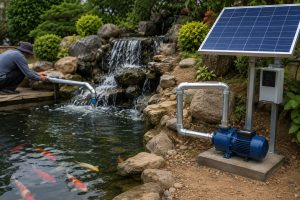
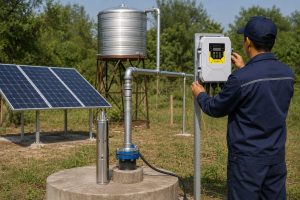
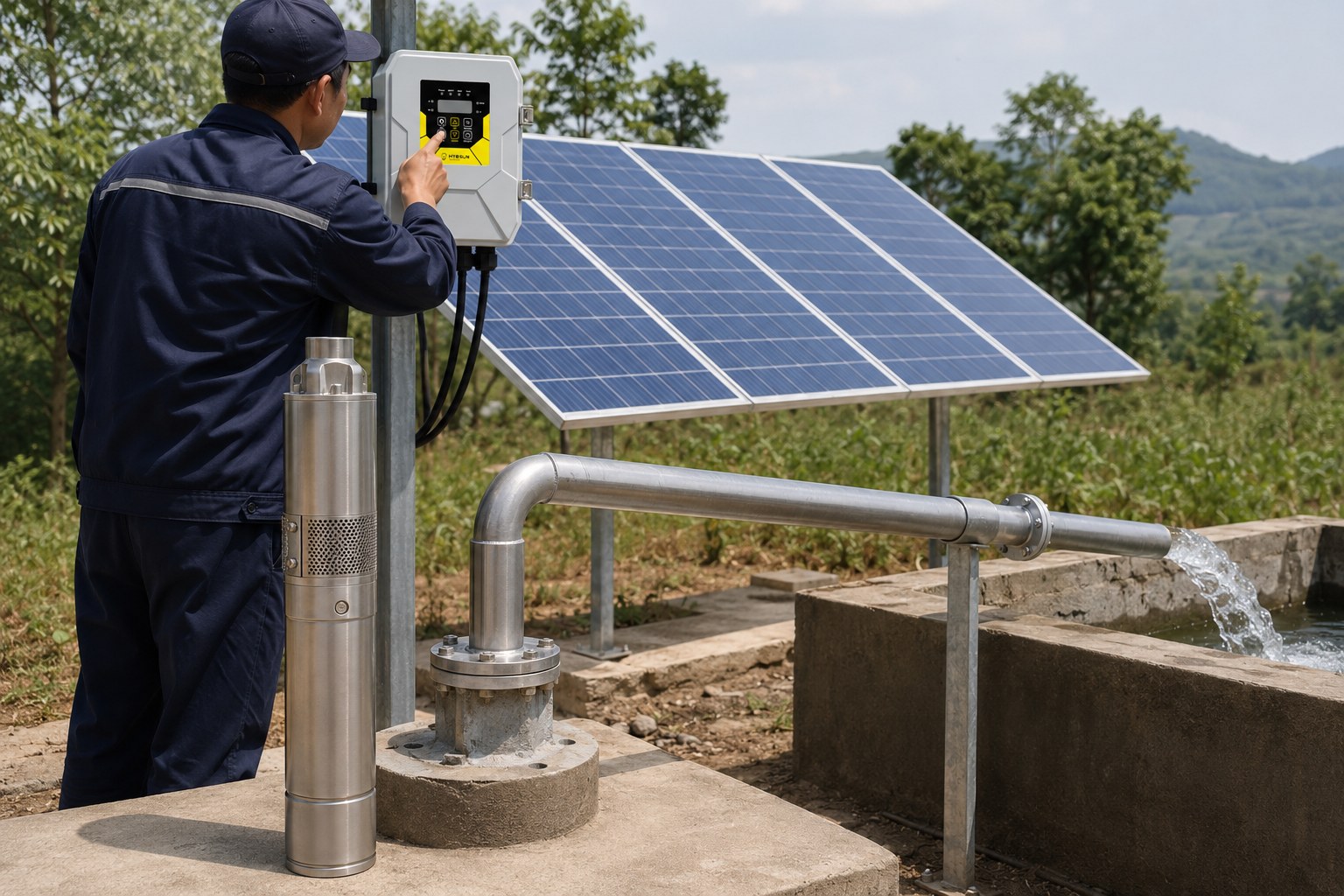
Most deep wells use submersible pumps, which are efficient and reliable. For off-grid or sustainable applications, solar-powered pumps—available in screw, plastic impeller, or stainless steel impeller models—offer an excellent grid-independent solution.
The technology inside the pump determines its performance characteristics, durability, and ideal use case.
Understanding these differences is key to selecting a product that not only delivers water but also aligns with your long-term goals for cost, maintenance, and sustainability.
Let's compare the most common options.
Conventional Submersible Pumps
This is the most common type of pump for residential wells deeper than 25 feet.
The entire unit, including the motor and pump end, is submerged deep inside the well.
This design is highly efficient because it pushes water to the surface rather than pulling it.
Being submerged also makes the pump very quiet and helps keep the motor cool.
They are available in a wide range of horsepower ratings, from 1/2 HP to over 10 HP.
Submersible pumps come in two main wiring configurations: 2-wire and 3-wire.
A 2-wire pump has its starting controls built into the motor down in the well.
A 3-wire pump has an external control box mounted above ground, which is easier to access for diagnostics and repair.
For most service professionals, the 3-wire design is preferred due to its serviceability.
The Rise of Solar Deep Well Pumps
With a growing global focus on sustainability and energy independence, solar water pumps have become a leading solution.
They are essential in off-grid locations across Africa, the Americas, and Australia.
These systems operate using power from photovoltaic (PV) panels, eliminating reliance on the grid and ongoing electricity costs.
They are driven by highly efficient brushless DC (BLDC) permanent magnet motors, which maximize the energy harvested from the sun.
There are three primary types of solar deep well pumps, each designed for a specific application profile.
Solar Screw Pumps: For High Head, Low Flow
This type of pump uses a helical rotor (a stainless steel screw) that turns inside a rubber stator.
This action creates sealed cavities that move water upward through compression.
The result is a pump that can generate very high pressure (head) but at a lower flow rate (GPM).
They are ideal for very deep wells where high lift is required for domestic water supply or livestock watering.
A key advantage is their excellent resistance to sand and solids, as the screw mechanism can handle abrasive water conditions better than centrifugal impellers.
Their main limitation is the lower flow rate, making them less suitable for large-scale irrigation.
Solar Plastic Impeller Pumps: For High Flow, General Use
This is a multi-stage centrifugal pump that uses impellers made from durable, engineered composite plastics.
It is designed to deliver high flow rates at a medium head range.
This makes it the workhorse for applications like farm irrigation, pasture water supply, and larger residential properties.
The plastic impellers offer good resistance to wear from fine sand.
These pumps are also lightweight and more economical, making them a popular choice in many markets.
Their durability may be limited in highly corrosive water or at extreme depths where pressure is very high.
Solar Stainless Steel Impeller Pumps: For Durability and Corrosion Resistance
This premium option features impellers and a pump body constructed from SS304 or SS316 stainless steel.
It is specifically designed for harsh water environments.
This includes acidic or alkaline water conditions often found in mining regions or areas with unique geology.
It offers high flow rates and can handle medium-to-high head requirements.
The primary advantage is superior corrosion resistance and a very long service life, ensuring high reliability.
The trade-off is a higher initial cost and greater weight compared to plastic impeller models.
| Solar Pump Type | Best For... | Flow Rate | Head (Lift) | Sand Resistance |
|---|---|---|---|---|
| Solar Screw Pump | Deep wells, homes | Low | Very High | Excellent |
| Solar Plastic Impeller | Farms, irrigation | High | Medium | Good |
| Solar Stainless Impeller | Corrosive water, high-end | High | Med-High | Good |
The Power Behind the Pump: Understanding Motors and Controllers
The pump itself is only half of the system.
The motor that drives it and the controller that manages it are just as critical.
The efficiency and intelligence of these components determine the entire system's performance.
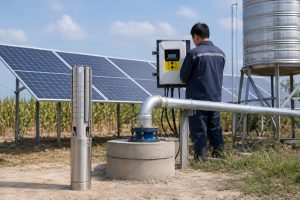
Modern solar pumps use high-efficiency Brushless DC (BLDC) motors, often exceeding 90% efficiency. Paired with an MPPT controller, they maximize solar energy use. Hybrid AC/DC controllers ensure 24/7 operation by automatically switching to grid power when sunlight is unavailable.
The innovation in motor and control technology is what makes modern solar pumping so effective and reliable.
These advancements reduce costs, simplify installation, and provide a level of performance that was previously unattainable.
Let's delve into the core components that provide the power and intelligence.
The BLDC Motor Advantage
At the heart of every modern solar pump is a Brushless DC (BLDC) permanent magnet motor.
Unlike traditional AC motors, BLDC motors do not have brushes that wear out, making them virtually maintenance-free.
They use powerful rare-earth magnets (like Neodymium Iron Boron) in their rotors.
This design results in extremely high efficiency, often exceeding 90%.
A conventional AC motor might only be 60-70% efficient.
This 20-30% efficiency gain is massive.
It means the motor can produce more power from less input energy.
BLDC motors are also more compact and lightweight.
A BLDC motor can be up to 47% smaller and 39% lighter than an AC motor with the same power output.
This makes installation easier and reduces shipping costs.
Why Motor Efficiency Matters More Than You Think
The high efficiency of a BLDC motor has a direct impact on the total system cost.
Because the motor requires less power to do the same amount of work, you need fewer solar panels to run it.
Solar panels are a significant portion of the initial investment.
A 30% reduction in power demand could mean the difference between needing four panels versus three.
Over the life of the system, this higher efficiency also translates into more water pumped per day from the same amount of sunlight.
It extends the pump's operating window, allowing it to start earlier in the morning and run later in the afternoon.
This increased daily water output is a major benefit for agricultural and livestock applications.
Intelligent Control with MPPT
To get the most out of the solar panels, a sophisticated controller is used.
This controller features Maximum Power Point Tracking (MPPT) technology.
The voltage and current produced by a solar panel change constantly with the sun's intensity.
An MPPT controller continuously monitors the panel's output and adjusts the electrical load of the motor to extract the maximum possible power at any given moment.
This technology can boost the system's overall energy harvest by up to 30% compared to a simple controller without MPPT.
It ensures that not a single watt of available solar energy is wasted.
Hybrid AC/DC Systems for 24/7 Water
A major advancement is the development of hybrid AC/DC controllers.
These controllers provide ultimate flexibility and ensure a worry-free water supply around the clock.
They have inputs for both DC power from solar panels and AC power from the grid or a generator.
The controller's logic is designed to prioritize solar power.
When the sun is shining, the pump runs entirely on free solar energy.
If clouds reduce the solar input, the controller can blend AC power with the available DC power to maintain pump operation.
When there is no solar input at all, such as at night or on very overcast days, it automatically switches over to the AC power source.
This guarantees that you have water whenever you need it, without having to manually switch power sources.
| Motor / Controller Feature | Benefit | Impact on System |
|---|---|---|
| BLDC Motor | Efficiency >90%, maintenance-free, compact | Reduces solar panel requirement, lowers operating cost |
| MPPT Controller | Maximizes power from solar panels (up to 30% boost) | More water pumped per day, longer daily run time |
| Hybrid AC/DC Controller | Automatically switches between solar and grid/generator power | Guarantees 24/7 water availability, ultimate reliability |
Conclusion
Choosing the right well pump requires a careful calculation of TDH and GPM.
Oversizing is destructive, and undersizing leads to poor performance.
Modern solar pumps offer efficient, sustainable solutions for all needs.
Frequently Asked Questions
What size well pump do I need for a 300 foot well?
It depends on your water level and GPM needs, but typically a 1 HP or 1.5 HP pump is required. A full TDH calculation is necessary for an accurate answer.
Can I use a bigger pump than I need?
No, this is highly discouraged. An oversized pump will short-cycle, destroying the motor, wasting energy, and potentially damaging your well by pulling in sand. Matched is better than bigger.
How many GPM does a house need?
A standard 3-bedroom, 2-bath home typically needs 8-12 GPM for peak use. Count 1 GPM per fixture (showers, faucets, toilets) that might run simultaneously.
Does a deeper well always mean a bigger pump?
Generally, yes, as depth increases the head requirement. However, a deep well with a high water level might need a smaller pump than a shallower well with a very low water level.
What is the difference between a 2-wire and 3-wire submersible pump?
A 2-wire pump has its starting components inside the motor. A 3-wire pump uses an external control box, which makes troubleshooting and repairs much easier.
How long should a well pump last?
A properly sized and installed submersible well pump should last between 10 and 15 years. Short cycling from oversizing can reduce this to just 2-5 years.
What is the main cause of well pump failure?
The most common causes are short cycling from an oversized pump, running dry due to an inadequate well yield, and damage from pumping sand or sediment.
Can I replace my well pump myself?
While possible for those with strong mechanical and electrical skills, it is a difficult and potentially dangerous job. It often requires special equipment to pull and install the pump.