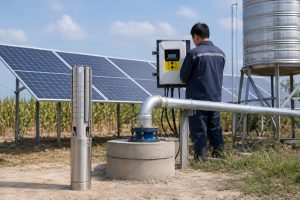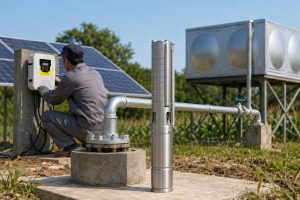
Struggling to get water in a remote location without a reliable power grid?
This challenge affects millions, impacting everything from farming to daily life.
A solar-powered water pump offers a life-changing solution.
Yes, solar-powered water pumps are a widely used and effective technology.
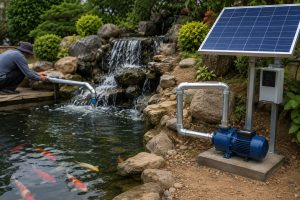
They harness energy from the sun using photovoltaic (PV) panels to power an electric pump.
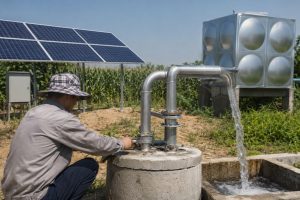
This system moves water from a source like a well, pond, or river for irrigation, livestock, or domestic use, completely independent of a power grid.
This technology is more than just a convenience.
It represents a fundamental shift in how communities access a vital resource.
For decades, the choice was between manual labor, expensive fuel, or unreliable electricity.
Solar pumps break this cycle, offering a sustainable and cost-effective path forward.
They are becoming essential tools for improving food security and quality of life across the globe.
Let's explore how these systems function, their benefits, and the different types available to meet diverse needs.
How Do Solar-Powered Water Pumps Work?
Wondering how simple sunlight can lift thousands of gallons of water from deep underground?
The science seems complex, but the process is elegant and reliable.
It's a system designed for efficiency and durability.
A solar-powered water pump works by converting sunlight directly into electricity to run a motor.
Solar panels capture photons from the sun, generating direct current (DC) electricity.
This power is fed to the pump's motor, which then moves water from its source to a storage tank or distribution point.
To truly understand the system, we need to look at its individual parts and how they work together.
Each component plays a critical role in transforming sunlight into a reliable flow of water.
The entire setup is a self-contained ecosystem of energy conversion and water management.
From the panel on the surface to the pump deep in a well, every piece is optimized for performance in off-grid environments.
The Core Components of a Solar Pumping System
A complete solar water pumping system is more than just a panel and a pump.
It includes several key components that ensure efficiency and longevity.
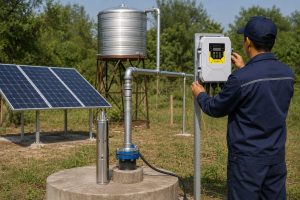
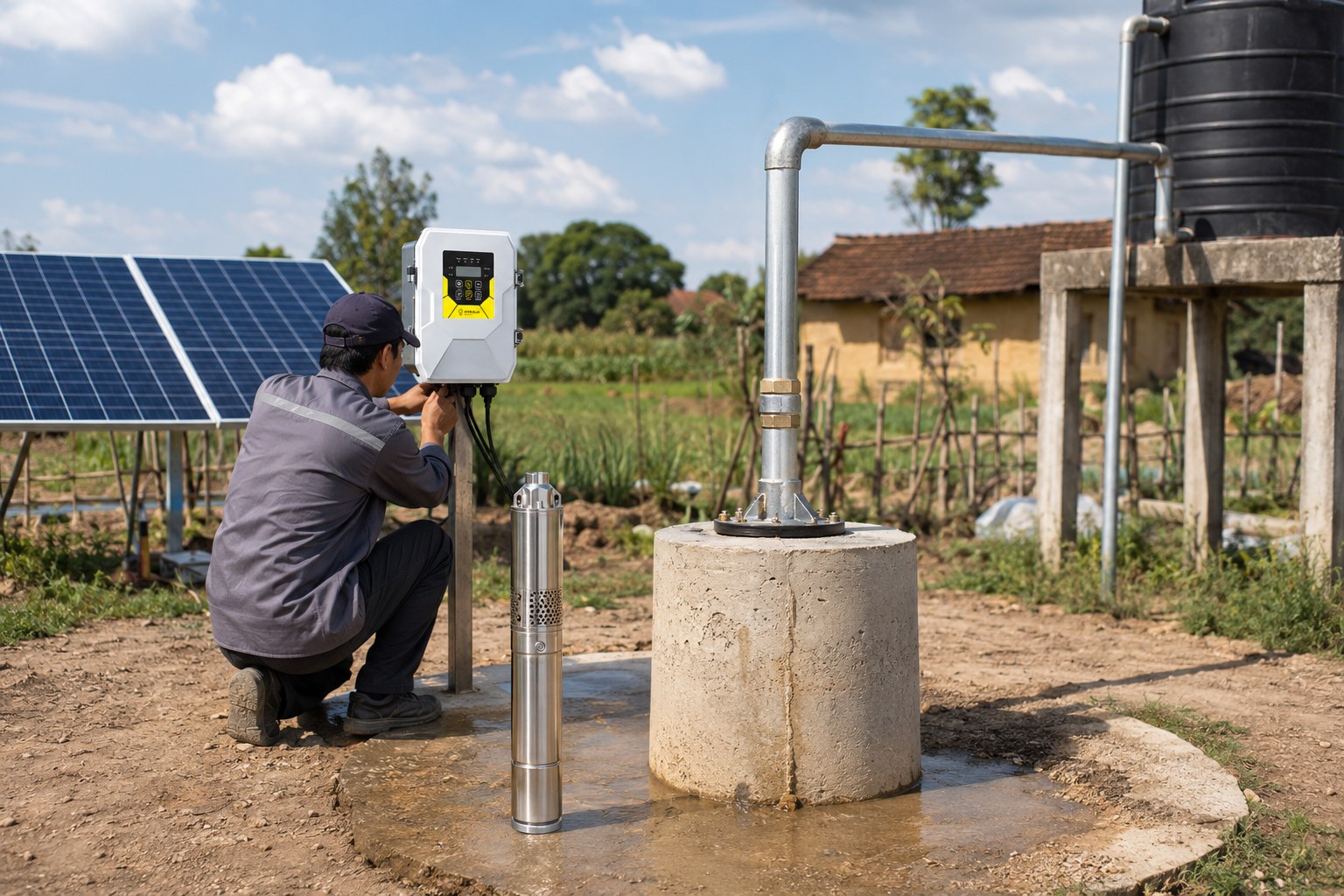
- Solar Panels: These are the system's power plant. Composed of photovoltaic (PV) cells, they absorb sunlight and convert it into DC electricity. The number and wattage of panels determine the total power available.
- Water Pump Motor: This is the heart of the system. It receives electricity from the panels and uses it to drive the pump mechanism. Modern systems often use highly efficient brushless DC (BLDC) motors.
- Inverter (for AC pumps): Many water pumps run on alternating current (AC). An inverter is a device that converts the DC electricity from the solar panels into AC electricity to power these pumps. This adds a step but allows for the use of more common AC pump types.
- Pipes: A network of pipes transports water from the source, through the pump, and to its final destination, whether it's an irrigation system, a livestock trough, or a household water tank.
- Water Tank: Storing water is crucial. A water tank allows you to collect water during peak sunlight hours for use at night or on cloudy days, ensuring a consistent supply.
- Pump Controller: This is the brain of the operation. It regulates the power going to the pump, protects it from damage, and maximizes water delivery. Many modern controllers include features like Maximum Power Point Tracking (MPPT).
The Energy Conversion and Pumping Process
The process begins the moment sunlight hits the solar panel.
Photons in the sunlight strike the solar cells, creating an electrical current.
This direct current (DC) is the raw energy that will power the system.
For DC pumps, this electricity can be sent directly to the motor.
For AC pumps, the DC electricity first flows to an inverter.
The inverter changes it to alternating current (AC), the same type of power that comes from a standard electrical outlet.
This AC power then energizes the pump motor.
The motor spins, driving the pump's internal mechanism—be it a screw or an impeller—which draws water in and pushes it out through the pipes.
An intelligent controller manages this entire flow of energy.
It often uses MPPT technology to adjust the electrical load continuously, ensuring the panels operate at their peak efficiency regardless of changing sun conditions.
This can boost the system's overall output by up to 30%.
The controller also provides vital protection, shutting the pump off if the water source runs dry (dry run protection) to prevent the motor from burning out.
| Feature | DC Pump System | AC Pump System |
|---|---|---|
| Power Type | Direct Current (DC) | Alternating Current (AC) |
| Inverter Needed | No | Yes |
| System Complexity | Simpler, fewer components | More complex, requires inverter |
| Typical Use | Smaller applications, fountains, low-volume wells | Larger applications, deep wells, high-volume irrigation |
| Efficiency | Generally higher (no conversion loss) | Slightly lower due to DC-to-AC conversion loss |
| Cost | Lower initial cost | Higher initial cost |
What Are the Benefits of Solar-Powered Water Pumps?
Relying on inconsistent rainfall or expensive diesel fuel is a gamble.
This uncertainty threatens crop yields, livestock health, and community well-being.
Solar pumps provide a stable, predictable, and clean alternative.
The key benefits are extremely low operating costs, energy independence, and environmental friendliness.
They are also reliable in remote areas without grid access, require minimal maintenance, and are easy to install.
This boosts agricultural productivity and ensures a secure water source for communities.
The advantages of solar water pumps extend far beyond simply moving water.
They represent an economic, social, and environmental revolution for off-grid areas.
By removing the reliance on fuel and the grid, they empower users with control over their most critical resource.
This shift has profound impacts on everything from household finances to regional food security.
Let's break down these benefits in more detail.
Economic Advantages
The most compelling benefit is the dramatic reduction in long-term costs.
While the initial investment for a solar pump system can be higher than for a diesel pump, the operating expenses are virtually zero.
The sun provides free energy every day.
Over the past decade, the cost of solar PV panels has plummeted by over 80%, making the initial setup more affordable than ever.
A diesel pump requires constant refueling, which is a significant and volatile expense, especially in remote areas where fuel delivery costs are high.
Maintenance costs for diesel engines, including oil changes and part replacements, also add up quickly.
In contrast, a solar pump has very few moving parts and requires minimal maintenance.
The long-term savings are substantial.
A typical solar pump system can pay for itself in fuel savings alone within two to four years.
Given that solar panels have a lifespan of 25 years or more, the return on investment is exceptional.
| Cost Factor | Solar Pump System (5-Year) | Diesel Pump System (5-Year) |
|---|---|---|
| Initial Investment | High | Medium |
| Fuel Costs | $0 | High & Volatile |
| Maintenance Costs | Very Low | Moderate to High |
| Total 5-Year Cost | Significantly Lower | Significantly Higher |
Environmental and Social Impact
Solar pumps run on clean, renewable energy.
They produce no greenhouse gas emissions or air pollutants during operation, unlike diesel pumps.
This helps combat climate change and improves local air quality.
In many developing regions, fuelwood is used to power pumps, leading to deforestation and scarcity.
Solar pumps eliminate this destructive practice.
The social benefits are equally profound.
In many cultures, women and children are responsible for collecting water, often walking for hours each day.
A solar pump frees up this time, allowing children to attend school and women to engage in other productive or educational activities.
Access to a reliable water source improves sanitation and health, reducing waterborne diseases.
For farmers, it means moving beyond subsistence.
Instead of being limited to one or two harvests dependent on seasonal rain, they can irrigate year-round.
The World Bank notes that over 70% of fresh water is used for agriculture.
Reliable irrigation leads to higher crop yields, greater food security, and increased income, helping to lift entire communities out of poverty.
Technical Reliability and Maintenance
Simplicity is a key feature of solar pump design.
With fewer mechanical components than diesel engines, there are fewer things that can break.
Brushless motors, common in modern solar pumps, have no brushes to wear out, offering a service life of over 10 years with no maintenance.
The solar panels themselves are incredibly durable, built to withstand harsh weather conditions and typically warrantied for 20-25 years of performance.
Maintenance is straightforward.
It usually involves wiping the solar panels clean a few times a year to ensure maximum sun absorption.
The pump's inlet may also need occasional checking to ensure it is free of debris.
This ease of maintenance is critical in remote areas where access to skilled technicians and spare parts is limited.
The system's reliability provides peace of mind, ensuring water is available when it's needed most.
What Are the Different Types of Solar Water Pumps?
Not all water sources are the same.
A deep well in an arid region has different demands than a shallow pond used for irrigation.
Choosing the wrong pump leads to poor performance, wasted energy, and potential system failure.
Solar deep well pumps are primarily categorized by their pumping mechanism.
The three most common types are solar screw pumps for low flow and high head, and solar centrifugal pumps, which use either plastic or stainless steel impellers for high flow and medium head.
This product portfolio is designed to cover a wide spectrum of water needs.
Each pump type has a distinct set of strengths tailored to specific applications, water conditions, and depths.
Understanding these differences is crucial for distributors and end-users to select the most effective and cost-efficient solution.
The choice of pump directly impacts the system's ability to deliver water reliably from a specific source.
Let's examine each type in detail.
Solar Screw Pumps: For Deep Wells and High Lifts
The solar screw pump, also known as a progressing cavity pump, is a positive displacement pump.
Its mechanism consists of a single helix-shaped stainless steel rotor spinning inside a double helix rubber stator.
As the rotor turns, it forms a series of sealed cavities that move progressively from the pump's inlet to its outlet, pushing the water upward.
This design is exceptionally good at creating high pressure.
This means it can lift water from very deep wells, a characteristic known as high "head."
However, the volume of water it moves with each rotation is small, resulting in a low flow rate.
These pumps are ideal for applications like domestic water supply for homes, filling livestock drinking troughs, or small-scale drip irrigation where high pressure is needed to lift water from depths exceeding 100 meters.
A key advantage is their high resistance to sand and silt, as the rubber stator can tolerate abrasive particles better than the tight clearances in a centrifugal pump.
This makes them highly durable in wells with less-than-perfect water quality, common in many parts of Africa and Latin America.
Solar Centrifugal Pumps: For High Volume Needs
Centrifugal pumps use a spinning impeller (or a series of impellers in a multi-stage pump) to move water.
Water is drawn into the center of the rotating impeller and thrown outward by centrifugal force.
This action increases the water's velocity and pressure, pushing it out of the pump.
These pumps are designed for high flow rates but typically have a lower to medium head capability compared to screw pumps.
They are perfect for applications that require moving large volumes of water, such as flood irrigation for farms, managing large pastures, or filling reservoirs.
They come in two main variations based on the impeller material.
- Plastic Impeller Pumps: These pumps use impellers made from durable, wear-resistant engineering plastics. They offer an excellent balance of high water output and good resistance to fine sand. They are also lightweight and more economical, making them a popular choice for general farm and home garden use in regions like the Americas and Africa. Their main limitation is durability in highly corrosive water or under the extreme pressures of very deep wells.
- Stainless Steel Impeller Pumps: This is the premium option. The impeller, pump body, and other wet-end components are made from SS304 or higher-grade stainless steel. This provides superior resistance to corrosion from acidic or alkaline water. They are the go-to choice for challenging water conditions, such as in the alkaline soil regions of Australia or for high-end residential and commercial properties where longevity and reliability are paramount. They are heavier and more expensive, targeting a more specialized market.
| Pump Type | Best For | Flow Rate | Head (Lift) | Sand Resistance |
|---|---|---|---|---|
| Solar Screw Pump | Deep wells, domestic use | Low | Very High | Excellent |
| Plastic Impeller Pump | Farm irrigation, high volume | High | Medium | Good |
| Stainless Steel Impeller Pump | Corrosive water, premium use | High | Medium-High | Fair |
What is the "Brain" Behind a Solar Pump System?
A powerful pump and large solar panels are only part of the equation.
Without an efficient motor and intelligent controls, much of that precious solar energy is wasted.
This inefficiency translates directly into higher costs and lower water output.
The core "brain" is a combination of a high-efficiency motor, typically a Brushless DC (BLDC) permanent magnet type, and an intelligent controller.
The motor converts electricity into motion with over 90% efficiency, while the controller optimizes power from the panels and protects the entire system.
These two components are the unsung heroes of a modern solar water pump system.
They are the critical link that determines the overall efficiency, reliability, and lifespan of the entire setup.
Advances in motor and controller technology are what have made solar pumping so competitive and effective today.
Their synergy ensures that every possible watt of solar energy is converted into pumped water.
Let's explore why these parts are so fundamentally important.
The Power of the BLDC Permanent Magnet Motor
The motor's job is to turn electrical energy into the mechanical force that drives the pump.
Traditional DC motors use brushes to transmit power, which wear out over time, create friction, and reduce efficiency.
Modern solar pumps use advanced Brushless DC (BLDC) permanent magnet motors.
These motors are a technological leap forward.
They use powerful permanent magnets (often made of 40SH neodymium iron boron) on the rotor and a sophisticated electronic controller to switch the electric field in the stator.
This design eliminates the friction and wear associated with brushes, leading to several key advantages:
- High Efficiency: BLDC motors can achieve efficiencies exceeding 90%, compared to 60-75% for traditional motors. This means more water is pumped for every watt of solar power generated.
- Long Lifespan: With no brushes to wear out, these motors are virtually maintenance-free and can operate for over a decade without issue.
- High Torque: They provide strong, consistent torque even at low speeds, which is ideal for starting the pump under load, especially in deep wells.
- Compact and Lightweight: The efficient design results in a motor that is significantly smaller and lighter. A BLDC motor can be up to 47% smaller and 39% lighter than a conventional motor of the same power output, simplifying installation.
This high efficiency directly reduces the overall system cost, as a smaller, less expensive solar panel array is needed to achieve the same water output.
The Role of the Intelligent MPPT Controller
If the motor is the heart, the controller is the brain.
Its primary job is to manage the power flowing from the solar panels to the motor.
The most critical feature of a modern controller is Maximum Power Point Tracking (MPPT).
Solar panels have a specific voltage and current at which they produce the most power—their "maximum power point."
This point changes constantly with the intensity of the sunlight.
An MPPT controller continuously monitors the panel's output and adjusts the electrical load to keep it operating at this peak efficiency point.
This process can increase the amount of water pumped per day by as much as 30% compared to a system without MPPT.
Beyond optimization, the controller serves as a vital protection system.
It safeguards the pump from:
- Dry Running: Sensors detect if the water level drops too low and shut off the pump to prevent burnout.
- Over-voltage/Under-voltage: It protects the motor from damaging power fluctuations.
- Over-current and Overload: It prevents the motor from drawing too much power and overheating.
Advanced Hybrid Systems for 24/7 Operation
The main limitation of a standard solar pump is that it only works when the sun is shining.
While a water tank can store water, some applications require continuous pumping.
To solve this, advanced hybrid controllers have been developed.
These controllers have inputs for both DC power from solar panels and AC power from the electrical grid or a generator.
The system is designed to prioritize solar power.
When there is enough sunlight, the pump runs entirely on free solar energy.
If clouds reduce the solar input, the controller can blend in AC power to maintain the required pump speed.
When there is no sunlight at all, such as at night, it can switch over completely to the AC source.
This hybrid functionality ensures a worry-free, 24/7 water supply, combining the cost savings of solar with the reliability of a grid or generator backup.
It offers the best of both worlds for critical applications.
Conclusion
Solar water pumps are a powerful, reliable, and eco-friendly solution to water access challenges worldwide.
Their true strength lies in combining the right pump type with a high-efficiency motor and an intelligent control system.
FAQs
How much water can a solar-powered water pump move?
This depends on the pump's power, flow rate (GPH), and the vertical distance (head) it needs to lift the water.
Systems range from small fountain pumps to large agricultural pumps moving thousands of gallons daily.
How deep will a solar water pump work?
Screw pumps are designed for very deep wells, capable of lifting water from over 100 meters.
Centrifugal pumps are better for shallow to medium-depth wells, typically up to 70-80 meters.
Can a solar pump work at night or on cloudy days?
Yes, but not on its own.
A system needs a battery bank to store energy for use at night or a hybrid controller that can switch to an AC power source like the grid or a generator.
How long do solar water pumps last?
Solar panels often have a 25-year performance warranty.
High-quality brushless motors and pumps can last for over 10 years with minimal maintenance, offering excellent long-term reliability.
Are solar water pumps expensive?
The initial investment is higher than for a diesel pump, but the operating costs are near zero.
They typically pay for themselves in fuel savings within 2-4 years, making them more economical long-term.
How do I choose a solar water pump?
Consider your daily water requirement, the depth of your water source (total head), and your water quality.
This will help you select the right pump type (screw vs. centrifugal) and size for your needs.
Do solar pumps require a lot of maintenance?
No, they are very low-maintenance.
Routine tasks simply involve cleaning the solar panels periodically and ensuring the pump's water inlet is clear of debris.
What is dry run protection?
It is a crucial safety feature.
Sensors in the well or pump detect when the water level is too low and automatically shut the pump off to prevent the motor from overheating and failing.