Struggling with water access in a remote location?
Traditional pumps can be complex and are often limited in where they can effectively work, leaving you without a reliable water source.
A hydraulic ram pump uses the energy of falling water to lift a portion of that water to a much greater height.
Typically, a well-designed ram pump can lift water about 10 to 20 times the height of the "fall" that powers it, but this technology requires a very specific location and has flow limitations.
But what if you don't have a stream with a convenient drop in elevation?
What if you need to lift water from a deep well or require a much higher volume of water for your farm, home, or community?
While ram pumps are a clever, centuries-old solution, they are not always practical for modern water needs.
For true versatility, reliability, and cost-effectiveness, especially in areas without a stable power grid, we need to look to the sun.
This is where solar-powered water pumps enter the picture, offering a powerful and sustainable solution to water challenges around the globe.
Let's explore how this technology works and why it might be the perfect fit for you.
What Are Solar Pumps & How Do They Work?
Need reliable water without access to a power grid?
The sun's energy is a powerful, untapped resource ready to work for you.
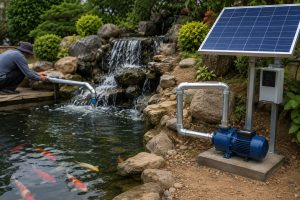
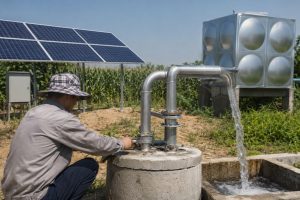
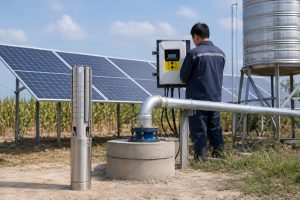
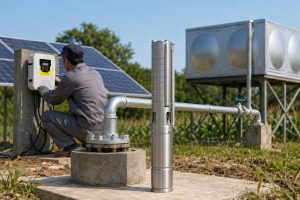
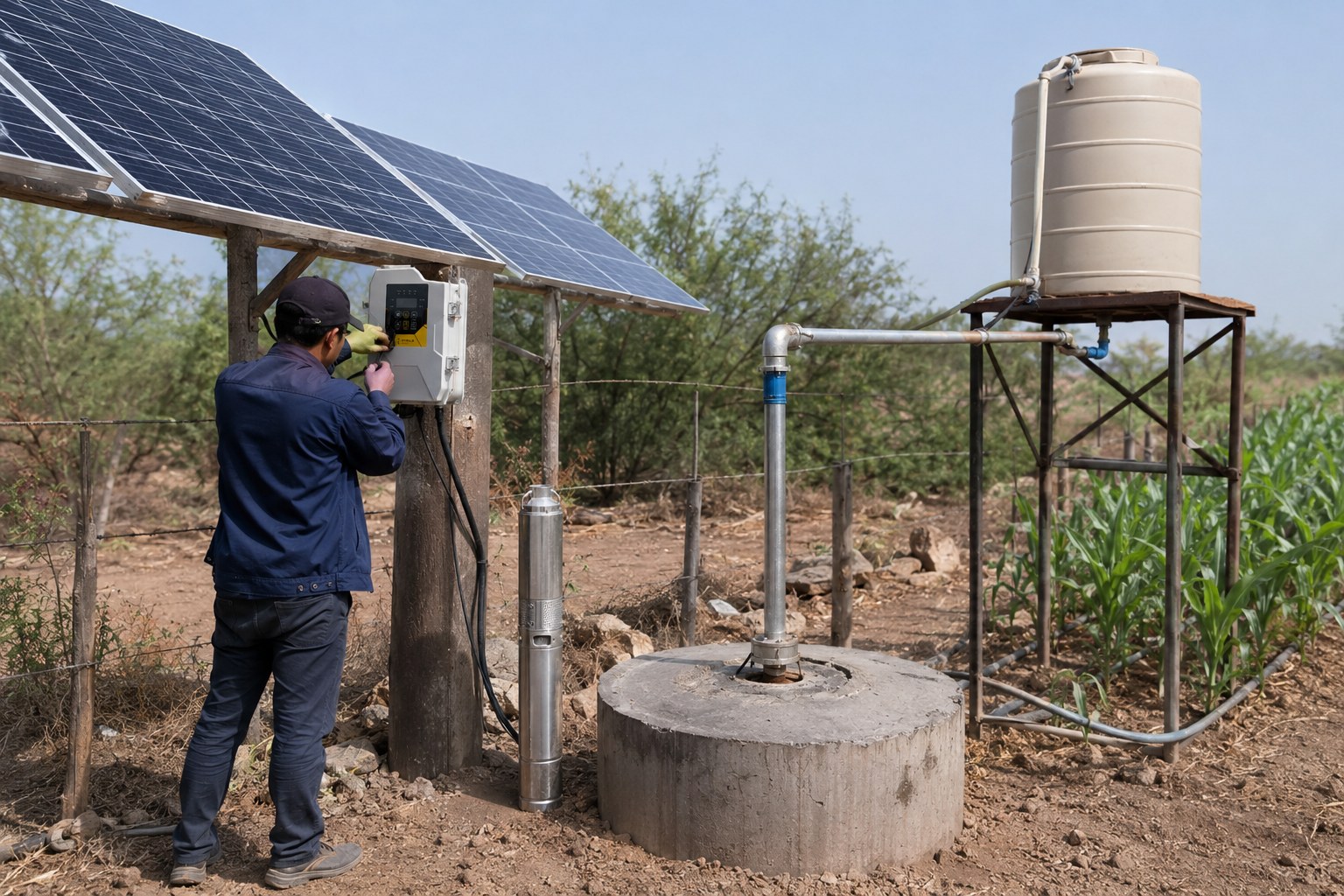
Solar pumps convert sunlight directly into electricity using photovoltaic (PV) panels.
This electricity then powers a motor that pumps water from a source like a deep well, river, or lake for agriculture, livestock, or domestic use.
To truly understand the power of this technology, we need to look at the components that make up a complete solar water pumping system.
Each part plays a crucial role in converting sunlight into a life-sustaining flow of water.
From the panels that capture the sun's rays to the controller that optimizes performance, the system is a model of efficiency.
It’s designed to be robust and operate in the very places where other power sources fail.
The Core Components
A typical solar water pump system isn't just a pump; it's a synergistic collection of parts designed for maximum efficiency and longevity.
-
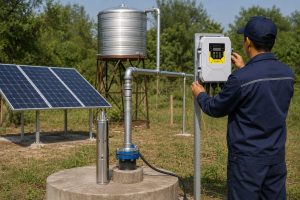
Solar Panels: Also known as the photovoltaic (PV) array, these are the system's power source. They are made of many solar cells that absorb photons from sunlight and convert that light energy into direct current (DC) electricity.
-
Water Pump Motor: This is the heart of the operation, taking the electricity generated by the panels and using it to move water. The motor can be designed for a submersible pump (placed deep inside a well) or a surface pump (for rivers or shallow sources).
-
Pump Controller: This is the brain of the system. The controller manages the electrical power from the panels, ensuring the pump motor receives the correct voltage and current. It often includes crucial protective features and performance optimization technology like Maximum Power Point Tracking (MPPT), which maximizes the power drawn from the solar panels.
-
Inverter (for AC pumps): While many solar pumps use efficient DC motors, some applications may use an alternating current (AC) motor. In this case, an inverter is needed to convert the DC electricity from the panels into AC electricity for the pump.
-
Pipes & Water Tank: Pipes transport the water from its source to its destination, which could be a storage tank, an irrigation system, or a tap. A water tank is often included to store water for use during cloudy periods or at night, ensuring a consistent supply.
The Pumping Process Explained
The process is elegantly simple yet technologically advanced.
- Sunlight (photons) strikes the solar panels.
- The solar cells within the panels absorb this energy, creating a flow of DC electricity.
- This DC electricity is channeled through wires to the pump controller.
- The controller conditions the power and sends it to the pump's motor. An MPPT controller constantly adjusts the electrical load to extract the maximum possible power from the panels as sunlight conditions change throughout the day.
- The energized motor drives the pump, lifting water from the source and pushing it through the pipes to where it's needed.
Here is a comparison of the two main types of solar pump systems:
| Feature | DC System | AC System |
|---|---|---|
| Motor Type | Brushless DC (BLDC) Motor | Standard AC Induction Motor |
| Inverter | Not required | Required (Converts DC to AC) |
| Efficiency | Generally higher system efficiency due to no inverter loss | Slightly lower efficiency due to inverter conversion losses (1-5%) |
| Complexity | Simpler wiring and fewer components | More complex due to the addition of an inverter |
| Common Use | Most dedicated solar pumping systems, especially for off-grid applications | Can be used to power existing AC pumps with solar; useful for larger systems |
Ultimately, the entire system is designed to be a set-and-forget solution.
Once installed, it harnesses the sun's daily cycle to provide water reliably and automatically, without the need for manual intervention or a connection to a distant power plant.
Why Choose Solar Pumps Over Traditional Methods?
Tired of the endless cycle of high fuel costs and unreliable power for your water pump?
There’s a more economical and dependable way to secure your water supply.
Solar pumps provide immense long-term savings by completely eliminating fuel costs.
They are also environmentally friendly, require very little maintenance, and offer a truly reliable water source, especially in remote or off-grid locations.
The choice between a modern solar pump and a traditional fuel-powered pump is a choice between the future and the past.
While the initial investment in a diesel or petrol pump might seem lower, the total cost of ownership quickly skyrockets.
Fuel costs, regular maintenance, and the logistical challenge of transporting fuel to remote sites add up to a significant and ongoing expense.
Solar pumps, on the other hand, represent a forward-thinking investment in sustainability and independence.
Let's break down the tangible benefits that make solar the superior choice.
Economic Advantage
The financial case for solar pumps is compelling.
While the initial setup cost was once a barrier, the price of photovoltaic (PV) panels has dropped by over 80% in the last decade.
This has made the upfront investment for a solar pumping system competitive with, and often superior to, diesel alternatives when viewed over the system's lifespan.
The primary economic benefit is the elimination of operating expenses.
The sun provides the energy for free.
- Zero Fuel Costs: A diesel pump requires a constant supply of expensive and often price-volatile fuel. A solar pump runs on free sunlight.
- Low Maintenance: Solar pumps have very few moving parts compared to internal combustion engines. There are no oil changes, filter replacements, or engine rebuilds. This drastically reduces maintenance costs and downtime.
- Long Lifespan: Solar panels are incredibly durable, typically warrantied for 20-25 years of performance. The pump motors, especially high-quality brushless DC models, are designed for years of maintenance-free operation.
Let's look at a simplified cost comparison over 5 years for a medium-sized agricultural pump.
| Cost Factor | Diesel Pump System | Solar Pump System |
|---|---|---|
| Initial Investment | $3,000 | $5,500 |
| Annual Fuel Cost (avg. 4hrs/day) | ~$4,380 | $0 |
| Annual Maintenance | ~$500 | ~$50 |
| Total 5-Year Cost | $27,400 | $5,750 |
Note: Costs are illustrative estimates and will vary based on location, pump size, and fuel prices.
The data clearly shows that the initial investment in a solar system is quickly recouped, often within the first two years, leading to decades of nearly free water pumping.
Environmental and Social Impact
Beyond the economics, solar pumps deliver profound benefits to the environment and communities.
In many developing regions, the alternative to solar is not just diesel but also labor-intensive and environmentally damaging practices.
This includes reliance on fuelwood and charcoal, which leads to deforestation.
It also includes the grueling physical labor of fetching water with buckets, a task that disproportionately falls on women and children, robbing them of time for education and other productive activities.
Solar pumps provide a clean, silent, and automated solution.
They produce no greenhouse gases or toxic emissions during operation, improving local air quality and combating climate change.
By providing easy access to water, they improve community wellness, increase food security by enabling reliable irrigation, and empower individuals by freeing up valuable time.
Which Solar Deep Well Pump is Right for You?
Choosing the wrong solar pump can lead to wasted money, inadequate water supply, and frustrating performance.
How do you navigate the options to pick the perfect one for your well?
The right solar pump is determined by your specific needs for well depth (head) and water volume (flow).
Screw pumps excel in deep wells with low flow, while impeller pumps are built for higher flow rates at more moderate depths.
The world of solar deep well pumps offers a specialized portfolio of solutions.
Understanding the fundamental differences between the main pump types is the key to matching the technology to your application.
Whether you're providing drinking water for a single home, watering livestock on a vast ranch, or irrigating crops, there is a pump designed for the job.
The three most competitive and popular options are the solar screw pump, the plastic impeller pump, and the stainless steel impeller pump.
Let's examine each one.
The Workhorse: Solar Screw Pumps (Low Flow, High Head)
This type of pump is a progressing cavity pump.
It uses a single helical rotor (the screw) that turns inside a flexible rubber stator.
As the screw rotates, it creates sealed cavities of water that are pushed progressively up towards the surface.
This mechanism is incredibly effective at creating high pressure, allowing it to lift water from very deep wells.
- Primary Application: Deep well domestic water supply, livestock drinking water in arid regions, and small-scale, high-pressure irrigation. They are ideal for the electricity-scarce regions of Africa and Latin America where wells can be hundreds of feet deep.
- Advantages: Its biggest advantage is the ability to generate high head (lift) from great depths. It is also highly resistant to sand and sediment, which would quickly destroy other pump types.
- Limitations: The trade-off for high head is a relatively low flow rate. This makes it less suitable for applications requiring large volumes of water quickly, like flood irrigation for large farms.
| Feature | Specification |
|---|---|
| Mechanism | Progressing Cavity (Screw & Stator) |
| Best For | Very Deep Wells (>200 ft / 60m) |
| Flow Rate | Low |
| Head (Lift) | Very High |
| Sand Resistance | Excellent |
The Sprinter: Solar Plastic Impeller Pumps (High Flow, Wear-Resistant)
This is a multi-stage centrifugal pump.
It uses a series of stacked impellers (think of them as spinning disks with vanes) to add energy to the water.
Each stage adds more pressure, and the combination of multiple stages allows it to achieve a good balance of flow and head.
The use of engineered, wear-resistant plastic for the impellers makes them lightweight and economical.
- Primary Application: Farm irrigation, pasture water supply, and filling large storage tanks for homes or communities. They are widely used in the Americas and parts of Africa for agricultural purposes.
- Advantages: Their main strength is delivering a high volume of water. They offer excellent resistance to fine sand, are significantly lighter than their stainless steel counterparts, and provide a fantastic balance of performance and cost.
- Limitations: While durable, the plastic impellers may not be the best choice for highly abrasive (coarse sand) or corrosive water conditions. Their head is generally medium, making them less suitable for extremely deep wells.
| Feature | Specification |
|---|---|
| Mechanism | Multi-stage Centrifugal (Stacked Impellers) |
| Best For | Medium Depth Wells with High Water Demand |
| Flow Rate | High |
| Head (Lift) | Medium |
| Sand Resistance | Good (for fine sand) |
The Specialist: Solar Stainless Steel Impeller Pumps (Premium, Corrosion-Resistant)
This pump operates on the same centrifugal principle as the plastic impeller model but with a crucial material upgrade.
Both the impellers and the pump housing are constructed from SS304 or higher-grade stainless steel.
This is specifically for durability and longevity in challenging water environments.
- Primary Application: Water supplies with acidic or alkaline properties, such as in alkaline soil regions in Australia or parts of the Americas. They are also the top choice for high-end homes and ranches where reliability and water purity are paramount.
- Advantages: Unmatched corrosion resistance ensures a long service life even in aggressive water. The material purity also makes it a preferred choice for drinking water systems.
- Limitations: This premium quality comes at a higher cost. The stainless steel construction also makes the pump heavier, which can be a factor during installation.
| Feature | Specification |
|---|---|
| Mechanism | Multi-stage Centrifugal (Stacked Impellers) |
| Best For | Corrosive Water, High-Reliability Needs |
| Flow Rate | High |
| Head (Lift) | Medium to High |
| Corrosion Resistance | Excellent |
The Unsung Hero: Why the Motor Matters Most
Are you focusing only on the pump itself?
You might be overlooking the single most important component for determining efficiency and long-term savings.
The BLDC (Brushless DC) permanent magnet motor is the powerful, efficient heart of a modern solar pump.
Its incredible efficiency, often exceeding 90%, means you get more water for your money by requiring fewer solar panels.
While the pump type (screw or impeller) determines how the water is moved, the motor determines how efficiently that work is done.
The choice of motor has a massive ripple effect across the entire system's performance, cost, and reliability.
All three of the pump types we've discussed are at their best when driven by a high-efficiency BLDC permanent magnet motor.
This advanced technology is what elevates a good pump system to a great one.
What is a BLDC Motor?
A Brushless DC (BLDC) motor is a significant upgrade from older motor technologies.
Unlike traditional brushed motors that use physical carbon brushes to transfer power—which wear out and create friction—a BLDC motor uses an electronic controller.
The rotor of the motor is made with powerful permanent magnets (often high-grade 40SH Neodymium Iron Boron).
The electronic controller precisely energizes the stator windings in a sequence that "pulls" the magnetic rotor around, creating rotation without any physical contact or wear.
This design offers a host of technical advantages:
- Extremely High Efficiency: With no energy lost to friction from brushes, BLDC motors can achieve efficiencies over 90%. A standard brushed DC motor might be 75-80% efficient, and a typical AC motor can be even lower.
- High Torque: They produce consistent torque across a wide range of speeds, which is crucial for starting a pump under load, even in low sunlight.
- Compact & Lightweight: A BLDC motor can be up to 47% smaller and 39% lighter than a traditional motor producing the same power output.
- Long & Maintenance-Free Lifespan: The absence of brushes to wear out means the motor can run for tens of thousands of hours with virtually no maintenance.
The Real-World Value of High Efficiency
The high efficiency of a BLDC motor isn't just a technical specification; it translates directly into tangible benefits and cost savings for the user.
A more efficient motor requires less power to do the same amount of work.
When your power source is a fixed number of solar panels, this efficiency is everything.
| Motor Feature | Practical Benefit for the User |
|---|---|
| Efficiency > 90% | Requires up to 25% fewer solar panels to pump the same amount of water, significantly lowering the initial system cost. |
| High Starting Torque | The pump starts earlier in the morning and works later in the afternoon, increasing the total daily water output. |
| Compact & Lightweight Design | Reduces shipping costs and makes installation easier and safer, often a one-person job. |
| Maintenance-Free Operation | Eliminates the cost and downtime associated with replacing brushes, ensuring reliable, long-term operation. |
In essence, investing in a pump with a high-quality BLDC motor is one of the smartest decisions you can make.
It's the core technology that reduces the overall cost of the system while simultaneously improving its performance and reliability.
What About Cloudy Days and Nighttime Pumping?
Does your water supply have to come to a halt the moment the sun goes down or disappears behind a cloud?
Your pump's limitations shouldn't hold back your access to water.
Modern solar pump systems can incorporate hybrid controllers.
These smart devices allow the system to automatically switch to an AC power source, like the grid or a generator, when solar energy is insufficient, guaranteeing a 24/7 water supply.
The most common concern about solar power is its intermittency.
What happens when you need water, but the sun isn't cooperating?
Historically, the answer was to oversize your system and add a large, expensive battery bank to store energy.
While batteries are an option, they add complexity, cost, and maintenance.
Fortunately, a much more elegant and cost-effective solution has emerged: the AC/DC hybrid solar pump system.
The Limits of Battery Storage
For years, batteries were the default solution for off-grid power storage.
However, for a high-power application like a water pump, a battery bank comes with significant drawbacks.
- High Cost: A battery bank large enough to run a pump for several hours can easily double the initial cost of the system.
- Maintenance: Lead-acid batteries require regular maintenance, and all batteries have a limited lifespan, needing replacement every 5-10 years.
- Inefficiency: The process of charging and discharging a battery results in energy loss, typically around 15-20%.
For these reasons, many users are seeking a more direct and reliable backup solution.
The Smarter Solution: Hybrid AC/DC Controllers
This is where true innovation shines.
A hybrid AC/DC controller is designed with two power inputs: one for the DC power from your solar panels and another for AC power from the grid or a portable generator.
The intelligent controller constantly monitors the power coming from the solar panels.
- Priority on Solar: As long as the sun is providing sufficient power, the controller will use 100% free solar energy to run the pump. The AC input remains on standby.
- Automatic Switchover: If the solar power drops below the level needed to run the pump (due to heavy clouds or at night), the controller instantly and automatically switches to the AC power source. There is no interruption in your water supply.
- Hybrid Functionality: The most advanced controllers offer a true hybrid function. If the solar panels are producing some power, but not quite enough (e.g., on an overcast day), the controller can blend the available solar power with a small amount of AC power. This maximizes your use of free solar energy and only draws the minimum necessary from the AC source, keeping running costs as low as possible.
This technology provides the best of both worlds: the cost-free, eco-friendly operation of solar during the day, and the unwavering reliability of AC power as a seamless backup whenever needed.
It ensures you have worry-free water access 24 hours a day, 365 days a year, without the expense and hassle of a large battery bank.
Conclusion
Modern solar pumps, powered by efficient motors and smart controllers, offer a reliable, cost-effective, and sustainable water solution for nearly any off-grid or remote application worldwide.
FAQs
How long do solar water pumps last?
A quality solar pump system is a long-term investment.
The solar panels are typically warrantied for 25 years, and a brushless motor pump can operate for 10+ years with minimal maintenance.
Can solar pumps work on cloudy days?
Yes, they can operate at a reduced flow on overcast days.
Systems with hybrid AC/DC controllers can automatically switch to grid or generator power to ensure a consistent water supply.
Do I need batteries for a solar pump?
No, batteries are not necessary for most systems.
It is more efficient and cost-effective to pump water into a storage tank during sunny hours or use a hybrid AC/DC controller.
Are solar water pumps expensive?
The initial investment is higher than a diesel pump, but with zero fuel costs, they pay for themselves within 2-3 years.
The long-term cost of ownership is significantly lower.
How deep can a solar pump pull water from?
This depends on the pump type.
Solar screw pumps are designed for very deep wells and can lift water from over 500 feet (150 meters) or more.
What maintenance do solar pumps require?
Maintenance is very low.
You should periodically wipe the solar panels to keep them clean and check for any leaks in the plumbing.
The pump and motor are typically sealed and maintenance-free.
Can a solar pump run a sprinkler system?
Yes, a properly sized pump can provide the pressure and flow needed for sprinklers.
You must match the pump's performance curve to the requirements of your irrigation system.
How many solar panels do I need for a water pump?
This depends on the pump's power rating, your location's sunlight, and daily water needs.
A system can range from one or two panels for a small pump to a large array for agricultural irrigation.