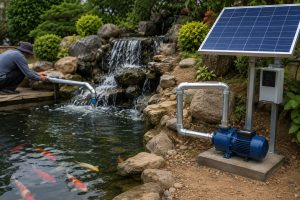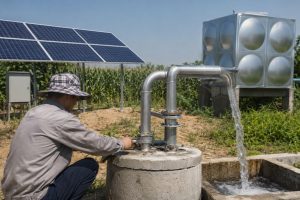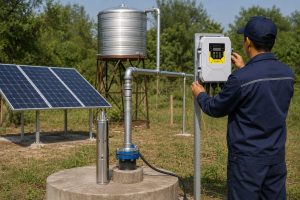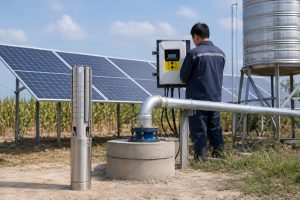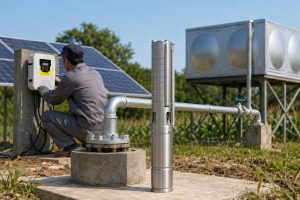
Struggling with unreliable water access in off-grid areas?
The constant need for fuel and electricity for your pump can be expensive and frustrating.
A solar water pump offers a sustainable, cost-effective solution.
A complete solar water pump system can cost anywhere from a few hundred to several thousand dollars.
The price depends heavily on the pump type, motor efficiency, required water flow, and well depth.
Factors like stainless steel construction versus plastic impellers significantly impact the final investment.
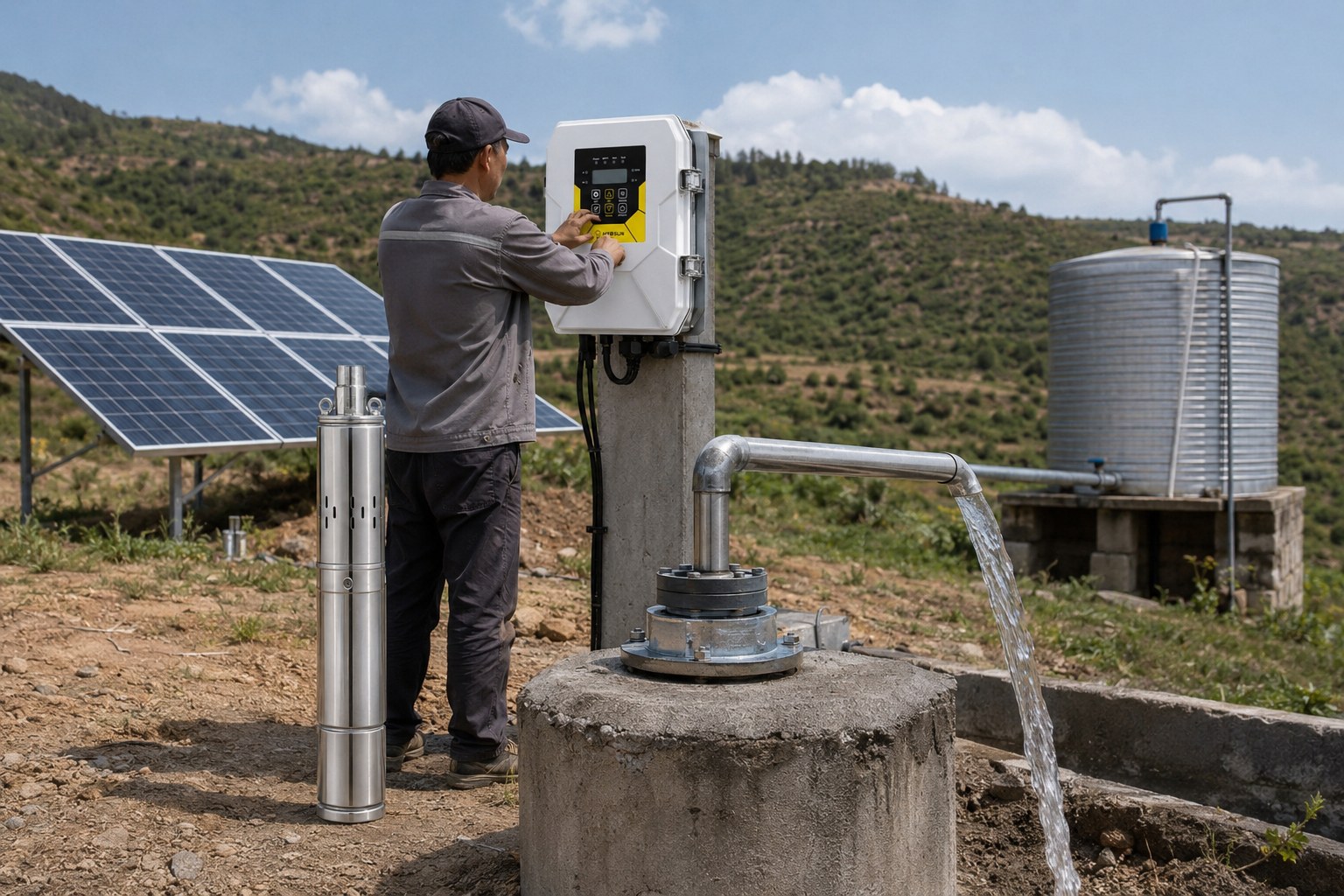
The total cost of a solar water pump is not just the price tag on the pump itself.
It represents a long-term investment in energy independence and reliable water supply.
Understanding the different types of pumps and their core components is crucial to choosing a system that fits both your needs and your budget.
This guide breaks down the key factors that determine the price, helping you make an informed decision.
We will explore the three most popular types of solar deep well pumps.
Each one is designed for specific applications and environments.
Let's dive into what makes each pump unique and how its features affect the overall cost and performance.
Solar Screw Pump: Low Flow, High Head
Are you trying to get water from a very deep well?
Traditional pumps often struggle to lift water from significant depths, consuming a lot of power.
A solar screw pump provides a powerful, efficient solution for high-head applications.
Solar screw pumps are excellent for deep wells where high pressure is needed more than high volume.
Their design allows them to lift water from great depths efficiently, making them ideal for domestic water supply in remote regions with deep water tables, like parts of Africa and Latin America.
Understanding the Screw Pump Advantage
A solar screw pump, also known as a progressive cavity pump, operates on a simple yet effective principle.
It uses a single helical rotor, typically made of stainless steel, that turns inside a double helical rubber stator.
As the rotor turns, it creates a series of sealed cavities that "progress" from the pump's intake to its outlet.
This action effectively pushes the water upwards with consistent pressure.
Unlike centrifugal pumps that use velocity to move water, the screw pump uses positive displacement.
This means it moves a fixed amount of water with each rotation, making it exceptionally good at building high pressure.
The result is the ability to achieve a very high head, or vertical lift, even with a low flow rate.
For example, a screw pump can lift water over 150 meters, whereas a similarly sized centrifugal pump might struggle to reach half that height.
This makes them the go-to choice for wells where the water level is far below the surface.
Key Applications and Scenarios
The unique characteristics of solar screw pumps make them perfect for specific situations.
They are a lifeline for providing domestic water to homes in areas without a reliable grid.
They are also widely used for livestock watering, where a steady, reliable supply of water is more important than a massive flow rate.
Imagine a remote ranch where cattle need drinking water.
A solar screw pump can reliably fill troughs day after day, powered only by the sun.
They are also suitable for small-scale irrigation, especially for drip systems that require consistent pressure but not a high volume of water.
Performance Comparison
To better understand where the screw pump fits, let's compare its performance metrics.
| Pump Type | Typical Flow Rate (Liters/Hour) | Typical Head (Meters) | Best For |
|---|---|---|---|
| Solar Screw Pump | 500 - 2,000 | 80 - 200+ | Deep wells, high lift |
| Plastic Impeller Pump | 3,000 - 10,000 | 30 - 100 | High volume, shallow wells |
| SS Impeller Pump | 3,000 - 10,000 | 40 - 120 | High volume, corrosive water |
Advantages and Limitations
One of the biggest advantages of a solar screw pump is its incredible resistance to sand and grit.
The rubber stator and steel screw can handle abrasive particles much better than the tight-tolerance impellers of a centrifugal pump.
This durability is essential in areas where well water is not perfectly clean.
They are true workhorses for harsh water conditions.
However, their main limitation is the flow rate.
They are not designed to move massive volumes of water quickly.
Therefore, they are not suitable for large-scale agricultural irrigation that might require flooding a field.
The rubber stator can also wear over time, especially in very abrasive conditions, and may eventually need replacement.
Despite this, their ability to provide water from extreme depths using only solar power makes them an invaluable asset.
Solar Plastic Impeller Pump: High Flow, Wear-Resistant
Need to move a lot of water for your farm or garden?
Low-flow pumps can't keep up with irrigation or livestock demands, leaving your land thirsty.
A solar plastic impeller pump delivers high flow rates, making it an economical and effective solution.
This pump type is a multi-stage centrifugal pump perfect for applications needing high water volume, such as farm irrigation and pasture water supply.
Its durable plastic impellers offer excellent wear resistance against fine sand, making it a popular, lightweight, and cost-effective choice in Africa and the Americas.
The Power of Multi-Stage Centrifugal Design
Solar plastic impeller pumps are a type of multi-stage centrifugal pump.
This design is key to their ability to deliver a high volume of water.
Inside the pump, a series of impellers are stacked along a single shaft.
Each impeller and its corresponding diffuser is called a "stage."
Water enters the first stage, where the spinning impeller throws the water outward, increasing its velocity.
The diffuser then converts this velocity into pressure and directs the water into the eye of the next impeller.
This process repeats through each stage, with the pressure increasing at every step.
By adding more stages, the pump can achieve a higher head, but its primary strength lies in moving a large quantity of water.
The use of engineered plastic for the impellers is a strategic choice.
Modern polymers are incredibly durable and offer excellent resistance to abrasion from fine sand, which can quickly wear down metal impellers.
This makes the pump both lightweight and cost-effective without sacrificing performance in many common water conditions.
Ideal Use Cases for High Volume
The high flow rate of these pumps makes them the preferred option for many agricultural applications.
They can supply enough water for sprinkler or flood irrigation on small to medium-sized farms.
They are also perfect for maintaining water levels in ponds or for large-scale livestock operations where many animals need water simultaneously.
For example, a single pump can deliver over 8,000 liters per hour, sufficient to irrigate several acres of crops throughout the day.
Homeowners with large gardens or properties also benefit from this pump type.
It can power a complex irrigation system or quickly fill a large water storage tank.
Its versatility and high output make it a popular general-purpose solar pump.
Performance and Material Comparison
Let's see how the plastic impeller pump stacks up.
| Feature | Solar Plastic Impeller Pump | Solar Stainless Steel Impeller Pump |
|---|---|---|
| Impeller Material | Engineered Plastic (e.g., Noryl) | Stainless Steel (SS304) |
| Best Application | General farming, high-flow needs | Corrosive water, premium domestic use |
| Sand Resistance | Excellent for fine sand | Good, but can wear with abrasives |
| Cost | More economical | Higher initial investment |
| Weight | Lightweight, easier to install | Heavier |
Weighing the Pros and Cons
The most significant advantage of the solar plastic impeller pump is its high water output combined with an economical price point.
It provides a fantastic return on investment for users who need to move a lot of water.
Its lightweight nature also simplifies installation, reducing labor costs and effort.
The excellent resistance to fine sand is another major benefit, extending the pump's operational life in many wells.
However, there are limitations.
In water with high levels of corrosives, such as high acidity or alkalinity, the plastic components may degrade over time.
They are also not the best choice for extremely deep wells that require very high head pressure, as the screw pump is better suited for that task.
For most typical farming and residential applications with moderately deep wells, the solar plastic impeller pump offers an unbeatable combination of performance, durability, and value.
Solar Stainless Steel Impeller Pump: Premium Quality, Corrosion Resistance
Is your water source acidic or alkaline?
Corrosive water can destroy standard pumps, leading to frequent replacements and high long-term costs.
A solar pump with stainless steel impellers offers unmatched durability for harsh water environments.
This premium pump uses SS304 stainless steel for its impellers and pump body, delivering high flow and superior longevity in corrosive water.
It is the ultimate solution for alkaline soils in Australia, acidic water in the Americas, or any high-end application where reliability is non-negotiable.
Why Stainless Steel is the Superior Choice
The heart of this pump's resilience lies in its construction material: SS304 stainless steel.
This grade of stainless steel is renowned for its excellent resistance to a wide range of corrosive agents.
Water is often not pure H2O.
It can contain dissolved minerals and chemicals that make it acidic (low pH) or alkaline (high pH).
These conditions can rapidly eat away at lower-grade metals or even some plastics.
Stainless steel forms a passive, protective layer of chromium oxide on its surface.
This layer self-heals if scratched, preventing rust and corrosion from taking hold.
This makes the pump ideal for challenging water chemistries found across the globe, from the alkaline artesian basins of Australia to areas with industrial or agricultural runoff.
Beyond corrosion resistance, stainless steel provides superior structural integrity and durability.
The impellers can be manufactured with very precise tolerances, which helps maintain high efficiency over the pump's entire lifespan.
They are less susceptible to deformation under high pressure or temperature compared to plastic alternatives.
Niche Markets and High-End Applications
Due to its higher cost, the stainless steel impeller pump targets more specific and demanding markets.
It is the definitive choice for any water source known to be corrosive.
Investing in a corrosion-resistant pump from the start saves money on future replacements and downtime.
This pump is also favored for high-end residential water supply and premium livestock ranches.
In these applications, the absolute reliability and long service life justify the higher initial investment.
Users who want a "fit and forget" solution that will operate flawlessly for years often choose stainless steel.
It provides peace of mind, ensuring a clean and consistent water supply without worry about pump degradation.
Benefits of SS304 vs. Other Materials
The choice of material has a direct impact on performance and longevity.
| Material | Corrosion Resistance | Durability | Typical Lifespan | Cost Factor |
|---|---|---|---|---|
| SS304 Stainless Steel | Excellent | Very High | 10-15+ years | High |
| Engineered Plastic | Good | Good | 5-10 years | Medium |
| Cast Iron | Poor | High | 3-7 years (in corrosive water) | Low |
Is the Higher Cost Justified?
For the right application, the answer is a resounding yes.
The main advantage is its exceptionally long service life.
While the upfront cost can be 20-40% higher than a plastic impeller model, its lifespan can be twice as long in corrosive environments.
This translates to a lower total cost of ownership over the pump's life.
The high reliability also means less maintenance and fewer service calls.
For a remote installation, this is a massive benefit.
The primary limitation is the initial price, which can put it out of reach for budget-conscious projects.
It is also heavier than a plastic pump, which can make installation slightly more challenging.
However, for anyone dealing with aggressive water or simply demanding the best possible quality and longevity, the solar stainless steel impeller pump is an unparalleled investment in water security.
The Core Power: BLDC Permanent Magnet Motors
What truly determines a solar pump's performance?
A great pump body is useless without an efficient motor, leading to wasted solar energy and the need for more panels.
The BLDC permanent magnet motor is the high-efficiency engine that drives modern solar pumps.
All three top-tier solar pumps are powered by a Brushless DC (BLDC) permanent magnet motor.
With an efficiency exceeding 90%, this motor technology is the key to maximizing water output while minimizing the number of solar panels needed, drastically reducing overall system cost.
Unpacking the 90%+ Efficiency
The remarkable efficiency of a BLDC motor comes from its advanced design.
First, it is "brushless."
Traditional DC motors use carbon brushes to transfer power to the rotor, which creates friction, heat, and wear.
By eliminating brushes, BLDC motors reduce energy loss by over 15-20%.
This also makes them virtually maintenance-free.
Second, they use powerful "permanent magnets."
These motors feature a rotor made from high-strength rare-earth magnets, such as 40SH neodymium iron boron.
Unlike standard induction motors that use electricity to create a magnetic field in the rotor, a permanent magnet motor has a constant magnetic field.
This eliminates the energy required to magnetize the rotor, pushing motor efficiency to unprecedented levels—often above 90%.
A conventional AC motor, by contrast, might only achieve 60-75% efficiency.
This 15-30% efficiency gain is a game-changer for solar applications.
Tangible Benefits of Advanced Motor Technology
The high efficiency of a BLDC motor translates directly into real-world advantages.
A more efficient motor can produce the same pumping power using significantly less energy.
This means you can run your pump with a smaller, less expensive solar panel array.
For example, a pump with a 90% efficient BLDC motor might require only three solar panels, while a pump with a 70% efficient motor would need four panels to do the same work.
This can reduce the initial system cost by 25% or more.
The design of BLDC motors also allows them to be more compact and lightweight.
They can be up to 47% smaller and 39% lighter than traditional motors of equivalent power.
This not only simplifies shipping and handling but also makes the pump easier to install, especially in deep wells.
They also deliver high torque at all speeds, which is crucial for starting the pump under load, particularly for positive displacement pumps like the screw pump.
BLDC vs. Traditional Motors
This table highlights the clear superiority of BLDC technology.
| Feature | BLDC Permanent Magnet Motor | Traditional Brushed DC Motor | Standard AC Motor |
|---|---|---|---|
| Efficiency | > 90% | 75-80% | 60-75% |
| Lifespan | Very Long (20,000+ hours) | Short (2,000-5,000 hours) | Long |
| Maintenance | None (no brushes) | Brush replacement needed | Low |
| Size & Weight | Compact & Light | Bulky & Heavy | Bulky & Heavy |
| Control | Excellent speed & torque control | Good | Limited |
How It Reduces Overall System Cost
The strategic role of the BLDC motor cannot be overstated.
It is the core component that determines the overall efficiency and competitiveness of the entire solar pumping system.
By requiring fewer solar panels, it lowers the single most expensive part of the installation.
The maintenance-free design eliminates long-term service costs associated with brush replacement.
Its long service life ensures that the investment pays off for many years.
When you are evaluating the price of a solar water pump, looking at the motor's efficiency is just as important as looking at the pump's flow rate or construction material.
A cheaper pump with an inefficient motor will ultimately cost you more in the long run through higher initial panel costs and lower performance.
Maximizing a System with Intelligent Controllers
How do you get the most out of your solar panels all day long?
Without smart control, a solar pump's performance will fluctuate wildly with the sun, and it won't work on cloudy days.
An intelligent controller with MPPT and hybrid power options ensures optimal performance and 24/7 water access.
Modern solar pump systems use an MPPT controller to maximize energy harvest from the panels.
Advanced controllers also offer an AC/DC hybrid function, allowing the pump to use grid or generator power when sunlight is insufficient, guaranteeing a reliable, round-the-clock water supply.
What is MPPT and Why Do You Need It?
MPPT stands for Maximum Power Point Tracking.
It is a sophisticated electronic function built into the solar pump controller.
The power output of a solar panel changes continuously based on sunlight intensity, temperature, and load.
For any given set of conditions, there is a specific voltage and current combination—the "maximum power point"—at which the panel operates most efficiently.
An MPPT controller constantly monitors the panel's output and adjusts the electrical load of the pump motor to keep the panels operating at this peak efficiency point.
Without MPPT, a pump connected directly to panels might only utilize 60-70% of the available energy.
With MPPT, that figure jumps to over 98%.
This means the pump can start earlier in the morning, run later in the evening, and perform better during overcast conditions.
It effectively squeezes every last drop of energy from your solar array, resulting in more water pumped per day.
This technology is essential for getting the maximum return on your solar panel investment.
The Game-Changer: Hybrid AC/DC Power
The biggest limitation of a purely solar-powered system is that it only works when the sun is shining.
What if you need water at night or during a week of rainy weather?
This is where hybrid AC/DC controllers come in.
These advanced controllers are designed with two power inputs: one for the DC power from your solar panels and another for AC power from the grid or a generator.
The controller's internal logic is programmed to prioritize solar power.
Whenever there is sufficient sunlight, the pump runs entirely on free energy from the sun.
If clouds roll in and solar power drops, the controller can automatically supplement the solar energy with AC power, blending the two sources to maintain pump operation.
When there is no sunlight at all, such as at night, it seamlessly switches over to the AC source.
This ensures you have a worry-free water supply 24 hours a day, 7 days a week, while still maximizing your use of clean, renewable energy.
Power Source Flexibility
A hybrid controller offers unmatched versatility.
| Power Scenario | Controller Action | Water Supply |
|---|---|---|
| Full Sun | Uses 100% DC solar power | Uninterrupted |
| Cloudy / Low Sun | Blends DC solar and AC grid power | Uninterrupted |
| Night / No Sun | Switches to 100% AC grid/generator power | Uninterrupted |
| Grid Outage (Day) | Runs on 100% DC solar power | Uninterrupted |
Ensuring 24/7 Water Access
The combination of a high-efficiency BLDC motor and an intelligent hybrid controller creates a truly robust and resilient water pumping system.
It provides the best of both worlds: the cost savings and environmental benefits of solar power, plus the reliability of grid power.
For critical applications like household water supply or vital livestock operations, this capability is not just a luxury—it's a necessity.
When considering the cost of a solar pump system, factoring in a high-quality controller with these features is a wise investment.
It elevates a simple solar pump into a complete, dependable water management solution that adapts to any condition.
Conclusion
A solar water pump's price is a function of its type, materials, motor, and controller.
Making the right choice depends on balancing your specific needs for flow, head, and water conditions with your budget.
Frequently Asked Questions (FAQs)
How long do solar water pumps last?
A quality solar pump system can last 10-20 years. The brushless motor and stainless-steel components offer exceptional longevity, while solar panels are often warrantied for 25 years.
Can a solar pump work without a battery?
Yes, most modern solar pumps are designed to run directly from solar panels during the day. A water storage tank is often used as a "battery" to store water for use at night.
How many solar panels do I need to run a water pump?
This depends on the pump's power rating and your location. A small domestic pump might need only 2-3 panels, while a large irrigation pump could require 10 or more.
Can solar pumps run at night?
Pumps can run at night if connected to a battery bank or, more commonly, a hybrid controller that can switch to grid or generator power.
What are the disadvantages of a solar water pump?
The primary disadvantages are the high initial investment cost and the dependence on sunlight. However, hybrid controllers and water storage tanks effectively mitigate the second issue.
How deep can a solar pump go?
Solar screw pumps are designed for deep wells and can lift water from depths exceeding 200 meters (over 650 feet), making them suitable for most deep-well applications.
Is a solar pump worth it?
For off-grid locations, a solar pump is absolutely worth it. It eliminates fuel costs and provides a reliable, low-maintenance water source, paying for itself in a few years.
What is the difference between a solar pump and a normal pump?
A solar pump uses a highly efficient DC motor designed to run on solar power. A normal pump typically uses a less efficient AC motor that requires grid electricity.