Struggling to find a reliable water source in an off-grid area?
The constant need for grid power or fuel for your pump is expensive and unreliable, hurting your productivity.
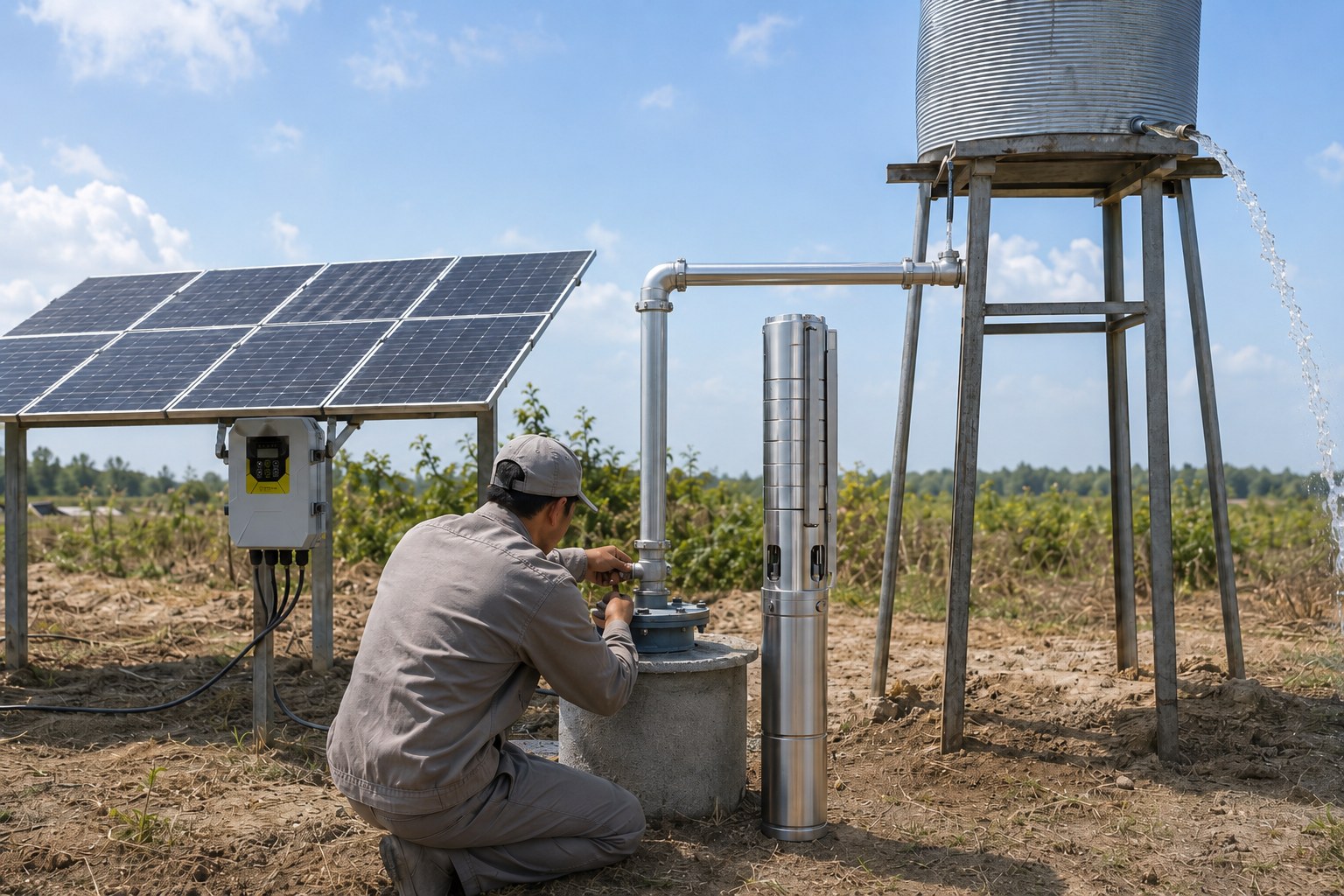
For a standard 1 horsepower (HP) water pump, you will typically need around 1,000 watts (1kW) of solar panels. This could be, for example, three 375-watt panels. However, this number can change significantly based on the pump's type, motor efficiency, and your specific water needs.
Answering "how many panels" isn't a simple one-size-fits-all number.
It's a question of system design.
The type of pump, the efficiency of its motor, and the intelligence of its controller all play a much larger role than most people realize.
Understanding these components is the key to building a truly efficient and cost-effective solar pumping solution that lasts.
Let's explore the factors that determine the right number of panels for your 1 HP pump.
The Simple Answer vs. The Real-World Calculation
Are you confused by conflicting information on solar panel requirements for your pump?
It's frustrating when one source says one thing and another says something completely different, leaving you unsure of what to buy.
A 1 HP pump requires approximately 746 watts to operate. However, due to system inefficiencies, you should plan for a solar array of at least 1,000 watts. The exact number of panels depends on their individual wattage (e.g., three 375W panels or five 200W panels).
The 1,000-watt figure is a great starting point, but it's not the final answer.
It's the baseline before we consider the critical details of your specific application.
Think of it like estimating fuel for a trip.
You can't just know the distance; you also need to know the vehicle's efficiency, the terrain, and the load you're carrying.
Similarly, for a solar pump, the number of panels depends heavily on the type of pump you're running and the job it needs to do.
A more efficient system might achieve the same water output with 15-20% fewer panels, leading to significant cost savings on the initial investment.
Factors Influencing Panel Requirements
The number of panels isn't just about horsepower.
Several other factors are just as important.
- Total Dynamic Head (TDH): This is the total pressure the pump must overcome, including the vertical distance it lifts the water and friction loss in the pipes. A higher head requires more energy, and thus more solar power.
- Desired Flow Rate (GPM/LPM): How much water do you need per day? Pumping more water requires more energy. A 1 HP pump can deliver a wide range of flow rates, from 6,200 to over 38,400 liters per day, depending on the head.
- Peak Sun Hours: This is the number of hours per day your location receives peak sunlight (equivalent to 1000W/m²). A location with only 4 peak sun hours will need a larger solar array than a location with 6 hours to pump the same amount of water.
- Pump & Motor Efficiency: This is a major factor we will discuss in detail. A more efficient system converts more solar energy into water movement, requiring fewer panels.
The table below shows how the required solar array can change based on these variables for a 1 HP pump.
| Pump Efficiency | Total Dynamic Head | Daily Water Needed | Required Solar Array (Approx.) |
|---|---|---|---|
| Standard (60%) | Low (20 meters) | 20,000 Liters | 1000 Watts |
| Standard (60%) | High (45 meters) | 20,000 Liters | 1200 Watts |
| High (85%+) | Low (20 meters) | 20,000 Liters | 850 Watts |
| High (85%+) | High (45 meters) | 20,000 Liters | 1000 Watts |
As you can see, a high-efficiency pump operating at a high head can require the same power as a standard-efficiency pump at a low head.
This demonstrates why just looking at the 1 HP rating is not enough for proper system sizing.
Why Pump Type is the First Thing to Consider
Do you think any 1 HP pump will work with solar panels?
Choosing the wrong type can lead to poor performance, higher costs, and a system that fails to meet your water needs.
The pump's electrical type (AC or DC) and physical type (Submersible or Surface) are critical. DC pumps are inherently more efficient for solar applications, often requiring 10-25% less power than comparable AC pumps. This directly reduces the number of panels needed.
Choosing the right pump type is the first step in designing an efficient solar water system.
It impacts everything from the number of panels you need to the complexity of the installation.
The decision between AC and DC, and submersible and surface, depends entirely on your situation.
You must evaluate your power source, water source depth, and budget to make the best choice.
Getting this right ensures your investment is both effective and economical.
AC vs. DC Pumps: A Matter of Efficiency
The most fundamental choice is between an Alternating Current (AC) pump and a Direct Current (DC) pump.
Solar panels naturally produce DC electricity.
A DC pump can use this power directly, making the system simpler and more efficient.
An AC pump requires an inverter to convert the DC power from the panels into AC power.
This conversion process always involves some energy loss, typically ranging from 10% to 25%.
This means that to get the same 1 HP (746W) of pumping power, an AC system will require a larger solar array to compensate for the inverter's inefficiency.
| Feature | DC Solar Pump System | AC Solar Pump System |
|---|---|---|
| Efficiency | High (No conversion loss) | Lower (Inverter causes 10-25% energy loss) |
| Components | Panels, Controller, DC Pump | Panels, Inverter, AC Pump |
| Complexity | Simpler, fewer components | More complex, requires an inverter |
| Panel Count | Fewer panels needed for the same water output | More panels needed to compensate for inverter loss |
| Use Case | Ideal for new, dedicated solar installations | Good for retrofitting an existing AC pump to run on solar |
Submersible vs. Surface Pumps: It Depends on Your Water Source
The next choice is based on where your water is.
Submersible pumps are designed to be placed deep inside a well or borehole, pushing water up to the surface.
They are necessary when the water level is more than 20 meters (about 65 feet) below the ground.
Surface pumps are placed on the ground and pull water from a shallow source like a pond, a stream, or a shallow well.
They are generally not effective for lifting water from depths greater than 7-8 meters (about 25 feet).
For a 1 HP system, the type of pump affects the "head" or pressure it works against.
Submersible pumps are built to handle higher head pressures, which requires more energy.
Therefore, a 1 HP submersible pump lifting water from 40 meters will require more solar power than a 1 HP surface pump transferring water across a field with minimal lift.
The specifications for a 1 HP pump often list its "Pump Head" range.
For example, a submersible pump might be rated for a 29-46 meter head, while a surface pump might be rated for a 20-meter head.
This rating is crucial for calculating the true power demand and sizing your solar array correctly.
Choosing the Right Pump for Your Water: Flow, Head, and Quality
Is your pump struggling with sand or corrosive water?
Using a standard pump in harsh conditions can cause rapid wear and failure, leading to costly replacements and water shortages.
The pump's internal design—screw, plastic impeller, or stainless steel impeller—is vital for longevity and performance. Each is suited for different conditions: high head (screw), high flow (plastic), or corrosive water (stainless steel), directly impacting system efficiency and reliability.
Beyond the basic types, the specific construction of the pump is what determines its suitability for your unique water source.
A well in an African desert with fine sand requires a completely different pump than a coastal farm in Australia with alkaline water, even if both require a 1 HP motor.
Choosing the right internal mechanism isn't about finding the "best" pump; it's about matching the pump to the job.
This ensures a long service life, maintains high efficiency, and prevents you from overspending on a system that isn't right for your needs.
A properly matched pump will deliver consistent water flow for years, while a mismatched one can fail in months.
Solar Screw Pumps: For Deep Wells and High Head
Solar screw pumps, also known as progressing cavity pumps, are specialists in high-head, low-flow applications.
They use a single helical screw rotor rotating inside a rubber stator.
This action creates sealed cavities that move water steadily up the pump.
Their strength lies in their ability to generate very high pressure, making them perfect for pushing water up from very deep wells.
They are also highly resistant to sand and sediment, which would quickly destroy other pump types.
- Best Application: Deep wells (over 50 meters), livestock watering, and domestic water supply where flow rate is less critical than lift.
- Advantage: Excellent sand resistance and high-head capability.
- Limitation: Lower flow rates compared to centrifugal pumps of the same horsepower.
Solar Plastic Impeller Pumps: For High Flow and General Use
These are multi-stage centrifugal pumps that use a series of durable, wear-resistant plastic impellers.
Each impeller stage adds pressure to the water, making them great all-rounders for medium-head and high-flow applications.
They are an economical and lightweight choice, ideal for farm irrigation, filling reservoirs, and general water transfer where the water isn't excessively deep or corrosive.
Their excellent resistance to fine sand makes them a reliable workhorse in many agricultural settings across Africa and the Americas.
- Best Application: Farm irrigation, pasture water supply, and home gardens from wells of moderate depth (20-50 meters).
- Advantage: High water output, good resistance to fine sand, and cost-effective.
- Limitation: Not ideal for very deep wells or highly corrosive water.
Solar Stainless Steel Impeller Pumps: For Durability in Harsh Water
When water quality is a concern, stainless steel impeller pumps are the premium solution.
The pump body and impellers are made from SS304 stainless steel, providing superior resistance to corrosion from acidic or alkaline water.
They offer high flow rates and are suitable for medium-to-high head applications.
This makes them the top choice for regions with known water quality issues, such as areas with alkaline soil in Australia or certain industrial and high-end residential applications.
- Best Application: Corrosive water conditions, high-end homes, and critical agricultural operations requiring maximum reliability.
- Advantage: Exceptional corrosion resistance and long service life.
- Limitation: Higher initial cost and weight compared to plastic impeller models.
| Pump Type | Best For | Flow Rate | Head (Lift) | Sand Resistance | Corrosion Resistance |
|---|---|---|---|---|---|
| Solar Screw Pump | Deep Wells | Low | Very High | Excellent | Good |
| Plastic Impeller Pump | General Irrigation | High | Medium | Good | Fair |
| Stainless Steel Impeller | Corrosive Water | High | Medium-High | Fair | Excellent |
The Unseen Hero: How Motor Efficiency Reduces Your Panel Count
Are you focused only on the pump and panels?
Ignoring the motor is a costly mistake. An inefficient motor can waste over 30% of your solar energy, forcing you to buy more panels.
The motor is the heart of the system. A high-efficiency Brushless DC (BLDC) permanent magnet motor can be over 90% efficient, compared to 60-70% for standard motors. This means it needs significantly less input power—and fewer solar panels—to produce the same 1 HP of work.
The motor's job is to convert electrical energy from the solar panels into the mechanical energy that drives the pump.
Every watt lost in the motor is a watt you paid for in solar panels that isn't pumping water.
This is where the technological advantage of a BLDC motor becomes a clear financial advantage for the end-user.
Investing in a system with a superior motor is one of the smartest ways to reduce the overall cost and size of your solar array.
It leads to a more compact, lighter, and more reliable system that delivers more water for every dollar spent on panels.
What is a BLDC Permanent Magnet Motor?
A Brushless DC (BLDC) motor is a leap forward in motor technology.
Unlike traditional motors with brushes that wear out, BLDC motors use electronics to switch the motor's phases, resulting in drastically higher efficiency and a much longer lifespan with zero maintenance.
The use of powerful permanent magnets, such as neodymium iron boron, in the rotor creates strong torque in a compact design.
Advanced BLDC motors can be up to 47% smaller and 39% lighter than traditional motors of the same power output.
This not only makes installation easier but also reduces shipping costs for importers and distributors.
The Financial Impact of High Efficiency
Let's look at the numbers.
A 1 HP motor needs to produce 746 Watts of mechanical power.
- A standard motor with 70% efficiency would need 1065 Watts of electrical input (746 / 0.70 = 1065).
- A high-efficiency BLDC motor with 92% efficiency would only need 811 Watts of electrical input (746 / 0.92 = 811).
That's a difference of 254 Watts.
This means you would need at least one extra 300-watt solar panel to power the less efficient motor.
Over the scale of hundreds or thousands of units for a distributor, this difference in required panel wattage represents a massive competitive advantage.
It allows you to offer a more powerful system for the same price, or a same-powered system for a lower price.
The high efficiency of a BLDC motor directly translates to:
- Lower Initial Cost: Fewer solar panels are needed.
- Better Performance: More of the sun's energy is used for pumping water.
- Higher Reliability: Maintenance-free design with a longer operational life.
Intelligent Controllers: Maximizing Every Ray of Sunshine
Is your pump stopping every time a cloud passes over?
Basic solar pump systems are inefficient, failing to adapt to changing sunlight and leaving you without water when you need it.
An intelligent controller with Maximum Power Point Tracking (MPPT) technology is essential. It constantly adjusts the pump's electrical load to extract up to 30% more power from your solar panels, especially during low-light conditions like morning, evening, and cloudy days.
The controller is the brain of your solar pumping system.
Without a smart controller, you are leaving a significant amount of potential energy untapped.
It acts as the bridge between the solar panels and the motor, ensuring they work together in perfect harmony.
Modern controllers do more than just manage power; they provide crucial protections for your pump and offer flexible power options.
Investing in an advanced controller ensures your system is not only efficient but also robust, secure, and capable of delivering water 24/7 if needed.
The Role of the MPPT Controller
Solar panels have a complex relationship between voltage and current that changes with sunlight intensity and temperature.
The "Maximum Power Point" is the sweet spot where the panels produce the most possible power.
An MPPT controller's sole job is to track this moving target in real-time.
By continuously adjusting the electrical parameters, it forces the panels to operate at this peak efficiency point.
This results in a significant boost in the total water pumped per day, especially when the sun is not at its peak.
Furthermore, these controllers provide essential protections that extend the life of your pump motor, including:
- Dry Run Protection: Shuts off the pump if the well runs out of water.
- Over-Current and Over-Voltage Protection: Safeguards the motor from electrical surges.
- High and Low Voltage Protection: Ensures the motor operates within its safe voltage range.
Hybrid AC/DC Systems: 24/7 Water Security
For applications that require water around the clock, regardless of sunshine, a hybrid AC/DC controller is the ultimate solution.
This technology provides two power inputs: one for your solar panels (DC) and one for the grid or a generator (AC).
The controller is smart enough to prioritize solar power.
When the sun is shining, the pump runs entirely on free solar energy.
If clouds reduce the solar input, the controller can blend in just enough AC power to maintain the desired flow, maximizing the use of solar energy.
When there is no sunlight at all, such as at night or during heavy storms, it automatically switches over to the AC source.
This ensures an uninterrupted water supply without the need for a large and expensive battery bank.
For farmers and communities, this means water security and peace of mind, 24 hours a day.
Conclusion
Sizing a 1 HP solar pump system is about more than just a panel count.
It requires a look at the entire system: the pump type, motor efficiency, and controller intelligence.
FAQs
How many watts does a 1hp water pump use?
A 1 HP pump requires 746 watts to run. However, due to system inefficiencies, the solar array needs to provide more power, typically around 1000 watts.
Can a 1hp pump run on solar?
Yes, a 1 HP pump can run very effectively on solar power. It requires a properly sized solar array (around 1000W) and a compatible solar pump controller.
How many solar panels do I need for a 2 hp pump?
For a 2 HP pump, you would typically need to double the solar array to around 2000 watts (2kW). The same principles of pump efficiency and system design apply.
What is the price of a 1hp solar pump system?
The price varies widely based on pump type (AC/DC, Submersible/Surface), technology (VFD, Hybrid), and brand. A complete system can range from basic to premium.
How much water can a 1hp solar pump?
This depends on the pump type and the pumping head. A 1 HP pump can typically deliver between 6,200 and 38,400 liters of water per day.
Do I need batteries for a solar water pump?
Batteries are not required for most solar pumping systems. They can pump water during the day using direct solar power and store the water in a tank for later use.