Struggling with a flooded basement or a parched field?
Choosing the wrong water pump is a frustrating and expensive mistake.
You need a reliable solution.
To choose the right water pump, you must first determine your power source: solar, electric, or gas.
Next, match the pump type (e.g., submersible, screw, centrifugal) to your specific task.
Finally, calculate the required flow rate (GPM) and total pumping height (Total Head Lift) to ensure it's properly sized.
Choosing a water pump can feel overwhelming with all the technical specifications and different models available.
However, the process is straightforward if you break it down into a few key decisions.
This guide will walk you through everything you need to know, from selecting the right power source to calculating the exact size you need for your job.
We will explore the different types of pumps and the advanced motor technology that drives modern, efficient systems.
By the end, you'll be able to select the perfect pump with confidence.
Electric vs. Gas vs. Solar: Which Power Source is Right for You?
Power outages render your electric pump useless right when you might need it most.
Gas pumps are powerful but loud, polluting, and can't be used indoors.
There is a cleaner, quieter, and more reliable way to power your water needs.
The best power source depends on your location and needs.
Electric pumps are ideal for indoor use with reliable grid power.
Gas pumps offer high power and portability for outdoor job sites.
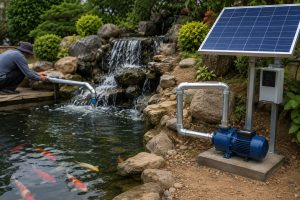
Solar pumps provide eco-friendly, off-grid water solutions, perfect for remote areas.
Choosing your pump's power source is the first and most critical decision.
This choice dictates where you can use the pump, its operating costs, and its environmental impact.
Let's dive deeper into the three main options to help you determine the best fit.
Power Source Showdown
Each power type comes with a distinct set of advantages and disadvantages.
An electric pump is often the default choice for homeowners with a flooded basement, as it can be plugged into a standard wall outlet.
However, its reliance on the grid makes it vulnerable during power outages caused by the very storms that lead to flooding.
Gas pumps, on the other hand, are workhorses for construction sites and remote agricultural tasks.
They offer immense power and total portability.
The trade-offs are significant: they are loud, produce harmful exhaust fumes requiring outdoor use, and demand constant refueling.
Solar power has emerged as a transformative third option.
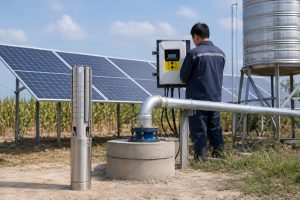
It offers complete energy independence, making it unparalleled for off-grid homes, remote livestock watering, and irrigation in developing regions.
With zero emissions and minimal operating costs after installation, it's the most sustainable choice.
The table below offers a clear comparison.
| Feature | Electric Pump | Gas Pump | Solar Pump |
|---|---|---|---|
| Ideal Location | Indoors, near an outlet | Outdoors, open spaces | Anywhere with sunlight |
| Portability | Limited by cord length | High | High (no fuel needed) |
| Noise Level | Low | Very High | Virtually Silent |
| Emissions | None at site | High (CO, NOx) | Zero |
| Operating Cost | Moderate (electricity bill) | High (fuel & maintenance) | Very Low (free energy) |
| Upfront Cost | Low | Moderate | High |
The Rise of Smart Solar and Hybrid Systems
Modern solar pump systems are far more advanced than their predecessors.
The key is the integration of high-efficiency motors and intelligent controllers.
Many systems now feature Brushless DC (BLDC) motors with efficiencies exceeding 90%.
This is a massive leap from older motor types, which often wasted 20-30% of energy as heat.
This high efficiency directly translates to needing fewer solar panels, reducing the initial system cost by as much as 30%.
Furthermore, the development of AC/DC hybrid controllers has solved solar's primary limitation: nighttime.
These smart controllers can be connected to both solar panels and an AC power source (like the grid or a generator) simultaneously.
The system prioritizes solar power automatically.
When sunlight is insufficient, it seamlessly blends in or switches completely to AC power, ensuring you have a reliable water supply 24 hours a day.
This makes solar a viable and worry-free option for critical applications, not just a daytime convenience.
What Size Water Pump Do I Need?
You bought a pump, but it's barely trickling water out.
Or worse, it's so powerful it's stressing your pipes and wasting energy.
Sizing a pump correctly is crucial, but the technical jargon like GPM and "head" can be confusing.
To size a pump, calculate your required Gallons Per Minute (GPM) for flow.
Then, measure the Suction Head (vertical distance from water to pump) and the Total Head Lift (total vertical height from water source to the final discharge point).
A pump that is too small won't get the job done, and one that is too large will waste money and electricity, and can even damage itself or your plumbing system through excessive pressure.
To ensure your pump performs as expected, you must understand three fundamental specifications.
Getting these calculations right is the key to an efficient and effective water-moving system.
Let's break down each one.
Calculating Your Flow Rate: Gallons Per Minute (GPM)
GPM measures how much water volume a pump can move in one minute.
The GPM you need is determined by your specific application.
Are you trying to drain a large area quickly, or do you just need a steady trickle for livestock?
To calculate it, you need to know the volume of water and the time you want to take to move it.
Formula: GPM = Total Gallons / Time in Minutes
-
Example: Draining a Flooded Basement
If your basement is 20 feet by 30 feet and has 1 foot of water, you have approximately 4,500 gallons to move (20 * 30 * 1 * 7.48).
If you want to clear it in 3 hours (180 minutes), you need a pump rated for at least 25 GPM (4500 / 180). -
Example: Irrigation
For irrigating a field, you might calculate needs based on the number of sprinklers.
If you have 10 sprinkler heads that each require 3 GPM, you'll need a pump that can deliver at least 30 GPM.
Understanding Head and Lift
"Head" is the term used to describe the vertical height a pump can move water against gravity.
This is arguably the most important factor in sizing your pump.
-
Suction Head (SH): This is the vertical distance from the surface of the water source up to the pump's inlet.
For a submersible pump, this is zero.
For a pump placed above a well or pond, this is a critical measurement. -
Total Head Lift (THL): This is the total vertical distance from the water source to the final discharge point.
It is the ultimate measure of a pump's power.
It also must account for friction loss from pipes.
The Golden Rule: Don't Forget Friction Loss
Water rubbing against the inside of a pipe creates friction, which the pump has to overcome.
This is called friction loss, and it adds to your Total Head Lift.
A longer pipe or a narrower pipe will create more friction.
A simple rule of thumb is that for every 10 feet of horizontal pipe run, you add 1 foot of "head."
Formula: Total Head Lift = (Vertical Height from Water to Discharge) + (Total Pipe Length / 10)
-
Example: You are pumping water from a basement.
The pump sits on the floor.
The discharge hose goes up 10 feet to a window and then runs 50 feet across the lawn.- Vertical Height = 10 feet
- Friction Loss = 50 feet / 10 = 5 feet
- Total Head Lift = 10 + 5 = 15 feet
You must buy a pump rated for your required GPM (e.g., 25 GPM) at your calculated THL (15 feet).
And always remember the pro tip: Never use an inlet hose that is smaller than the pump's inlet port.
Doing so chokes the pump, drastically reduces performance, and can cause a destructive process called cavitation, which will quickly ruin the internal components.
Which Type of Solar Pump is Best for My Well?
Not all wells are the same.
A pump that works perfectly in a shallow, clean well will fail quickly in a deep, sandy, or corrosive one.
Using the wrong pump type leads to clogs, burnout, and repeated costly replacements.
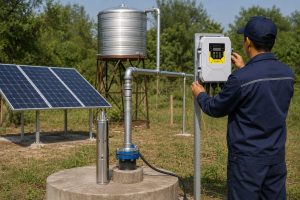
For deep wells (over 150m) needing high lift but low flow, a solar screw pump is best.
For high-volume irrigation from shallower wells, a wear-resistant solar plastic impeller pump is ideal.
For water with high mineral or acid content, a solar stainless steel impeller pump is essential for long-term durability.
The global demand for reliable, off-grid water has led to specialized solar pumps designed for specific well conditions.
The three most popular and effective types are the solar screw pump, the solar plastic impeller pump, and the solar stainless steel impeller pump.
Each is powered by the same ultra-efficient motor technology but is built to handle vastly different challenges.
Choosing the right one is the key to a long-lasting and effective water system.
The Workhorse: Solar Screw Pump
This pump is the specialist for deep wells.
It uses a simple, robust design: a single rotating stainless steel screw (rotor) inside a rubber housing (stator).
As the screw turns, it creates sealed cavities that move water upward.
This mechanism is like an Archimedes' screw, pushing water through compression.
-
Profile: Low Flow, High Head.
It doesn't move a massive volume of water, but it can push that water from extreme depths, often exceeding 200 meters (650 feet).
A typical spec might be 5 GPM at a 400-foot head. -
Key Advantage: Sand Resistance.
The screw design can handle water with a significant amount of sand and grit without clogging or rapid wear, often tolerating sand content up to 5%.
This makes it ideal for newly drilled or unstable boreholes. -
Best Applications: Domestic water supply for homes, livestock drinking troughs, and small-scale drip irrigation, especially in arid regions of Africa and Latin America where wells must be drilled deep to reach the water table.
The Sprinter: Solar Plastic Impeller Pump
This is a multi-stage centrifugal pump and the most common type for general-purpose use.
It uses a series of stacked impellers that spin at high speed, flinging water outwards and upwards from one stage to the next.
The impellers are made of high-strength, engineered plastic.
-
Profile: High Flow, Medium Head.
This pump is designed to move a lot of water but to a more moderate height, typically up to 100-150 meters (300-500 feet).
A sample spec could be 30 GPM at a 150-foot head. -
Key Advantage: Cost-Effectiveness and Wear Resistance.
Plastic impellers are lightweight, economical to produce, and surprisingly resistant to abrasion from fine sand.
This makes the pump an excellent value choice for many applications. -
Best Applications: Farm irrigation, pasture water management, and larger home or community water systems where high output is needed.
It's a popular choice in the Americas and Africa for agricultural development.
However, its plastic components may degrade in highly corrosive water or under the extreme pressures of very deep wells.
The Tank: Solar Stainless Steel Impeller Pump
This pump is a premium, heavy-duty version of the centrifugal pump.
Its internal components, including the impellers, diffusers, and pump body, are constructed from SS304 or even higher-grade stainless steel.
-
Profile: High Flow, Medium-to-High Head.
It offers similar flow characteristics to the plastic impeller version but with greater durability and often slightly better performance due to precision engineering. -
Key Advantage: Corrosion Resistance.
This is its defining feature.
It is built specifically to survive in water that would destroy other pumps, such as water with a low pH (acidic) or high pH (alkaline), or high salinity. -
Best Applications: Wells in regions with naturally corrosive groundwater, such as in alkaline soil areas of Australia or certain coastal and geothermal regions.
It is also the go-to choice for high-end residential, commercial, or industrial applications where reliability and longevity are paramount, and the higher initial cost (often 20-30% more) is a worthy investment.
| Pump Type | Flow/Head Profile | Sand Resistance | Corrosion Resistance | Best For |
|---|---|---|---|---|
| Solar Screw | Low Flow / High Head | Excellent | Good | Deep domestic wells (>150m) |
| Plastic Impeller | High Flow / Medium Head | Good (Fine Sand) | Poor | Farm irrigation, shallow wells |
| Stainless Steel Impeller | High Flow / Medium Head | Fair | Excellent | Corrosive water, premium use |
What is a BLDC Motor and Why Does It Matter?
You see "BLDC Motor" listed on the spec sheet, but it just seems like another technical acronym.
You might be tempted to ignore this detail.
Doing so could mean you end up overpaying for solar panels and are stuck with a less reliable, shorter-lived pump.
A BLDC (Brushless DC) motor is the highly efficient engine of a modern solar pump.
Its superior efficiency (often over 90%) means it requires up to 30% fewer solar panels to do the same job, saving you money and simplifying installation.
The pump itself—whether it's a screw or centrifugal type—is only half of the system.
The motor that drives it is the other half, and it's the component that determines the system's overall efficiency, reliability, and lifespan.
The shift to Brushless DC (BLDC) permanent magnet motors has been the single biggest technological leap in solar pumping, making the entire proposition more affordable and effective.
The 90%+ Efficiency Advantage
Efficiency is a measure of how well a motor converts electrical energy into mechanical rotating power.
Wasted energy is lost as heat.
-
Traditional Brushed DC Motors: These have a typical efficiency of 75-80%.
This means for every 100 watts of power from your solar panels, 20-25 watts are wasted. -
BLDC Motors: These routinely achieve efficiencies of over 90%.
In the best models, this can reach 92-94%.
That means only 6-8 watts are wasted for every 100 watts of input.
This 15-20% improvement in efficiency has a direct and powerful impact.
It means a 500-watt pump with a BLDC motor can do the same amount of work as a 600-watt pump with an older motor.
This directly reduces the number of solar panels you need to buy and install, lowering the entire system's initial cost.
The 'No-Maintenance' Design
The difference between a brushed motor and a brushless one is simple but profound.
Brushed motors use small carbon blocks ("brushes") to make physical contact with the rotating part of the motor to deliver power.
These brushes wear down from friction, create carbon dust, and eventually need to be replaced.
They are a built-in failure point.
BLDC motors deliver power electronically, using a controller.
There are no brushes and no physical contact points to wear out.
This design offers several key benefits:
- Longer Lifespan: A BLDC motor's lifespan can exceed 20,000 hours of operation, compared to 3,000-5,000 hours for many brushed motors.
- No Maintenance: There are no brushes to inspect or replace.
The motor is often permanently sealed, making it truly maintenance-free. - Higher Reliability: With fewer moving parts and no components designed to wear out, the motor is significantly more reliable, which is critical for pumps installed hundreds of feet down a well.
The Real-World Impact: Smaller, Lighter, Stronger
The advanced magnets used in BLDC motors (like Neodymium Iron Boron) are incredibly powerful for their size.
This allows engineers to design motors that are much more compact and lightweight than traditional motors of the same power output.
A modern BLDC pump motor can be up to 47% smaller and 39% lighter than its predecessor.
This isn't just a trivial detail.
A lighter, more compact pump is easier and cheaper to transport, and far easier for a small crew (or a single person) to install in a remote well, reducing labor costs and logistical complexity.
| Feature | BLDC Motor | Brushed DC Motor |
|---|---|---|
| Efficiency | >90% | 75-80% |
| Lifespan | 20,000+ hours | 3,000-5,000 hours |
| Maintenance | None | Brush replacement required |
| Reliability | Very High | Moderate |
| Size & Weight | Compact & Light | Bulky & Heavy |
Conclusion
Choosing the right pump means matching power, size, and type to your job.
Efficient motor technology and smart controls are the key to a modern, reliable water system.
FAQs
How long do solar water pumps last?
A quality system has a long lifespan.
The pump and motor can last 10+ years, while solar panels often have a performance warranty for 25 years.
Can a solar pump work at night?
Not on its own.
It requires a battery storage system or, more commonly, a hybrid AC/DC controller that can switch to grid or generator power.
What size solar panel do I need for a water pump?
This depends on the pump's wattage and local sunlight hours.
A general rule is to have 1.2 to 1.5 times the pump's watt rating in solar panels.
How deep can a solar pump go?
It depends on the pump type.
Standard centrifugal pumps work well to about 150 meters (500 ft), while specialized solar screw pumps can operate deeper than 200 meters (650 ft).
Do solar pumps work on cloudy days?
Yes, but at a reduced flow rate.
An MPPT controller helps maximize power on overcast days, but output will be lower than in full sun.
How much does a solar water pump system cost?
The cost varies greatly, from a few hundred to many thousands of dollars.
It depends on the pump size, well depth, and the number of solar panels required.
What is an MPPT controller?
MPPT (Maximum Power Point Tracking) is an electronic controller that optimizes the match between the solar panels and the pump motor, boosting output by up to 30%.
Can I run a pump directly from a solar panel?
You can, but it is inefficient.
Using an MPPT controller is highly recommended to regulate the voltage and maximize the power transferred from the panels to the pump.