Struggling to find a reliable water source for an off-grid location?
You need a dependable water pump, but grid power is unavailable and fuel costs are skyrocketing.
The best brand of water pressure pump is the one that offers the right technology for your specific needs, focusing on motor efficiency, pump type, and intelligent controls rather than just a name. A portfolio with screw, plastic, and stainless steel impeller options driven by efficient BLDC motors covers most applications.
Choosing the right pump system can feel overwhelming.
It's not about a single "best" brand.
It's about understanding the core components that make a pump system efficient, durable, and cost-effective.
This guide breaks down the different types of solar pumps, the motors that power them, and the controllers that make them smart.
By understanding this, you can build a flexible product offering that meets diverse customer needs, from remote homes in Africa to large ranches in Australia.
Let's explore the technologies that truly define a superior water pump system.
Solar Water Pumping: A Practical Introduction
Are you looking for a water solution beyond the reach of power lines?
Solar-powered pumps offer a fantastic alternative to fuel-burning engines and windmills, providing water when it's needed most.
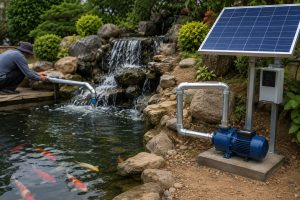
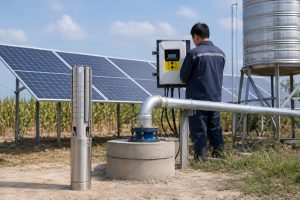
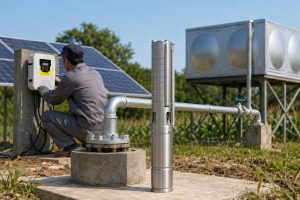
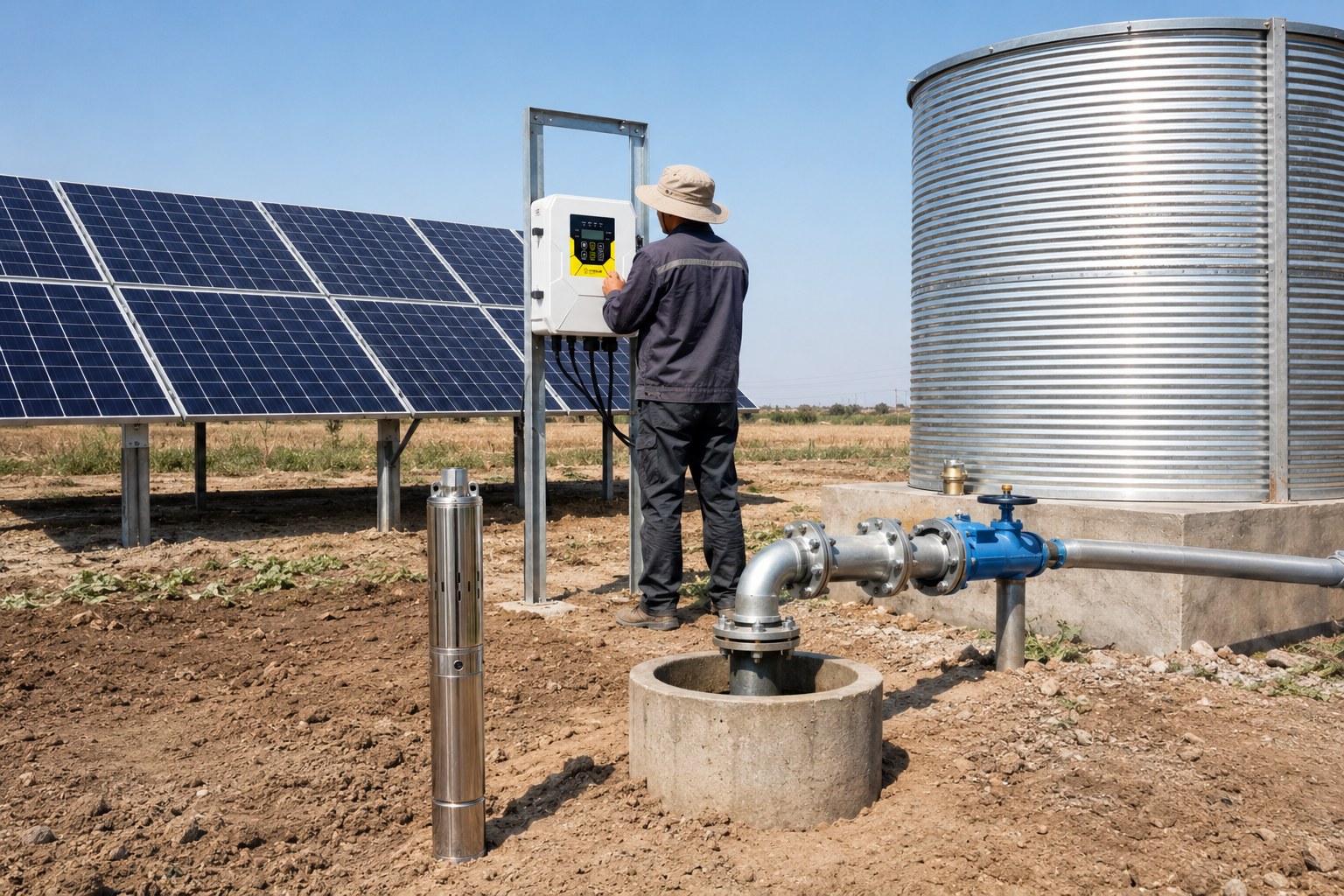
Solar water pumping works by using photovoltaic (PV) panels to generate DC electricity, which powers a specially designed pump. A controller optimizes the power, allowing the pump to function even in low light, making it a reliable, long-lasting, and low-maintenance water solution.
The Core Components of a Solar Pumping System
A solar water pumping system is more than just a pump.
It's an integrated solution designed for reliability and efficiency.
Understanding each part helps you select the right system for any application.
-
Photovoltaic (PV) Modules: These are the solar panels. They convert sunlight directly into DC electricity. They have no moving parts and are incredibly reliable. Most top-tier manufacturers offer a 25-year power output warranty, with an expected lifespan of over 30 years.
-
The Solar Water Pump: These pumps are engineered to run on DC power from the panels. They must be able to operate efficiently across a wide range of power levels, from the bright sun of midday to the low light of a cloudy afternoon. We will explore the different types, like submersible and surface pumps, in more detail.
-
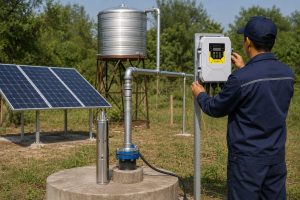
The Pump Controller: This device is the brain of the system. It acts like an automatic transmission, managing the power flow from the panels to the pump. It helps the pump start in low light and protects it from stalling. Advanced controllers, like those with Maximum Power Point Tracking (MPPT), can boost water output by up to 30% by constantly optimizing the electrical load.
Storage: Water vs. Batteries
Storing energy is crucial for a consistent water supply.
You have two main options: storing water or storing electricity.
Water Storage: This is the simplest and most cost-effective method.
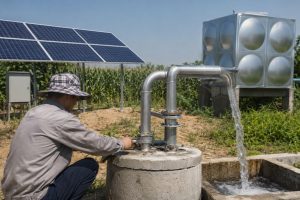
The solar pump fills an elevated storage tank during sunny hours.
The water is then distributed by gravity whenever it's needed.
A simple float switch in the tank can automatically turn the pump off when the tank is full, preventing overflow and saving energy.
A system might require three to ten days of water storage, depending on the local climate and daily water usage.
Battery Storage: In some cases, batteries are used to store electrical energy.
This allows the pump to run at night or during extended cloudy periods.
However, batteries add significant cost, complexity, and maintenance requirements to the system.
With the cost of solar panels decreasing by over 70% in the last decade, it's often more economical to add more panels and store water in a larger tank rather than investing in a battery bank.
| Storage Method | Cost | Complexity | Maintenance | Best For |
|---|---|---|---|---|
| Water Tank | Low | Low | Very Low | Most applications, especially agriculture and livestock. |
| Battery Bank | High | High | Moderate | Pressurized systems or when a tank is not feasible. |
How deep can a solar pump work?
Is your well too deep for a standard pump?
You're concerned that a solar pump won't have the power to lift water from the necessary depth.
High-quality solar pump systems can handle a total pump head of up to 1,000 feet (over 300 meters). However, "total head" is different from how deep the pump itself can be submerged, which is typically around 400 feet (120 meters) for most models.
Understanding Total Pump Head
Choosing the right pump requires understanding a key term: Total Pump Head (TPH).
This isn't just the depth of your well.
It's the total vertical distance the pump must push the water, plus any pressure it needs to create.
Getting this number right is the most critical step in sizing a pump correctly.
How to Calculate Your Total Pump Head
You can calculate your TPH by adding a few key measurements together.
-
Static Water Level: This is the distance from the ground surface down to the top of the water in your well when the pump is off. For example, if your well is 500 feet deep, but the water level sits at 150 feet, your static water level is 150 feet.
-
Elevation Change: If you are pumping water uphill from the wellhead to a storage tank, you must add this vertical distance. If your tank is on a hill 50 feet higher than the well, you add 50 feet to your TPH.
-
Pressure Requirements: If you are pumping directly into a pressure tank, you need to convert the tank's pressure setting into feet of head. The formula is simple: add 2.31 feet of head for every 1 PSI of pressure. Most residential pressure tanks are set to 40-60 PSI. For a 40 PSI tank, you would add approximately 93 feet (40 PSI x 2.31) to your TPH.
Example Calculation:
| Component | Measurement |
|---|---|
| Static Water Level | 200 feet |
| Elevation to Tank | 50 feet |
| Pressure Tank (40 PSI) | 93 feet (40 x 2.31) |
| Total Pump Head | 343 feet |
In this scenario, you would need a pump system sized for at least 343 feet of head.
For wells up to 300 feet deep, many standard 3-inch submersible pumps will work perfectly.
For deeper applications or those requiring more volume, you need to look at specialized deep well models.
For instance, a 3 HP deep well pump can often handle heads exceeding 800 or even 1,000 feet, making them ideal for extremely deep wells found in arid or mountainous regions.
Solar Screw Pump: The Deep Well Specialist
Do you need to pump water from a very deep well, but don't require massive amounts of water?
You may think a high-horsepower pump is your only option, driving up costs.
The solar screw pump is the ideal solution for low-flow, high-head applications. It uses a stainless steel helical rotor within a rubber stator to push water, allowing it to efficiently lift water from depths exceeding 650 feet (200 meters) with minimal solar power.
How a Screw Pump Excels in Tough Conditions
The screw pump, also known as a progressive cavity pump, operates on a unique principle.
It doesn't use impellers to spin water.
Instead, a spiral-shaped stainless steel rotor (the "screw") turns inside a flexible rubber stator.
This action creates sealed cavities that "progress" from the pump's intake to its outlet, pushing the water upward.
This design gives it two major advantages.
Unmatched Head and Sand Resistance
First, it generates very high pressure.
This makes it perfect for deep wells where the pump must overcome hundreds of feet of head.
A small screw pump running on just a few solar panels can often outperform a much larger centrifugal pump in deep well scenarios.
Second, it is highly resistant to sand and sediment.
The rubber stator can flex to allow small particles to pass through without causing significant damage or wear.
In wells with sandy water, a traditional centrifugal pump can be destroyed in a matter of months, while a screw pump can last for years.
This makes it the go-to choice for domestic water, livestock watering, and small-scale drip irrigation in regions with poor water quality, like parts of Africa and Latin America.
Application and Limitations
Screw pumps are the specialists of the solar pumping world.
They are not designed for high-volume applications like flood irrigation for large farms.
Their strength lies in reliability and efficiency under difficult conditions.
| Feature | Screw Pump | Centrifugal Pump |
|---|---|---|
| Best Application | Deep wells, domestic water | Shallow wells, high-volume irrigation |
| Flow Rate | Low (e.g., 1-10 GPM) | High (e.g., 10-100+ GPM) |
| Head Capacity | Very High (up to 1,000 ft) | Moderate (up to 400 ft) |
| Sand Resistance | Excellent | Poor to Fair |
| Primary Markets | Africa, Latin America, Remote Homes | Americas, Asia, Commercial Farms |
For distributors, offering a solar screw pump in your portfolio allows you to serve customers with deep wells or challenging water conditions that other pumps simply cannot handle.
It's a problem-solver product.
Solar Plastic Impeller Pump: The High-Volume Workhorse
Do you need to move a lot of water for your farm, ranch, or large garden?
You're worried about the cost and durability of a pump that can handle high flow rates and fine sand.
The solar plastic impeller pump is an economical, high-flow solution perfect for farm irrigation and livestock water supply. This multi-stage centrifugal pump uses durable, engineered plastic impellers that offer excellent resistance to wear from fine sand, delivering impressive volume at a competitive price.
Balancing Performance and Cost
For many agricultural applications, the goal is to move the maximum amount of water for the lowest possible cost.
This is where the plastic impeller pump shines.
These pumps use a series of impellers stacked on top of each other.
Each impeller and diffuser combination is a "stage," and each stage adds pressure, increasing the total head the pump can handle.
The Advantage of Engineered Plastics
Modern "plastic" impellers are not made from cheap, brittle material.
They are typically constructed from high-strength, wear-resistant polymers like Noryl or polycarbonate.
These materials have two key benefits.
First, they are significantly more resistant to abrasion from fine sand and silt than softer metals like brass or bronze.
When fine particles pass through the pump, the engineered plastic can absorb some of the impact, reducing wear and tear.
This extends the pump's life in wells that are not perfectly clean.
Second, they are lightweight and less expensive to manufacture than stainless steel.
This results in a pump that is more affordable upfront and easier to install, as it weighs considerably less than an all-metal equivalent.
A 3-inch plastic impeller pump might be 25-40% lighter than a comparable stainless steel model.
This makes them extremely popular in the Americas and Africa for large-scale irrigation and supplying water to large herds of cattle.
Know Its Limits
While excellent for many uses, the plastic impeller pump has limitations.
It is not the best choice for very deep wells where extremely high pressures are required.
The material can deform under the immense pressure found at depths greater than 400-500 feet.
It's also not suitable for highly corrosive water (acidic or alkaline), as certain chemicals can degrade the plastic over time.
For those applications, a different material is needed.
| Feature | Plastic Impeller Pump | Stainless Steel Impeller Pump |
|---|---|---|
| Primary Use | High-volume agriculture, livestock | Corrosive water, high-end residential |
| Sand Resistance | Excellent (for fine sand) | Good (can be damaged by abrasives) |
| Corrosion Resistance | Fair | Excellent |
| Cost | Lower | Higher |
| Weight | Lighter | Heavier |
Solar Stainless Steel Impeller Pump: The Premium Choice
Are you dealing with corrosive water or need a pump that will last a lifetime?
You need a solution that prioritizes durability and reliability above all else, even if it comes at a higher price.
The solar stainless steel impeller pump is the premium option, designed for maximum durability and corrosion resistance. Using SS304 or SS316 stainless steel for the impellers and pump body, it offers high flow and long life, even in acidic or alkaline water conditions.
Built to Withstand the Harshest Environments
When water quality is a problem, material choice becomes critical.
Standard pumps can fail quickly in water that is acidic, alkaline, or has high salinity.
This is where stainless steel proves its worth.
The Power of SS304 and SS316
SS304 is a high-grade stainless steel that provides excellent corrosion resistance in a wide variety of water conditions.
It's the industry standard for high-quality pumps.
For even more demanding environments, such as coastal areas with saltwater intrusion or regions with unusually aggressive water, SS316 stainless steel is used.
SS316 contains molybdenum, which significantly increases its resistance to chlorides and other corrosive elements.
This investment in premium materials ensures the pump's structural integrity and performance over a very long service life.
It's not uncommon for a well-maintained stainless steel pump to operate for 15-20 years or more.
Applications for Premium Quality
The higher cost and weight of stainless steel pumps position them in specific market segments.
They are the ideal choice for:
- High-End Homes and Ranches: Where reliability and clean water are top priorities, and the owner is willing to invest in long-term quality.
- Corrosive Water Regions: This includes areas with acidic groundwater or alkaline soils, such as those found in parts of Australia and the Americas.
- Coastal and Island Communities: Where saltwater can contaminate the freshwater lens, requiring materials that can resist chloride corrosion.
While a stainless steel impeller may be less forgiving to large, abrasive sand particles than an engineered plastic one, its overall structural resilience and resistance to chemical attack make it the ultimate choice for durability in challenging water chemistries.
For a distributor, offering a premium stainless steel option caters to the high-end market segment that values longevity and is less sensitive to price.
The Power Core: Why BLDC Motors Dominate
What is the single most important component for a solar pump's performance?
While the pump end is crucial, the motor that drives it is the true heart of the system.
All high-performance solar pumps—whether screw, plastic, or stainless steel—are powered by a brushless DC (BLDC) permanent magnet motor. With efficiencies exceeding 90%, these motors are the key to maximizing water output while minimizing the number of solar panels needed.
A Leap in Efficiency
Traditional AC motors or brushed DC motors are far less efficient.
They can lose 30-40% of their energy to heat and friction.
A BLDC motor, by contrast, is a marvel of modern engineering.
The Technical Advantage
Here's what makes them superior:
-
No Brushes: Traditional DC motors use carbon brushes to transmit power to the rotor. These brushes wear out, create dust, and cause energy loss. BLDC motors are electronically commutated, eliminating this point of failure and maintenance.
-
Permanent Magnet Rotor: The rotor is made with powerful rare-earth magnets, often 40SH-grade Neodymium Iron Boron. This creates a strong magnetic field without consuming any electricity, unlike traditional induction motors.
-
High Power Density: Because they are so efficient, BLDC motors can be much smaller and lighter than other motors of the same power output. A typical BLDC solar pump motor can be up to 47% smaller and 39% lighter than a comparable AC submersible motor.
This combination of features results in an overall motor efficiency of over 90%.
Some of the best designs can even reach 92-94% efficiency.
This means that more of the sun's energy captured by the panels is converted into the useful work of pumping water.
The Market Value of High Efficiency
This high efficiency has direct, tangible benefits for the end-user and the distributor.
| Benefit | Impact for User / Distributor |
|---|---|
| Reduced Solar Panel Cost | A 90% efficient motor needs 25% fewer solar panels than a 72% efficient motor to pump the same amount of water. This is a huge cost saving. |
| Simplified Installation | A lighter motor and fewer panels make the system easier and cheaper to transport and install, especially in remote locations. |
| Longer Service Life | With no brushes to wear out and less heat generated, BLDC motors are virtually maintenance-free and have an extremely long operational life. |
| Better Low-Light Performance | The high torque and efficiency allow the pump to start earlier in the morning and run later in the evening, increasing daily water output. |
The BLDC motor is the core technology that enables the entire solar pumping market.
As a distributor, highlighting the motor's efficiency is a powerful way to demonstrate the superior value and lower total cost of ownership of your product line.
The Smart Brain: AC/DC Hybrid Controllers
What happens when the sun doesn't shine?
For critical water needs, relying solely on solar power can be a source of anxiety.
Modern solar pumping systems solve this with AC/DC hybrid controllers. These intelligent devices automatically switch between solar power and a backup AC source like the grid or a generator, ensuring a reliable 24/7 water supply without any manual intervention.
Never Run Out of Water
A standard solar pump system works only when there is sufficient sunlight.
This is fine for many applications where water can be stored in a tank.
However, for households, critical irrigation, or industrial processes, a continuous water supply is essential.
This is where hybrid technology becomes a game-changer.
How Hybrid Control Works
An AC/DC hybrid controller is designed with two power inputs: one for the DC power from the solar panels and one for an AC power source.
-
Solar Priority: The controller's primary logic is to use 100% of the available solar power first. It constantly monitors the output from the PV array.
-
Automatic Blending: If the solar power is insufficient to meet the pump's demands (for example, on a cloudy day), the controller doesn't just switch off. It intelligently "blends" in just enough AC power to make up the difference. This maximizes the use of free solar energy and minimizes the cost of using the backup source. For example, if the pump needs 1000 watts but the sun is only providing 600 watts, the controller will draw the remaining 400 watts from the AC source.
-
Full AC Backup: When there is no solar input at all, such as at night or during heavy storms, the controller seamlessly and automatically switches over to run the pump entirely on the AC power source.
This ensures the user has water whenever they need it, without having to manually switch power sources or worry about their tank running dry.
The system provides the best of both worlds: the cost savings and environmental benefits of solar, with the reliability of the grid.
For a distributor, offering a hybrid controller option dramatically expands the potential market for solar pumps.
It makes solar a viable option not just for off-grid applications, but also for grid-connected customers who want to reduce their electricity bills and have a backup water supply during power outages.
It transforms the solar pump from a niche product into a mainstream, high-resilience water solution.
Conclusion
The best pump isn't defined by a brand, but by a flexible portfolio of screw, plastic, and stainless steel pumps powered by efficient BLDC motors and smart hybrid controllers.
FAQs
How do I choose a water pressure pump?
First, determine your Total Dynamic Head (vertical lift + pressure). Next, calculate your daily water need (Gallons Per Day). Finally, select a pump type (screw, centrifugal) that matches these requirements.
Can a solar pump work without a battery?
Yes, most solar pumps are designed to work without batteries. They pump water during sunny hours into a storage tank, and the water is then used as needed, providing a simpler and more cost-effective system.
What is a good PSI for a well water pump?
A typical residential well system operates on a 40-60 PSI pressure switch. This means the pump turns on at 40 PSI and off at 60 PSI, providing strong, consistent water pressure for your home.
How deep can a solar pump pull water from?
Specialized deep well solar pumps can handle a Total Pump Head of up to 1,000 feet (305 meters). The physical pump unit is typically submerged no more than 400 feet below the water's surface.
How long do solar water pumps last?
A quality solar pump system can last for many years. The solar panels have a lifespan of 25+ years, and the brushless DC motor is designed for over a decade of maintenance-free operation.
What are the main types of solar pumps?
The main types are submersible pumps, which are placed down in the well, and surface pumps, which are located at ground level. Submersible pumps are further divided by mechanism, like screw or centrifugal types.
How many solar panels are needed to run a water pump?
The number of panels depends on the pump's power rating and your location's sun hours. A small domestic pump might need only two or three panels (600-900W), while a large irrigation pump could require 10 or more.