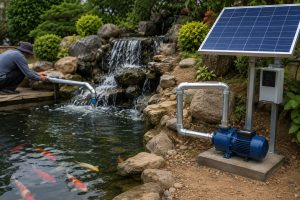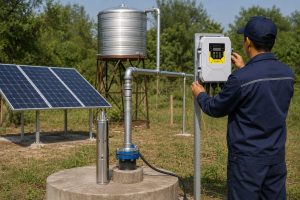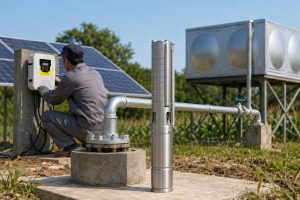
Struggling to move water across your large property?
Grid power can be expensive or completely unavailable, making it a challenge to get water where you need it most.
The horizontal distance a solar pump can push water is not a fixed number; it depends entirely on the pump's power, the Total Dynamic Head (TDH), and especially the friction loss in your pipes. For instance, a 1 HP pump moving 10 GPM could push water over 3,000 feet horizontally through a 1.25-inch pipe, but less than half that distance through a 1-inch pipe.
Answering this question isn't about finding a simple distance rating on a box.
It's about understanding the physics of moving water against resistance.
The total work a pump does is measured in Total Dynamic Head (TDH), and a significant portion of that work is spent overcoming friction in the pipes.
This guide will break down the key factors—TDH, friction loss, pipe size, and pump type—so you can calculate exactly how far your pump can push water and choose the perfect system for your needs.
Let's dive into the details.
What is Total Dynamic Head (TDH) and Why Does It Matter?
Confused by technical terms like 'head' and 'TDH' when looking at pumps?
Choosing a pump based on guesswork can lead to poor performance, low pressure, and a system that fails years before it should.
Total Dynamic Head (TDH) is the total amount of resistance your pump must overcome to move water from its source to its destination. It's calculated by adding together the vertical lift, the pressure required at the outlet, and the friction loss from the pipes. Accurately calculating TDH is the single most important step in sizing your pump correctly.
To truly understand how far a pump can push water, you must first master the concept of TDH.
It's the universal language of pump performance.
Every pump has a performance curve that shows how many gallons per minute (GPM) it can deliver at a specific TDH.
If you miscalculate your TDH, you will choose the wrong pump.
Let's break down each component of the TDH formula.
Breaking Down the TDH Formula
The formula itself is straightforward: TDH = Static Head + Pressure Head + Friction Loss.
Each part of this equation represents a different type of work the pump has to do.
By understanding each variable, you gain control over your system's design and performance.
Static Head: The Vertical Challenge
Static Head is the total vertical distance the pump needs to lift the water.
This is not the same as your well's total depth.
It's measured from the pumping water level in the well to the highest point of discharge.
For example, if you have a 400-foot-deep well, but the water level sits at 80 feet when the pump is running, your initial lift is 80 feet.
If you are then pumping that water up to a storage tank on a hill 20 feet high, your total static head is 100 feet (80 ft + 20 ft).
This vertical lift is a fixed amount of work the pump must do before it can even begin to push water horizontally.
Pressure Head: Meeting Your System's Needs
Most water systems don't just pour water into an open tank; they feed into a pressurized system for a house or irrigation.
This pressure requirement adds to the pump's workload.
This is converted into "feet of head" to be used in the TDH calculation.
The conversion is simple: 1 PSI = 2.31 feet of head.
A standard residential pressure tank operates on a 40-60 PSI switch.
To ensure the pump can reach the 60 PSI shut-off pressure, you must add that requirement to your calculation.
- 40 PSI = 40 x 2.31 = 92.4 feet of head
- 50 PSI = 50 x 2.31 = 115.5 feet of head
- 60 PSI = 60 x 2.31 = 138.6 feet of head
So, a 60 PSI requirement adds nearly 140 feet to your TDH calculation.
Friction Loss: The Horizontal Distance Killer
This is the most critical factor for determining horizontal pumping distance.
As water moves through a pipe, it rubs against the inner walls, creating friction.
This friction acts as a resistance that the pump must overcome.
Friction loss depends on three main things:
- Pipe Diameter: A smaller pipe creates drastically more friction than a larger one.
- Flow Rate (GPM): The faster the water moves, the more friction it creates.
- Pipe Length: The longer the pipe, the more total friction.
This is where horizontal distance comes into play.
Every foot of horizontal pipe adds to the total friction loss, increasing the TDH and reducing the pump's overall performance.
How Pipe Size and Flow Rate Determine Horizontal Distance
Did you buy a powerful pump but are only getting a trickle of water hundreds of feet away?
The problem might not be the pump; it could be that your pipes are choking its performance.
Pipe size is the single biggest factor influencing how far you can push water horizontally. Upgrading from a 1-inch to a 1.25-inch pipe can reduce friction by over 50%, allowing the same pump to push water more than twice as far. Using undersized pipes is like forcing an athlete to breathe through a straw.
The relationship between pipe size, flow rate, and friction loss is not linear—it's exponential.
This means that small changes in your setup can lead to huge differences in performance.
Ignoring friction loss is the most common and costly mistake people make when designing a water system.
It's the primary reason a pump that looks great on paper fails to deliver in the real world.
Let's look at a practical example to see how this works and how you can calculate the maximum horizontal distance for your pump.
A Practical Example: Calculating Maximum Horizontal Distance
Let's imagine you've selected a 1 HP pump.
By looking at its pump performance curve, you see that it can deliver 12 GPM at a maximum TDH of 250 feet.
Now, let's define the other parts of our system:
- Static Head (Vertical Lift): 30 feet
- Pressure Head (for a 60 PSI system): 139 feet
First, we calculate how much "head" is left over to overcome friction.
Available Head for Friction = Max TDH - Static Head - Pressure Head
Available Head for Friction = 250 ft - 30 ft - 139 ft = 81 feet
This 81 feet is the total amount of friction loss your system can have before the pump fails to deliver the desired pressure.
Friction Loss Comparison Table
Now, let's see how pipe size affects this.
The table below shows the friction loss in feet for every 100 feet of pipe at a flow rate of 12 GPM.
| Pipe Diameter | Material | Friction Loss (feet per 100 ft) |
|---|---|---|
| 1" | PVC | ~9.1 ft |
| 1.25" | PVC | ~3.1 ft |
| 1.5" | PVC | ~1.7 ft |
| 2" | PVC | ~0.6 ft |
Note: These are standard estimates. Always consult a detailed friction loss chart for your specific pipe material and flow rate.
Calculating the Max Horizontal Distance
Now we can calculate the maximum horizontal distance for each pipe size.
*Max Distance = (Available Head for Friction / Loss per 100 ft) 100**
- For 1" Pipe: (81 ft / 9.1) * 100 = 890 feet
- For 1.25" Pipe: (81 ft / 3.1) * 100 = 2,612 feet
- For 1.5" Pipe: (81 ft / 1.7) * 100 = 4,764 feet
The difference is staggering.
Simply by upgrading from a 1-inch pipe to a 1.25-inch pipe, you can push water almost three times farther.
This demonstrates that investing in a larger pipe size is often more effective and cheaper than buying a bigger pump.
Choosing the Right Pump Type for Your Needs
Feeling overwhelmed by choices like screw pumps, plastic impellers, or stainless steel models?
Selecting the wrong pump type for your water conditions and needs can lead to poor efficiency and a short lifespan for your investment.
The best pump type matches your specific application. Solar screw pumps are for deep wells (high head, low flow). Plastic impeller centrifugal pumps are for irrigation (high flow, medium head). Stainless steel impeller pumps offer the same high flow but add corrosion resistance for harsh water.
The "wet end" of the pump—the part that actually moves the water—is designed for a specific trade-off between pressure (head) and volume (flow).
A pump designed to create extremely high pressure to lift water from a deep well will have less energy left over to push high volumes horizontally.
Conversely, a pump designed for high flow on flat ground won't be able to lift water from a deep well.
Understanding these three common solar pump types will help you match the hardware to your landscape.
Solar Screw Pumps: The Deep Well Specialist
A solar screw pump, also known as a progressive cavity pump, uses a helical rotor (the screw) inside a rubber stator.
As the screw turns, it creates sealed cavities of water that are "progressively" pushed upwards.
This design is incredibly effective at creating very high pressure.
It's perfect for applications with high static head, such as lifting water from wells that are hundreds of feet deep.
However, this design inherently limits the flow rate.
Because so much of the pump's energy is dedicated to vertical lift, there is less power available to move high volumes over long horizontal distances.
It excels at "lift," not "push."
Solar Centrifugal Pumps (Plastic Impeller): The High-Flow Workhorse
Centrifugal pumps use a spinning impeller to throw water outwards, converting rotational energy into water velocity and pressure.
Multi-stage centrifugal pumps use several impellers in a series to build pressure.
Models with plastic impellers are an economical and lightweight choice.
They are designed to produce high flow rates at low to medium head.
This makes them ideal for applications like farm irrigation, pasture water supply, or filling a pond where the vertical lift is minimal.
With less energy spent on lifting, more power is available to overcome friction loss, allowing them to push large volumes of water over very long horizontal distances on relatively flat terrain.
They are excellent at "push," provided the "lift" isn't too great.
Solar Centrifugal Pumps (Stainless Steel Impeller): The Durable Performer
This pump operates on the same centrifugal principle as the plastic impeller model but is built for superior durability.
The stainless steel impellers and pump housing provide excellent resistance to corrosion and abrasion.
This makes them the premium choice for applications with acidic or alkaline water, or in regions with fine sand that would quickly wear down a plastic impeller.
They offer the same high-flow characteristics as their plastic counterparts, making them equally effective at pushing water horizontally.
The primary difference is their longevity and reliability in challenging water conditions, which comes at a higher initial cost.
| Pump Type | Primary Strength | Ideal Application | Impact on Horizontal Distance |
|---|---|---|---|
| Solar Screw Pump | High Head, Low Flow | Deep domestic wells, livestock water in hills | Best for high-lift scenarios; less energy for horizontal push. |
| Plastic Impeller Pump | High Flow, Medium Head | Farm irrigation, filling ponds, shallow wells | Excellent for long horizontal runs with low vertical lift. |
| SS Impeller Pump | High Flow, Corrosion-Resistant | Corrosive water, high-value ranches, sandy wells | Same high-flow push as plastic, but with added durability. |
The Unsung Hero: The High-Efficiency Motor
Are you focusing only on the pump and ignoring the motor that drives it?
An inefficient motor wastes precious solar energy, forcing you to buy more solar panels and increasing the overall cost of your system.
The motor is the heart of your solar pump. Modern systems use high-efficiency Brushless DC (BLDC) permanent magnet motors that are over 90% efficient. This is a massive improvement over older motor designs, meaning more water is pumped for every watt of solar power you generate.
For decades, the efficiency of water pump motors hovered around 60-70%.
That meant that 30-40% of the electricity going into the motor was wasted as heat, not used to pump water.
The development of BLDC permanent magnet motors has completely changed the game for solar pumping.
These motors are not only more powerful but also significantly more efficient, smaller, and lighter than their predecessors.
This technological leap is what makes modern solar pumping so effective and affordable.
Why BLDC Motors Dominate Solar Pumping
A Brushless DC (BLDC) motor uses powerful permanent magnets on the rotor and electronic controls instead of physical "brushes" to commutate the motor.
This design eliminates the friction and energy loss associated with brushes, which is a primary reason for their high efficiency.
Top-tier solar pumps use rotors made from high-grade neodymium iron boron magnets, which create a powerful magnetic field in a compact size.
This results in a motor with higher torque and a better power-to-weight ratio.
Efficiency and Cost Savings by the Numbers
The impact of motor efficiency is easy to quantify.
- A standard motor at 70% efficiency requires about 1,428 watts of input power to produce 1,000 watts of pumping power.
- A BLDC motor at 92% efficiency requires only about 1,087 watts of input power to produce the same 1,000 watts.
That's a difference of 341 watts.
This means you could achieve the same water output with roughly 25% fewer solar panels.
Given that solar panels are a major cost component of any system, a high-efficiency motor directly translates into significant upfront savings.
Furthermore, these motors are often 40-50% smaller and lighter, making installation easier and cheaper, especially for deep well pumps.
The Role of the Intelligent Controller
A high-efficiency motor can only perform at its peak with a smart controller.
Modern solar pump systems use an MPPT (Maximum Power Point Tracking) controller.
The MPPT controller constantly adjusts the electrical load to ensure the solar panels are operating at their peak power output, regardless of changing sunlight conditions.
It intelligently manages the power from the panels and delivers it to the BLDC motor in the most efficient way possible.
Some advanced controllers also feature AC/DC hybrid capability.
This allows the system to run on solar power during the day and automatically switch to grid power or a generator at night or on cloudy days, ensuring a reliable 24/7 water supply.
The Dangers of Sizing Your Pump Incorrectly
Do you believe that "bigger is better" when it comes to water pumps?
This common misconception is a recipe for disaster. An oversized pump can destroy itself and your well, while an undersized pump will leave you without adequate water.
Pump sizing must be precise for a long-lasting, efficient system. An oversized pump will short-cycle, burning out the motor and pulling damaging sand into your well. An undersized pump will run constantly, overheat, and fail prematurely, never meeting your pressure and flow demands.
Getting the pump size right is a balancing act.
You need a pump powerful enough to meet your peak demand at your calculated TDH, but not so powerful that it overwhelms your well or your pressure tank.
Both oversized and undersized pumps lead to premature failure, just for different reasons.
Understanding these failure modes is key to appreciating why a proper TDH calculation is not just recommended—it's essential.
Problems with an Oversized Pump
An oversized pump is far more destructive than an undersized one.
- Short Cycling: An oversized pump fills the pressure tank extremely quickly. This causes the pump to turn on and off rapidly, sometimes 20 or more times per hour instead of a healthy 4-6 times. Each startup draws 3 to 5 times the motor's running amperage, creating massive heat surges that destroy the motor windings. A pump that should last 10-15 years can burn out in just 2-3 years.
- Well Damage: If a pump draws water faster than the aquifer can replenish it, the water level can drop below the pump's intake. This can pull fine sand and sediment into the pump, which acts like sandpaper, eroding the impellers and check valves. Over time, this can permanently reduce your well's yield.
- Higher Energy Costs: The damage isn't just mechanical; it's financial. A 1.5 HP motor might draw 11 amps, while the correct 0.75 HP motor would only draw 7 amps. You're paying over 50% more in electricity costs every hour the pump runs.
Problems with an Undersized Pump
While less destructive to the well, an undersized pump will also fail early and leave you frustrated.
- Constant Running and Overheating: An undersized pump has to run continuously for long periods to try and reach the pressure switch's cutoff point. Submersible motors are designed to be cooled by the flow of water past them. When a pump runs at its absolute limit for hours on end, it generates more heat than the water flow can dissipate, leading to overheating and motor failure in as little as 4-6 years.
- Low Pressure and Flow: The most obvious symptom is poor performance. Your shower pressure will drop when a toilet is flushed, and sprinklers won't cover their intended area. The pump simply cannot meet the household's peak demand.
The Right-Sizing Solution
The only way to avoid these problems is to size your pump based on a careful calculation of your Total Dynamic Head and your required GPM.
Do not guess or size based on horsepower alone.
If you find yourself with a mismatched system, there are temporary fixes.
A cycle stop valve (CSV) can be installed to mitigate short cycling on an oversized pump.
For a low-yielding well with an undersized pump, the best solution is often to have the pump slowly fill a large, non-pressurized storage tank, and then use a separate, smaller booster pump to provide pressure to the house.
Conclusion
Ultimately, a solar pump's horizontal reach is a direct function of its power, your system's TDH, and the friction caused by your pipes.
Properly calculating these factors is critical.
FAQs
How far can a 1/2 HP pump push water horizontally?
It depends on pipe size and lift. With low vertical lift and a 1.25" pipe, a 1/2 HP pump might push 10 GPM for 1,000-1,500 feet.
How do you calculate horizontal water distance?
Calculate the pump's available head for friction (Max TDH - Vertical Lift - Pressure Head), then divide that by the friction loss per 100 ft for your pipe.
Does pipe size affect water pressure?
Indirectly. A smaller pipe increases friction loss, which raises the TDH. This reduces the pump's flow rate at the outlet, which you will perceive as lower pressure.
Can you use a bigger pump than you need?
It is not recommended. An oversized pump will short-cycle, causing the motor to burn out quickly and potentially damage your well by pulling in sand.
How many GPM does a house need?
A standard 3-bedroom, 2-bathroom home typically needs 8-12 GPM to satisfy peak demand when multiple fixtures are running at once.
What is the difference between a 2-wire and 3-wire submersible pump?
A 2-wire pump has the starting controls inside the motor down in the well. A 3-wire pump has an external control box above ground, making it easier to diagnose and repair.
How do I increase the horizontal distance my pump can push water?
The easiest and most effective way is to use a larger diameter pipe. This dramatically reduces friction loss, allowing the pump to push water farther.
What is a constant pressure system?
This system uses a variable frequency drive (VFD) to adjust the pump motor's speed in real-time, maintaining a steady water pressure regardless of how many taps are open.