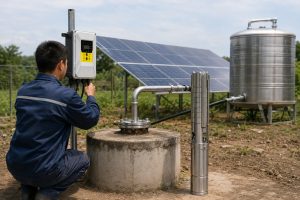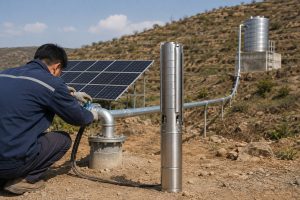
Struggling with inconsistent water access from ponds or lakes?
Floating pumps are effective for surface water, but for a truly reliable, all-season supply, especially from underground, solar deep well pumps offer superior performance, efficiency, and sustainability.
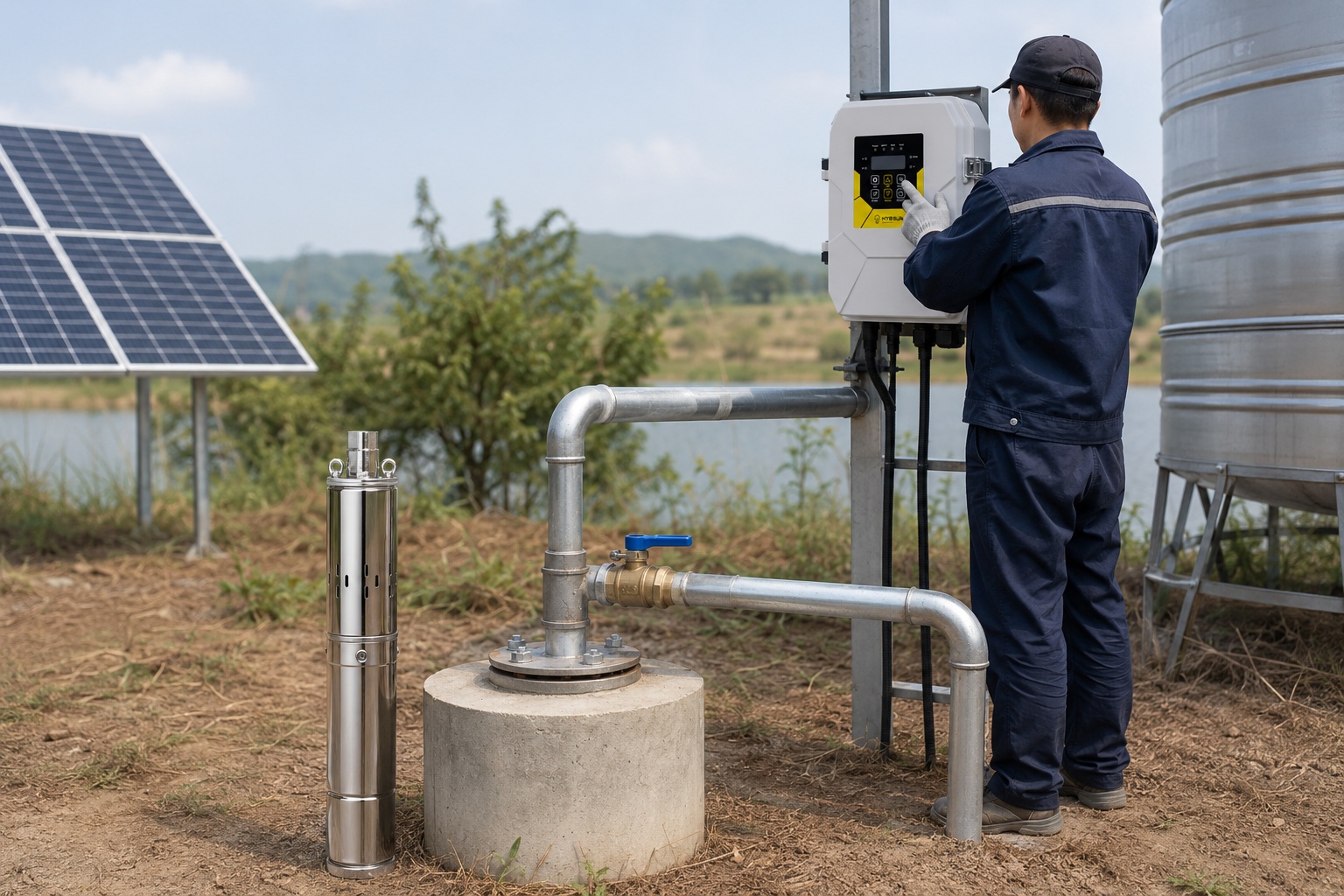
Floating pumps certainly have their place.
They are great for moving large volumes of water from surface sources like dams, rivers, and lakes.
However, what if your water source is deep underground?
What if you need consistent pressure year-round, even when surface water levels drop?
This is where the real innovation in water pumping technology shines.
The focus shifts from floating on the surface to diving deep.
Solar deep well pumps represent a major leap forward, providing clean energy solutions for agriculture, livestock, and domestic use across the globe.
Let's explore the powerful and diverse world of solar deep well pumps, which offer a more robust solution for many water challenges.
Solar Screw Pump: Low Flow, High Head
Need to lift water from a very deep well but struggling with high energy costs?
This pump type uses a robust stainless steel screw to deliver water from extreme depths with high efficiency, making it perfect for domestic and livestock use in off-grid areas.
A solar screw pump, also known as a progressing cavity pump, is a true specialist.
It excels in situations where other pumps fail, particularly in deep well applications.
Its unique design allows it to generate immense pressure, enabling it to push water vertically over hundreds of feet.
This makes it an invaluable tool for accessing deep aquifers, which is common in arid regions of Africa and parts of Latin America.
Let's dive deeper into what makes this technology so effective for high-head, low-flow scenarios.
How a Screw Pump Works
The core of the pump is a single helical metal rotor (the screw).
This screw turns inside a double helical elastomer stator (the rubber housing).
As the rotor turns, it creates a series of sealed cavities.
These cavities "progress" from the pump's intake to its outlet, carrying a fixed volume of water with them.
This mechanism is a form of positive displacement.
It pushes the water through compression rather than flinging it with centrifugal force.
This process is highly efficient at creating high pressure, even at low rotational speeds.
Key Applications and High-Head Performance
These pumps are the go-to solution for specific needs.
- Domestic Water Supply: Ideal for homes with deep wells, providing consistent water pressure.
- Livestock Watering: Reliably supplies water to remote troughs, essential for ranching.
- Small-Scale Irrigation: Perfect for drip irrigation systems that require high pressure but not massive flow rates.
The "high head" capability is its main selling point.
Head is a measure of the vertical distance a pump can lift water.
A standard screw pump can achieve heads of over 150 meters (nearly 500 feet), far surpassing many other pump types of a similar size.
Why is it So Sand-Resistant?
Wells, especially newly drilled ones, often contain sand and silt.
This grit can quickly destroy the impellers of a centrifugal pump.
The screw pump's design is inherently more resistant to abrasion.
The flexible rubber stator and the slow, steady movement of the rotor allow small abrasive particles to pass through without causing significant damage.
This durability makes it exceptionally reliable in harsh water conditions, reducing maintenance needs and extending the pump's lifespan.
| Feature | Solar Screw Pump | Standard Centrifugal Pump |
|---|---|---|
| Pumping Mechanism | Positive Displacement (Screw) | Centrifugal Force (Impeller) |
| Best For | High Head, Low Flow | Low Head, High Flow |
| Typical Max Head | 150m+ | 50-80m |
| Sand Resistance | Excellent | Poor to Fair |
| Primary Use | Deep wells, livestock, domestic | Irrigation, pool circulation |
Solar Plastic Impeller Pump: High Flow, Wear-Resistant
Need to move a large amount of water for your farm or garden without breaking the bank?
This multi-stage centrifugal pump uses durable, lightweight plastic impellers to deliver high flow rates, making it an economical and wear-resistant choice for irrigation and general water supply.
When the priority is volume, not extreme depth, the solar plastic impeller pump is a champion.
This pump is designed for applications where you need to move a lot of water quickly and efficiently.
It is a popular choice for farm irrigation, filling large tanks, or managing water on a pasture.
Its design balances performance with cost, providing an accessible solution for users in regions like Africa and the Americas.
The use of engineered plastics for the impellers is a key feature, offering surprising durability and efficiency.
Let’s explore the mechanics and advantages of this high-flow workhorse.
The Power of Multi-Stage Centrifugal Design
Unlike the screw pump, this is a centrifugal pump.
It uses a series of spinning impellers to accelerate water and convert velocity into pressure.
Each impeller and its corresponding diffuser is called a "stage."
Water enters the first stage, is sped up by the impeller, and then passes to the next stage at a higher pressure.
Adding more stages increases the total head the pump can achieve.
A typical pump might have 5 to 15 stages.
This design allows for a high flow rate, often exceeding 100 liters per minute, while still providing a medium head (e.g., 50-80 meters), which is sufficient for most agricultural and domestic applications.
Balancing Cost, Weight, and Performance
The choice of plastic for the impellers is a strategic one.
Modern engineering polymers are not the flimsy plastics of the past.
They are specifically designed to be highly resistant to abrasion from fine sand.
This gives them an excellent performance-to-cost ratio.
- Economical: Plastic impellers are significantly cheaper to manufacture than stainless steel ones, making the overall pump more affordable.
- Lightweight: The reduced weight makes the pump easier to transport and install, lowering labor costs, which is a major benefit in remote areas.
- Wear-Resistant: They are surprisingly tough and can handle water with fine sand better than some metal impellers, which can be eroded over time.
Limitations to Consider
While excellent in many scenarios, there are limitations.
These pumps are not ideal for very deep wells that require extremely high head.
They are also less suited for water that is highly corrosive (acidic or alkaline), as certain chemicals can degrade the plastic over time.
In those specific cases, a different pump material is necessary.
| Feature | Plastic Impeller | Stainless Steel Impeller |
|---|---|---|
| Cost | Lower (Approx. 20-40% less) | Higher |
| Weight | Lighter | Heavier |
| Fine Sand Resistance | Excellent | Good |
| Corrosion Resistance | Fair | Excellent |
| Ideal Use | General farm & home use | Corrosive water, premium use |
Solar Stainless Steel Impeller Pump: Premium Quality, Corrosion Resistance
Is your well water acidic, alkaline, or salty, causing other pumps to fail prematurely?
This premium pump features stainless steel impellers and housing, offering unmatched corrosion resistance and longevity, ensuring a reliable water supply even in the most challenging water conditions.
When durability and reliability are non-negotiable, the solar stainless steel impeller pump is the ultimate choice.
This pump is engineered for the toughest environments.
It shares the high-flow, multi-stage centrifugal design of the plastic impeller model but upgrades all water-contact components to high-grade stainless steel.
This makes it the perfect solution for dealing with corrosive water, a problem found in coastal regions, areas with acidic soil, and specific geological formations in places like Australia and parts of the Americas.
It represents a long-term investment in water security.
The SS304 Advantage
The key to this pump's resilience is its material: SS304 stainless steel.
SS304 is a specific alloy known for its excellent resistance to a wide range of corrosive agents.
This includes acids, alkaline solutions, and chlorides (salt).
While a standard pump might corrode and fail within a year or two in such conditions, an SS304 pump can operate reliably for many years.
This not only prevents the cost of frequent pump replacements but also ensures the purity of the water, as there is no rust or material degradation contaminating the supply.
This level of quality makes it suitable for high-end homes, commercial operations, and any application where water quality is paramount.
When is the Higher Cost Justified?
The initial investment for a stainless steel pump is higher, sometimes by 40% or more compared to a plastic impeller model.
However, this cost is easily justified in several scenarios:
- Known Corrosive Water: If a water test reveals a pH outside the neutral 6.5-8.5 range or high levels of dissolved salts, stainless steel is a necessity, not a luxury.
- Mission-Critical Applications: For a high-value ranch or a remote community, the cost of pump failure (in lost livestock or lack of drinking water) is far greater than the extra cost of a durable pump.
- Long-Term Investment: For property owners who want a "set it and forget it" solution, the extended service life and lower maintenance needs of a stainless steel pump provide a better return on investment over a decade.
A Niche and High-End Solution
While the plastic impeller pump is the high-volume seller for general applications, the stainless steel model targets a more specific, high-end market.
It is for users who understand the chemistry of their water source and demand the highest level of reliability and longevity from their equipment.
| Water Condition | Plastic Impeller Pump | Stainless Steel Impeller Pump |
|---|---|---|
| Neutral pH, Low Minerals | Suitable | Suitable (Over-specified) |
| High Fine Sand Content | Excellent | Good |
| Acidic or Alkaline Water | Not Recommended | Highly Recommended |
| Brackish/Salty Water | Not Recommended | Highly Recommended |
| High Iron/Manganese | Prone to Staining/Buildup | Resistant to Staining/Buildup |
BLDC Permanent Magnet Motor: Core Power, High Efficiency
Are you worried that a powerful pump will require a huge and expensive solar array?
All these solar pumps are driven by an advanced BLDC motor with over 90% efficiency, drastically reducing the number of solar panels needed and lowering overall system costs.
The pump itself is only half of the equation.
The motor that drives it is the heart of the system, determining its efficiency, lifespan, and overall performance.
The secret weapon behind this entire portfolio of solar pumps is the Brushless DC (BLDC) permanent magnet motor.
This advanced motor technology is a significant leap beyond older motor types, providing the power and efficiency needed to make solar pumping a truly viable solution worldwide.
It is the unseen hero that makes everything else possible.
What is a BLDC Motor?
A Brushless DC motor, as the name implies, does not have brushes.
In a traditional brushed motor, carbon brushes make physical contact with a commutator to deliver power to the rotor, causing friction, wear, and energy loss.
A BLDC motor uses an electronic controller to switch the direction of the magnetic field in the stator.
This interacts with powerful permanent magnets on the rotor, causing it to spin.
The rotor in these high-end pumps is made from neodymium iron boron (40SH grade), one of the strongest permanent magnet materials available.
This design eliminates friction, improves reliability, and dramatically boosts efficiency.
The Efficiency Game-Changer
Efficiency is the percentage of electrical energy that a motor converts into useful mechanical work.
A typical AC motor might be 60-75% efficient.
These advanced BLDC motors consistently achieve efficiencies exceeding 90%.
This massive 15-30% improvement has profound implications for a solar-powered system.
A 90% efficient motor requires significantly less power to do the same amount of work as a 70% efficient motor.
This means you can run your pump with a smaller, less expensive solar panel array.
For example, a pump system that might have required four solar panels with an older motor may now run perfectly on just three.
This reduces the initial system cost by 25%.
Technical and Market Advantages
The benefits of the BLDC motor are numerous.
- Compact & Lightweight: With no brushes and a powerful magnet rotor, the design is much more compact. These motors can be up to 47% smaller and 39% lighter than traditional motors of equivalent power. This simplifies installation.
- High Torque: They deliver strong torque even at low speeds, which is ideal for starting the pump mechanism, especially the screw pump.
- Long Service Life: With no brushes to wear out, the motor is virtually maintenance-free and has a much longer operational lifespan.
| Feature | BLDC Motor | Standard AC Induction Motor |
|---|---|---|
| Efficiency | >90% | 60-75% |
| Lifespan | 20,000+ hours | 10,000 hours (brush changes) |
| Maintenance | None | Requires brush replacement |
| Size & Weight | Compact & Light | Bulky & Heavy |
| Solar Panel Need | Lower | Higher (Approx. 25-30% more) |
Hybrid AC/DC Systems: 24/7 Water Security
What happens when the sun isn't shining and you still need water?
Hybrid AC/DC controllers solve this problem by automatically switching between solar power and a grid or generator source, ensuring you have uninterrupted water access 24 hours a day.
Solar power is fantastic, but it has one obvious limitation: it requires sunlight.
For applications that need water around the clock—like household use or critical irrigation schedules—relying solely on solar can be a source of anxiety.
What do you do on cloudy days or at night?
The answer lies not in the pump or the motor, but in the brains of the operation: the controller.
An intelligent AC/DC hybrid controller provides the ultimate solution for water security, blending the best of renewable energy with the reliability of a conventional power source.
Overcoming Solar's Limitations
A standard solar pump system connects the solar panels directly to the pump controller, and the pump runs only when the sun is out.
A hybrid system introduces a second power input to the controller.
You can connect both your solar panels (DC power) and a utility grid connection or a backup generator (AC power) at the same time.
This dual-input capability fundamentally changes the reliability of the system.
It transforms the pump from a daytime-only device into a 24/7 water solution, removing the dependency on weather conditions.
How Automatic Power Blending Works
The intelligence is in the controller's logic.
The controller constantly monitors the power coming from the solar panels.
- Priority on Solar: The system is designed to prioritize free energy from the sun. If the solar panels are providing enough power to run the pump, the controller will use 100% solar energy.
- Hybrid Function: On partly cloudy days, when solar input is reduced, the controller can blend power. It will use all available solar power and supplement it with just enough AC power to meet the pump's demand. This maximizes the use of free solar energy.
- Automatic Switchover: When there is no solar input (at night or during very heavy cloud cover), the controller seamlessly and automatically switches to the AC power source. The user doesn't have to do anything.
This ensures the pump is always ready to run, providing complete peace of mind.
Applications for Hybrid Systems
This technology is ideal for a wide range of users.
- Off-Grid Homes: Guarantees that faucets, showers, and toilets work at any time of day or night.
- Commercial Agriculture: Allows for irrigation scheduling at optimal times (e.g., early morning or evening) to reduce evaporation, not just when the sun is at its peak.
- Livestock Operations: Ensures water troughs are never empty, regardless of the weather.
| Power Source Scenario | Solar (DC) Input | Grid/Generator (AC) Input | Pump Operation |
|---|---|---|---|
| Sunny Day | 100% | 0% | Full speed on solar |
| Partly Cloudy Day | 50% | 50% | Full speed with blended power |
| Night / Heavy Cloud | 0% | 100% | Full speed on AC power |
Conclusion
The right solar pump is a system.
It involves matching the pump type to your water needs, powered by an efficient motor, and managed by an intelligent controller for ultimate reliability.
FAQs
What is the main disadvantage of a floating pump?
Floating pumps are limited to surface water sources like ponds and lakes. They cannot access deep groundwater and may be affected by drought or fluctuating water levels.
How deep can a solar water pump go?
It depends on the pump type. Solar screw pumps are designed for high head and can lift water from depths exceeding 150 meters (nearly 500 feet).
Can solar pumps run at night?
Yes, if they are part of a hybrid AC/DC system. The controller automatically switches to grid or generator power when solar energy is unavailable at night or on cloudy days.
How many solar panels do I need for a water pump?
This depends on the pump's power rating and the motor's efficiency. A highly efficient BLDC motor (90%+) requires fewer panels than a standard motor for the same job.
Are solar water pumps worth it?
Yes, for off-grid or remote locations, they offer huge savings on fuel and electricity costs. They provide energy independence and have low operating costs after the initial investment.
What is the life of a solar water pump?
A well-maintained, high-quality solar pump system can last for many years. The BLDC motors have a lifespan of over 20,000 hours, and solar panels are often warrantied for 25 years.