Struggling with a cloudy pond and shocking electricity bills?
You've invested in a pump, but it's either weak, noisy, or a constant drain on your wallet.
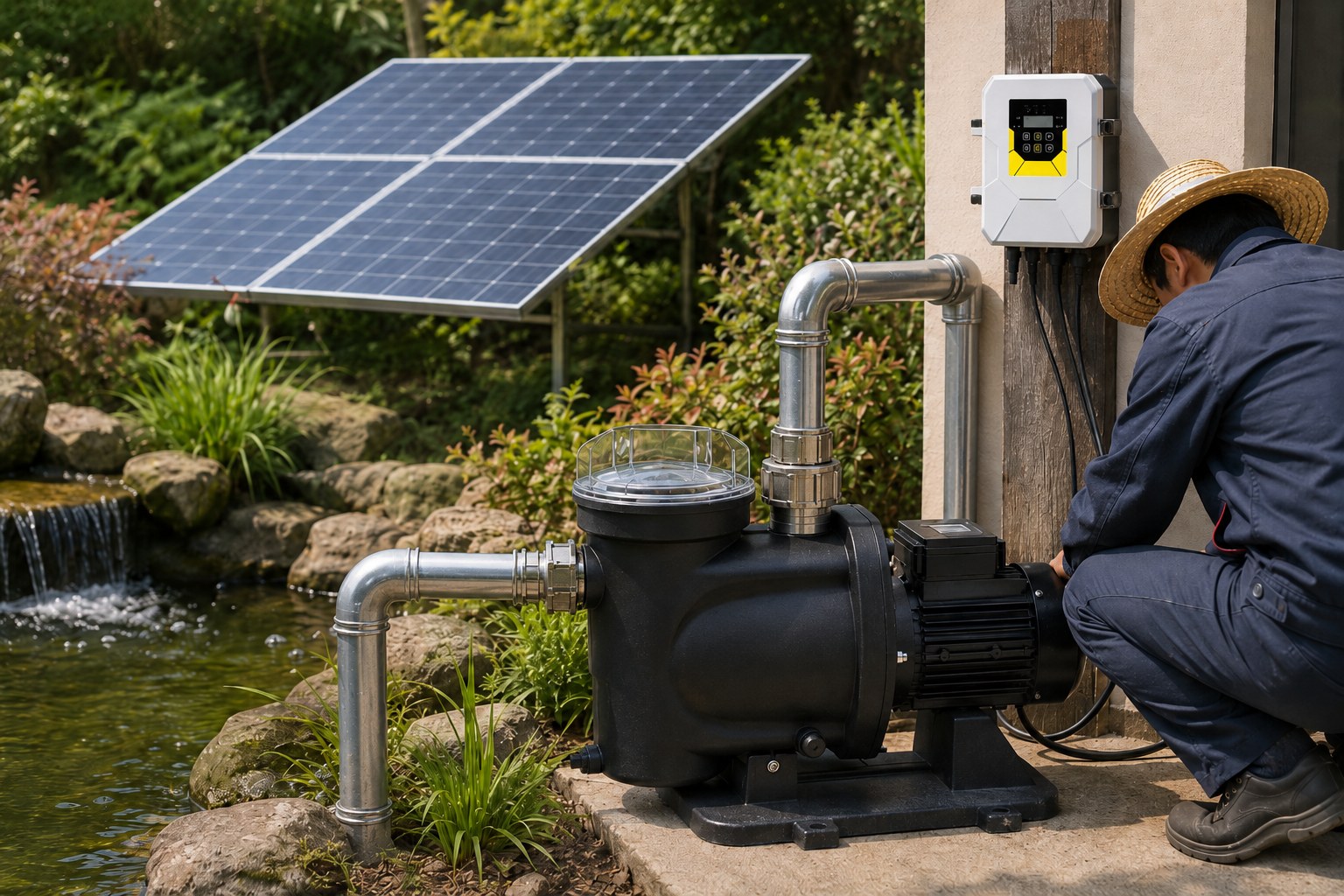
The best pond pump is a complete system that balances flow rate, long-term running costs, and durability for your specific needs. For many, modern solar pumps with high-efficiency motors offer the lowest total cost of ownership, providing a powerful, reliable, and grid-independent solution for a healthy pond.
Choosing a pond pump can feel overwhelming.
You see terms like GPH, TDH, and watts, and every box promises a perfect pond.
But the truth is, the pump itself is only one part of the equation.
The real "best" choice comes from understanding the technology that powers it and matching that technology to your pond's unique demands.
This guide moves beyond brand names to explore the core technologies that define a truly great pump system.
We will focus on how modern advancements, particularly in solar power and motor efficiency, are changing what's possible for pond owners.
Let's dive into how you can select a pump that not only keeps your water crystal clear but also saves you a significant amount of money over its lifetime.
Why Your Pump's Power Source is the New Priority
Are you tired of seeing your electricity bill climb every month just to keep your pond running?
A standard pond pump can be one of the most energy-hungry appliances you own.
The single biggest long-term expense of any pond pump is electricity, as it runs 24/7. By shifting to a solar-powered solution, you can reduce this running cost to zero, achieving significant savings and complete energy independence for your pond's circulation and filtration systems.
A traditional pond pump might seem cheaper upfront, but the costs quickly add up.
A pump that uses just 300 watts of power will run continuously, 24 hours a day, 365 days a year.
Let's break down what that really costs.
The Hidden Cost of Grid-Powered Pumps
When you buy a conventional pump, you are also signing up for a perpetual energy subscription.
The initial purchase price is just the entry fee.
Consider the numbers.
A modest 300-watt pump, at an average electricity rate of $0.16 per kWh, costs over $420 per year to operate.
Over five years, that's more than $2,100 in electricity alone, often many times the cost of the pump itself.
This is a critical factor that is frequently overlooked in the store aisle.
The Solar Advantage: A Smarter Investment
Solar-powered pumps fundamentally change this financial model.
While the initial investment may be higher, the operational cost is virtually zero.
The sun provides the power for free.
This technology is no longer just for remote, off-grid locations.
It has become a strategic financial decision for savvy pond owners in sun-rich regions like Australia, the Americas, and parts of Asia and Africa.
The return on investment is no longer a question of if, but when.
Comparing Long-Term Ownership Costs
Let's visualize the financial impact over three years for a mid-sized pump.
| Feature | Standard 300W Grid Pump | Equivalent Solar Pump |
|---|---|---|
| Upfront Cost (Est.) | $300 | $700 |
| Annual Energy Cost | ~$420 | $0 |
| 3-Year Energy Cost | $1,260 | $0 |
| Total 3-Year Cost | $1,560 | $700 |
As the table shows, the solar pump becomes the cheaper option in less than two years.
Over the pump's lifespan of five to ten years, the savings become massive.
You are not just buying a pump; you are investing in a future with no electricity bills for your pond.
Best for Deep Ponds & High Lift: The Solar Screw Pump
Need to pull water from a deep well to feed your pond or power a very tall waterfall?
A standard pump might struggle or burn out under the strain.
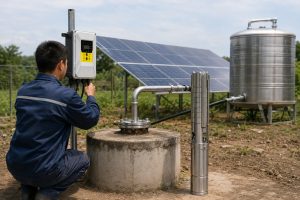
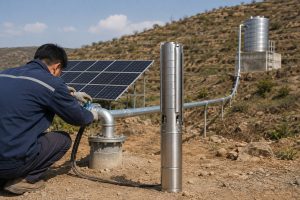
For applications requiring high head (vertical lift) but lower flow, the solar screw pump is the superior choice. Its unique design uses a stainless steel screw to efficiently push water from extreme depths, making it perfect for deep-well water sources or high-lift features where other pumps fail.
The solar screw pump doesn't use a traditional impeller.
Instead, it operates on a progressive cavity principle.
A rotating stainless steel screw (the rotor) turns inside a rubber casing (the stator).
This action creates sealed cavities of water that are pushed progressively upwards.
This mechanism is incredibly effective at generating high pressure, allowing it to pump water from depths exceeding 100 meters with ease.
Key Applications and Ideal Scenarios
This type of pump truly shines in specific situations.
It's the go-to solution for:
- Deep Well Water Supply: If your primary water source is a deep borehole, this pump can reliably bring water to the surface for your pond or home.
- High-Lift Water Features: For ambitious waterfalls or streams that require significant vertical lift, the screw pump delivers the necessary pressure.
- Livestock Watering: In agricultural settings, it's ideal for drawing water from deep wells to supply drinking troughs in remote pastures.
It's particularly valuable in electricity-scarce regions across Africa and Latin America, where grid power is unreliable or non-existent.
Technical Strengths and Limitations
The design of the solar screw pump gives it distinct advantages.
Its ability to handle sandy or silty water is exceptional, as the screw mechanism is far less susceptible to damage from abrasives than a high-speed impeller.
However, it's important to understand its primary limitation: flow rate.
This pump is a specialist, built for pressure, not volume.
| Feature | Solar Screw Pump | Traditional High-Head Pump |
|---|---|---|
| Power Source | Solar (Zero Running Cost) | Grid (High Running Cost) |
| Best Use Case | Low Flow, High Head (Pressure) | Varies, often less efficient at high head |
| Sand Resistance | Excellent | Prone to impeller wear and clogging |
| Ideal Environment | Deep wells, off-grid locations | Areas with stable grid power |
If your goal is to move a massive volume of water for a large filtration system, another pump type will be more suitable.
But for high-pressure jobs, the solar screw pump is in a class of its own.
Best for High Flow & General Use: The Solar Plastic Impeller Pump
Need to circulate your entire pond's volume every hour for a healthy ecosystem?
This requires moving a lot of water efficiently and consistently.
The solar plastic impeller pump is the workhorse for high-flow applications. It delivers a powerful combination of high water output, excellent wear resistance against fine sand, and an economical price point, making it the ideal choice for large pond circulation, farm irrigation, and garden water supply.
This pump is a type of multi-stage centrifugal pump.
It uses a series of precisely engineered plastic impellers, each housed in its own stage.
As water enters the pump, each impeller adds pressure and velocity, compounding the effect to produce a strong, steady flow.
The use of high-quality, wear-resistant plastic for the impellers makes this pump lightweight and cost-effective, while still providing impressive durability in most water conditions.
The Go-To for Volume and Versatility
This pump's ability to move large volumes of water makes it extremely versatile.
It's the perfect match for:
- Large Pond Filtration: It provides the high flow rates needed to push water through bead filters, UV sterilizers, and other filtration components.
- Farm and Pasture Irrigation: Its high output can supply water to multiple sprinklers or irrigation lines, making it a staple in agricultural regions in Africa and the Americas.
- Filling and Draining: It can quickly fill or empty large ponds, tanks, or reservoirs.
The key benefit is achieving this high flow with zero ongoing electricity costs, a game-changer for anyone managing large water systems.
Performance Profile and Economic Value
This pump is designed to be a balanced, all-around performer.
It offers a great mix of features that make it a top choice for most general applications.
| Feature | Solar Plastic Impeller Pump | Traditional High-Flow Pump |
|---|---|---|
| Primary Function | High Flow, Medium Head | High Flow, often at high energy cost |
| Fine Sand Resistance | Very Good | Can suffer from premature wear |
| Weight | Lightweight, Easy to Install | Often heavy and bulky |
| Upfront Cost | Economical | Varies, but with added energy costs |
While it offers excellent performance, its plastic components may have limitations in highly corrosive water or extremely deep wells where immense pressure is a factor.
For the vast majority of pond and irrigation needs, however, its blend of high flow, durability, and economic value is simply unbeatable.
Best for Harsh Water & Ultimate Durability: The Solar Stainless Steel Impeller Pump
Is your water source acidic, alkaline, or high in minerals that corrode typical pumps?
This can lead to frequent, costly pump replacements.
For the most demanding water conditions or for users who prioritize maximum longevity, the solar stainless steel impeller pump is the premium choice. Its full SS304 stainless steel construction offers unmatched corrosion resistance, ensuring extreme reliability and a long service life even in harsh environments.
This pump is the pinnacle of durability in the solar pump world.
It uses the same efficient multi-stage centrifugal design as the plastic impeller model but upgrades all key components to a higher grade of material.
Both the impellers and the pump housing are constructed from SS304 stainless steel.
This material is specifically chosen for its superior resistance to rust, corrosion, and chemical degradation, making it ideal for environments where other pumps would quickly fail.
When to Invest in Stainless Steel
This pump is a specialized solution for challenging situations and high-end applications.
Consider this option if you face:
- Corrosive Water: Perfect for water with a high or low pH (acidic or alkaline).
- Brackish or Salty Water: Offers far better resistance to salt corrosion than standard pumps.
- Specific Geographies: Essential in regions with known water quality issues, such as the alkaline soil areas of Australia.
- High-End Systems: The preferred choice for premium residential water systems and ranches where reliability is the absolute top priority.
The Value of Superior Materials
The decision to use stainless steel is a strategic one focused on long-term value over short-term cost.
While the upfront investment is higher, the total cost of ownership is often lower due to its extended service life and minimal maintenance needs.
| Feature | Solar Stainless Steel Pump | Solar Plastic Impeller Pump |
|---|---|---|
| Corrosion Resistance | Exceptional | Good |
| Service Life | Very Long (10+ years) | Long (5-8 years) |
| Ideal Water Quality | Harsh, Corrosive, or Mineral-Rich | Normal to Moderately Hard |
| Upfront Cost | Premium | Economical |
For a user who values a "fit and forget" solution and cannot afford downtime, the stainless steel pump is not a luxury—it's a necessity.
It provides peace of mind and guarantees performance in conditions that would destroy lesser pumps.
The Engine Driving It All: The BLDC Motor Advantage
What truly separates a good solar pump from a great one?
It's not just the pump end; it's the engine that drives it.
The heart of every elite solar pump is a high-efficiency Brushless DC (BLDC) permanent magnet motor. With an operational efficiency exceeding 90%, it extracts maximum power from every watt of solar energy, dramatically reducing the number of solar panels needed and lowering the entire system's cost.
A motor's job is to convert electrical energy into mechanical motion.
How efficiently it does this is the single most important factor in a solar-powered system.
Traditional AC or brushed DC motors can waste 25-40% of the energy they consume as heat.
A BLDC motor is different.
The Science of Superior Efficiency
BLDC motors use powerful permanent magnets (often high-grade 40SH neodymium iron boron) on the rotor and a sophisticated electronic controller instead of physical brushes.
This design eliminates the friction and energy loss associated with brushes.
The result is a motor that is not only hyper-efficient but also significantly more compact and reliable.
Our advanced BLDC motors are up to 47% smaller and 39% lighter than traditional motors of equivalent power.
The Market-Changing Impact of a Better Motor
This leap in motor technology has profound benefits for the end-user.
| Feature | High-Efficiency BLDC Motor | Standard AC/DC Motor |
|---|---|---|
| Energy Efficiency | >90% | ~60-75% |
| Solar Panels Needed | Fewer (Lower System Cost) | More (Higher System Cost) |
| Maintenance | Maintenance-Free (No Brushes) | Brushes Require Periodic Replacement |
| Lifespan | Long and Reliable | Shorter, Prone to Wear |
| Torque | High Torque at All Speeds | Torque Varies with Speed |
An efficiency gain of 20-30% is massive.
It means a pump system that might have required four solar panels with an old motor can now run just as powerfully with only three.
This directly reduces the initial investment, simplifies installation, and makes solar pumping accessible to a much wider market.
The BLDC motor is the core innovation that makes the entire product portfolio—from screw pumps to stainless steel models—so competitive and effective.
Powering Your Pump 24/7: The Hybrid Solution
Do you love the savings of solar but worry about water flow on cloudy days or at night?
This is a common concern that has held many back from adopting solar.
Modern solar pump systems solve this problem with intelligent AC/DC hybrid controllers. Our advanced controllers automatically detect available power, prioritizing free solar energy first and seamlessly blending or switching to AC grid power only when needed, ensuring worry-free, 24/7 water access.
You no longer have to choose between solar savings and grid reliability.
A hybrid system gives you the best of both worlds, managed by one smart device.
This is how it provides uninterrupted performance.
How the Hybrid Controller Works
Our hybrid controllers are engineered with dual power inputs.
You can connect both your solar panel array and a standard AC power source (like your home's grid power or a generator) to the controller simultaneously.
The controller's internal logic is programmed for maximum efficiency:
- Solar Priority: As long as the sun is providing sufficient power, the system will run 100% on free solar energy.
- Hybrid Blending: On overcast days when solar power is reduced, the controller doesn't just shut off. It intelligently supplements the available solar energy with just enough AC power to maintain the pump's required speed. This maximizes the use of every available watt of solar.
- Automatic AC Switchover: When the sun goes down or during extended periods of heavy cloud cover, the controller automatically and instantly switches over to the AC power source to ensure the pump continues to run without interruption.
The Ultimate in Flexibility and Peace of Mind
This technology removes the final barrier for many potential solar pump users.
It is especially critical for:
- Koi Ponds: Where 24/7 circulation is mandatory to keep fish healthy.
- Essential Water Supply: For households or farms that cannot afford any downtime in their water access.
- Maximizing ROI: It ensures your pump is always running when needed, while still slashing your energy bill by using solar whenever possible.
With a hybrid system, you gain the economic freedom of solar without ever having to compromise on the round-the-clock reliability you expect from a traditional grid-powered pump.
It is the smartest, most flexible way to power your water system.
Conclusion
The best pump is a complete, intelligent system.
It combines the right pump type for your needs, a hyper-efficient BLDC motor, and a smart controller that guarantees performance while saving you money.
Frequently Asked Questions
How many hours a day should a pond pump run?
A koi pond pump should run 24 hours a day, 7 days a week. This constant circulation is vital for oxygenating the water and allowing the filter to remove waste.
Can a pond pump be too powerful?
Yes. An oversized pump can create excessive currents that stress fish and can overwhelm your filter's capacity, rendering it ineffective. Always match the pump's flow rate to your pond volume and filter specifications.
What is the difference between a pond pump and a fountain pump?
Pond pumps (solids-handling) are designed to move dirty water with debris to a filter. Fountain pumps are made for clean water and prioritize creating decorative spray patterns over high flow rates.
Do I need a pump for a small pond?
Even small ponds benefit greatly from a pump. It prevents water from becoming stagnant, smelly, and mosquito-infested, creating a healthier environment for any fish or plants you may have.
How do I calculate what size pond pump I need?
For a koi pond, aim to circulate the entire volume of water at least once per hour. For a 2,000-gallon pond, you need a pump that delivers at least 2,000 GPH at your system's specific head pressure.
How much does it cost to run a pond pump?
A traditional grid-powered pump can cost hundreds of dollars per year in electricity. A solar-powered pump, after the initial investment, has a running cost of virtually zero.
What is the most energy-efficient pond pump?
The most energy-efficient systems use a high-efficiency BLDC motor paired with solar panels. This eliminates grid electricity consumption entirely, making it the cheapest and greenest option to run long-term.
Should my pond pump be submersible or external?
Submersible pumps are easier to install and are great for smaller ponds. External pumps are more efficient, longer-lasting, and easier to service, making them the preferred choice for serious koi ponds over 1,000 gallons.