Are you considering solar energy?
But worried about its reliability on cloudy days or at night?
Modern technology offers solutions to ensure a constant power supply.
The biggest disadvantage of solar power is its intermittency.
Solar panels only produce electricity when exposed to sunlight.
This means no power generation at night and significantly reduced output on overcast or stormy days, posing a challenge for consistent, 24/7 energy needs without a backup or storage system.
This single issue, the sun's schedule, creates several downstream challenges for homeowners and industries.
It affects everything from powering your home after sunset to running critical equipment that requires a steady flow of energy.
However, recognizing this limitation is the first step toward overcoming it.
As we'll explore, the problem of intermittency isn't a deal-breaker.
Innovative solutions now exist that make solar a dependable power source around the clock.
Let's dive into why dependency on weather is such a hurdle and how modern systems are engineered to conquer it.
Solar's Biggest Flaw: The Weather
Relying on the sun feels great, until a week of cloudy weather rolls in.
This unpredictability can disrupt your energy supply.
But understanding this weakness is the key to designing a truly resilient solar system.
The primary disadvantage of solar energy is its direct dependence on weather and sunlight.
Productivity drops dramatically on cloudy days and ceases completely at night.
This variability, or intermittency, makes it difficult to guarantee a stable power supply for applications that need consistent energy.
Solar panel output is directly linked to solar irradiance, which is the amount of sunlight hitting the panel's surface.
On a clear, sunny day, a solar system might operate at 100% of its rated capacity.
However, on a heavily overcast day, that output can plummet to as low as 10-25% of its normal production.
This poses a significant problem for energy-intensive applications.
How Weather Impacts Critical Systems
For a home, intermittent power might be an inconvenience.
For a farm or business, it can mean lost productivity and revenue.
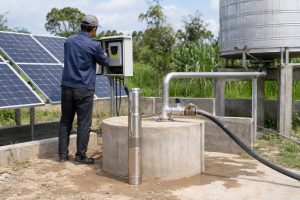
Consider a solar-powered water pump, a technology vital for agriculture in off-grid areas of Africa, the Americas, and Asia.
A standard "solar direct" system will see its water flow fluctuate with the sun's intensity.
This is simply not acceptable for many users.
- Inconsistent Water Flow: During peak sun, the pump works well. During cloudy spells, the flow rate drops, failing to meet irrigation or livestock watering needs.
- System Shutdown: At night, a solar direct pump stops working entirely, unless you have an expensive and maintenance-heavy battery bank.
- Feature Failure: As noted with solar pool pumps, features like spa jets or fountains require consistent, high flow rates that a weather-dependent pump cannot guarantee.
The Modern Solution: Hybrid Systems
The industry has moved beyond simple solar-direct models to solve this core problem.
Advanced controllers now offer hybrid functionality, creating a seamless and reliable energy supply.
A state-of-the-art AC/DC hybrid controller is designed with two power inputs.
It can be connected to solar panels and a traditional AC source (like the grid or a generator) at the same time.
The intelligent controller automatically prioritizes solar energy when available.
If solar power is insufficient due to clouds, the controller blends in AC power to maintain performance.
When there is no solar input at all, it automatically switches entirely to the AC source.
This guarantees worry-free, 24-hour operation, effectively eliminating the primary disadvantage of solar power.
| Power Source Priority | Scenario | Outcome |
|---|---|---|
| 1. Solar (PV) | Sunny Day | System runs 100% on free solar energy. |
| 2. Hybrid (PV + AC) | Cloudy Day / Low Light | Controller maximizes solar use and supplements with AC power. |
| 3. AC Power | Night / No Sunlight | System automatically switches to grid or generator power. |
This intelligent management turns an unreliable power source into a dependable, cost-effective, and resilient solution for any application.
The Upfront Cost: A Barrier to Entry?
Everyone loves the idea of free energy from the sun.
But the initial price tag for a solar system can be intimidating.
It often feels like a long-term investment that is just out of reach.
While solar energy saves money over time, the high initial cost of purchasing and installing panels, inverters, and potentially batteries is a significant financial barrier.
The payback period can take several years, making it a challenging investment for many homeowners and small businesses without financing or incentives.
The cost of a solar installation is a major talking point.
While prices have fallen dramatically over the last decade, a full system is still a considerable expense.
A typical residential solar PV system can cost thousands of dollars.
For businesses or agricultural operations requiring more power, the investment is even larger.
Let's break down the economics and how the industry is making it more accessible.
Calculating the Return on Investment (ROI)
Investing in solar is a numbers game.
You are trading a large upfront cost for decades of reduced or eliminated electricity bills.
A typical 1 horsepower (HP) pool pump running 8 hours a day can cost over $550 per year in electricity in a place like Florida.
A solar pump system to replace it might cost around $5,000.
After a 30% federal tax credit, the net cost drops to $3,500.
In this scenario, the payback period would be about 6.3 years.
That represents a return on investment (ROI) of over 15% annually, which is better than many traditional investments.
However, this calculation assumes the equipment lasts and works perfectly.
If a key component fails before the payback period is over, the financial benefits diminish quickly.
Reducing Costs with Smart Engineering
The key to improving ROI isn't just about government incentives; it's about engineering efficiency.
This is especially true in the B2B market, where distributors and installers are looking for a competitive edge.
The most critical component for efficiency is the motor.
High-efficiency motors are the core of a cost-effective solar water pump system.
Modern solar pumps utilize Brushless DC (BLDC) permanent magnet motors, which can achieve efficiencies of over 90%.
Here’s why that matters:
- Fewer Solar Panels: A more efficient motor requires less power to do the same amount of work. This directly translates to needing fewer solar panels to run the system, reducing the largest single cost component of the installation.
- Lower Operating Costs: By maximizing the energy converted from every sunbeam, high-efficiency motors reduce the reliance on expensive grid power in hybrid systems.
- Compact & Lightweight Design: Advanced BLDC motors can be up to 47% smaller and 39% lighter than traditional motors. This simplifies logistics, reduces shipping costs for importers, and makes installation faster and easier for technicians.
By focusing on core motor technology, manufacturers can provide a system that is not only cheaper to install but also delivers superior long-term value, making the upfront investment much more attractive for end-users and more profitable for distributors.
Performance Limitations: Not a One-Size-Fits-All Solution
Thinking solar can power anything is a common mistake.
Many specialized systems have power demands that basic solar setups can't meet.
This leads to disappointing performance and wasted investment.
Standard solar energy systems often lack the power and consistent flow rates required for high-demand applications.
Equipment like heaters, spa jets, or large-scale irrigation systems may not function optimally or at all, as solar output varies and may not meet the minimum operational thresholds.
The allure of "free energy" can lead people to overlook crucial technical requirements.
Power is not just about having electricity; it's about having the right kind of electricity, at the right time, and at the right volume.
This is where many solar-only systems fall short, especially in the world of water pumping.
Different applications have vastly different needs for flow and pressure (head).
A one-size-fits-all pump simply doesn't exist.
Matching the Pump to the Job
The failure to match pump technology to the specific water need is a primary source of dissatisfaction with solar water systems.
A pump designed for one task will perform poorly in another.
A sophisticated product portfolio is required to meet diverse market demands, from small domestic wells to large-scale agriculture.
Let's examine three distinct types of solar deep well pumps and their ideal applications.
1. Solar Screw Pumps
- Principle: Uses a stainless steel screw (rotor) inside a rubber stator. It pushes water upward through compression.
- Performance: Delivers low flow but can achieve a very high head (pressure). It is excellent for lifting water from very deep wells.
- Best For: Domestic water supply, livestock drinking troughs, and small-scale drip irrigation where well depth is the main challenge. Its high resistance to sand makes it ideal for harsh water conditions in regions like Africa and Latin America.
- Limitations: The flow rate is limited, making it unsuitable for applications requiring large volumes of water, such as flood irrigation for large farms.
2. Solar Plastic Impeller Centrifugal Pumps
- Principle: A multi-stage centrifugal pump equipped with durable, wear-resistant plastic impellers.
- Performance: Provides high flow rates at a medium head.
- Best For: Farm irrigation, pasture water management, and filling residential cisterns. The high volume output and excellent resistance to fine sand make it a cost-effective workhorse popular in the Americas and for agricultural use in Africa.
- Limitations: Not ideal for highly corrosive water or extremely deep wells, as the materials can degrade over time under such stress.
3. Solar Stainless Steel Impeller Centrifugal Pumps
- Principle: A premium multi-stage centrifugal pump using SS304 stainless steel for both the impellers and pump body.
- Performance: Offers high flow and medium-to-high head, with exceptional durability.
- Best For: Corrosive water environments, such as areas with acidic or alkaline water tables. It is a preferred choice for alkaline soil regions in Australia, parts of the Americas, and for high-end residential or commercial properties demanding maximum reliability and long service life.
- Limitations: This is a premium product with a higher cost and weight, targeting a more niche, high-value market.
| Pump Type | Flow Rate | Head (Pressure) | Key Advantage | Target Market |
|---|---|---|---|---|
| Screw Pump | Low | Very High | Sand Resistance | Deep wells, Homes |
| Plastic Impeller | High | Medium | Wear Resistance / Cost | Farms, Ranches |
| Stainless Steel Impeller | High | Medium-High | Corrosion Resistance | Corrosive Water, High-End |
Ultimately, overcoming performance limitations isn't just about having power; it's about having a flexible product portfolio.
For a distributor, this means being able to offer customers the right tool for the right job, ensuring performance, reliability, and customer satisfaction.
Environmental & Production Concerns
We champion solar as a green technology.
But what about the energy and materials needed to create the panels themselves?
The manufacturing process has its own environmental footprint that is often overlooked.
While solar energy is clean during operation, the manufacturing of solar panels and batteries is energy-intensive and involves mining raw materials like silicon, lithium, and other metals.
This process can contribute to greenhouse gas emissions and ecological damage if not managed sustainably.
The "green" label on solar energy primarily applies to its operational phase.
Once installed, a solar panel produces electricity with zero carbon emissions.
However, the lifecycle of a solar panel—from raw material extraction to manufacturing and eventual disposal—is not entirely without environmental impact.
This is a critical point of discussion when evaluating the true sustainability of solar technology.
The Manufacturing Footprint
Creating a solar panel is a complex, multi-step process.
- Raw Material Extraction: The primary component of most solar panels is silicon, which is derived from quartz. Mining quartz requires energy and can disrupt local ecosystems. Other materials, like silver, aluminum, and copper, also need to be mined and processed.
- Purification and Ingot Production: The raw silicon must be purified to an extremely high grade (99.9999% purity), a process that consumes a massive amount of electricity. This purified silicon is then melted and formed into large cylindrical ingots.
- Wafer, Cell, and Module Assembly: The ingots are sliced into ultra-thin wafers. These wafers are treated with chemicals (like phosphorus and boron) to create the photovoltaic cell, and then assembled into modules (panels). Each step requires significant energy.
The "Energy Payback Time" (EPBT) is the time it takes for a solar panel to generate the same amount of energy that was required to produce it.
Thanks to manufacturing improvements, the EPBT for modern panels has dropped to just 1-2 years.
Given that panels have a lifespan of 25-30 years, they will produce 12 to 30 times more energy than they consumed during their production.
The Battery Dilemma
Energy storage is key to overcoming solar's intermittency, but batteries bring their own environmental challenges.
- Material Sourcing: Lithium-ion batteries, the current standard, rely on materials like lithium, cobalt, and nickel. The mining of these materials, particularly cobalt, is associated with significant environmental and social issues.
- Recycling and Disposal: Solar batteries have a lifespan of 5-15 years, much shorter than the panels themselves. While recycling processes exist, they are complex and not yet widely implemented on a large scale. Improper disposal can lead to soil and water contamination.
Despite these challenges, the net environmental benefit of solar technology remains overwhelmingly positive.
The carbon footprint of manufacturing is paid back relatively quickly.
Furthermore, the solar industry is heavily invested in improving sustainability.
Ongoing research is focused on:
- Reducing the amount of silicon and silver needed in panels.
- Developing new battery chemistries that use more abundant and less harmful materials.
- Establishing robust, closed-loop recycling programs for both panels and batteries.
For distributors and importers, aligning with manufacturers who prioritize sustainable production and hold certifications like RoHS (Restriction of Hazardous Substances) demonstrates a commitment to true environmental responsibility.
Conclusion
The major disadvantage of solar power—its intermittency—is now largely a solved problem.
Modern hybrid systems and efficient designs ensure reliable, 24/7 energy for any application.
FAQs
What are 2 real-world disadvantages of solar energy?
The two main disadvantages are its intermittency, as it only works with sunlight, and the high upfront cost required for installation, which can take years to pay back.
Why is solar energy not used by everyone?
Not everyone uses solar due to the high initial investment, lack of suitable roof space or orientation, and concerns about its reliability at night or during poor weather.
What is the main problem with solar panels?
The main problem with solar panels is their dependence on sunlight. Production stops at night and is greatly reduced by clouds, making consistent power supply a challenge without storage.
Is solar energy a failure?
No, solar energy is not a failure. It is a rapidly growing, increasingly affordable renewable energy source whose main drawback, intermittency, is being solved by battery storage and hybrid systems.
Can solar panels power a house 24/7?
Yes, but not on their own. To power a house 24/7, solar panels must be combined with a battery storage system or a connection to the utility grid.
Does solar work on rainy days?
Yes, solar panels do work on rainy days, but their output is significantly reduced. They will produce about 10-25% of their normal power, depending on cloud thickness.
How long do solar panels last?
Most solar panels come with a performance warranty of 25-30 years. They will continue to produce electricity after that, but their efficiency will slowly decrease over time.