Struggling to move water over long distances for your farm or property?
A miscalculation could lead to an underperforming system.
Choosing the right pump is critical for success.
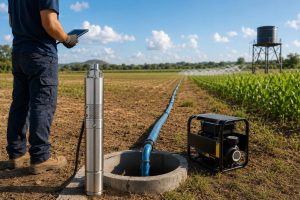
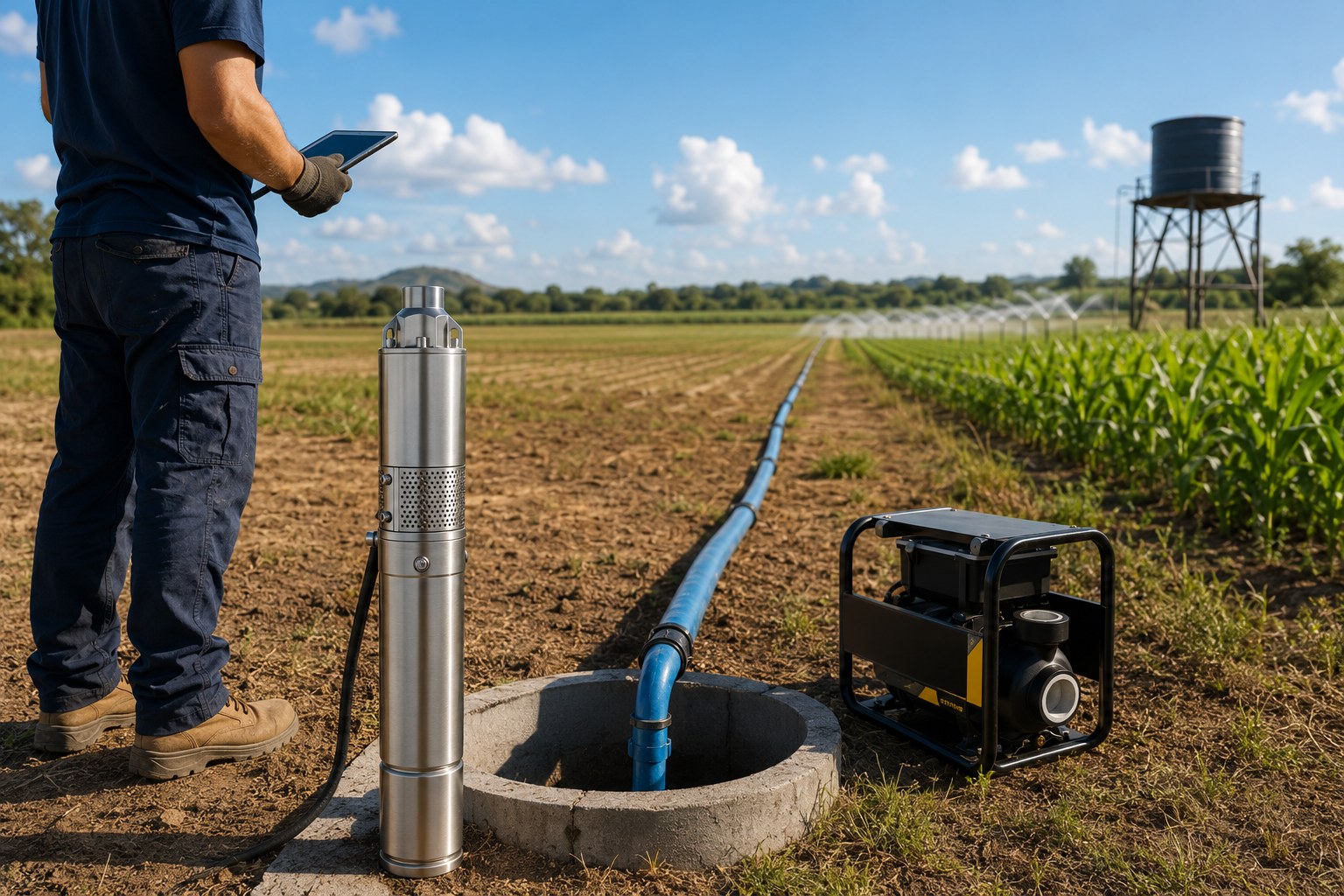
A typical 2 HP submersible pump can push water 3,000 to 8,000 feet horizontally on level ground. Its vertical lift, or head, often ranges from 150 to over 250 feet. However, the exact distance depends heavily on pipe size, flow rate, and elevation changes.
Understanding your pump's capabilities is more than just reading a spec sheet.
It's about designing a water system that delivers reliable results day after day.
Many factors can drastically reduce a pump's effective range.
Failing to account for them can turn a powerful pump into a weak link in your water supply chain.
Let's break down the key variables that determine exactly how far your 2 HP pump can push water, ensuring you make an informed investment.
Understanding the Core Mechanics of a 2 HP Pump
Your water system is failing to deliver the pressure you need.
This lack of performance halts irrigation and costs you money.
You need a pump that can overcome the distance.
The performance of a 2 HP pump is defined by its ability to generate head pressure. This pressure, dictated by motor power and impeller design, must overcome the total resistance of your system, including vertical lift, horizontal distance, and friction, to move water effectively.
To truly grasp how far a 2 HP pump can move water, we need to look beyond simple horsepower ratings.
The core concept is Total Dynamic Head (TDH), which is the total equivalent height that a fluid is to be pumped, taking into account friction losses in the pipe.
It's the sum of all the resistances your pump must fight against.
Total Dynamic Head (TDH) is Everything
TDH combines several critical factors into a single number, usually measured in feet or meters.
A 2 HP pump's performance curve will show you exactly how much water (flow rate) it can deliver at a specific TDH.
The main components of TDH are:
- Static Lift: This is the vertical distance from the water source's surface to the highest point in your discharge pipe. A 2 HP pump might have a maximum head of 250 feet, meaning it can lift water 250 feet straight up with zero flow at the outlet.
- Friction Loss: As water moves through pipes, fittings, and valves, it creates friction. This resistance slows the water down and consumes pump energy. A longer pipe, a smaller diameter pipe, or more bends will all increase friction loss significantly.
- Operating Pressure: This is the pressure required at the end of the pipe. For example, if you are feeding a sprinkler system, you might need 40 PSI (pounds per square inch) of pressure at the sprinkler head. Every 1 PSI of pressure required is equivalent to 2.31 feet of additional head the pump must generate.
The Power of the Motor
The heart of any solar pump system is its motor.
Modern systems utilize high-efficiency Brushless DC (BLDC) permanent magnet motors.
These motors can achieve efficiencies over 90%, a significant jump from traditional AC motors.
For a 2 HP system, this high efficiency is crucial.
It means more of the sun's energy is converted directly into water-pumping power.
This translates to better performance, especially on partly cloudy days.
A high-efficiency motor allows the pump to generate higher torque, enabling it to start under load and maintain pressure more effectively over long distances.
This efficiency also reduces the number of solar panels needed by up to 25%, lowering the initial system cost and simplifying installation.
| Motor Type | Typical Efficiency | Key Advantage | Impact on Pumping Distance |
|---|---|---|---|
| BLDC Permanent Magnet | >90% | High torque, low energy use | Maximizes distance per watt of solar power |
| Standard AC Motor | 60-75% | Widely available | Requires more power for the same distance |
| Brushed DC Motor | 75-80% | Simple design | Less efficient, shorter lifespan |
Choosing a pump with a superior motor is a strategic decision.
It directly impacts the system's reach, reliability, and long-term operating costs.
Key Factors That Affect Horizontal Pumping Distance
You assume your new 2 HP pump will solve your water problem.
But it's not delivering water to the far end of your property.
You've overlooked the critical factors that reduce pump performance.
The primary factors limiting a 2 HP pump's horizontal reach are pipe diameter, required flow rate, and elevation changes. An undersized pipe or a high flow rate can increase friction exponentially, drastically cutting the effective pumping distance by as much as 50% or more.
A 2 HP pump has a significant amount of power, but that power can be wasted if the system is not designed correctly.
Each component of your water system plays a role in determining the final distance water can travel.
Understanding these variables allows you to design a system that maximizes efficiency and reach.
Pipe Diameter and Material: The Unseen Bottleneck
The size of your pipe is arguably the most critical factor after the pump itself.
Water flowing through a small pipe experiences far more friction than in a larger one.
Doubling the pipe diameter can reduce friction loss by a factor of four or more.
- Impact of Diameter: For a 2 HP pump moving 20 gallons per minute (GPM), a 1.5-inch pipe might have a friction loss of about 4 feet of head per 100 feet of pipe. Increasing the pipe to 3 inches could drop that loss to less than 0.5 feet per 100 feet. Over a 5,000-foot run, that's the difference between 200 feet of friction head and just 25 feet.
- Material Matters: The smoothness of the pipe's interior also affects friction. Smooth PVC or HDPE pipes create the least resistance. Older, rougher materials like galvanized steel or concrete can increase friction losses by 15-30% compared to PVC.
Flow Rate Requirements: A Balancing Act
How much water do you need to move?
The answer has a direct trade-off with distance.
A pump's energy is split between pushing water forward (creating distance) and moving a certain volume of it (flow rate).
Higher flow rates cause more turbulence inside the pipe, which dramatically increases friction.
A 2 HP pump might be able to push 10 GPM for 8,000 feet, but if you need 30 GPM, that distance could drop to less than 3,000 feet with the same pipe size.
It's essential to consult the pump's performance curve, which plots flow rate against total dynamic head, to find the sweet spot for your application.
| Flow Rate (GPM) | Friction Loss in 2" Pipe (ft/100ft) | Friction Loss in 3" Pipe (ft/100ft) |
|---|---|---|
| 15 | 1.2 | 0.2 |
| 30 | 4.3 | 0.8 |
| 45 | 9.0 | 1.7 |
As the table shows, increasing the flow rate from 15 GPM to 45 GPM increases friction loss by over 700% in a 2-inch pipe.
Elevation Changes: The Power of Gravity
Even on what looks like flat ground, small changes in elevation have a massive impact.
Every foot of vertical lift your pump must overcome is a foot of static head added to the TDH.
This directly reduces the energy available to push water horizontally.
Conversely, a downhill slope can assist the pump.
Gravity will add pressure to the system, a phenomenon known as "gravity head."
This can effectively extend your pump's horizontal reach.
Careful surveying of your pipe route is not an optional step; it's a requirement for an accurate calculation.
Calculating Your Specific 2 HP System Requirements
You're ready to buy a pump but don't know your system's needs.
Guessing the wrong specifications leads to system failure and wasted investment.
You need to perform a precise calculation before you purchase.
To determine if a 2 HP pump is right for you, you must calculate your Total Dynamic Head (TDH). This involves adding your static lift (vertical height), all friction losses from pipes and fittings, and any required pressure at the destination. This total defines your pump's workload.
Moving from a general understanding to a specific calculation is the most critical step in designing your water pump system.
This process removes guesswork and ensures the 2 HP pump you select will perform as expected in your unique environment.
Step-by-Step System Head Calculation
Follow these steps to find your system's Total Dynamic Head.
You’ll need to know your vertical lift, pipe length, pipe size, and desired flow rate.
- Calculate Static Head: Measure the vertical distance from the water level in your well or tank to the highest point of the discharge pipe. For example, if your well water is 100 feet down and the pipe outlet is 20 feet above ground, your static head is 120 feet.
- Calculate Friction Loss: This is the most complex part. You need to account for the pipe itself and all the fittings.
- Pipe Friction: Use an online friction loss calculator or a chart based on the Hazen-Williams formula. For a 2 HP system aiming for 30 GPM, a 4,000-foot run of 3-inch PVC pipe would have about 32 feet of friction head (0.8 ft per 100 ft).
- Fitting Friction: Every elbow, valve, and tee adds resistance. A 90-degree elbow can add friction equivalent to several feet of straight pipe. Sum the equivalent lengths of all fittings and add this to your total pipe length for a more accurate calculation. A system with many bends can easily add another 10-15% to the total friction loss.
- Determine Pressure Head: If you need pressure at the outlet (e.g., for sprinklers), convert it to head. If you need 40 PSI, multiply by 2.31. This adds 92.4 feet of head to your calculation.
- Sum for Total Dynamic Head (TDH):
- Static Head + Pipe Friction Loss + Pressure Head = TDH
- Example: 120 ft (Static) + 32 ft (Friction) + 92.4 ft (Pressure) = 244.4 ft TDH.
Matching TDH to a 2 HP Pump Curve
Once you have your TDH and target flow rate (e.g., 244.4 ft at 30 GPM), you can look at a 2 HP pump's performance curve.
This chart, provided by the manufacturer, shows if the pump can meet your requirements.
If your calculated point falls on or below the curve, the pump is suitable.
If it's above the curve, the pump is too small, and you'll need a more powerful model or need to redesign your system (e.g., use a larger pipe).
It’s also wise to add a safety margin of 10-20% to your TDH calculation.
This accounts for factors like pipe aging, which can increase friction over time, and potential variations in water level.
An intelligent MPPT (Maximum Power Point Tracking) controller is essential for solar systems.
It continuously adjusts the pump's operation to match the available solar power, maximizing water output throughout the day and ensuring the pump operates at its most efficient point on the curve.
Some advanced systems also offer AC/DC hybrid controllers.
These automatically switch to grid or generator power when solar energy is insufficient, ensuring a reliable 24/7 water supply.
Maximizing Your 2 HP Pump's Horizontal Reach
Your pump is installed, but it’s not reaching the last irrigation zone.
You're facing costly re-installation or crop loss.
You must optimize your system to extend its reach.
The most effective way to maximize a 2 HP pump's horizontal range is by increasing the pipe diameter. Upgrading from a 2-inch to a 3-inch pipe can reduce friction loss by over 60%, allowing the pump to push water significantly farther with the same amount of energy.
Getting the most out of your 2 HP pump isn't just about buying a quality unit.
It's about smart system design.
A few strategic choices during the planning phase can dramatically extend your pump’s effective range, saving you money on both initial installation and long-term operating costs.
Pipe Sizing is a Financial Decision
While a larger pipe has a higher upfront material cost, it almost always pays for itself over the system's lifetime.
Reducing friction loss means the pump doesn't have to work as hard.
- Lower Energy Costs: In a solar setup, lower energy demand means you might be able to use a smaller, less expensive solar array. It also means the pump will start earlier in the morning and run later in the evening, increasing your total daily water output by up to 20%.
- Reduced Wear and Tear: A pump operating under less strain will last longer and require less maintenance, reducing its total cost of ownership.
- Future-Proofing: Installing a larger pipe than you currently need provides capacity for future expansion without having to dig up and replace your main pipeline.
Strategic Use of Multiple Pumps
For extremely long distances, a single large pump is not always the most efficient solution.
A booster pump strategy often proves superior.
Instead of one 2 HP pump trying to push water 10,000 feet, you could use two 1 HP pumps.
The first pump would push the water 5,000 feet to a holding tank, and a second booster pump would then take it the remaining distance.
This approach offers several advantages:
- Increased Efficiency: Each pump operates closer to its Best Efficiency Point (BEP), saving energy.
- Redundancy: If one pump fails, you don't lose your entire water supply.
- Easier Maintenance: Smaller pumps are generally easier and cheaper to service or replace.
Designing an Efficient Pumping System
Beyond pipe size, other design elements can help you maximize distance.
- Minimize Bends and Fittings: Design the pipe layout to be as straight as possible. Every 90-degree elbow you eliminate reduces friction. Use sweeping 45-degree bends instead of sharp 90s where turns are necessary.
- Use High-Quality Valves: Choose full-port ball valves or gate valves, as they create minimal restriction when fully open, unlike globe valves.
- Incorporate a Variable Frequency Drive (VFD): For solar pumps, an intelligent controller with a VFD is standard. This device adjusts the motor's speed to match the exact flow and pressure requirements, preventing the pump from running at full power unnecessarily and saving significant energy. It also enables soft starts, which reduce mechanical and electrical stress on the entire system.
By combining these strategies, you can transform a standard 2 HP pump system into a highly optimized, efficient, and long-reaching water delivery machine.
Conclusion
A 2 HP pump offers substantial power, but its true reach depends on smart system design.
Prioritize correct pipe sizing and accurate head calculations to maximize performance and ensure a reliable water supply.
Frequently Asked Questions
What is the maximum head of a 2 HP submersible pump?
The maximum head for a 2 HP submersible pump typically ranges from 150 to over 250 feet (45 to 76 meters). This varies based on the pump's design and brand.
Can a 2 HP pump be used for a deep well?
Yes, a 2 HP pump is well-suited for deep wells. With a vertical lift capacity often exceeding 200 feet, it can effectively pump water for residential or agricultural use.
How many solar panels are needed to run a 2 HP water pump?
A 2 HP motor requires about 1500 watts. You would typically need a solar array of 2000 to 2500 watts to run it effectively, accounting for real-world conditions and efficiency losses.
How do I choose the right pipe size for my 2 HP pump?
To choose the right pipe size, calculate your required flow rate and total pipe length. Use a friction loss chart to select a diameter that keeps friction losses low, usually under 5 feet per 100 feet.
Does a 2 HP pump need a pressure tank?
While not always required, a pressure tank is highly recommended. It reduces pump cycling, which saves energy, extends the pump's lifespan, and provides more consistent water pressure.
What is the difference between a 2 HP surface pump and a submersible pump?
A submersible pump is placed directly in the water source and pushes water up. A surface pump sits on land and pulls water from a source, making it better for shallow wells or tanks.
How much water can a 2 HP pump move?
A 2 HP pump's flow rate depends on the total head. It might deliver over 50 gallons per minute at low head but drop to 15-20 GPM at higher head pressures.
Can I run a 2 HP pump on a generator?
Yes, you can run a 2 HP pump on a generator. You will need a generator rated for at least 3500-4000 watts to handle the pump's startup power surge.