Struggling with unreliable water access and soaring fuel costs for your current pump?
Constant maintenance and dependence on the grid can be a significant drain on resources.
Imagine a world where you harness free solar energy for a consistent, low-maintenance water supply.
No, solar water pumps do not strictly need batteries to function.
They are designed to operate directly from solar panels during daylight hours.
However, batteries are one of several options, alongside water storage and hybrid systems, to ensure water availability at night or during consistently cloudy weather, providing a truly 24/7 solution.
Understanding this core function is key to designing the most efficient and cost-effective system for your specific needs.
While the idea of storing solar power seems logical, the direct-drive approach is often the most practical and economical.
So, how does this work, and what are the trade-offs?
Let's delve into the mechanics of solar pumping and explore why a battery-free setup is the preferred choice for many, and when you might consider alternatives.
This guide will walk you through all the options to help you make an informed decision.
The Simplicity of Direct Solar Pumping
Concerned that adding batteries will drastically increase your system's cost and complexity?
The short lifespan and maintenance needs of batteries can be a major drawback.
Discover how a direct-drive system offers a streamlined, reliable, and more affordable solution for water pumping.
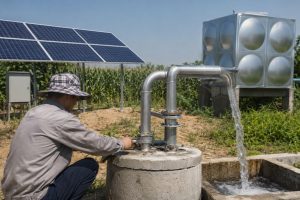
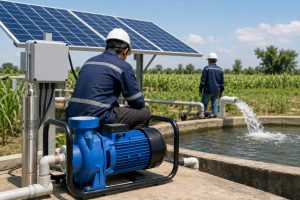
A battery-free, or direct-drive, solar pump system is the most common and efficient configuration.
In this setup, solar panels are connected directly to the pump via an intelligent controller.
This eliminates the initial expense, ongoing maintenance, and eventual replacement costs of a battery bank, offering a simple and durable solution for daytime water needs.
The Power of Direct Connection
A direct-drive solar pumping system is elegantly simple.
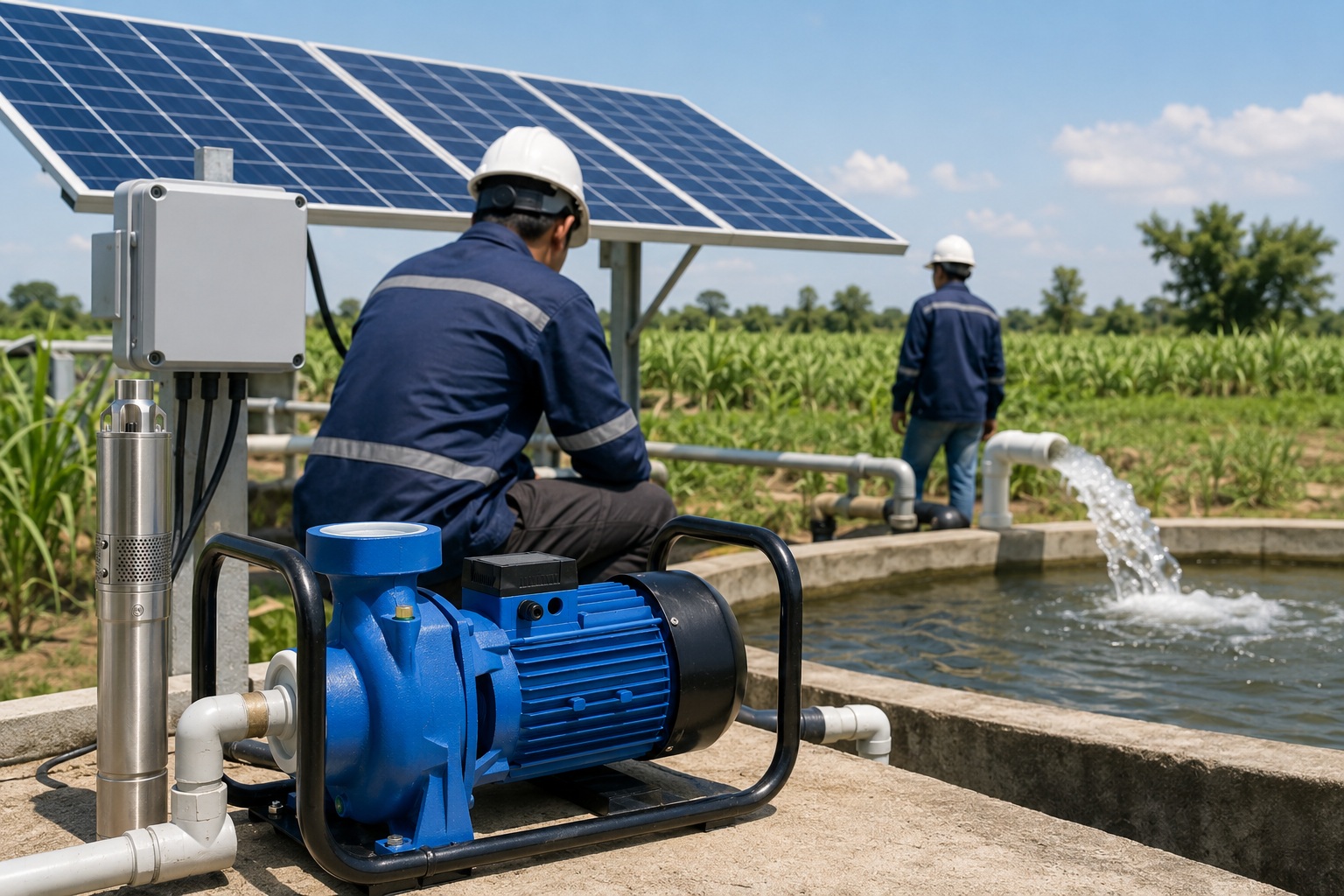
It consists of three primary components: the solar panels, an MPPT controller, and the pump itself.
When sunlight hits the solar panels, they generate DC (Direct Current) electricity.
This electricity flows to the MPPT (Maximum Power Point Tracking) controller.
The controller acts as the system's brain, optimizing the power from the panels and delivering it directly to the pump's motor.
The pump then activates, moving water from your source to your destination.
This entire process happens in real-time without any need for energy storage.
The system's performance is directly proportional to the amount of sunlight, or solar irradiance, available.
On a bright, sunny day, the pump operates at or near its maximum capacity.
On an overcast day, it will still operate but at a reduced flow rate, a testament to the efficiency of modern systems.
For thousands of applications globally, this daytime-only operation is more than sufficient.
Core Technology: The BLDC Motor
The heart of a modern solar water pump is its high-efficiency motor.
Most premium solar pumps utilize a Brushless DC (BLDC) permanent magnet motor.
These motors are a game-changer, with operational efficiencies often exceeding 90%.
A high-efficiency motor is crucial because it converts more of the sun's energy into useful work—pumping water.
This means the pump can start earlier in the morning, run later in the evening, and perform better during cloudy periods.
Technically, these motors use powerful neodymium iron boron magnets in their rotors, delivering high torque even at low speeds.
Their advanced design is also significantly more compact, often being up to 47% smaller and 39% lighter than traditional motors.
This not only simplifies shipping and installation but also underscores the modern engineering behind these systems.
A high-efficiency BLDC motor directly reduces the number of solar panels needed, lowering the overall system cost and making solar pumping more accessible.
System Intelligence: The MPPT Controller
The silent hero of the battery-free system is the MPPT controller.
Its function is to maximize the energy harvest from the solar panels.
Solar panels have a specific voltage and current at which they produce the most power, known as the "maximum power point."
This point changes constantly with temperature and sunlight intensity.
The MPPT controller continuously tracks this optimal point and adjusts the electrical parameters to ensure the pump motor receives the maximum possible power at any given moment.
Without an MPPT controller, a system could lose 20-30% of its potential power.
With it, the system gains the ability to function effectively even under less-than-ideal conditions, such as during hazy or partly cloudy weather.
This intelligent power management makes a direct-drive system remarkably resilient and effective, significantly reducing the argument for needing a battery buffer in most situations.
| Feature | Direct-Drive System | Battery-Based System |
|---|---|---|
| Initial Cost | Lower | Higher (30-50% more) |
| Complexity | Simple (Fewer components) | Complex (Requires batteries, charge controller) |
| Maintenance | Minimal (Clean panels) | High (Battery monitoring, fluid checks) |
| Lifespan | Long (20+ years for panels, 10+ for pump) | Shorter (Batteries last 3-7 years) |
| Efficiency | High (Direct power transfer) | Lower (Losses from charging/discharging) |
When Cloudy Days Arrive: Ensuring Water Flow
Worried that a few cloudy days will leave you without water?
The unreliability of weather can be a major concern when depending on solar power.
Let's explore practical, battery-free strategies to guarantee a consistent water supply, no matter the weather.
The most reliable and recommended method to handle cloudy days is not batteries, but water storage.
By pumping water into a storage tank on sunny days, you create a water reserve.
This stored water can then be gravity-fed to where it's needed, ensuring you have a consistent supply for 3-5 days of bad weather.
The "Water Battery" Strategy
The concept is simple: store the product, not the power.
Instead of investing in expensive and perishable batteries to store electricity, you invest in a durable tank to store water.
This approach is often called a "water battery."
During peak sunlight hours, your solar pump works at its maximum capacity, pumping more water than you may need at that moment.
This surplus water is directed into a storage tank, typically elevated on a stand or a hill.
When the sun goes down or clouds roll in, you have a ready supply of water.
This stored water can be distributed using gravity, eliminating the need for a second pump or any additional energy.
It's a low-tech, highly effective solution that aligns perfectly with the rhythm of solar energy.
A well-sized tank can provide 3 to 5 days of water autonomy, creating a robust buffer against extended periods of poor weather.
This strategy is far more cost-effective and sustainable than relying on chemical batteries.
Tanks have a much longer lifespan, require virtually no maintenance, and are a one-time capital investment that adds permanent value to your property.
Sizing Your Water Storage
To implement this strategy effectively, you need to properly size your storage tank.
The first step is to calculate your daily water demand.
This will vary based on your application, whether it's for livestock, crop irrigation, or domestic use.
For instance, a single cow might drink up to 15 gallons per day, while an acre of crops could require thousands of gallons.
Once you know your daily need, you can determine how many days of autonomy you want.
A common recommendation is to plan for at least three days of storage.
So, if your daily water requirement is 1,000 gallons, you would need a tank with a minimum capacity of 3,000 gallons.
It's often wise to oversize the tank slightly to account for unexpected demands or longer-than-usual cloudy spells.
This upfront planning ensures your "water battery" is large enough to provide true water security.
Pump Performance in Low Light
A common myth is that solar pumps stop working the moment a cloud appears.
This is not true for modern, high-quality systems.
Thanks to the efficient BLDC motors and intelligent MPPT controllers discussed earlier, these pumps can operate even in overcast or rainy conditions.
While the flow rate will be reduced, they will continue to pump water.
For example, a pump rated for 10 gallons per minute in full sun might produce 3-5 gallons per minute on a heavily overcast day.
This reduced but continuous pumping still contributes to filling your storage tank.
Over the course of a cloudy day, the pump can still add a significant amount of water to your reserve.
This resilience means your system isn't just an "on or off" device.
It's a dynamic system that adapts to available energy, constantly working to keep your water supply secure.
This performance characteristic is a key reason why direct water storage is so effective—the system keeps replenishing the supply even when the sun isn't shining brightly.
The Role of Hybrid Solar Pump Systems
What if you absolutely need water 24/7, regardless of sun or stored supply?
Relying solely on solar or stored water might not meet critical demands.
Hybrid systems offer the ultimate flexibility, blending solar with another power source for guaranteed, around-the-clock operation.
A hybrid solar pump system, also known as an AC/DC pump, provides the ultimate water security.
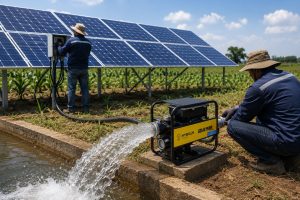
It prioritizes free solar energy during the day but can automatically switch to an alternate power source, like the grid or a generator, when sunlight is insufficient.
This ensures uninterrupted water pumping 24/hours a day.
How Hybrid Systems Work
The core of a hybrid system is a specialized controller designed with dual power inputs.
It can accept both DC power from solar panels and AC power from the electrical grid or a generator.
The controller's internal logic is programmed to always prioritize the solar input.
As long as the solar panels are producing enough power to run the pump, the system will use 100% free solar energy.
If clouds reduce the solar output, the controller can seamlessly blend in AC power to maintain the desired water flow.
When there is no solar input at all, such as at night or during a storm, the controller will automatically switch over completely to the AC power source.
This intelligent switching happens automatically, without any need for manual intervention.
It offers the best of both worlds: the cost savings and sustainability of solar, combined with the on-demand reliability of a conventional power source.
This ensures that critical operations, like irrigating a high-value crop or supplying water to a large herd of livestock, are never compromised.
When to Choose a Hybrid System
A hybrid system is the ideal solution for specific, mission-critical applications.
Consider a hybrid system if:
- You require 24/7 Pumping: Applications like industrial processes, large-scale dairy operations, or community water supplies cannot afford any downtime.
- Water Storage is Impractical: In some situations, installing a large water tank may not be feasible due to space constraints, terrain, or cost. A hybrid system provides an alternative way to guarantee water access.
- You Need to Irrigate at Night: Some irrigation methods, like drip irrigation, are more efficient at night when evaporation is lower. A hybrid system allows you to run your pump on grid power after sunset.
- You Have an Existing AC Pump: In some cases, a solar pump inverter can be used to convert an existing AC pump into a solar-hybrid pump, allowing you to leverage your current equipment while adding the benefits of solar power.
Cost and Benefit Analysis
While a hybrid system has a higher upfront cost than a direct-drive solar system, it is often more economical than relying on a generator alone.
Let's break down the economics.
A generator has a lower initial purchase price, but it comes with continuous and ever-increasing fuel costs.
It also requires frequent maintenance, including oil changes and servicing, which adds to the lifetime operating cost.
A hybrid solar system, by contrast, operates on free solar energy for the majority of the time.
The AC power source is only used as a backup, dramatically reducing fuel or electricity bills.
While the initial investment is higher, the return on investment (ROI) is often realized within just a few years due to these massive operational savings.
The solar components also have a much longer lifespan and require minimal maintenance, further improving the long-term financial picture.
For businesses and large farms, a hybrid system is not just an expense; it's a strategic investment in operational stability and long-term cost reduction.
| Power Solution | Pros | Cons | Best For |
|---|---|---|---|
| Grid Power Only | High reliability, 24/7 operation. | High electricity costs, vulnerable to power outages. | Areas with stable and affordable grid access. |
| Generator Only | Lower initial cost, portable. | High fuel costs, noisy, high maintenance, emissions. | Temporary or emergency backup power. |
| Solar Hybrid | Uses free solar energy, 24/7 reliability, low operating cost. | Higher initial cost than a generator. | Mission-critical applications needing 24/7 water. |
Choosing the Right Pump for Your System
You understand the power options, but which pump type is right for your water source?
Choosing the wrong pump can lead to inefficiency, low water flow, or premature failure.
Matching the pump to your well depth, water quality, and flow requirements is critical for success.
The ideal solar water pump depends on your specific needs: low flow and high head (deep wells) call for a screw pump; high flow for irrigation is best served by a plastic impeller pump; and corrosive water requires a durable stainless steel impeller pump.
All are powered by the same high-efficiency motor technology.
For Deep Wells: Solar Screw Pumps
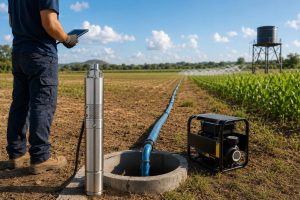
Solar screw pumps, also known as progressing cavity pumps, are engineered for high-head, low-flow applications.
This means they excel at lifting water from very deep wells.
The pump mechanism uses a helical stainless steel rotor that turns inside a rubber stator.
This action creates sealed cavities that move water upward with each rotation, generating powerful pressure.
Their key advantage is their ability to handle water with higher concentrations of sand and silt without damage, making them extremely durable in harsh well conditions.
They are the perfect choice for domestic water supply, livestock watering troughs, and small-scale drip irrigation where the well is deep but the volume of water needed is not massive.
Their simple, robust design ensures a long service life with minimal maintenance.
For High Volume Irrigation: Solar Plastic Impeller Pumps
When your priority is moving a large volume of water for applications like flood irrigation or filling large reservoirs, a centrifugal multi-stage pump with plastic impellers is the answer.
These pumps use a series of stacked impellers that spin at high speed to move water.
The use of high-strength, wear-resistant engineering plastic for the impellers offers two significant benefits.
First, it makes the pump lightweight and more economical.
Second, it provides excellent resistance to abrasion from fine sand, which is a common issue in many agricultural wells.
This combination of high flow and durability makes them immensely popular for farm irrigation, pasture water supply, and larger domestic water systems in regions across the Americas and Africa.
They deliver the best performance in terms of gallons per minute per dollar invested.
For Harsh Water Conditions: Solar Stainless Steel Impeller Pumps
In environments where the water is corrosive, acidic, or has high salinity, durability is paramount.
For these challenging conditions, a solar pump with stainless steel impellers is the premium choice.
These pumps use the same high-flow centrifugal design but construct the impellers and pump housing from high-grade SS304 or even SS316 stainless steel.
This material provides superior resistance to corrosion and chemical abrasion, ensuring a very long and reliable service life.
They are the go-to solution for applications in coastal regions, areas with alkaline soils like parts of Australia, or for high-end residential and commercial properties that demand the highest quality and longevity from their water system.
While they represent a larger initial investment, their resilience in harsh water environments provides unmatched long-term value.
Ultimately, the power system (direct, storage, or hybrid) and the pump type work together.
A high-efficiency BLDC motor drives all three pump types, ensuring that no matter your choice, you are getting a system optimized for solar power.
The key is to build a portfolio: the screw pump for deep wells, the plastic impeller for high-flow agriculture, and the stainless steel impeller for durability, all forming a complete solution to meet any customer demand.
Conclusion
Solar water pumps offer a powerful, sustainable, and cost-effective solution for water access.
Batteries are not a requirement but an option for specific needs.
For most, a direct-drive system paired with water storage is the most reliable and economical choice, ensuring water security for years to come.
FAQs
Can a solar water pump run at night?
No, a standard solar pump cannot run at night without a backup power source. It requires sunlight to generate electricity and operate.
How many solar panels are needed for a water pump?
The number of panels depends on the pump's horsepower, well depth, and desired water volume. A system can range from just two panels to over a dozen.
Do solar pumps work on rainy days?
Yes, modern solar pumps work on cloudy and rainy days, but at a reduced flow rate. The pump's output is directly proportional to the amount of sunlight received.
What is the life of a solar water pump?
A high-quality solar water pump can last for 10-15 years, while the solar panels that power it are typically warrantied for 20-25 years of production.
Can a solar pump fill a water tank?
Yes, this is one of their most common and effective applications. A solar pump can run all day to fill a storage tank for use
anytime.
How deep can a solar pump pull water from?
Solar submersible pumps are designed for various depths. Screw pumps can lift water from over 500 feet, while impeller pumps are used for shallower wells.
Is a battery or a water tank better for a solar pump?
A water tank is almost always better. It is more cost-effective, has a much longer lifespan, and requires virtually no maintenance compared to a battery bank.
What maintenance does a solar water pump require?
Maintenance is minimal. The primary task is to periodically clean the solar panels to ensure they are free of dust and debris for maximum energy production.